
Trigonometric identities are statements about sin, cos and tan that are true for every angle. This guide explains the core identities, how to prove them and how to use them to find every solution of a trig equation in a range.
Key takeaways
- An identity is true for all angles where defined. An equation is true only for some.
- The key identity is sin^2 x + cos^2 x = 1. It comes from Pythagoras on the unit circle.
- Divide it by cos^2 x or sin^2 x to get 1 + tan^2 x = sec^2 x and 1 + cot^2 x = cosec^2 x.
- To prove an identity, start from the more complicated side.
- When solving, factorise. Never divide by sin x or cos x, or you lose solutions.
What are trigonometric identities?
Quick answer: Trigonometric identities are equations in sin, cos, tan and their reciprocals that hold for every angle where both sides are defined. The most important are tan x = sin x / cos x and sin^2 x + cos^2 x = 1. You use them to rewrite expressions, prove results and turn hard equations into ones you can solve.
What is the difference between an identity and an equation?
An equation is true only for certain values: 2x + 1 = 7 is true only when x = 3. An identity is true for every value: (x + 1)^2 ≡ x^2 + 2x + 1 works for any x. The sign ≡ means "is identically equal to".
The AQA GCSE Maths 8300 specification asks students to "know the difference between an equation and an identity". For a refresher on sin, cos and tan, read trigonometry ratios explained.
Which trigonometric identities do you need to know?
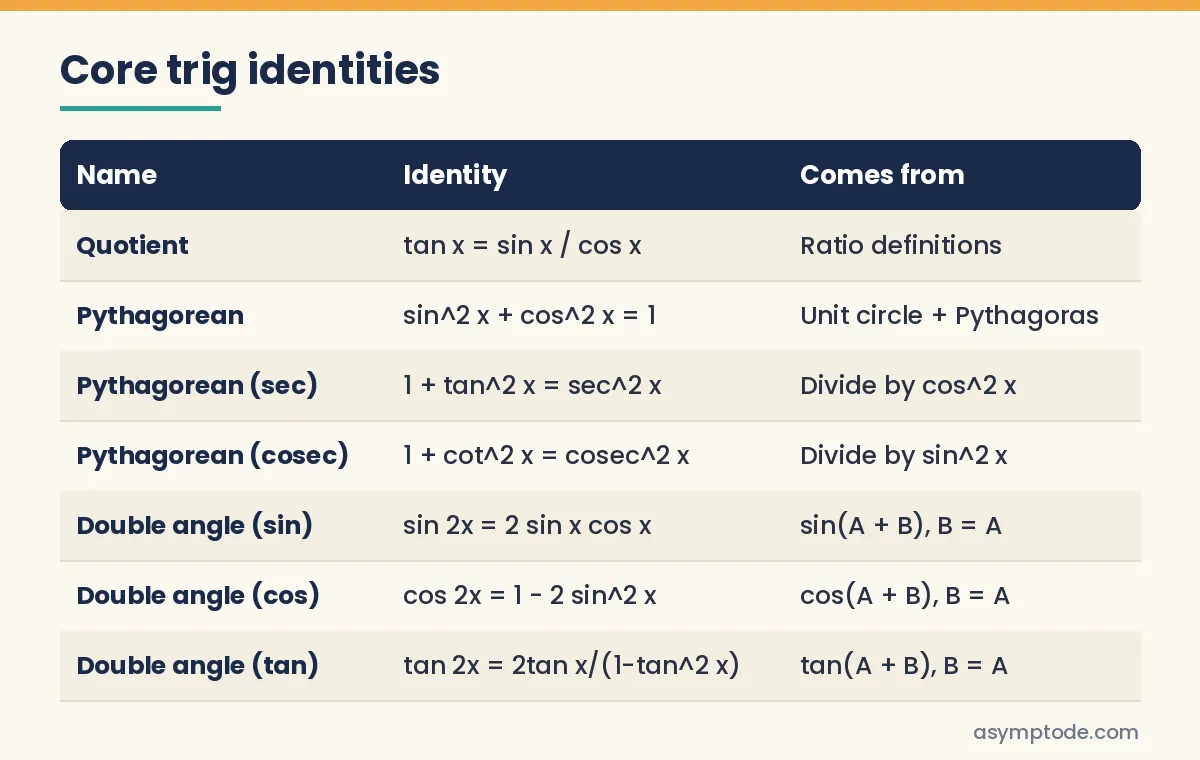 The core trigonometric identities and where each one comes from.
The quotient identity is tan x = sin x / cos x, from the ratio definitions. The Pythagorean identity is sin^2 x + cos^2 x = 1, from the unit circle and Pythagoras. Dividing it by cos^2 x gives 1 + tan^2 x = sec^2 x. Dividing by sin^2 x gives 1 + cot^2 x = cosec^2 x. Putting B = A in the compound angle formulae gives sin 2x = 2 sin x cos x, cos 2x = 1 − 2 sin^2 x and tan 2x = 2 tan x / (1 − tan^2 x).
Where does sin^2 x + cos^2 x = 1 come from?
On a circle of radius 1 centred at the origin, the point P at angle x has coordinates (cos x, sin x). Drop a line from P to the x-axis to get a right-angled triangle with sides cos x and sin x and hypotenuse 1, so Pythagoras gives cos^2 x + sin^2 x = 1.
This works for every angle, so it is an identity. Now divide every term by cos^2 x (where cos x ≠ 0) to get tan^2 x + 1 = sec^2 x. Divide by sin^2 x (where sin x ≠ 0) to get 1 + cot^2 x = cosec^2 x. Here sec x = 1/cos x, cosec x = 1/sin x and cot x = cos x / sin x.
What are the compound angle and double angle formulae?
At A-level and similar courses you also meet these:
| Formula | Identity |
|---|---|
| sin(A ± B) | sin A cos B ± cos A sin B |
| cos(A ± B) | cos A cos B ∓ sin A sin B |
| tan(A ± B) | (tan A ± tan B) / (1 ∓ tan A tan B) |
Watch the sign in the cos formula: cos(A + B) has a minus in the middle.
Put B = A to get the double angle formulae:
- sin 2A = 2 sin A cos A
- cos 2A = cos^2 A − sin^2 A = 2cos^2 A − 1 = 1 − 2 sin^2 A
- tan 2A = 2 tan A / (1 − tan^2 A)
Pick the form of cos 2A that leaves only one trig function in your problem.
How do you prove a trigonometric identity?
- Start with the more complicated side.
- If stuck, rewrite everything in sin and cos.
- Combine fractions over a common denominator.
- Look for sin^2 x + cos^2 x or a double angle pattern, and replace it.
- Stop when you reach the other side exactly.
Worked example 1: a Pythagorean proof
Prove that (1 − cos^2 x)(1 + cot^2 x) ≡ 1.
- 1 − cos^2 x = sin^2 x, and 1 + cot^2 x = cosec^2 x
- So LHS = sin^2 x × 1/sin^2 x = 1 = RHS
Worked example 2: using a double angle formula
 Step-by-step proof that tan x + cot x ≡ 2 cosec 2x.
Prove that tan x + cot x ≡ 2 cosec 2x. LHS = sin x / cos x + cos x / sin x = (sin^2 x + cos^2 x) / (sin x cos x) = 1 / (sin x cos x). Multiply top and bottom by 2: 2 / (2 sin x cos x) = 2 / sin 2x = 2 cosec 2x = RHS.
Worked example 3: using a compound angle formula
Prove that cos x cos 2x + sin x sin 2x ≡ cos x. This example appears in the Edexcel specification.
- The LHS matches cos A cos B + sin A sin B = cos(A − B), with A = 2x and B = x
- So LHS = cos(2x − x) = cos x = RHS
How do you use identities to solve trigonometric equations?
- Use an identity to get one trig function (for example, cos^2 x = 1 − sin^2 x).
- Rearrange to = 0 and factorise.
- Solve each factor, then find all angles in the range using the graph or CAST diagram.
- Check each answer in the original equation.
Book a free demo class to work through these live with a mentor, or see our plans and fees.
Worked example 4: a quadratic in sin x (degrees)
 Solving 2cos^2 x + 3 sin x − 3 = 0 for 0° ≤ x < 360°.
Replace cos^2 x with 1 − sin^2 x: 2 − 2 sin^2 x + 3 sin x − 3 = 0. Tidy up: 2 sin^2 x − 3 sin x + 1 = 0, so (2 sin x − 1)(sin x − 1) = 0. sin x = 1/2 gives x = 30° and 150°. sin x = 1 gives x = 90°. So x = 30°, 90° or 150°.
Worked example 5: a double angle equation (radians)
Solve sin 2x = sin x for 0 ≤ x ≤ 2π.
- Use sin 2x = 2 sin x cos x: 2 sin x cos x − sin x = 0
- Factorise: sin x (2 cos x − 1) = 0
- sin x = 0 gives x = 0, π, 2π
- cos x = 1/2 gives x = π/3, 5π/3
So x = 0, π/3, π, 5π/3 or 2π: five solutions. Dividing both sides by sin x would leave only π/3 and 5π/3, losing three.
What about multiple angles like cos 2x?
Double the range first. For cos 2x = 1/2 with 0 ≤ x < 2π, use 0 ≤ 2x < 4π: 2x = π/3, 5π/3, 7π/3, 11π/3, so x = π/6, 5π/6, 7π/6, 11π/6.
What are the most common mistakes with trig identities?
- Dividing by sin x or cos x. You lose the solutions where it equals 0. Factorise instead.
- Misreading notation. sin^2 x is (sin x)^2, not sin(x^2). But sin^-1 x means arcsin x, not 1/sin x.
- Splitting brackets. sin(A + B) is not sin A + sin B, and cos(A + B) has a minus sign.
- Mixing degrees and radians. Check the range and calculator mode, as with the sine and cosine rules.
- Treating a proof like an equation. Work from one side to the other.
Where do trigonometric identities appear in exams?
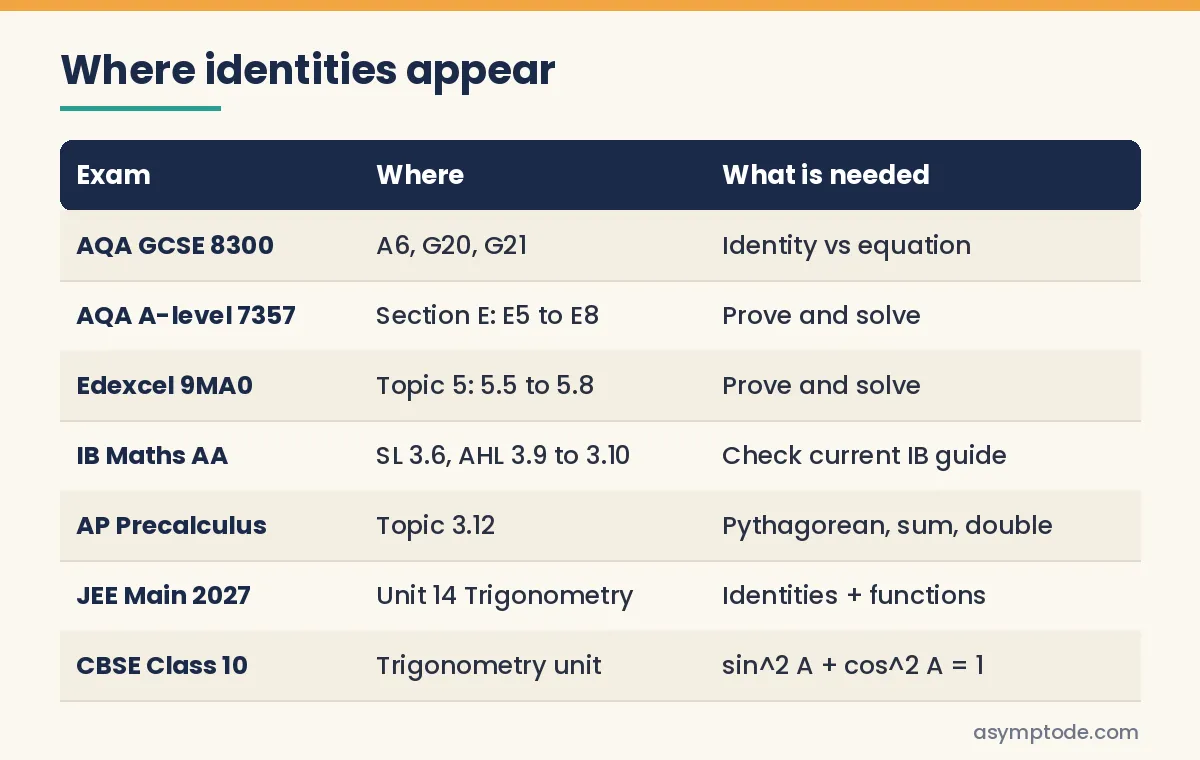 Where trigonometric identities appear in each syllabus.
AQA GCSE 8300 only asks you to know an identity from an equation (A6), plus ratios and exact values (G20, G21); see GCSE maths papers explained. AQA A-level 7357 (Section E, E5 to E8) and Edexcel 9MA0 (Topic 5, 5.5 to 5.8) ask you to prove identities and solve equations; see our A-level maths guide. IB Maths AA has identities in SL 3.6 and AHL 3.9 to 3.10 (check the current IB guide); see IB Maths AA vs AI. AP Precalculus Topic 3.12 covers Pythagorean, sum and double angle identities; half-angle identities are not assessed. See our AP Precalculus exam guide. JEE Main 2027 Unit 14 lists "Trigonometrical identities and trigonometrical functions" (JEE Main 2027 guide), and CBSE Class 10 includes proving and using sin^2 A + cos^2 A = 1; check the official CBSE curriculum page and our CBSE board exams 2027 guide.
How Asymptode helps you with trigonometric identities
At Asymptode, a qualified mentor teaches your child one-to-one, live online. Lessons follow the trig content of their actual course (A-level, IB Maths AA, AP Precalculus, JEE Main or CBSE Class 10) and its real exam dates.
Between classes, your child gets practice built for them. If their last attempt showed they divided by sin x and lost solutions, the next worksheet targets exactly that, at their level, never generic. This is Asymptode's AI-assisted practice: the AI writes it to the mentor's brief, and it is sent only after the mentor approves it.
The mentor then marks the work. You see what your child understood and what to practise next, so preparation keeps correcting itself towards confident proofs and complete solution sets. Book a free demo class or see our fees.
Facts checked against official sources on 12 November 2026.
FAQ
What is the most important trigonometric identity?
It is sin^2 x + cos^2 x = 1, from Pythagoras on the unit circle. The sec and cosec identities follow from it.
Are trigonometric identities on the GCSE Maths exam?
AQA GCSE 8300 asks you to know the difference between an equation and an identity. sin^2 x + cos^2 x = 1 is not in its content; it is A-level content at AQA and Edexcel.
Which identities do I need to memorise for A-level Maths?
AQA and Edexcel both list the three Pythagorean identities and the double angle formulae for sin, cos and tan. The Edexcel specification says these will not appear in the formula booklet.
Why do I lose solutions when I divide by sin x?
Dividing by sin x assumes it is not zero, but sin x = 0 can give valid solutions such as x = 0, π and 2π. Factorise out sin x instead.
Does sin^2 x mean sin(x^2)?
No. sin^2 x means (sin x)^2. But sin^-1 x is the inverse function arcsin x, not 1/sin x.
Should I answer in degrees or radians?
Use the unit in the question. If the range uses π, such as 0 ≤ x ≤ 2π, answer in radians; Edexcel says the question will specify which.
Ready to start? Book a free demo class and advisor call, or see our plans and fees.