
If you want to know how to get into Yale, start with one fact: Yale calls your school transcript "the single most important document" in your file. Strong grades in hard classes come first. After that, Yale reads your SAT or ACT, teacher letters, short Yale answers and activities. This guide walks students and parents, in the US and worldwide, through fall 2027 entry: deadlines, tests, essays, interviews, cost, aid and a four-year plan.
Key takeaways
- The transcript matters most. Yale wants top grades in the hardest classes your school offers.
- For the 2026-27 cycle, the SAT or ACT is required. Yale is no longer "test flexible".
- Single-Choice Early Action closes November 1, 2026. Regular Decision closes January 2, 2027.
- Yale is need-blind for every applicant, including international students, and meets 100% of need with no loans.
- The Class of 2030 had 54,919 applicants and 2,328 admits, about 4.2%.
How to get into Yale: what does it really take?
Quick answer: To get into Yale, earn top grades in the most demanding classes you can take, score well on the SAT or ACT (now required), and show real depth in one or two interests. Then apply by November 1 (Early Action) or January 2 (Regular Decision) with strong teacher letters and honest, specific Yale answers.
There is no minimum GPA and no score cut-off. Yale says, "Every application to Yale is considered by a real person." Your file is read in context: your school, your country and the chances you had. The transcript comes first, then tests, letters, your Yale answers and your activities. Depth matters more than a long list. See Yale's What Yale Looks For page.
What are the Yale requirements for 2026-27?
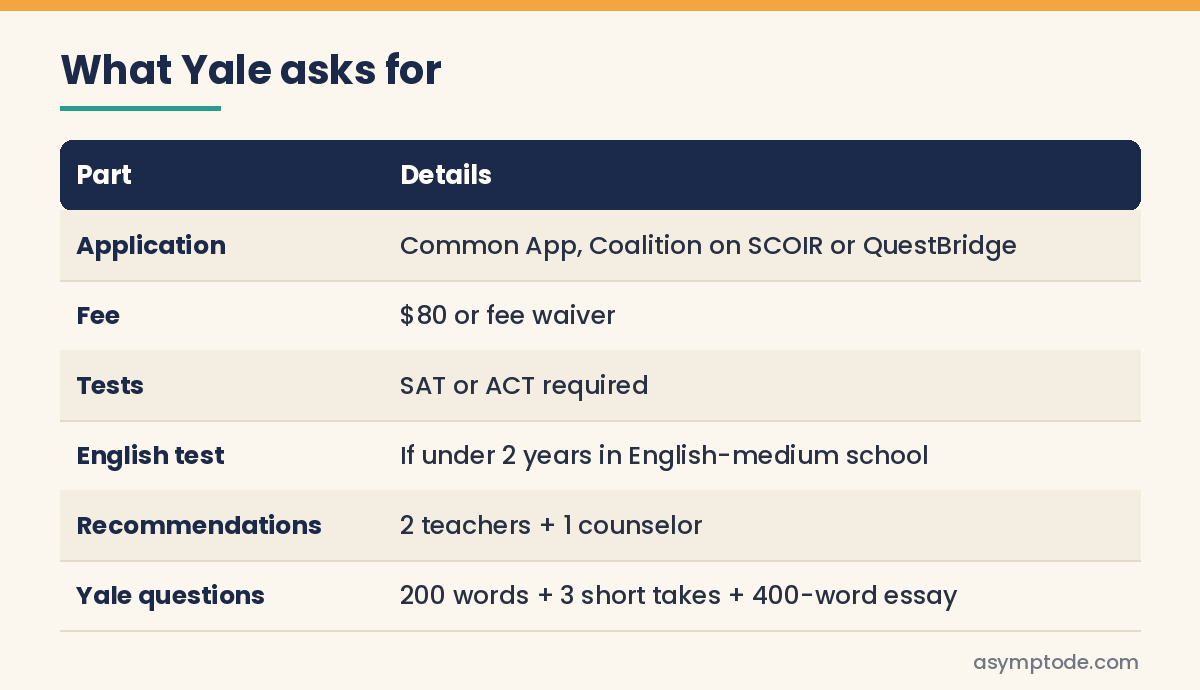
The table shows each part of the application. You apply through the Common App, the Coalition App on SCOIR, or the QuestBridge App. The fee is $80, or you can use a fee waiver. You need an SAT or ACT score, two teacher letters and one counselor letter. If you have spent fewer than two years at an English-medium school, you also need an English test.
A few more details:
- You can submit only one application per cycle.
- Fee waivers come through your application platform. Yale does not issue its own. US veterans and active-duty service members get automatic waivers.
- Your school sends a School Report and transcript, plus a Mid-Year Report in senior year.
- Optional supplements exist for Visual Art, Dance, Music, Film and STEM research.
Yale says it "does not advantage students who apply through any program." So pick the platform that is easiest for you. The official list is on the Yale requirements page.
When are the Yale deadlines for fall 2027?
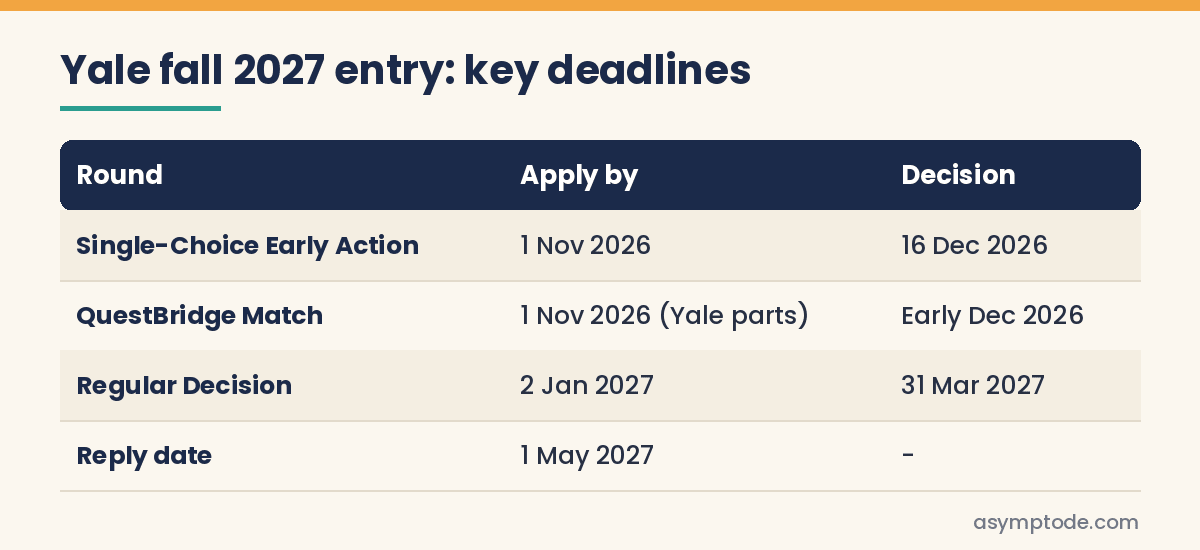
The table shows the rounds. Single-Choice Early Action closes November 1, 2026, with decisions on December 16, 2026. QuestBridge finalists send Yale materials by November 1, with results in early December. Regular Decision closes January 2, 2027, with decisions on March 31, 2027. Admitted students reply by May 1, 2027.
Today is October 30, 2026, so the early deadline is only days away. Check the Yale timelines page for updates.
What is Yale Single-Choice Early Action?
Yale early action is called Single-Choice Early Action (SCEA). It is non-binding, so you do not have to attend if admitted. But it is restrictive: you cannot apply early to other private colleges. Yale offers no Early Decision.
These are still allowed:
- Non-binding rolling admission
- Non-binding early plans at public universities
- Early Decision or Early Action rounds that notify after January 1 ("Round 2")
- Universities outside the US
SCEA has three outcomes: admit, deny, or defer to Regular Decision. If you are denied, you cannot apply again in Regular Decision that year. Yale admitted 779 students in SCEA for the Class of 2030. Read the SCEA rules.
How does QuestBridge work at Yale?
QuestBridge is a route for high-achieving students from lower-income families. The Match application is due in late September (October 1 on Yale's 2026-27 counselor sheet). Finalists who rank Yale send Yale materials by November 1. Matches come on December 1.
The Match is binding. A matched student gets aid with a $0 parent share. Finalists who do not match move to Regular Decision. Finalists can also opt out and apply SCEA by emailing Yale before November 1. Yale admitted 118 QuestBridge students to the Class of 2030. See Applying to Yale through QuestBridge.
Does Yale require the SAT or ACT now?
Yes. For 2026-27, the SAT or ACT is required for all first-year and transfer applicants. Yale is no longer "test flexible", and AP and IB scores no longer count toward the requirement.
Key rules from the Yale standardized testing page:
- No preference between the SAT and ACT.
- Yale superscores, taking your best section scores across dates.
- Your ACT composite must come from ACT itself. ACT Writing and Science are optional.
- AP and IB scores are encouraged but not required. Predicted IB scores are optional.
- Test in October or November for SCEA, or January or February for Regular Decision.
Not sure which test suits you? Read our guide to SAT vs ACT.
What are Yale SAT scores and ACT scores?
Yale's Common Data Set 2025-26 (fall 2025 entrants) gives these middle 50% ranges. A quarter of students scored higher, and a quarter lower.
| Test | Middle 50% | Median |
|---|---|---|
| SAT composite | 1480-1560 | 1540 |
| SAT Reading and Writing | 730-780 | - |
| SAT Math | 740-790 | - |
| ACT composite | 33-35 | 34 |
The Class of 2030 profile adds that 70% scored 760-800 on SAT Math, and 94% scored 32-36 on the ACT. These are not cut-offs, but maths is where many applicants score near the top. Our Digital SAT math guide and ACT math test guide show what each test covers.
What is the Yale acceptance rate?
Yale's press release for the Class of 2030 reported 54,919 applicants and 2,328 admitted students. That is an acceptance rate of about 4.2%. Another 37 earlier admits had postponed enrolment. Yale's later class profile uses slightly different figures, so always name your source. The profile says the class came from 67 countries and is 10% international and 19% first-generation. Read the release on Yale News.
Top grades and scores are common in the pool, so your file also needs a clear picture of who you are.
What are the Yale essay questions and word limits?
Yale changed its questions for 2026-27. The "Why Yale" question is gone. Short takes dropped from four to three, with a new one on how you hope to grow in college.
| Question | Who answers | Limit |
|---|---|---|
| Choose up to 3 academic areas | All applicants | Selection |
| A topic or idea that excites you | All applicants | 200 words |
| 3 short takes | Common App / Coalition | 200 characters each (about 35 words) |
| 1 essay: an opposing view, your community, or a personal experience | Common App / Coalition | 400 words |
Be specific. Write like you talk. Do not repeat your activity list. Draft early. The exact prompts are on the Yale essay topics page.
How do Yale recommendations and interviews work?
Recommendations. You need two teacher letters and one counselor letter. Teachers should be recent and teach core academic subjects. Ask teachers who have seen you think hard and improve.
Interviews. Yale interviews are optional and by invitation only. You cannot request one. Alumni or virtual Senior Interviewers run them, and they are evaluative. Having no interview does not count against you. See the Yale interviews page.
How much does Yale cost in 2026-27?
Tuition for 2026-27 is $72,500. Adding Yale's listed items gives a total of about $97,985, not counting travel.
| Item | 2026-27 |
|---|---|
| Tuition | $72,500 |
| Student activity fee | $185 |
| Housing | $12,080 |
| Food | $9,520 |
| Books and supplies | $1,000 |
| Personal expenses | $2,700 |
| Total (excluding travel) | about $97,985 |
See the Yale cost of attendance page. For many families, aid brings the price far lower.
How does Yale financial aid work?
Yale financial aid is need-based. From the Yale affordability page:
- Need-blind for "any student, anywhere in the world". Asking for aid does not hurt your chances.
- Yale meets 100% of demonstrated need, with no loans in the first offer.
- Family income under $100,000 (typical assets): no cost, a zero parent share.
- Family income under $200,000 (typical assets): at least tuition is covered.
Yale's counselor sheet gives typical yearly parent shares: about $10,000 at $150,000 income, $20,000 at $200,000, and $43,000 at $250,000. Every family is different.
What are the Yale financial aid deadlines and forms?
| Round | Priority aid deadline |
|---|---|
| QuestBridge | Nov 1, 2026 |
| Early Action (US citizens and permanent residents) | Nov 1, 2026 |
| Early Action (international) | Dec 1, 2026 |
| Regular Decision | Feb 15, 2027 |
US citizens and permanent residents use the CSS Profile (code 3987), the FAFSA (code 001426) and, depending on the family, tax returns through IDOC, using 2025 income documents. International applicants tick interest in aid on the application, and Yale sends next steps. Yale does not accept the ISFAA. Yale says late aid forms do not reduce the offer. Start at Yale financial aid for prospective students.
How do Yale international students apply?
Yale international students follow the same process and requirements as US applicants. Yale is need-blind for them too, meets 100% of need, and its aid includes travel twice a year.
Key points for students in India, the UK, the UAE, Singapore and elsewhere:
- The SAT or ACT is still required. National leaving-exam results do not replace it.
- Send your school transcript in your own curriculum. Yale does not publish a list of named boards, so check the Yale international applicants page.
- Translate documents. Anything not in English needs a certified translation.
- Take an English test if you have not spent two or more years at an English-medium school.
| English test | Typical for Yale's most competitive applicants |
|---|---|
| TOEFL iBT | 5+ on the new scale (100+ before January 21, 2026) |
| IELTS | 7+ |
| Cambridge English | 185+ |
| Duolingo English Test | 120+ |
| InitialView | Unscored interview |
Yale says these are not minimums. IB students can see our IB Diploma Programme guide.
What is a good Grade 9-12 plan for Yale?
- Grade 9: build the base. Take the hardest classes you are ready for. Fix gaps in algebra and reading early. Try a few activities.
- Grade 10: go deeper. Commit to one or two interests. Start light SAT or ACT practice.
- Grade 11: peak year. Take your most demanding courses. Sit the SAT or ACT, and retest if needed, since Yale superscores. Build ties with two core-subject teachers. Consider research for high school students.
- Summer before Grade 12: write. Draft your Yale answers. Choose SCEA or Regular Decision. Families should check aid numbers.
- Grade 12: apply. Submit by November 1 or January 2. Keep grades strong, because Yale sees your Mid-Year Report.
Want a mentor to map this plan around your own exams? Book a free demo class with Asymptode, or compare our plans and fees.
What do SAT maths questions look like for Yale applicants?
Small slips cost a lot at the top of the scale. Here are two classic types.
Example 1: a system of equations
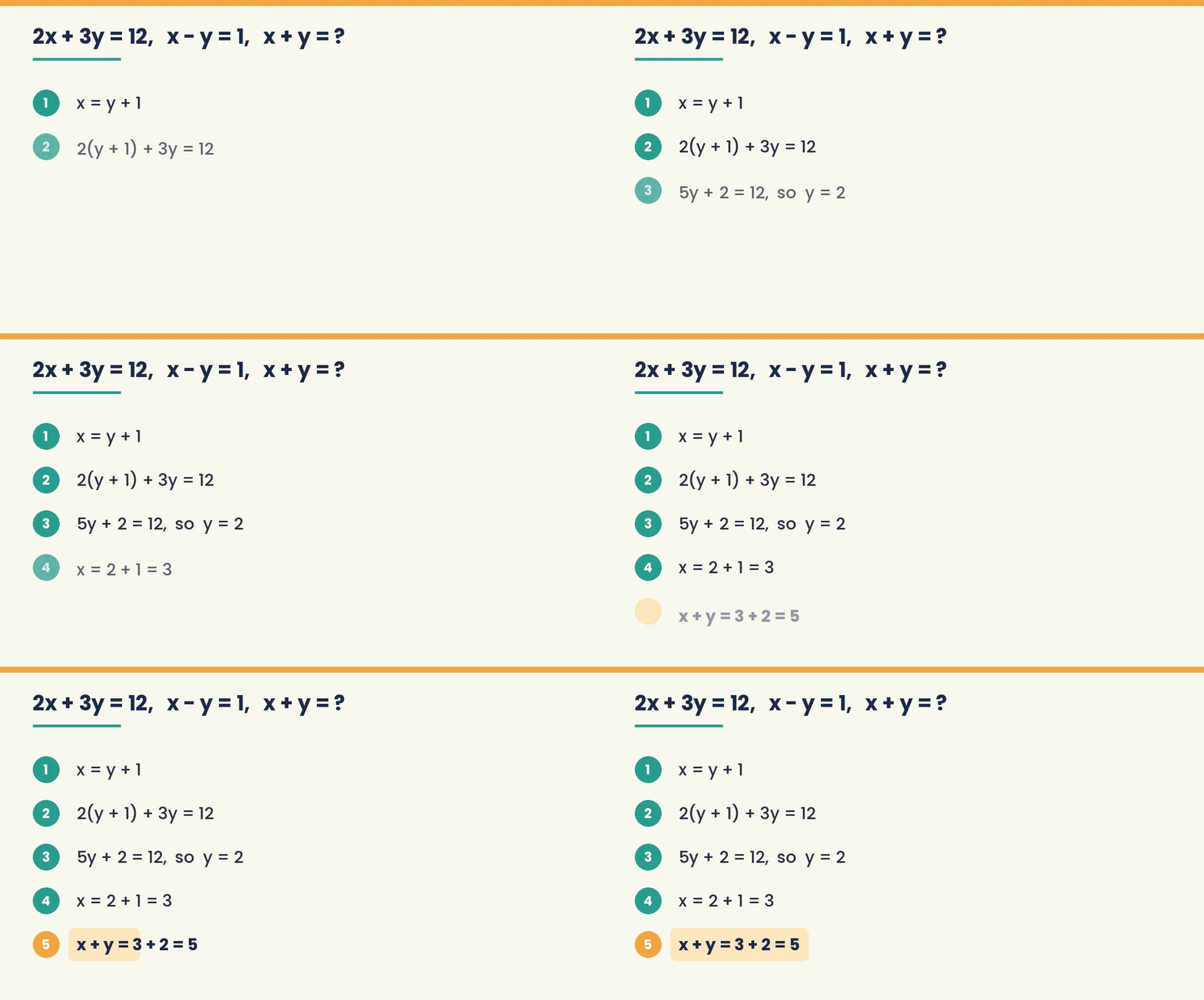
The animation solves 2x + 3y = 12 and x - y = 1. It rewrites the second equation as x = y + 1 and substitutes it into the first. That gives 5y + 2 = 12, so y = 2 and x = 3. The answer is x + y = 5.
- From x - y = 1, write x = y + 1.
- Substitute: 2(y + 1) + 3y = 12, so 5y + 2 = 12.
- Solve: 5y = 10, so y = 2. Then x = 3.
- Check: 2(3) + 3(2) = 12, and 3 - 2 = 1.
- Answer: x + y = 5.
The trap: students find x or y and stop. Reread what the question asks for.
Example 2: percent up, then percent down
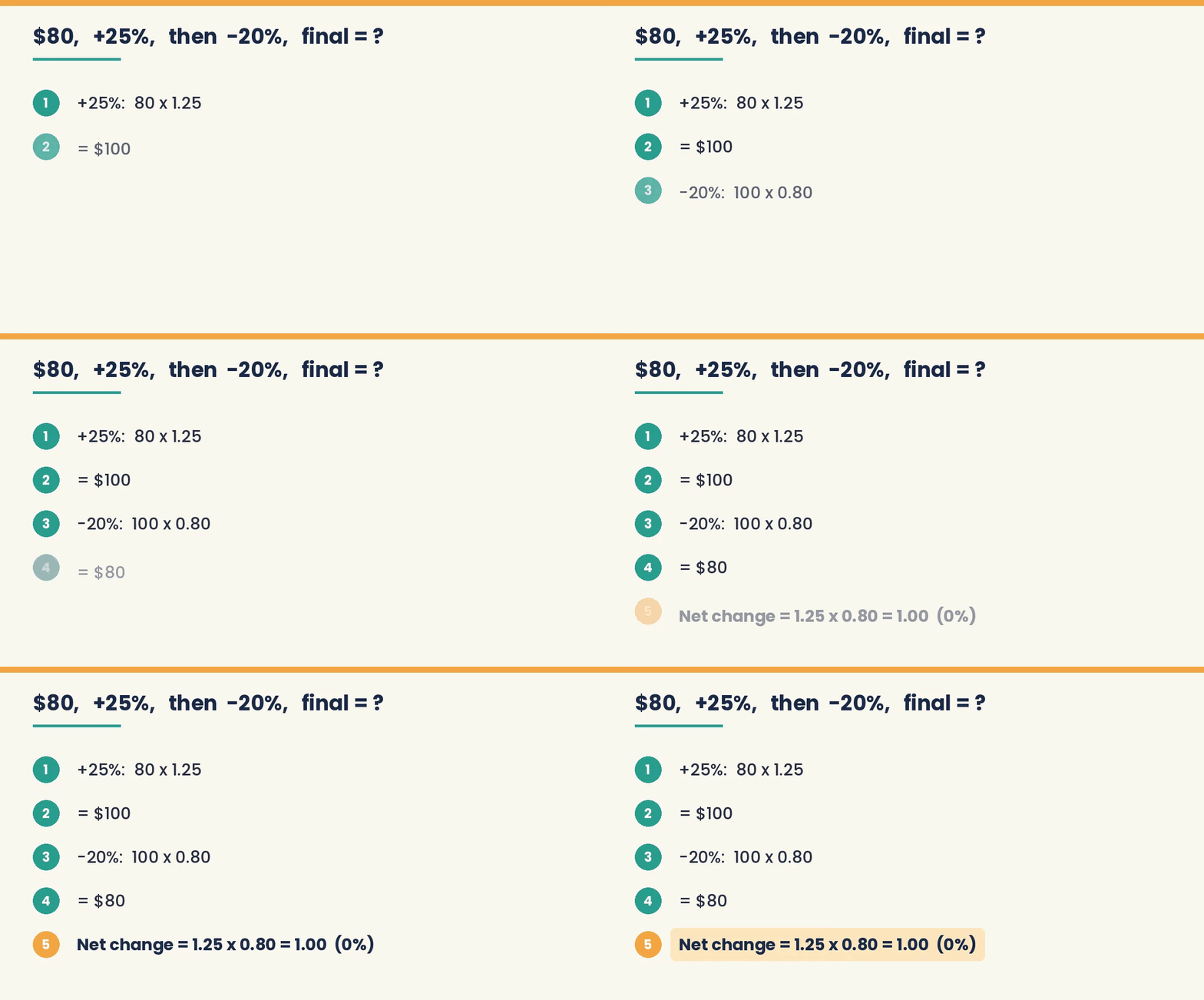
The animation starts at $80. A 25% rise gives 80 x 1.25 = $100. A 20% cut gives 100 x 0.80 = $80. The net change is 1.25 x 0.80 = 1.00, so the price ends where it started.
Each percent change multiplies the current amount. The trap is to subtract the percents (25 - 20 = 5) and answer "up 5%". That is wrong, because the 20% is taken from $100, not $80.
What are common mistakes Yale applicants make?
- Skipping the SAT or ACT. Testing is now required.
- Applying early to other private colleges. SCEA is restrictive. Check the exceptions.
- Confusing "denied" with "deferred". A denied SCEA applicant cannot reapply in RD that year.
- Writing a "Why Yale" essay. That question was removed.
- Going over limits. 200 words, 400 words and 200 characters mean exactly that.
- Missing aid deadlines. International Early Action applicants have a December 1 priority date.
- Letting senior grades slip. Yale reads the Mid-Year Report.
Compare with how to get into Harvard and MIT.
How 1-on-1 tutoring helps with getting into Yale
Yale's file starts with your transcript and test scores. That is where Asymptode helps most.
- One dedicated mentor for SAT and ACT maths. Live online 1-on-1 classes target the question types you miss. The mentor watches each step of your working, so slips like the ones above get fixed.
- AP, IB and school maths and science. Your mentor follows your own syllabus and exam dates, so grades and test prep move together.
- Planning and method for the rest. For essays, the mentor helps with a timeline and feedback on structure. The words and ideas stay yours. We do not write essays.
- Personalised homework with feedback, short parent updates and every class recorded. Start with a free demo class.
Facts checked against official sources on 30 October 2026.
FAQ
Is the SAT required for Yale in 2026-27?
Yes. Yale requires the SAT or ACT from all first-year and transfer applicants. AP or IB scores no longer meet the requirement. Yale superscores and has no preference between the tests.
What is the Yale acceptance rate?
Yale's Class of 2030 press release reported 54,919 applicants and 2,328 admits, about 4.2%. The later class profile gives slightly different figures, so check your source.
Is Yale early action binding?
No. Single-Choice Early Action is non-binding but restrictive. You cannot apply early to other private colleges, with some exceptions such as public universities, rolling admission and universities outside the US.
Does Yale give financial aid to international students?
Yes. Yale is need-blind for every applicant worldwide and meets 100% of demonstrated need with no loans in the first offer. Aid for international students includes travel twice a year.
What GPA do you need to get into Yale?
Yale sets no minimum GPA or score cut-off. It calls the transcript the single most important document. Aim for top grades in your school's most demanding courses.
Can I request a Yale interview?
No. Interviews are optional and by invitation only. Not being invited does not count against you.
Ready to start? Book a free demo class and advisor call, or see our plans and fees.
Sources
- Yale Admissions: Apply
- Yale Admissions: Requirements
- Yale Admissions: Timelines
- Yale Admissions: Single-Choice Early Action
- Yale Admissions: Applying through QuestBridge
- Yale Admissions: Standardized Testing
- Yale Admissions: Application Update 2026-2027
- Yale Admissions: Essay Topics
- Yale Admissions: Interviews
- Yale Admissions: What Yale Looks For
- Yale Admissions: Applying as an International Student
- Yale Admissions: Affordability
- Yale Admissions: 2026-27 Counselor Sheet
- Yale Financial Aid: Cost of Attendance
- Yale Financial Aid: Prospective Students
- Yale Financial Aid: FAQ
- Yale News: Yale admits 2,328 applicants to the Class of 2030
- Yale Class of 2030 Profile
- Yale Common Data Set 2025-26