
If you want to know how to get into MIT, the short answer is this: apply through MIT's own application in the MIT application portal, send an SAT or ACT score, two teacher letters and your school report, and show strong maths and science plus real curiosity and initiative. MIT reviews every applicant as a whole person, so a clear plan from Grade 9 matters more than any single trick.
This guide is for families in the US and abroad, including India, the UK, Canada, the UAE and Singapore. Every figure comes from MIT's official pages.
Key takeaways
- MIT uses its own application, not the Common App. The fee is $75, and fee waivers exist for US and international students.
- For fall 2027 entry: Early Action is due 1 November 2026 and Regular Action is due 4 January 2027.
- The SAT or ACT is required for everyone. There are no SAT/ACT cutoffs, but there are minimum English test scores.
- MIT is need-blind and meets 100% of demonstrated need for all undergraduates, domestic and international.
- Calculus, physics, chemistry and biology are the core of MIT preparation. Build them early.
Facts checked against official sources on 26 October 2026.
How do you get into MIT?
Quick answer: Apply through the MIT application portal by 1 November 2026 (Early Action) or 4 January 2027 (Regular Action). Send the SAT or ACT, two teacher letters, your school report and transcript, four short essays and four short answers. MIT looks for strong maths and science, collaboration, initiative, hands-on creativity and a good match with its mission.
MIT says grades and scores show readiness, but "the match between the applicant and the Institute" drives selection.
Does MIT use the Common App?
No. MIT uses its own first-year application in the MIT application portal. The official requirements page lists these parts:
- MIT first-year application form: biographical information, essays, activities, academics, recommendations and test scores.
- Secondary School Report (SSR) with transcript from every high school (and college) you attended.
- Two teacher letters of recommendation.
- SAT or ACT scores (self-reported).
- English proficiency exam (strongly recommended for some non-native speakers).
- Application fee of $75, or a fee waiver.
There is one other route. If you are a QuestBridge Finalist and rank MIT, your QuestBridge application plus an MIT QuestBridge Supplement replaces the first-year application, as the MIT FAQ explains.
You may apply only once per entry year. If you are denied in Early Action, you cannot apply again in Regular Action.
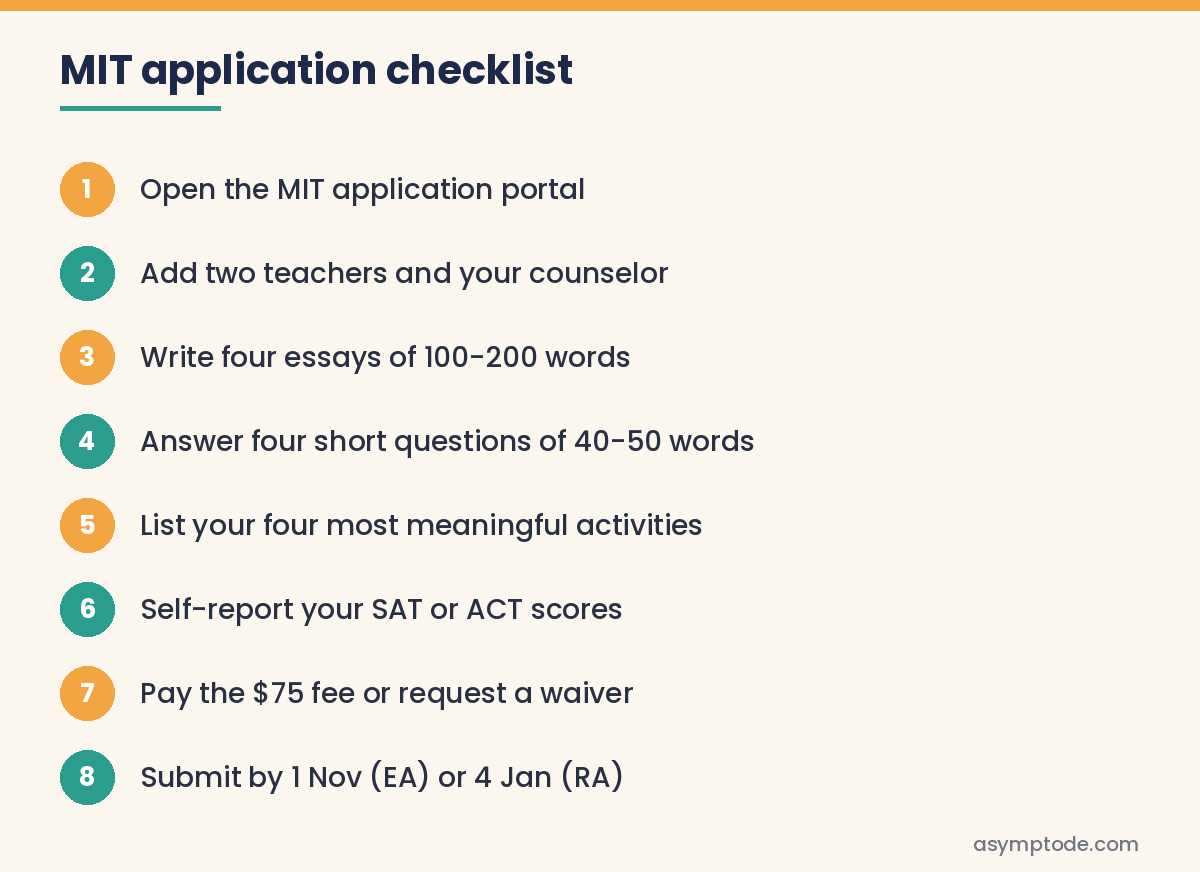
- Open the MIT application portal.
- Add two teachers and your school counselor as recommenders.
- Write four essays of about 100-200 words each.
- Answer four short questions of 40-50 words each.
- List the four activities that mean the most to you.
- Self-report your SAT or ACT scores.
- Pay the $75 fee or request a waiver.
- Submit by 1 November (EA) or 4 January (RA).
What are the MIT deadlines for the class entering in fall 2027?
MIT has two cycles: Early Action (EA) and Regular Action (RA). MIT says the only difference is the dates. There is no strategic benefit to either one. EA is not binding and not single-choice, and it is open to international students too. But if you apply early to another school with restrictive rules, you must follow those rules.
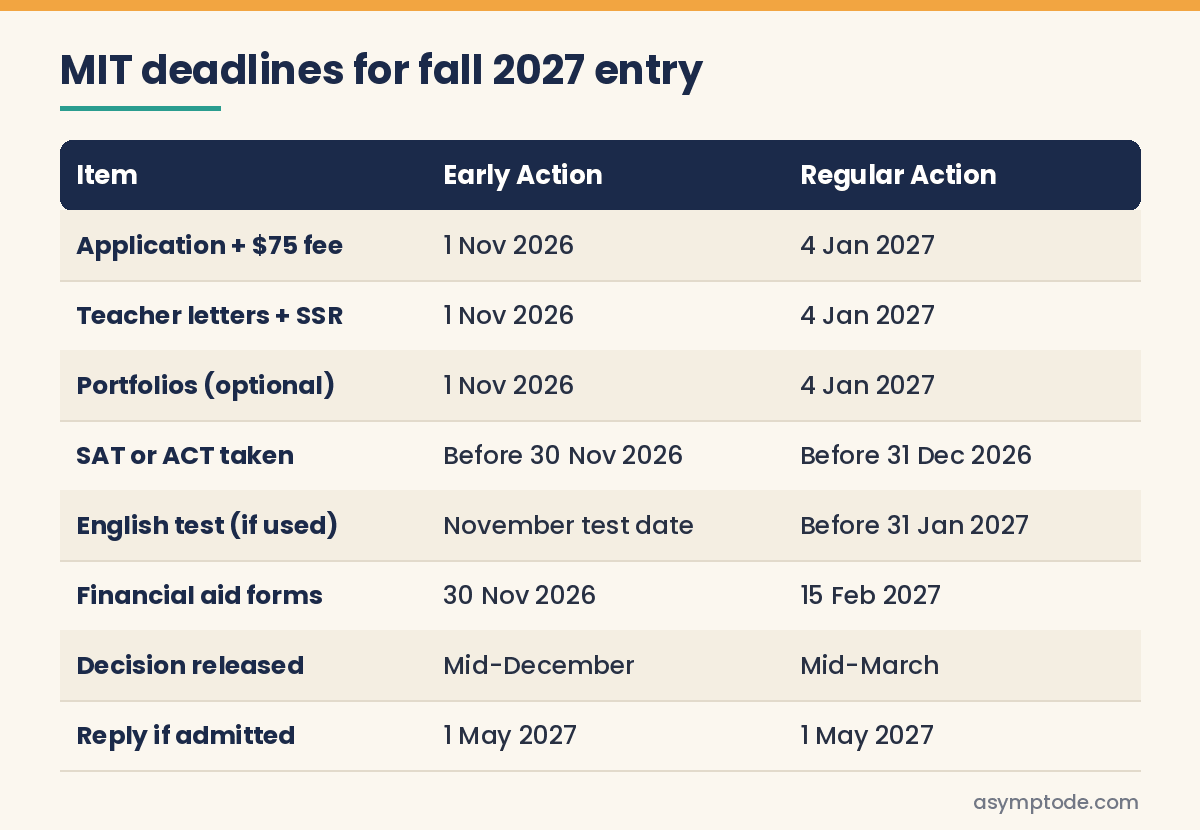
| Item | Early Action | Regular Action |
|---|---|---|
| Application + $75 fee (or waiver) | 1 Nov 2026 | 4 Jan 2027 |
| Two teacher letters + SSR with transcript | 1 Nov 2026 | 4 Jan 2027 |
| Creative portfolios (optional) | 1 Nov 2026 | 4 Jan 2027 |
| SAT or ACT must be taken | Before 30 Nov 2026 | Before 31 Dec 2026 |
| English proficiency test (if used) | November test date | Before 31 Jan 2027 |
| Financial aid (CSS Profile + IDOC) | 30 Nov 2026 | 15 Feb 2027 |
| Admission decision | Mid-December | Mid-March |
| Enrollment reply (if admitted) | 1 May 2027 | 1 May 2027 |
Sources: deadlines and requirements and aid deadlines. MIT lists the dates as "November 1" and "January 4" for the current cycle.
Submit on time even if teachers have not sent letters yet; late letters are still attached. Deferred and admitted students send the FUN Form with midyear grades in mid-February.
What tests does MIT require?
MIT requires the SAT or the ACT for all first-year applicants, US and international. Key rules:
- You do not need the ACT writing or science sections, or the SAT essay.
- MIT accepts both the paper and the digital SAT.
- There are no cutoff or recommended SAT/ACT scores. Scores are read in context.
- MIT superscores: it looks mainly at your highest score in each section.
- You self-report scores. MIT verifies them if you enroll.
- Report AP, IB, A-level, CBSE and similar exam results in the test section too.
For context, MIT's admissions statistics for the Class of 2029 show a middle 50% SAT Math range of 780-800 and an ACT Composite range of 34-36 for admitted students. The same page reports 29,281 first-year applicants and 4.6% admitted. These are results of the process, not cutoffs.
Strong SAT or ACT maths is the part most students can train. Our guides to the Digital SAT Math section and the ACT Math test show what each test covers.
What English test scores does MIT need?
MIT strongly recommends an English test if you have used English for fewer than five years, or do not speak English at home or in school. It accepts TOEFL, IELTS, Duolingo, PTE Academic and Cambridge C1/C2. MIT publishes minimum and recommended scores:
| English test | Minimum | Recommended |
|---|---|---|
| TOEFL (taken before 21 Jan 2026) | 90 | 100 |
| TOEFL (taken on or after 21 Jan 2026, 1-6 scale) | 5 | 5.5 |
| IELTS | 7 | 7.5 |
| Duolingo English Test | 120 | 125 |
| PTE Academic | 65 | 70 |
| Cambridge C1 Advanced / C2 Proficiency | 185 | 190 |
What essays does the MIT application ask for?
MIT asks for several short pieces, not one long essay. For the 2026-2027 application:
Four essays (about 100-200 words each):
- Which field of study appeals to you most right now, and what led you to it?
- In what ways have you done something different than expected in your educational journey?
- How have your experiences shaped the problems you want to tackle with an MIT education, and the impact you aim to make on your community?
- How did you manage a situation or challenge you did not expect? What did you learn?
Four short answers (40-50 words each): what you do just for fun; someone you admire and why; a topic you could talk about for hours; and whether you are a "generalist" or a "specialist".
For activities, MIT's form has space for four. Pick the ones that mean the most. MIT says it is "not a writing test": be honest, not strategic.
Who should write your MIT recommendation letters?
MIT requires two teacher letters. It recommends one from a math or science teacher and one from a humanities, social science or language teacher. This is not a hard rule, but it is the expected mix. Your counselor may add a letter, and one optional supplemental letter is allowed.
Ask teachers who know you well, and ask early.
Does MIT interview applicants?
Yes, when possible. After you apply, a member of the Educational Council may contact you. This is a network of over 3,500 MIT graduates worldwide. Most EA interviews happen in November and most RA interviews in January. They usually last about an hour. If no interviewer is available, it is waived with no penalty.
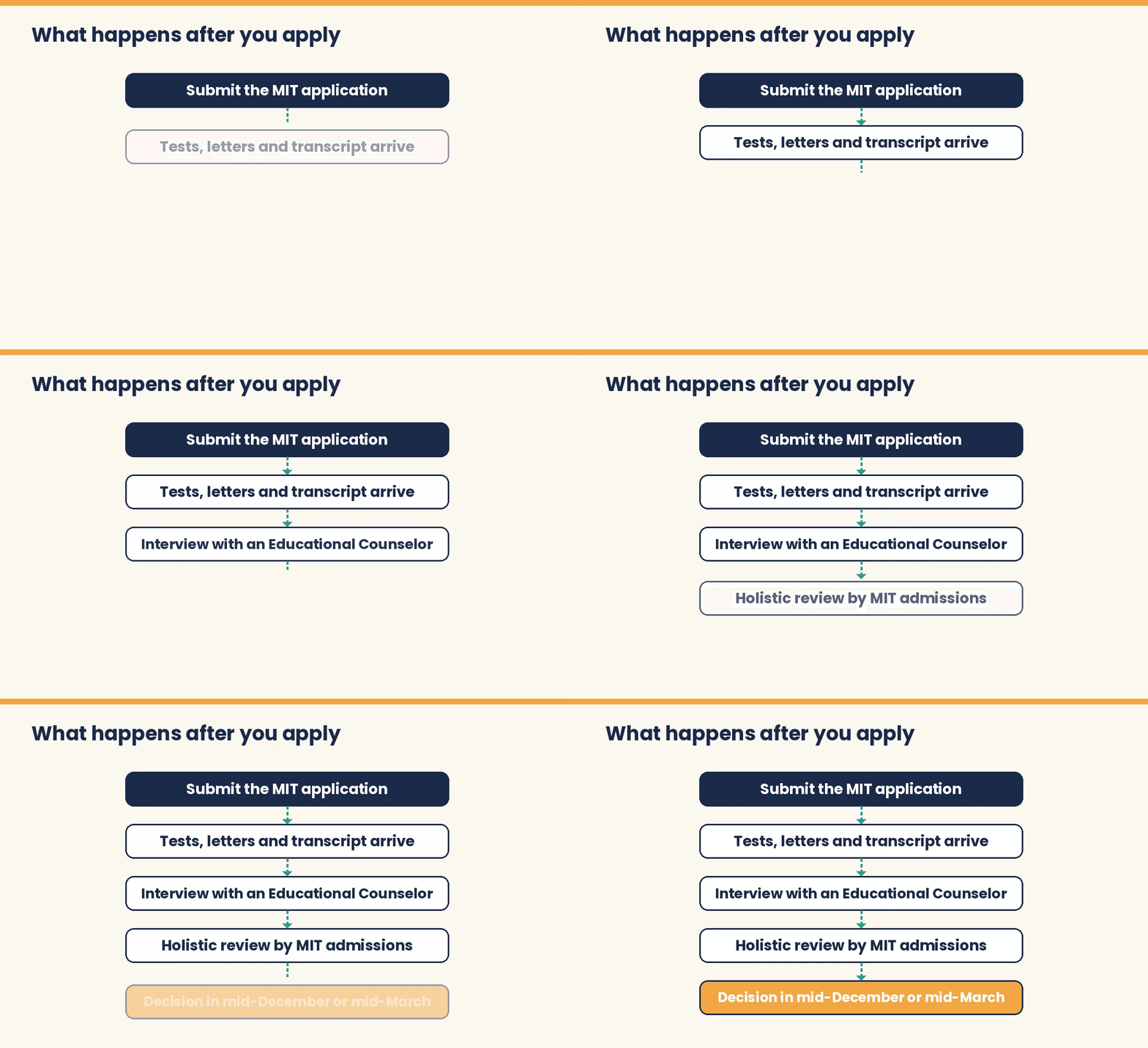
- You submit the MIT application.
- Tests, letters and your transcript arrive.
- An Educational Counselor may interview you.
- MIT admissions reviews your file holistically.
- You get a decision in mid-December (EA) or mid-March (RA).
Should you send a Maker Portfolio or creative portfolio?
Only if the work is significant to you and relevant to your application. MIT offers four optional creative portfolios in SlideRoom, due with your cycle deadline, at $10 each (waivers available):
- Research Supplement for a significant research project done outside class.
- Music & Theater Arts for advanced performers.
- Visual Art & Architecture for exceptional creative work.
- Maker Portfolio for engineering or craft projects you designed and built.
For the Maker Portfolio, MIT allows up to 25 media files and no more than 2 minutes of video in total. It cares more about your build process than the final product. Code projects need your codebase and a working demo.
Want a mentor to plan your SAT, AP or contest maths around these dates? Book a free demo class or see fees.
How does MIT treat international applicants?
MIT treats you as international if you are not a US citizen or permanent resident, wherever you live. MIT says this does not change when or how you apply, or the aid you are offered. Other key points:
- There are no caps or quotas for countries.
- MIT does not convert your grades. Readers know your school system.
- Your transcript should show three years of grades plus external exams such as IB, A Levels or CBSE. Send predicted grades if you have them.
- You still need the SAT or ACT, and usually an English test.
- In the Class of 2029, 6,926 international students applied and 136 were admitted, per MIT's statistics page.
How much does MIT cost, and is there aid for international students?
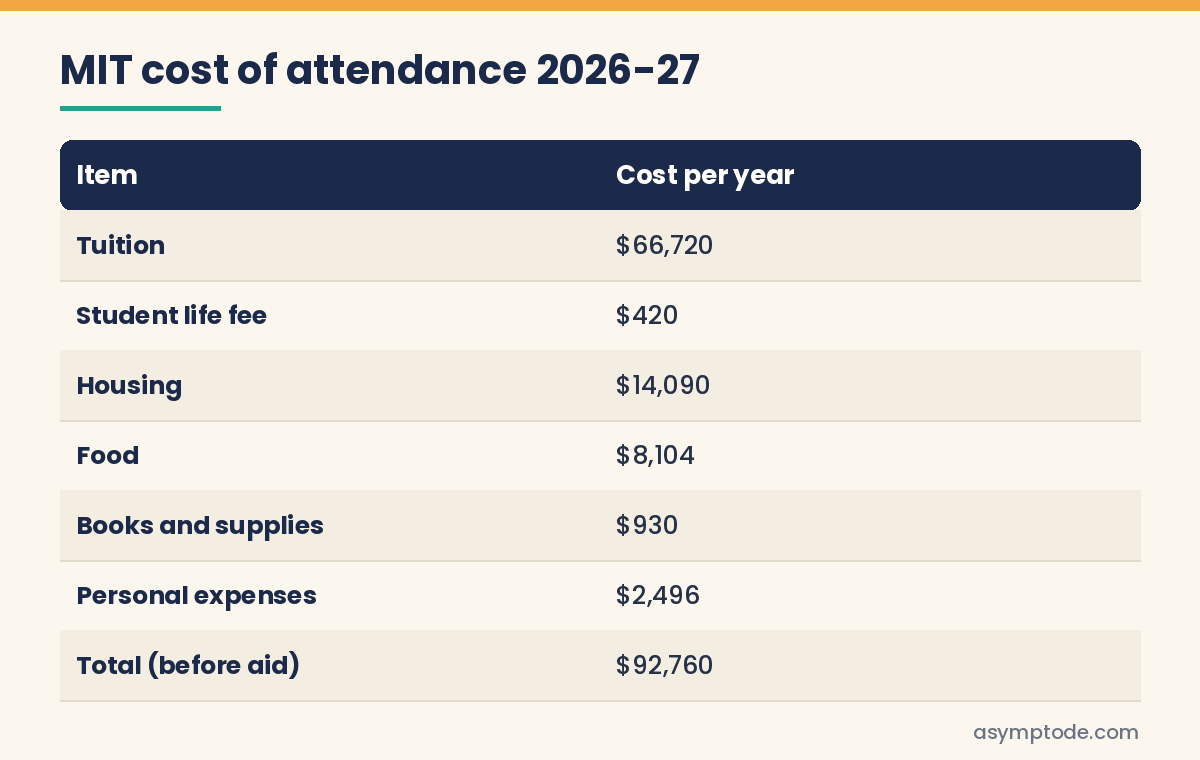
MIT's official cost of attendance for 2026-2027 is:
| Item | Cost (2026-27) |
|---|---|
| Tuition | $66,720 |
| Student life fee | $420 |
| Housing | $14,090 |
| Food | $8,104 |
| Books and supplies | $930 |
| Personal expenses | $2,496 |
| Total (before aid) | $92,760 |
Travel is extra and depends on where you live.
The sticker price is not what most families pay. MIT is need-blind and full-need for all undergraduates, domestic and international. Your ability to pay does not affect admission, and MIT meets 100% of demonstrated need. MIT also states:
- From 2025-26, students from families earning under $200,000 typically attend tuition-free.
- For families earning under $100,000, parents typically pay nothing (with typical assets).
- 58% of undergraduates received an MIT Scholarship in 2025-26. The median price paid by recipients was $11,432.
For international families: submit the CSS Profile (MIT code 3514) and your parents' tax returns or income papers through IDOC, by 30 November 2026 (EA) or 15 February 2027 (RA). Home-country tax returns are fine, and a family member may translate them. See MIT's international aid page. Note that MIT's online cost calculators are not accurate for international students.
What does MIT look for in applicants?
MIT's What we look for page lists these themes:
| Theme | What it looks like in practice |
|---|---|
| Alignment with MIT's mission | Using science and ideas to help others, even tutoring one child |
| Collaborative spirit | Enjoying group problem-solving |
| Initiative | Seeking hard courses, projects, family or community roles |
| Risk-taking | Trying hard things and learning from failure |
| Hands-on creativity | Building, testing and fixing, not just thinking |
| Intensity, curiosity, excitement | Deep focus on a few things you love |
| Balance | Real interests outside work |
| Character | Caring for and lifting up your community |
MIT's high school page requires no specific course, but recommends calculus foundations, some physics, chemistry and biology, and challenging humanities. "A Level Mathematics" or "HL Maths" counts.
What is a good Grade 9 to Grade 12 plan for MIT?
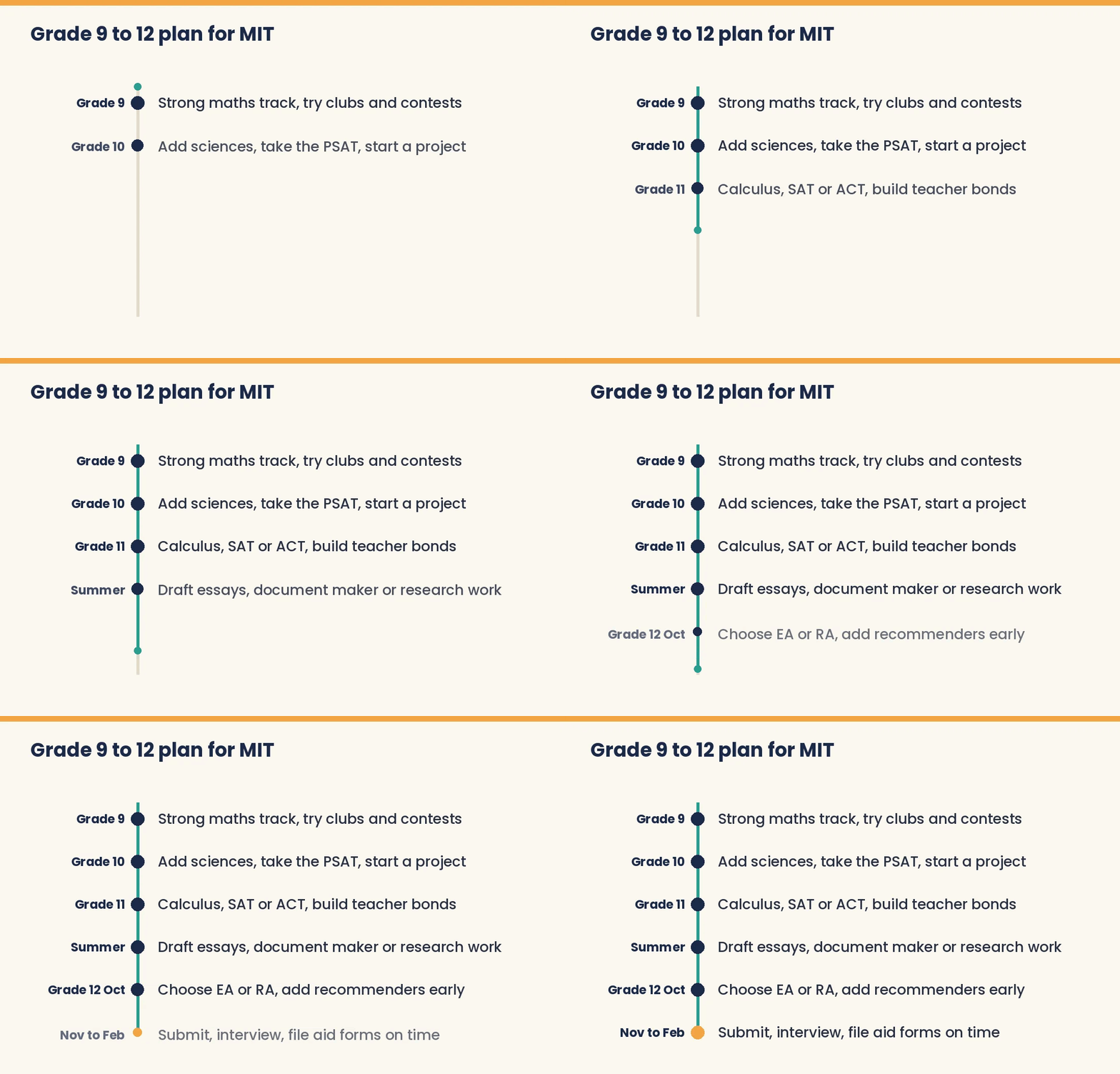
- Grade 9: Get on the strongest maths track your school offers. Join a club or try a contest such as the AMC.
- Grade 10: Add physics, chemistry and biology where you can. Take the PSAT if offered. Start one real project you care about.
- Grade 11: Take calculus or its equivalent, plus a hard science. Sit the SAT or ACT. Build close bonds with one maths/science teacher and one humanities teacher.
- Summer before Grade 12: Draft your essays. Document maker or research work with photos and notes.
- Grade 12, October: Choose EA or RA. Add recommenders early in the portal.
- November to February: Submit on time, prepare for your interview, and file aid forms by the aid deadline.
For course choices in the US system, our AP Calculus AB vs BC guide helps you pick the right level.
Worked example: a contest-style counting problem
Question: How many positive integers less than 100 are divisible by 3 or 5?
- Multiples of 3 below 100: 99 ÷ 3 = 33, so there are 33.
- Multiples of 5 below 100: 99 ÷ 5 = 19.8, so there are 19.
- Numbers counted twice are multiples of 15: 99 ÷ 15 = 6.6, so there are 6.
- Inclusion-exclusion: 33 + 19 − 6 = 46.
The key step is step 3. Many students forget to subtract the overlap and answer 52.
Common mistakes when applying to MIT
- Thinking MIT is on the Common App. It is not. Start in the MIT portal early.
- Waiting too long on tests. EA tests must be taken before 30 November 2026.
- Skipping the English test when you have used English for fewer than five years.
- Listing ten activities. MIT gives space for four. Choose depth.
- Writing "impressive" essays instead of honest ones. MIT says over-strategising is "doing it wrong".
- Asking the wrong teachers. Pick one maths/science and one humanities teacher who know you well.
- Missing aid deadlines. Aid is separate from admission and due 30 November (EA) or 15 February (RA).
How 1-on-1 tutoring helps with getting into MIT
No tutor can get you into MIT. But strong maths and science is the base MIT reads first, and that part can be trained. At Asymptode, every class is 1-on-1 and live online, with one student and one dedicated mentor. There are no batches.
- SAT and ACT maths: your mentor follows your test date and watches each step of your working, fixing the method, not just the answer.
- AP Calculus and AP Physics: classes follow your own syllabus, whether AP, IB, A Level or CBSE. See our AP Physics 1 guide.
- Contest maths such as the AMC: method-first, calm practice on counting, number theory and geometry.
- Planning: for essays and interviews, your mentor helps with planning, logic and a steady practice routine, not ghost-writing.
You get personalised homework with feedback, short parent updates, and every class is recorded. Scheduling is flexible across time zones, from Boston to Bengaluru to Dubai.
Ready to start? Book a free demo class or see fees.
Frequently asked questions
Does MIT accept the Common App?
No. MIT uses its own first-year application in the MIT application portal. QuestBridge Finalists who rank MIT use the QuestBridge application plus an MIT supplement.
When is the MIT Early Action deadline for fall 2027?
Early Action is due 1 November 2026, with decisions in mid-December. Regular Action is due 4 January 2027, with decisions in mid-March.
Is the SAT required for MIT?
Yes. MIT requires the SAT or ACT from all first-year applicants, including international students. It has no cutoff score and superscores by section.
What TOEFL or IELTS score does MIT need?
MIT's minimums are TOEFL 90 (old scale) or 5 (new 1-6 scale), IELTS 7 and Duolingo 120. Recommended scores are TOEFL 100 or 5.5, IELTS 7.5 and Duolingo 125.
Does MIT give financial aid to international students?
Yes. MIT is need-blind and meets 100% of demonstrated need for international students, just as for US students. Apply with the CSS Profile and IDOC.
Is the MIT interview required?
No. MIT offers an interview with an Educational Counselor when one is available. If not, it is waived and your application is not disadvantaged.
Sources
- MIT Admissions: First-year deadlines & requirements
- MIT Admissions: Early vs Regular
- MIT Admissions: Tests & scores
- MIT Admissions: Essays, activities & academics
- MIT Admissions: Letters of recommendation
- MIT Admissions: Interview
- MIT Admissions: Creative portfolios
- MIT Admissions: International applicants
- MIT Admissions: What we look for
- MIT Admissions: Academic foundations
- MIT Admissions: Admissions statistics
- MIT Admissions FAQ: QuestBridge
- MIT Student Financial Services: Cost of attendance
- MIT Student Financial Services: Making MIT affordable
- MIT Student Financial Services: Aid deadlines and process
- MIT Student Financial Services: International students