

How to get into Harvard for fall 2027: apply on the Common Application by 1 November 2026 (Restrictive Early Action) or 1 January 2027 (Regular Decision). Send SAT or ACT scores, five short Harvard answers, two teacher letters and a school report. Then show strong academics, depth in a few activities and good character. Harvard admitted about 4.2% of applicants for the Class of 2029, so plan early. This guide covers each step for US and international students.
Key takeaways
- Apply through the Common Application. The fee is $95, and Harvard waives it for students with financial hardship who plan to apply for aid.
- Deadlines: Restrictive Early Action on 1 November 2026 (decision by mid-December). Regular Decision on 1 January 2027 (decision at the end of March).
- Harvard requires the SAT or ACT. IB, A-Level, AP or national exam results count only in exceptional cases, when you cannot get a seat.
- No English test is required. TOEFL, IELTS and Duolingo cannot replace the SAT or ACT.
- The 2026-27 billed cost is $91,634. Harvard is need-blind for everyone, meets 100% of need, and gives international students the same aid as Americans.
- Class of 2029: 47,893 applied and 2,003 were admitted. Harvard has not yet published Class of 2030 figures.
How do you get into Harvard?
Quick answer: Take a rigorous course load and earn top grades. Score well on the SAT or ACT. Go deep in a few activities and help your community. Then submit a complete Common App by 1 November (REA) or 1 January (RD), with five 150-word Harvard answers, two teacher letters and a school report. Harvard says "there is no formula."
Harvard reads every file as a whole person. Its admissions criteria FAQ says academic work matters most, but the committee also weighs "community involvement, leadership and distinction in extracurricular activities, and personal qualities and character." The sections below turn that into a plan.
Harvard deadlines for fall 2027 entry
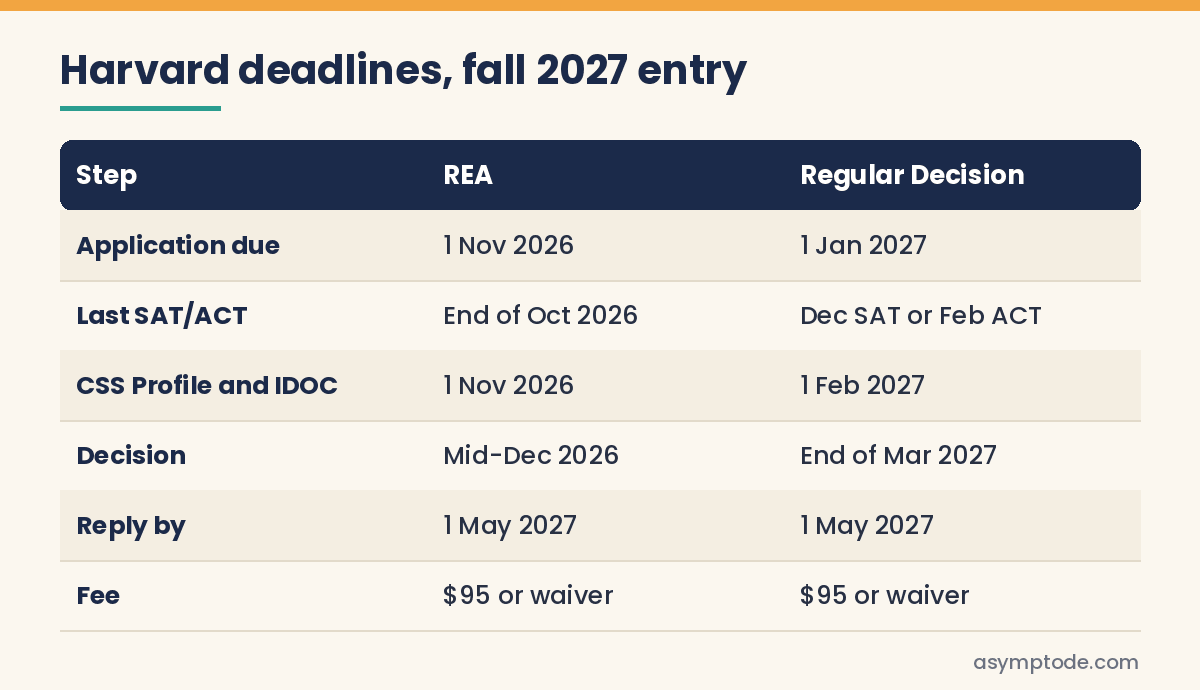
Harvard deadlines for fall 2027 entry, from Harvard College admissions and financial aid pages.
| Step | Restrictive Early Action | Regular Decision |
|---|---|---|
| Application due | 1 Nov 2026, 11:59 pm your local time | 1 Jan 2027, 11:59 pm your local time |
| Counselor and teacher forms | About one week later | About one week later |
| Last test to take | By the end of October (November scores can still be used) | December SAT or February ACT accepted |
| CSS Profile, FAFSA, IDOC | 1 Nov 2026 | 1 Feb 2027 |
| Decision | By mid-December 2026 | End of March 2027 |
| Reply deadline | 1 May 2027 | 1 May 2027 |
| Application fee | $95 or fee waiver | $95 or fee waiver |
Harvard's first-year applicants page lists these dates without a year. They are the dates for the current cycle, whose financial aid forms are labelled 2027-2028. The Common App opens on 1 August each year.
What is Restrictive Early Action at Harvard?
REA is "a non-binding early program." If you are admitted, you can still wait until 1 May to decide. But there are limits. Under the REA rules, you may not apply early (ED, EA or REA) to any other private college. You also may not apply to a binding early plan at a public university.
You can apply early (non-binding) to public universities, military academies and universities outside the US. That means a student in India or the UK can still apply to home-country universities. If Harvard defers you, you may apply Early Decision II elsewhere.
Harvard application timeline
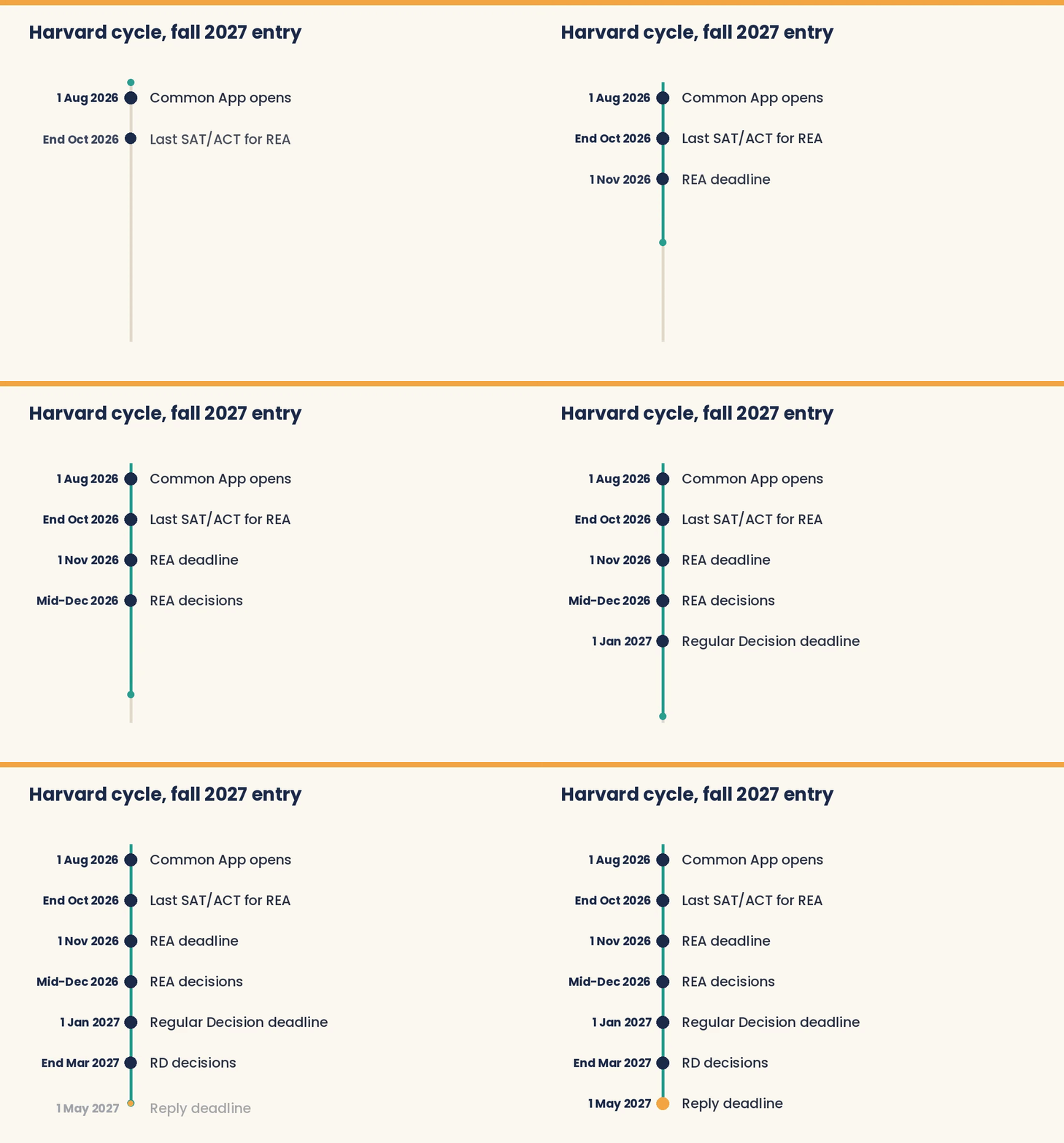
The Harvard application cycle for fall 2027 entry, month by month.
- 1 Aug 2026: Common App opens.
- End of Oct 2026: last SAT or ACT for REA.
- 1 Nov 2026: REA deadline and REA aid forms due.
- Mid-Dec 2026: REA decisions released.
- 1 Jan 2027: Regular Decision deadline.
- End of Mar 2027: Regular Decision results.
- 1 May 2027: reply deadline.
What do you need to apply to Harvard?
The application requirements page lists these parts:
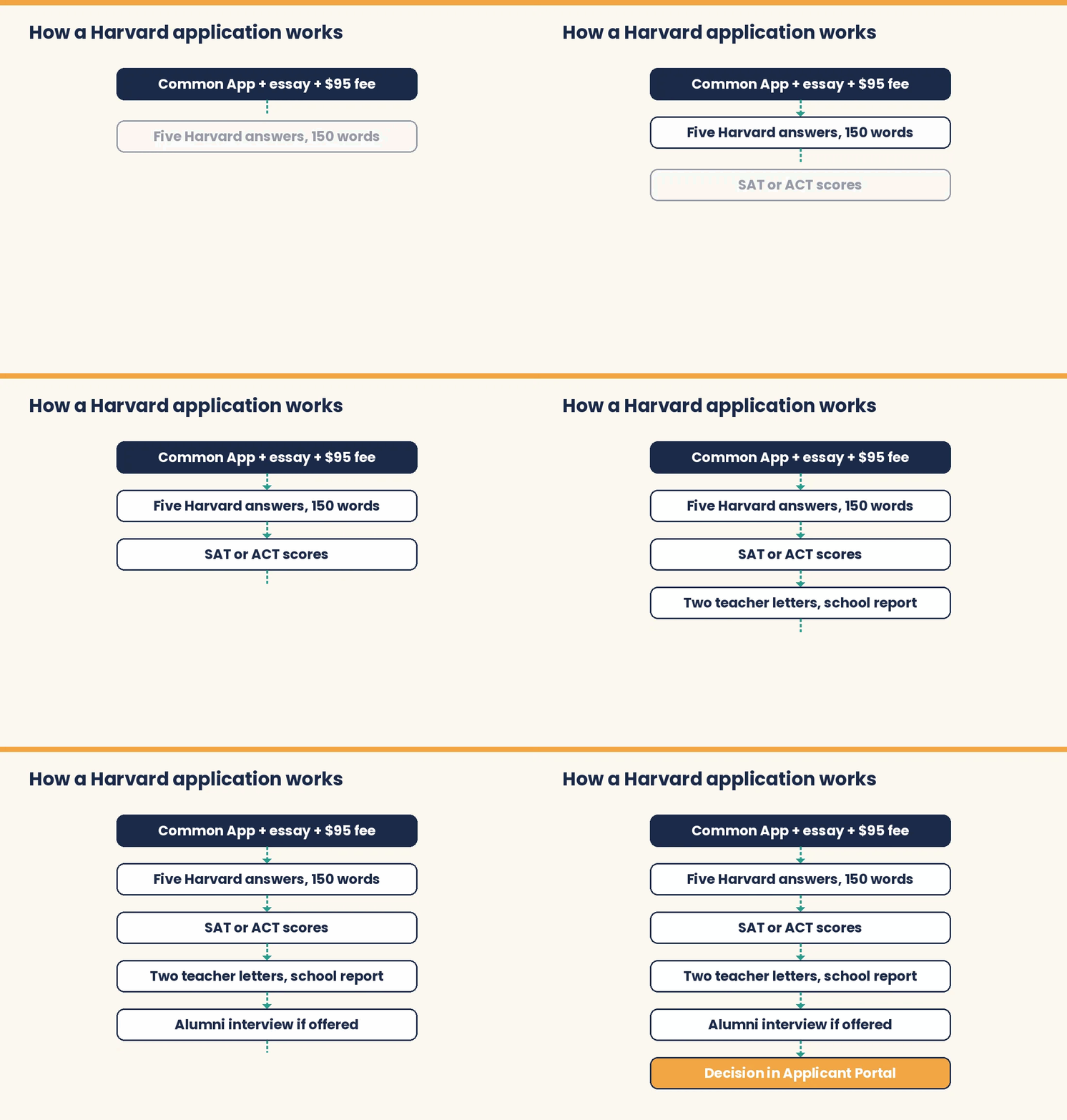
How a Harvard application comes together, from Common App to decision.
- Common Application with the 650-word personal essay. Pay the $95 fee or request a waiver. (QuestBridge finalists can apply through the National College Match.)
- Harvard Questions supplement: five required short answers, 150 words each.
- SAT or ACT scores. Self-reporting is fine when you apply.
- Two teacher recommendations from different academic subjects.
- School report from your counselor, with transcripts and a letter. A midyear report follows for most students.
- Optional: an alumni interview if offered, and art, music or research samples through Slideroom or the Applicant Portal.
After you submit, Harvard emails you a PIN for the Applicant Portal. You can upload documents and check your checklist there. Your decision also appears there.
What are the Harvard supplemental essays?
Harvard asks five short questions, each up to 150 words. They cover:
- How your life experiences would help you contribute to Harvard.
- A time you strongly disagreed with someone, and what you learned.
- An activity, job, trip or family duty that shaped you.
- How you hope to use your Harvard education in the future.
- Three things your future roommates should know about you.
Short answers leave no room for filler. Each answer should make one clear point with one real example. Harvard's dean also said in October 2026 that AI-written answers did poorly, as The Harvard Crimson reported. Write in your own voice.
Does Harvard require interviews?
No. Alumni interviews are offered "at the discretion of the Admissions Committee." You cannot request one, and Harvard says not having one "will not adversely affect your candidacy." If an alum emails you, reply fast. Interviews may be online or in person. The interviewer does not see your application. See what to expect after you apply.
Does Harvard require the SAT or ACT?
Yes. Harvard announced the return to required testing in 2024, and its testing FAQ still says: "Harvard requires the SAT or ACT to meet its standardized testing requirement." Key points:
- No cut-off score. For the ACT, Harvard uses your highest composite.
- Self-report when you apply. Send official scores only if you enroll. Codes: SAT 3434, ACT 1840.
- Do not report practice test scores.
- Alternatives (AP, IB actual or predicted, GCSE/A-Level actual or predicted, or national leaving exams) count only in exceptional cases. Examples are cost, no test centre nearby, or no seat before the RD deadline. If you can reach an SAT or ACT, Harvard expects you to take it.
For context, the 2025-26 Common Data Set shows the middle 50% of enrolled first-years scored 730-790 in SAT Math, 720-770 in SAT Reading and Writing, and 33-35 on the ACT. These are not cut-offs.
Not sure which test fits you? Read SAT vs ACT. For maths, use our digital SAT Math guide or ACT Math test guide.
Do international students need TOEFL or IELTS for Harvard?
No. Harvard's international applicants page says first-year applicants "are not required to take an English proficiency exam." You may submit TOEFL, IELTS or Duolingo scores, but they cannot replace the SAT or ACT. Students from India, the UAE, Singapore, Canada or the UK sit the same SAT dates as the US. Non-US students at schools abroad are usually not eligible for SAT or ACT fee waivers.
Documents in another language need an English translation, made by someone other than you, such as an English teacher. Send the original with it.
How much does Harvard cost, and is it need-blind for international students?
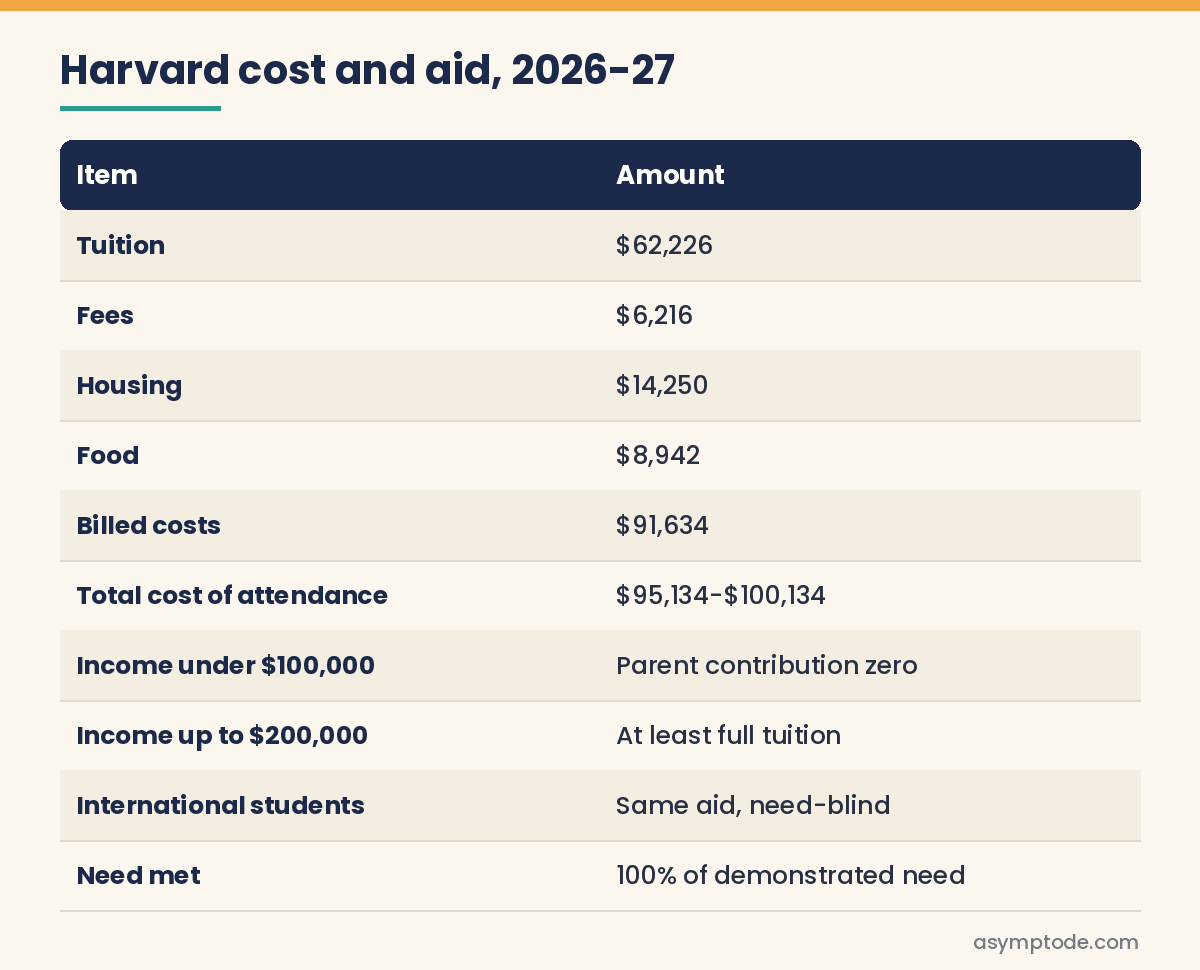
Harvard College costs for 2026-27 and key financial aid facts, from Harvard's financial aid pages.
| Item (2026-27) | Amount |
|---|---|
| Tuition | $62,226 |
| Fees | $6,216 |
| Housing | $14,250 |
| Food | $8,942 |
| Billed costs | $91,634 |
| Personal expenses (estimate) | $2,500 |
| Books (estimate) | $1,000 |
| Travel (estimate) | $0-$5,000 |
| Total cost of attendance | $95,134-$100,134 |
Health insurance ($4,954) is also required unless your family plan covers you. Source: Harvard's How Aid Works page and the FAS registrar.
The aid facts are strong:
- Need-blind for everyone. Harvard says your aid application "will never affect your chance of being admitted."
- Same aid for internationals. "International students are eligible for exactly the same aid as American students."
- 100% of demonstrated need is met.
- Family income under $100,000: expected parent contribution is zero.
- Income up to $200,000: aid covers at least full tuition.
- Travel allowances are included for aided students, including internationals.
To apply for aid, file the CSS Profile (code 3434) and IDOC tax documents. US students also file the FAFSA (code E00468). International families submit translated 2025 tax or income documents. Deadlines are 1 November for REA and 1 February for RD.
Want help building a test plan? Book a free demo class with an Asymptode mentor.
What is Harvard's acceptance rate?
Harvard's admissions statistics page shows the Class of 2029 had 47,893 applicants and 2,003 admits (including 75 from the waitlist). That works out to about 4.2%. About 16% of the class is international, by home address. Harvard has not yet published Class of 2030 numbers. It now holds this data until it reports to the US Department of Education in the fall.
How does Harvard compare with MIT and Stanford?
| Harvard | MIT | Stanford | |
|---|---|---|---|
| Early plan | REA, 1 Nov 2026 | EA, 1 Nov 2026 | REA, 1 Nov 2026 |
| Regular deadline | 1 Jan 2027 | 4 Jan 2027 (RA) | 5 Jan 2027 |
| Early decision out | Mid-December | Mid-December | Mid-December |
| Regular decision out | End of March | Mid-March | Early April |
| Fee | $95 | $75 | $100 |
| SAT/ACT | Required | Required | Required |
| Platform | Common App | MIT's own portal | Common App |
Sources: MIT deadlines and Stanford first-year page. Harvard REA and Stanford REA block each other, so pick one early school. MIT's EA is not restrictive, but Harvard's REA rules stop you applying early to MIT, a private college, too. Read our guides on how to get into MIT and how to get into Stanford.
What does Harvard look for in applicants?
Harvard's application tips name four things:
- Growth: how you handle challenges and setbacks.
- Interests and activities: "We are much more interested in the quality of students' activities than their quantity."
- Personal character: how you used the chances you had, including work and family duties.
- Contribution to community: how you have helped your school and the people around you.
Harvard's course advice suggests four years of English, four of maths, four of science (biology, chemistry and physics, plus one advanced course), three of history and four of one foreign language. Calculus is not required. The strongest applicants take the hardest courses their school offers.
For IB students, that usually means HL Maths and HL sciences. For A-Level students, Maths plus sciences, with Further Maths if your school offers it. For CBSE and ICSE students, PCM with a strong maths record. See IB Maths AA vs AI and our A-Level Maths guide.
A Grade 9-12 plan to get into Harvard
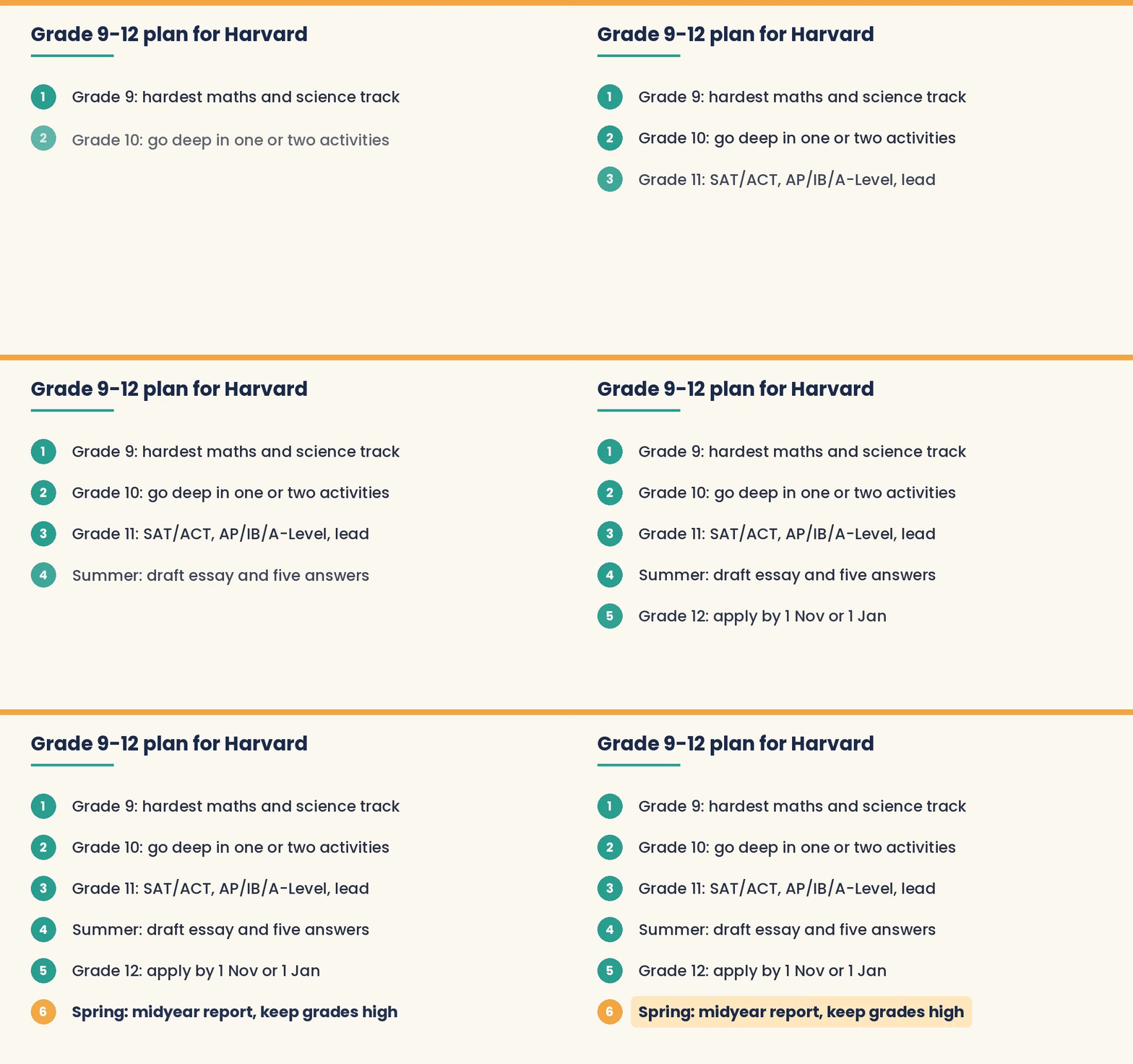
A four-year plan from Grade 9 to the Harvard application.
- Grade 9: build the base. Pick the hardest maths and science track you can handle. Try a few activities. Read widely and start a foreign language you will keep for four years.
- Grade 10: go deeper. Drop activities you do not care about. Take on more in one or two. Try a maths contest such as the AMC 10. Take the PSAT or a practice SAT to find gaps.
- Grade 11: test and lead. Take the SAT or ACT, then retake if needed. Take AP, IB HL or A-Level courses. Lead or build something real. Ask two teachers early about letters.
- Summer before Grade 12: draft. Write the personal essay and the five Harvard answers. Finalise the activity list and decide REA or RD.
- Grade 12 autumn: submit. File by 1 November (REA) or 1 January (RD), plus CSS Profile and IDOC. Prepare for an alumni interview.
- Grade 12 winter and spring: finish well. Send the midyear report. Keep grades high, because the final transcript is due by 1 July.
Common mistakes Harvard applicants make
- Breaking REA rules by also applying early to another private college.
- Assuming IB or A-Level predictions replace the SAT. They only count in exceptional cases.
- Testing too late. For REA, sit the SAT or ACT by the end of October.
- Using a nickname. Use your legal name on every document, or files may not match.
- Filling every activity line. Harvard calls the grid "an act of prioritization."
- Generic or AI-written short answers. 150 words must sound like you.
- Skipping aid forms because of cost fears. Harvard is need-blind, even for international students.
- Emailing transcripts. Harvard cannot accept a transcript as an email attachment.
How 1-on-1 tutoring helps with getting into Harvard
Harvard wants top grades in the hardest maths and science courses, and a strong SAT or ACT. That is where Asymptode helps. One student works with one dedicated mentor in live online classes. No batches. Your mentor follows your own syllabus, whether that is AP, IB, A-Level, CBSE or a US school, and plans around your test dates.
- SAT and ACT Maths: the mentor watches each step of your working and fixes the method, not just the answer. This includes Desmos habits for the digital SAT.
- AP, IB and A-Level maths and science: calculus, physics, chemistry and biology taught method-first. See our AP Calculus AB vs BC guide.
- Contest maths: AMC and AIME problem practice.
- Essays and reading: we are honest here. The mentor helps with planning, structure and practice routines. Your essays must be your own words.
You get personalised homework with feedback, flexible class times across time zones, every class recorded, and short parent updates.
Ready to start? Book a free demo class or see fees.
Facts checked against official sources on 27 October 2026.
Related guides on Asymptode
- How to get into MIT
- How to get into Stanford
- SAT vs ACT: which test to take
- Digital SAT Math guide
- SAT complete guide for parents
- AP complete guide for parents
FAQ
Is Harvard need-blind for international students?
Yes. Harvard says financial need "will never affect your chance of being admitted," for all applicants. International students get exactly the same aid as Americans, and Harvard meets 100% of demonstrated need.
What is the Harvard application fee?
It is $95, paid through the Common Application or by mail. Harvard waives it if the fee is a hardship and you plan to apply for financial aid. Asking for a waiver does not hurt your application.
Can I apply to Harvard with IB or A-Level predicted grades instead of the SAT?
Only in exceptional cases, such as no test centre, cost barriers or no seat before the deadline. If you can take the SAT or ACT, Harvard expects you to. You should still list your IB or A-Level results.
When does Harvard release decisions?
REA decisions come out by mid-December 2026. Regular Decision results come out at the end of March 2027. You see your decision in the Applicant Portal. All admitted students have until 1 May 2027 to reply.
Is it better to apply REA or Regular Decision to Harvard?
Apply REA only if Harvard is your clear first choice and your file is ready by 1 November, including test scores. Harvard's FAQ also says sending your materials before the deadline does not improve your chances. If you need a December SAT or more time, apply RD.
What SAT score do you need for Harvard?
There is no cut-off. In the 2025-26 Common Data Set, the middle 50% of enrolled students scored 730-790 in SAT Math and 720-770 in Reading and Writing. On the ACT, the range was 33-35.
Sources
- Harvard College: Apply
- Harvard College: First-year applicants (deadlines and decision dates)
- Harvard College: Application requirements
- Harvard College: Restrictive Early Action
- Harvard College: Which standardized tests does Harvard require?
- Harvard College: International applicants
- Harvard College: Fee waiver FAQ
- Harvard College: Application tips
- Harvard College: What to expect after you apply
- Harvard College: Admissions criteria FAQ
- Harvard College: Secondary school course recommendations
- Harvard College: How aid works (cost of attendance)
- Harvard College: Applying for aid as a prospective student
- Harvard FAS Registrar: Tuition and fees 2026-27
- Harvard College: Admissions statistics
- Harvard OIRA: Common Data Set
- Harvard Gazette: Harvard announces return to required testing
- MIT Admissions: Deadlines and requirements
- Stanford Undergraduate Admission: First-year applicants