If you want to know how to get into Princeton, start here. Princeton admits only a tiny share of applicants, and its rules for fall 2027 entry differ from the rules for the year after. This guide covers platforms, deadlines, testing, essays, the graded paper, letters, courses, cost and aid, for families in the US and worldwide, including India.
Key takeaways
- Apply through the Common App or QuestBridge. Princeton no longer accepts the Coalition Application.
- Single-Choice Early Action closed on 1 November 2026. The next route is Regular Decision, due 1 January 2027.
- The SAT and ACT are optional for fall 2027 entry, but required again from fall 2028 entry.
- Every applicant sends a graded written paper, four essays and three short answers.
- Admission is need-blind for all students, including international students, and aid is grant, not loan.
How to get into Princeton: what does it really take?
Quick answer: To get into Princeton, take the hardest courses your school offers and earn top grades. Write strong essays and a clear graded paper. Get two teacher letters from core subjects. Apply by 1 November (Single-Choice Early Action) or 1 January (Regular Decision). Tests are optional for fall 2027 entry, but required from fall 2028.
Princeton's Common Data Set (CDS) rates nine factors as "Very Important": rigor, class rank, GPA, test scores, the essay, recommendations, extracurriculars, talent or ability, and character. The interview, first-generation status, alumni relation and geography are "Considered". Your level of interest is "Not considered", so visits and emails will not lift your file.
What is the Princeton acceptance rate?
Princeton stopped publishing its admit rate on its website in 2022. It also releases no data during the admission cycles. The numbers below come from the CDS and Princeton's profile page.
| Class of 2029 (entered fall 2025) | Figure |
|---|---|
| Applicants | 42,303 |
| Admitted | 1,868 |
| Enrolled | 1,408 |
| Admit rate | About 4.4% (our calculation) |
| International applicants | 10,567 |
| International admits | 241 (about 2.3%, our calculation) |
On the waitlist, 1,370 students were offered a place, 1,086 accepted it, and 36 were admitted.
Applicant and admit numbers for the Class of 2030 (1,414 first-years from 63 countries) are not yet published.
When is the Princeton early action deadline?
Princeton's early route is Single-Choice Early Action (SCEA). It is "a nonbinding process", so you do not have to attend if admitted. It is also restrictive, which limits where else you can apply early. Princeton has no Early Decision.
For fall 2027 entry, the SCEA deadline was 1 November 2026. If you missed it, the next route is Regular Decision, due 1 January 2027. All dates come from the official deadlines page.
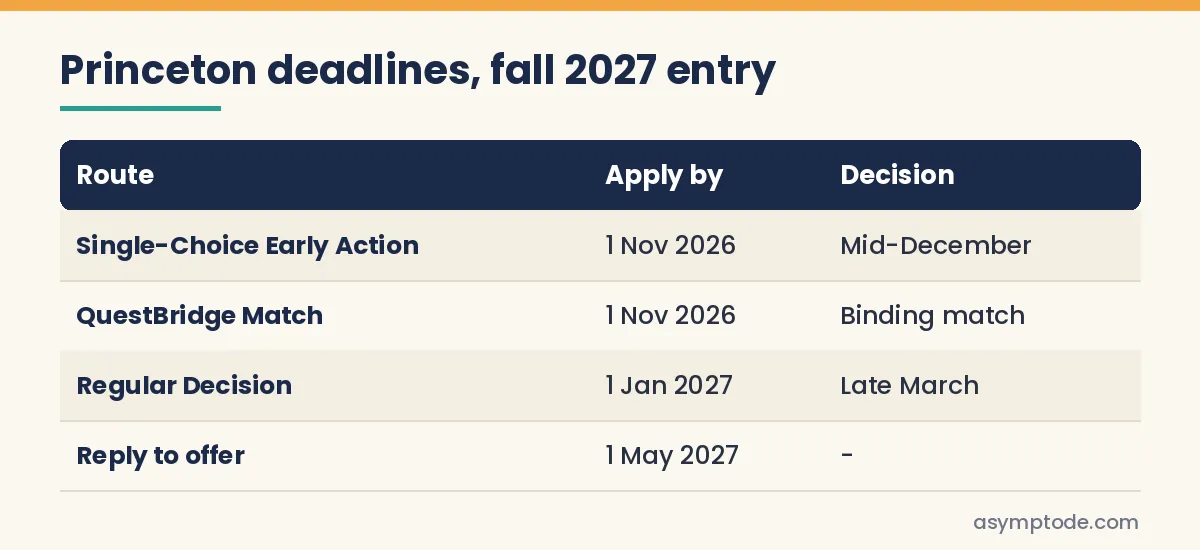 Princeton deadlines for fall 2027 entry.
Single-Choice Early Action: apply by 1 November 2026, decision in mid-December. QuestBridge Match: apply by 1 November 2026, and a Princeton match is binding. Regular Decision: apply by 1 January 2027, decision in late March. Reply to an offer by 1 May 2027.
Other dates: the Optional Arts Supplement is due Nov. 6 (SCEA) or Jan. 8 (RD). The Princeton Financial Aid Application (PFAA) is due Nov. 9 (SCEA) or Feb. 1 (RD). Exact decision release days for this cycle are not yet announced.
How does QuestBridge work at Princeton?
QuestBridge finalists who rank Princeton submit everything, including the PFAA and tax documents, by Nov. 1. A Princeton match is binding. Results arrive in early December. Finalists who rank Princeton but do not match are considered in Regular Decision. Finalists who do not rank Princeton can apply by Jan. 1 with the QuestBridge RD form. Read the QuestBridge page for details. All finalists get an automatic fee waiver.
What are the Princeton admissions requirements?
You send the application and the Princeton-specific questions through the Common App (CEEB code 2672) or apply through QuestBridge. The full list is on the application checklist.
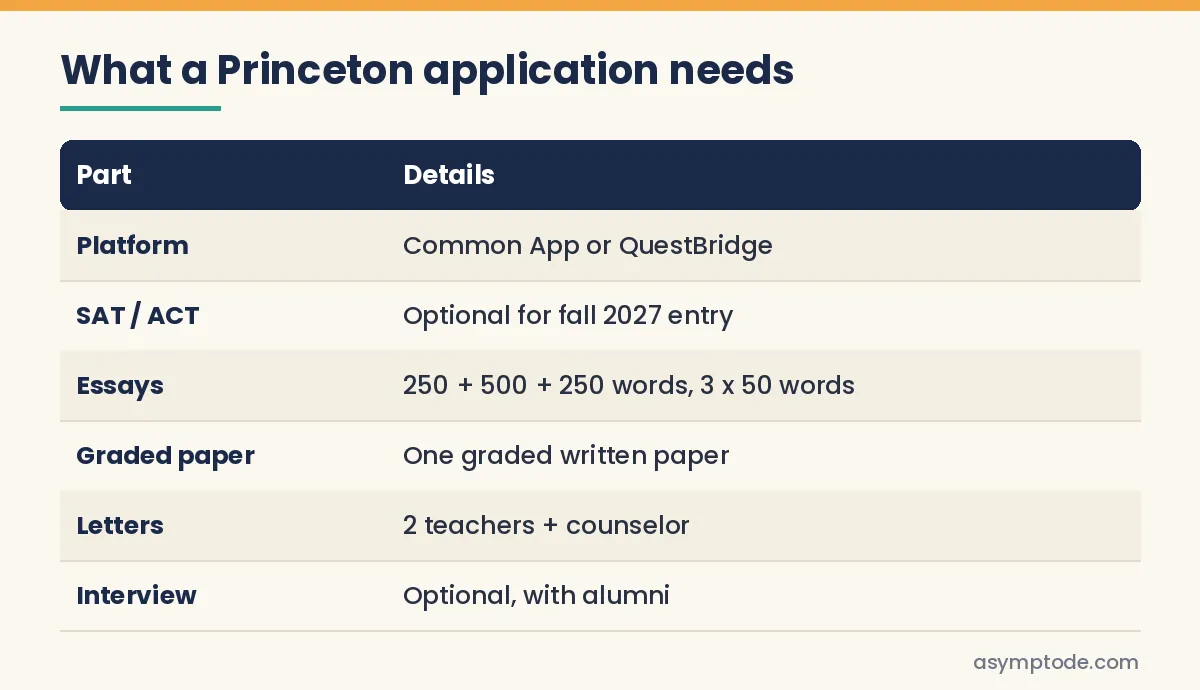 What a Princeton application needs.
Platform: the Common App or QuestBridge. SAT or ACT: optional for fall 2027 entry. Essays: 250 + 500 + 250 words, plus three 50-word answers. One graded written paper, letters from two teachers and a counselor, and an optional alumni interview.
The school sends your official transcript, the School Report, a counselor letter, two teacher letters and the Midyear School Report. The two teachers should teach higher-level courses, such as AP or IB, in different core subjects.
Is there an application fee?
Yes. Check the fee shown on Princeton's site before you pay. You can ask for a fee waiver. Options include the Common App waiver (needs counselor approval) and ACT, College Board or NACAC waivers. Low-income applicants and current or former U.S. military members qualify for the Princeton-specific waiver, which needs no counselor approval.
Is Princeton test optional? What SAT scores do you need?
For fall 2027 entry, yes. Princeton says: "Applicants who submit no ACT or SAT score will not be at a disadvantage."
This changes for younger students. From the 2027-28 cycle (fall 2028 entry), the SAT or ACT is required for first-year and transfer applicants. There is no minimum score. Active-duty military are exempt. Princeton says a review of five years of data found stronger academic results among students who sent scores. If your child is in Grade 10 or below now, plan for a test. See the official testing page.
Here are the scores of students who enrolled in fall 2025 (CDS 2025-26):
| Score | 25th | 50th | 75th |
|---|---|---|---|
| SAT composite | 1490 | 1530 | 1560 |
| SAT EBRW | 740 | 760 | 780 |
| SAT Math | 760 | 790 | 800 |
| ACT composite | 34 | 35 | 35 |
| ACT Math | 33 | 35 | 36 |
60% sent the SAT and 20% sent the ACT. The average high school GPA was 3.96, and 72% had a 4.0. These are ranges, not cut-offs.
Score rules for this cycle:
- Send official scores from the testing agency (SAT code 2672, ACT code 2588).
- SAT Score Choice is accepted. For the ACT, Princeton takes your highest composite. The ACT science section is optional.
- Take the test by the October date for SCEA or the December date for RD.
- Self-report all AP or IB scores on the application.
Not sure which test suits you? Read our SAT vs ACT comparison.
 A sample SAT maths step: a percent question, solved line by line.
The animation works through one percent problem from start to finish. Each line shows a single step, so you can see where the numbers come from. SAT Math scores at Princeton cluster near the top, so small slips matter. Writing each step clearly is how you catch them.
For more practice, see our Digital SAT Math guide and our ACT Math test guide.
Want a mentor to check every step of your SAT or ACT maths? Book a free demo class, or compare our plans and fees.
What are the Princeton supplemental essays?
Every applicant answers the Princeton-specific questions. The prompts are on the official questions page.
| Prompt | Word limit |
|---|---|
| Academic essay (A.B. or B.S.E. version) | 250 or fewer |
| "Your Voice" 1: how your lived experience will shape conversations on campus | 500 or fewer |
| "Your Voice" 2: how your story connects to service and civic engagement | 250 or fewer |
| "More About You": a new skill to learn, what brings you joy, your current soundtrack song | 50 or fewer each |
The academic essay depends on your degree. A.B. or undecided applicants write about the areas that pique their curiosity. B.S.E. applicants explain why they want engineering at Princeton and what experience they have.
Tips that follow the official guidance:
- Answer the exact question asked.
- Use real details only you can give.
- Write it yourself. Dean of Admission Karen Richardson cautions against using AI, and you certify that your work is your own.
What is the Princeton graded written paper?
Princeton still requires a graded written paper. It is due with your application (Nov. 1 or Jan. 1).
- Choose a paper of at least one page.
- It must come from an academic English, social studies or history course in your last three years of secondary school.
- Pick expository, thesis-driven analytical writing. Science research, creative writing and personal narratives are not what Princeton most wants.
- Include the prompt, the grade and your teacher's comments, plus the rubric if one was used.
- It must have been written in English originally.
- Upload it through the Common App or QuestBridge, or send it to the applicant portal.
See the graded written paper page. Keep your best graded essays from Grade 10 onward so you have choices.
Does Princeton do interviews?
Princeton offers optional alumni interviews of about 30-45 minutes. They are not guaranteed and not recorded. You can opt out with no penalty. There are no on-campus interviews, and QuestBridge match students do not interview. The CDS rates the interview as "Considered".
Artists can add the Optional Arts Supplement through the applicant portal.
 The Princeton application path, in four steps.
Step 1: choose the Common App or QuestBridge. Step 2: prepare your essays, graded paper and letters. Step 3: apply by 1 November or 1 January. Step 4: get your decision in mid-December or late March.
What courses should you take for Princeton?
Princeton says its list "is not a list of admission requirements". But if possible, it expects:
| Subject | Recommended |
|---|---|
| English | 4 years, with continued writing practice |
| Mathematics | 4 years (calculus for engineering) |
| Foreign language | 4 years of one language |
| Laboratory science | At least 2 years (physics and chemistry for engineering) |
| History | At least 2 years |
| Arts | Most candidates have some visual or performing arts |
The CDS lists 21 recommended academic units, including 4 of science (2 of them lab). See before you apply.
What are the Princeton engineering BSE requirements?
Princeton Engineering gives clear advice, though these are recommendations, not requirements:
- "Ideally, your math preparation will include calculus." If you must choose, pick calculus over statistics.
- "Take a college-preparatory physics course in your junior or senior year."
- "You should take a rigorous chemistry course in addition to physics." Chemistry does not replace physics.
Read the engineering guidance. Princeton offers two degrees, the A.B. and the B.S.E., with 37 concentrations. Computer Science is offered as either.
How do international students get into Princeton?
International applicants go through the same process as U.S. applicants. Each student is read within their own national school system. No system or country is preferred. Princeton names IGCSE, British A-Levels, the IB and national leaving exams "such as India's Std X/Std XII". No GPA conversion is needed. Your Midyear Report carries internal or predicted grades.
If English is not your native language and your school does not teach in English, send TOEFL, IELTS Academic, Duolingo English Test or PTE Academic. You are exempt if you attended an English-medium school for at least three years. Note that the RD listing does not name the Duolingo test, so check the international students page.
IB students can read our IB Diploma Programme guide.
How much does Princeton cost, and how does Princeton financial aid work?
The 2026-27 budget for first-year students is:
| Item | 2026-27 |
|---|---|
| Tuition | $68,140 |
| Housing | $13,010 |
| Food | $9,110 |
| Books, personal, fees | $4,364 |
| Total | $94,624 |
Travel is not included. See the student budget page.
Many families pay much less: 71% of the Class of 2030 receive aid. Princeton's aid rules are:
- Admission is need-blind, including for international students.
- Princeton meets 100% of demonstrated need with grant aid. It has had a no-loan policy since 2001.
- Princeton says "most families with incomes up to $150,000 a year will now pay nothing", and most families earning up to $250,000 pay no tuition.
- There are no merit or athletic scholarships.
- Outside scholarships reduce your Princeton grant.
How these dollar limits apply outside the US is not stated, so check with the aid office. Princeton uses its own PFAA, not the CSS Profile. International families send income documents in local currency, with certified English translations. See how to apply for aid.
What is a good Grade 9-12 plan for Princeton?
- Grade 9: Take the strongest courses you can. Start a language you can keep for four years.
- Grade 10: Add lab science. Save your best graded history or English essays. Try a first SAT or ACT practice test.
- Grade 11: Take calculus and physics if you want engineering. Take the SAT or ACT. Build deep work in one or two interests, such as research for high school students. Ask two core-subject teachers for letters.
- Summer before Grade 12: Draft your essays. Pick your graded paper. Decide on SCEA, QuestBridge or RD.
- Grade 12: Apply by 1 November or 1 January. Send the PFAA on time. Keep your grades up for the Midyear Report.
If your child enters Grade 12 in fall 2027, testing will be required. Start test prep early.
What mistakes should you avoid?
- Thinking "test optional" applies forever. It ends with fall 2027 entry.
- Sending a creative or science paper as the graded paper.
- Asking two teachers from the same subject.
- Missing the PFAA deadline, which comes after the application deadline.
- Using AI to write your essays.
Comparing schools? Read our guides on how to get into Yale and how to get into MIT.
How 1-on-1 tutoring helps with getting into Princeton
- One dedicated mentor, live and online. Your mentor follows your own school syllabus and your SAT, ACT and school exam dates.
- Method-first maths and science. The mentor watches each step of your working in calculus, physics and chemistry, the courses Princeton Engineering recommends.
- Personalised homework with feedback. You get short parent updates, and every class is recorded so you can review it.
- Planning help for the rest. For essays and the graded paper, your mentor helps with planning and method. The writing stays your own.
You can start with a free demo class.
Facts checked against official sources on 31 October 2026.
FAQ
What is the Princeton acceptance rate?
Princeton does not publish its rate. For the Class of 2029, 1,868 of 42,303 applicants were admitted. That is about 4.4%, by our calculation.
Is Princeton test optional for 2027?
Yes, for fall 2027 entry the SAT and ACT are optional. Students who do not send scores are not at a disadvantage. From fall 2028 entry, the SAT or ACT is required again.
When is the Princeton early action deadline?
Single-Choice Early Action closed on 1 November 2026 for fall 2027 entry. If you missed it, apply Regular Decision by 1 January 2027. RD decisions come in late March.
Is Princeton early action binding?
No. Single-Choice Early Action is nonbinding, so you can decide by May 1. It is restrictive, though, so it limits other early applications. A QuestBridge match with Princeton is binding.
Does Princeton give aid to international students?
Yes. Admission is need-blind for international students, and Princeton meets their full need with grants. There are no merit or athletic scholarships.
Does Princeton accept CBSE or ISC students from India?
Princeton accepts national leaving exams "such as India's Std X/Std XII". It does not name CBSE or ISC on its page, so check with the office if unsure. No GPA conversion is needed.
Ready to start? Book a free demo class and advisor call, or see our plans and fees.
Sources
- Princeton: First-year application dates and deadlines
- Princeton: Application checklist
- Princeton: Standardized testing
- Princeton: Princeton-specific questions
- Princeton: Graded written paper
- Princeton: Optional Arts Supplement
- Princeton: QuestBridge
- Princeton: International students
- Princeton: Before you apply
- Princeton: Information for counselors
- Princeton: Cost and aid
- Princeton: Admission announcement
- Princeton Financial Aid: Student budget
- Princeton Financial Aid: Apply for aid
- Princeton Financial Aid: FAQs
- Princeton Engineering: High school guidance
- Princeton profile: Admission and costs
- Princeton Common Data Set 2025-26
- Princeton welcomes Class of 2030
- Princeton: Dean Richardson on testing, rigor and AI