

If you want to know how to get into Stanford, here is the short version: earn near-perfect grades in the hardest courses your school offers, send strong SAT or ACT scores (they are required again), write honest and specific Stanford essays, and apply through the Common App by 1 November (Restrictive Early Action) or 5 January (Regular Decision). This guide covers the 2026-27 cycle (fall 2027 entry) for US and international students.
Key takeaways
- For fall 2027 entry, the Restrictive Early Action (REA) deadline is 1 November 2026 and the Regular Decision (RD) deadline is 5 January 2027. Everyone replies by 1 May 2027.
- SAT or ACT scores are required. Stanford has no preferred test and no minimum score.
- You apply to Stanford as a whole. You do not choose a major on the form, and you usually declare by the end of your second year.
- The application has 5 short questions (50 words each) and 3 short essays (100-250 words each), plus the Common App personal essay.
- Stanford meets full demonstrated need for all admitted students. For international students, asking for aid is a factor in the admission decision.
- For the Class of 2029, 2,302 of 60,646 applicants were admitted, about 3.8%.
How do you get into Stanford?
Quick answer: Build an outstanding transcript in Grades 10-12, with four years of maths through calculus. Take the SAT or ACT and aim for the top range. Show real curiosity in your activities and essays. Get two strong teacher letters and a counselor letter. Then submit the Common App, the Stanford Questions and the $100 fee (or a fee waiver) by your deadline.
Stanford's admission overview calls academic excellence the main criterion: "flawless or nearly flawless grades in rigorous courses". Grade 9 is a transition year; readers focus on Grades 10-12. They also weigh context, depth in activities and intellectual vitality, meaning real curiosity.
How is a Stanford undergraduate degree structured?
When you apply, you apply to the university, not to a major, department or school (Application and Essays). You can list possible majors and careers on the form, but you are not bound by them.
You start undeclared and must declare by the end of sophomore spring (Declaring Your Major). Stanford runs on a fast quarter system, admits only for the fall, and has no pre-med, pre-law or business major (Preparing for Stanford Academics).
What are the Stanford deadlines for fall 2027 entry?
Stanford offers two plans. Submit the Common App by 11:59 pm in your local time zone on the date shown (First-Year Requirements and Deadlines).
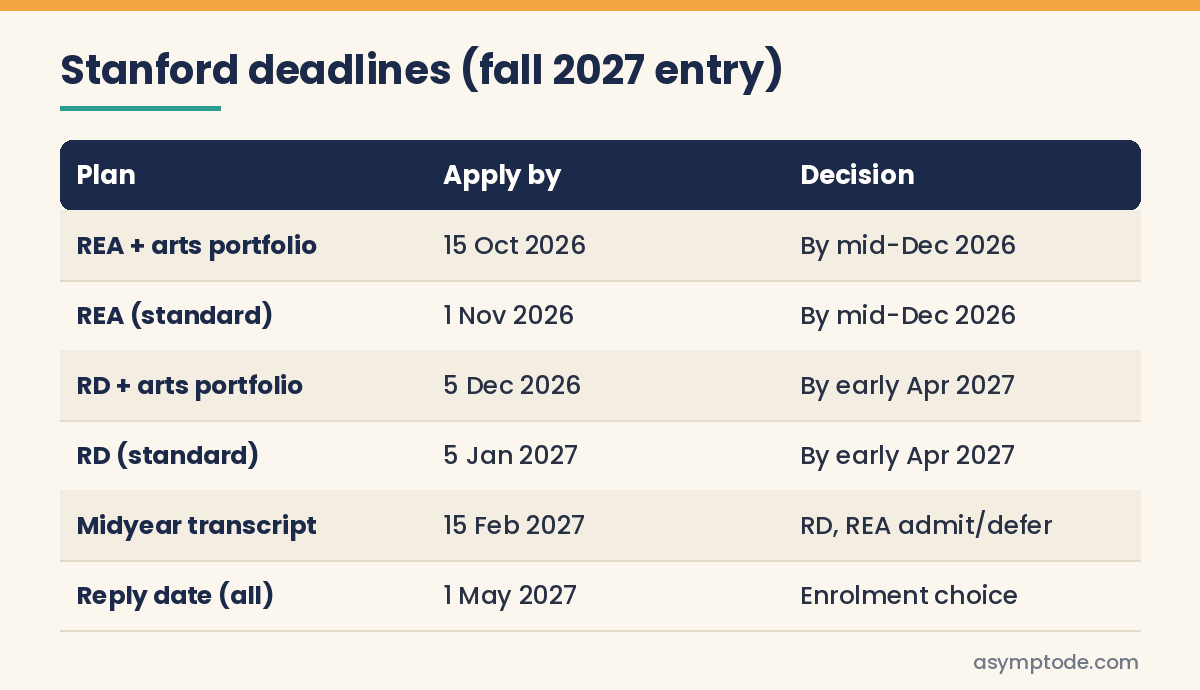
| Plan (fall 2027 entry) | Common App due | Arts portfolio due | School documents due | Decision | Reply by |
|---|---|---|---|---|---|
| REA with arts portfolio | 15 Oct 2026 | 20 Oct 2026 | 1 Nov 2026 | By mid-December 2026 | 1 May 2027 |
| REA (standard) | 1 Nov 2026 | n/a | 1 Nov 2026 | By mid-December 2026 | 1 May 2027 |
| RD with arts portfolio | 5 Dec 2026 | 10 Dec 2026 | 5 Jan 2027 | By early April 2027 | 1 May 2027 |
| RD (standard) | 5 Jan 2027 | n/a | 5 Jan 2027 | By early April 2027 | 1 May 2027 |
The arts-portfolio REA deadline has passed; standard REA (1 November 2026) is days away. Exact release times appear on Stanford's News and Announcements page a few days before.
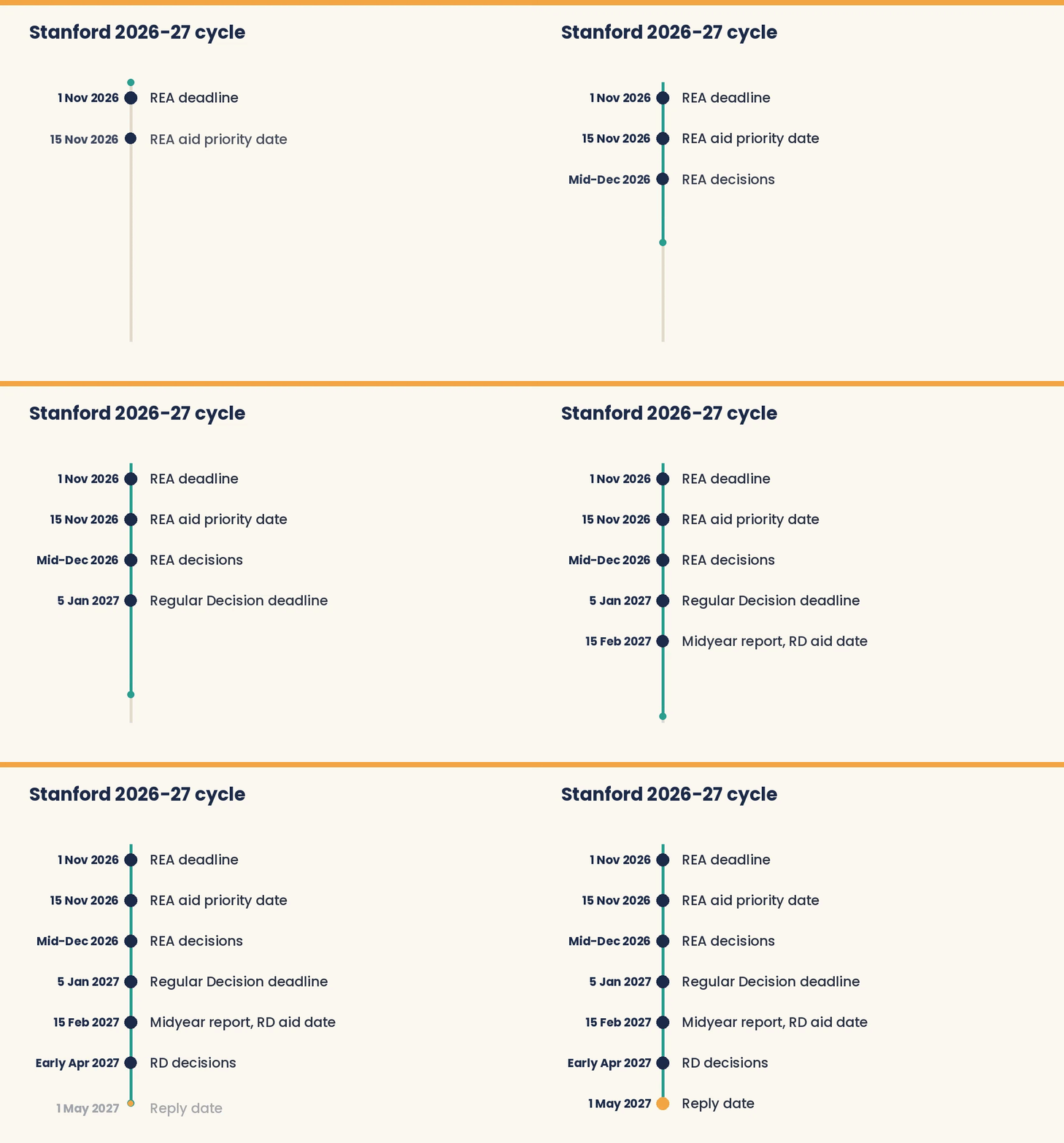
Key dates: REA 1 November 2026; REA aid priority 15 November 2026; REA decisions mid-December 2026; RD 5 January 2027; midyear transcript and RD aid priority 15 February 2027; RD decisions early April 2027; reply by 1 May 2027.
Should I apply Restrictive Early Action or Regular Decision?
REA is non-binding, but restrictive. You may not also apply early (EA, REA, ED or Early Notification) to any other private US college, or to a public university under a binding plan (Regular Decision and Restrictive Early Action). Stanford's own example: you cannot apply to Stanford REA and MIT Early Action at the same time.
Allowed exceptions include non-binding early plans at public universities, rolling admission, non-US universities, military academies and early plans required for a scholarship.
REA ends in admit, deny (final for that year) or a deferral to RD, which is rare. Choose REA if Stanford is your first choice and Grades 9-11 are already strong. Choose RD if your grades are rising or you are retaking the SAT or ACT. You may apply to Stanford only three times in total.
Does Stanford require the SAT or ACT for 2027 entry?
Yes. Stanford resumed its test requirement starting with students applying in fall 2025 for the Class of 2030 (Stanford Report), and it still applies to you. The Standardized Testing page says:
- ACT or SAT scores are required. Self-report your highest; official scores are needed only if you enroll.
- No preferred test and no minimum score. Stanford superscores both.
- Latest test sitting: ACT by end of September and SAT by end of October for REA; either test by end of December for RD.
- AP scores are not required, but if you took any AP exam, you must self-report every score.
- English tests cannot replace the SAT or ACT.
For the Class of 2029 (tests optional that year), the middle 50% scored 1520-1570 on the SAT and 34-36 on the ACT, with SAT Math at 770-800 (Common Data Set). Every maths error counts. Our Digital SAT Math guide and ACT Math guide explain the content, and the SAT guide for parents covers dates and registration.
Worked example: a typical top-score SAT maths trap
A price rises by 20%, then falls by 20%. What percent of the original price is the final price?
- Let the original price be 100.
- After a 20% rise: 100 x 1.2 = 120.
- After a 20% fall: 120 x 0.8 = 96.
- The final price is 96% of the original, not 100%.
The trap is adding +20 and -20 to get zero. Multiply the factors (1.2 x 0.8 = 0.96) instead.
Do international students need TOEFL or IELTS for Stanford?
No. Stanford requires no English proficiency exam, though you may self-report one (International Applicants). Fluency in English is still a prerequisite. Other rules: requirements match US students; a school official (not you) must translate documents into English; do not convert marks to a GPA; and Stanford does not work with paid agents.
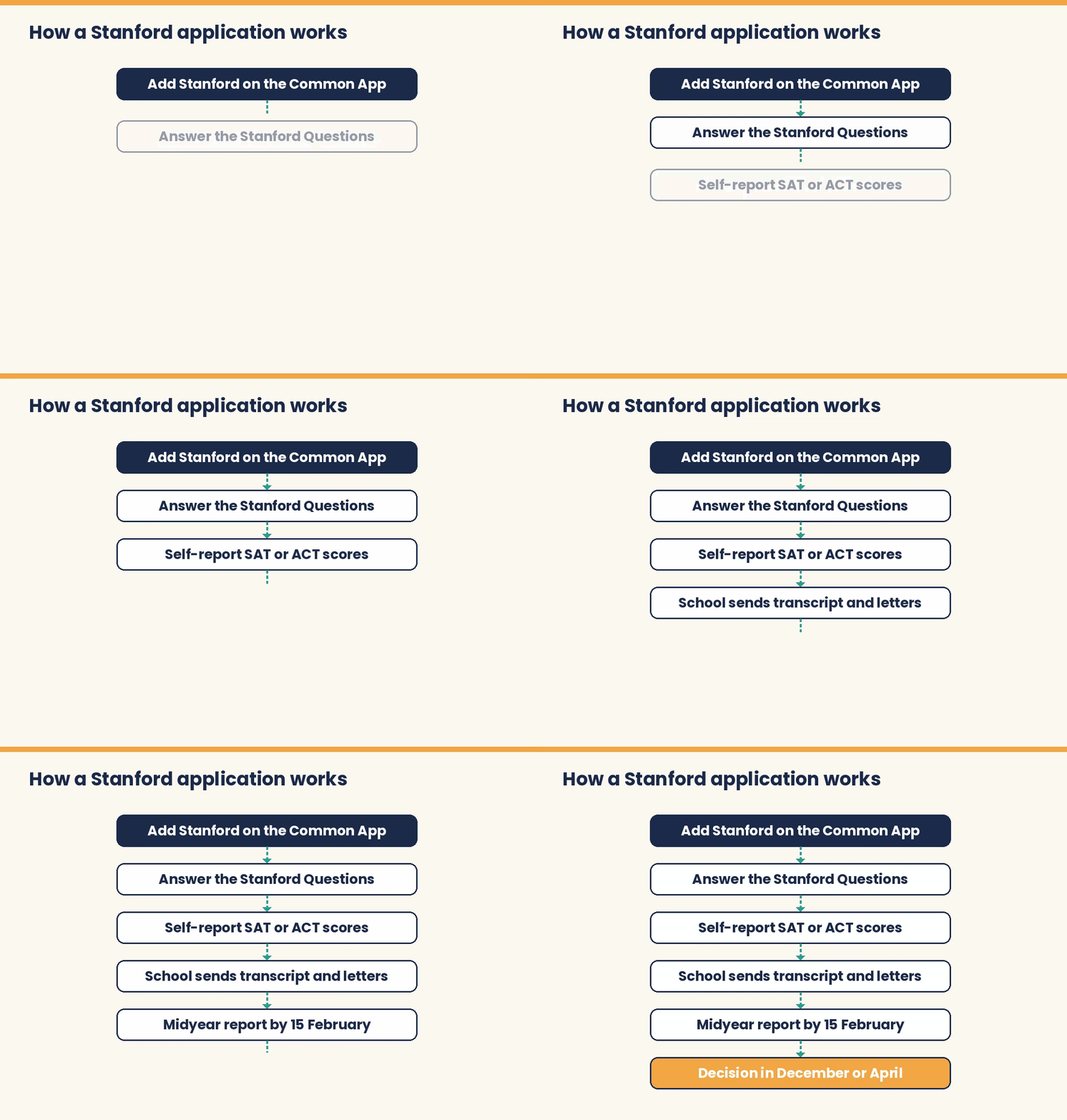
What does the Stanford application contain?
| Part | What it is |
|---|---|
| Common App | Includes your personal essay and activities list |
| Fee | $100 non-refundable, or a Common App fee waiver (open to US and non-US students) |
| SAT or ACT | Self-reported highest scores |
| School Report + counselor letter | Sent by your counselor or another school official |
| Two teacher letters | Academic teachers, ideally Grade 11 or 12 |
| Optional extra letter | One "Other Recommender" who adds new insight |
| Official transcript | Grades 9-12, or your national results and predictions |
| Midyear transcript | Due 15 February 2027 for RD, deferred and admitted REA students |
| Optional arts portfolio | Art Practice, Dance, Music, or Theater and Performance Studies |
| Optional interview | With an alumni volunteer, only in interview areas |
You apply through the Common App at commonapp.org; Stanford's page lists no Coalition option. Details: recommendations, fee, arts, interview.
What are the Stanford essay prompts?
The Stanford Questions open in early August each year. For the 2026-27 cycle they are:
Short questions (3-50 words each):
- What is the most significant challenge that society faces today?
- How did you spend your last two summers?
- What historical moment or event do you wish you could have witnessed?
- Briefly elaborate on one of your extracurricular activities, a job you hold, or responsibilities you have for your family.
- List five things that are important to you.
Short essays (100-250 words each):
- Reflect on an idea or experience that makes you genuinely excited about learning.
- Write a note to your future roommate that reveals something about you.
- Describe what aspects of your life experiences, interests and character would help you make a distinctive contribution to Stanford.
Be specific. One real detail says more than a list of awards.
Do I need an interview or an arts portfolio?
Neither is required. Alumni interviews run in early November (REA) and mid-January to mid-February (RD) where alumni are available. The arts portfolio is for outstanding talent and has earlier deadlines.
Planning SAT maths or senior-year calculus around these dates? Book a free demo class and a mentor will build a plan around your school calendar.
How much does Stanford cost in 2026-27?
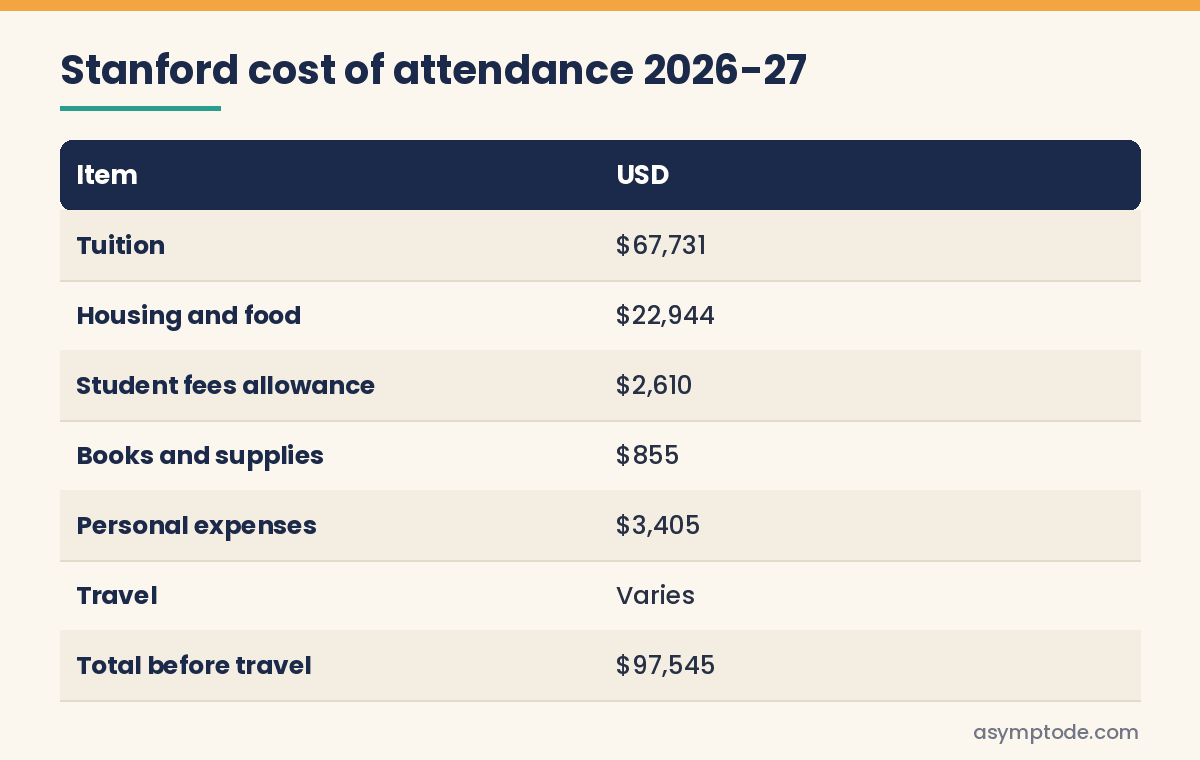
| Item (2026-27) | Amount (USD) |
|---|---|
| Tuition | $67,731 |
| Housing and food | $22,944 |
| Student fees allowance | $2,610 |
| Books and supplies | $855 |
| Personal expenses | $3,405 |
| Travel | Varies |
| Total (before travel) | $97,545 |
New students also pay one-time fees of $525 (orientation) and $250 (document). International budgets add Cardinal Care health insurance (The Student Budget). 2027-28 costs are not yet announced; usually spring.
Can international students get financial aid at Stanford?
Yes, but it is limited and it affects admission. Stanford is need-blind for US citizens, permanent residents, undocumented students and eligible non-citizens. For other international citizens, asking for aid is a factor in the admission decision, which makes the process more selective (International Applicants).
Key rules:
- Admitted students get their full demonstrated need met, whatever their citizenship.
- Ask for aid on the application. If you say no, you cannot apply later (International Students).
- There are no merit scholarships, apart from a few athletic awards.
- For fall 2027 entry, international REA applicants file the CSS Profile (school code 4704, open from 1 October) and the International Student Supplement by 15 November 2026 (REA International checklist). The RD priority date is 15 February 2027.
Parents earning below $100,000 with typical assets pay no parent contribution; below $150,000, tuition is covered (The Parent Contribution). Aided Class of 2028 students averaged $74,310 in scholarship and grant (How Aid Works).
How hard is it to get into Stanford?
These are official numbers only, from Stanford's 2025-26 Common Data Set for students who started in fall 2025 (Class of 2029):
| Class of 2029 (fall 2025 entry) | Number |
|---|---|
| Applicants | 60,646 |
| Admitted | 2,302 (about 3.8%) |
| Enrolled first-years | 1,839 |
| Offered a waitlist place | 669 |
| Admitted from waitlist | 57 |
| SAT middle 50% | 1520-1570 |
| ACT middle 50% | 34-36 |
In fall 2025, 12.7% of first-years were international (Stanford Report). Class of 2030 data is not yet published.
What is the Grade 9 to 12 plan for Stanford?
Stanford recommends (not requires) four years of English, four years of maths including calculus, three-plus years of science and history, three years of one language, and about five academic courses each semester.
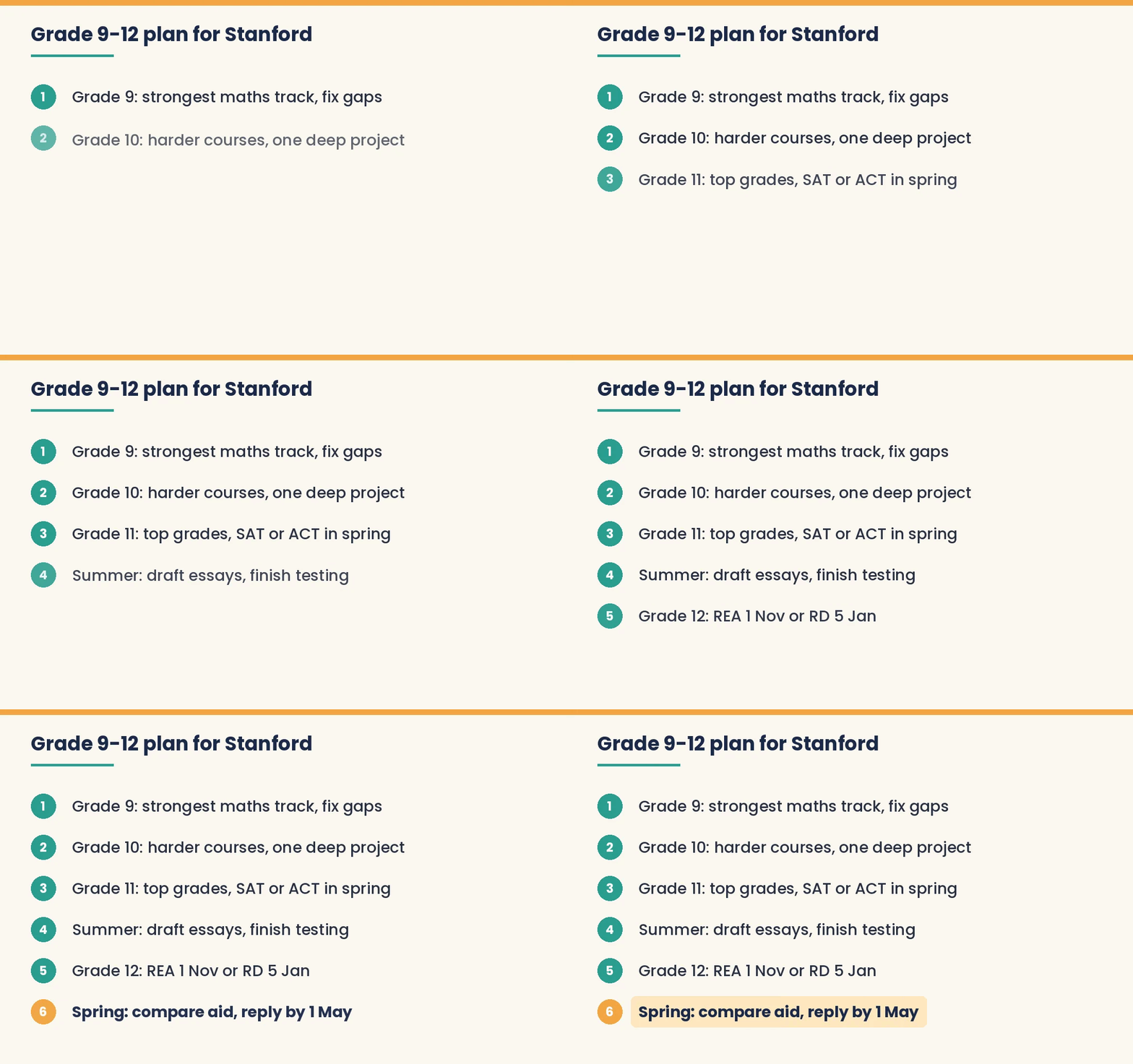
- Grade 9: Take the strongest maths track. Fix algebra gaps. Try a few activities.
- Grade 10: Add harder courses (Honors, AP, IB or the science stream). Start one long-term project.
- Grade 11: Keep grades near perfect. Sit the SAT or ACT in spring. Ask two teachers for letters.
- Summer before Grade 12: Draft essays (Stanford Questions open in early August). Finish testing. Prepare the CSS Profile.
- Grade 12: Apply REA (1 November) or RD (5 January). Keep calculus. Midyear grades go by 15 February.
- Spring: Compare aid and reply by 1 May. Final transcript by 1 July.
What should students in India, IB and A-level schools know?
Stanford has no curriculum preference. Take the courses that would admit you to a strong degree at home.
- India (CBSE, ISC and state boards): Send Grades 9-12 marks and predicted Class XII results from your school. Choose the science stream with Mathematics, since Stanford wants calculus. Do not convert percentages to GPA. Plan the SAT around board exams and JEE if you are also sitting it.
- IB Diploma: Your school must send predicted IB marks, including the TOK/Extended Essay bonus points. Choose a maths course that includes calculus; see our IB Maths AA vs AI guide.
- A-levels (UK and international): Your school sends GCSE (or IGCSE) results and predicted A-level grades. Most applicants take at least three full A-levels. Include Maths if you want a STEM path. Because Oxford and Cambridge are non-US, you can apply to them and to Stanford REA in the same year.
- AP and US curriculum: No set number of APs is needed. Our AP guide for parents explains exam dates and scores.
- Gulf and Asian international schools: Ask your counselor to explain grading and course limits in the School Report.
What are the common mistakes Stanford applicants make?
- Applying early to another private college while applying REA. This breaks Stanford's REA policy.
- Skipping AP scores. If you took the exam, you must report it, even a low or cancelled score.
- Weak maths in Grade 12. Dropping calculus or taking a light final year hurts.
- Late testing. An SAT in November is too late for REA.
- Generic essays that read like a résumé.
- Saying no to aid as an international, then needing it. You cannot ask later.
- Many shallow clubs instead of depth in one or two.
For a comparison with another top STEM school, read how to get into MIT.
How 1-on-1 tutoring helps with getting into Stanford
We help with the maths and science behind your application: near-perfect grades, top SAT or ACT maths, and strong AP, IB, A-level or CBSE results.
- One student, one dedicated mentor. No batches. Live online classes that follow your own syllabus (AP Calculus, IB Maths, A-level Physics, CBSE Class XII) and your exam dates.
- Method first, calmly. The mentor watches each step of your working and fixes the method, so careless errors like the 20% trap disappear before test day.
- SAT and ACT maths. Practice aimed at the 770-800 range, with personalised homework and feedback.
- Flexible and clear. Scheduling across time zones, short parent updates, and every class recorded.
For the essays and reading sections, a mentor can help with planning and practice routines, while the writing stays your own.
Facts checked against official sources on 27 October 2026.
Ready to start? Book a free demo class or see fees.
FAQ
What GPA do you need for Stanford?
Stanford has no minimum GPA. It looks for flawless or nearly flawless grades in rigorous courses, focusing on Grades 10-12. International students do not need to convert marks into a GPA.
Is the SAT required for Stanford in 2026-27?
Yes. The SAT or ACT is required for fall 2027 entry. You can self-report your highest scores, and Stanford superscores. There is no minimum score.
Can I apply to Stanford REA and other schools early?
Not to other private US colleges' early plans. You can apply early to non-binding plans at public universities, rolling-admission schools and non-US universities. You may also apply anywhere under Regular Decision.
Is Stanford need-blind for international students?
No. For international citizens, a request for financial aid is a factor in admission. If admitted, Stanford meets full demonstrated need. Students who do not request aid when applying cannot ask for it later.
Do I choose a major when I apply to Stanford?
No. You apply to the university as a whole and can list interests without commitment. Students declare a major by the end of sophomore spring.
Does Stanford require IELTS or TOEFL?
No English test is required. You may self-report one if you wish, but it cannot replace the SAT or ACT. Fluency in English is still a prerequisite.
Sources
- Stanford Undergraduate Admission: First-Year Requirements and Deadlines
- Stanford: Regular Decision and Restrictive Early Action
- Stanford: Standardized Testing (first-year)
- Stanford: Application and Essays
- Stanford: Transcript, School Report, and Recommendations
- Stanford: Application Fee/Fee Waiver
- Stanford: Arts Portfolio
- Stanford: Interview
- Stanford: Preparing for Stanford Academics
- Stanford: Holistic Admission overview
- Stanford: International Applicants
- Stanford Report: Stanford to resume standardized test requirement
- Stanford Report: Larger first-year and transfer classes (Nov 2025)
- Stanford IR&DS: Common Data Set (2025-2026)
- Stanford Financial Aid: The Student Budget 2026-27
- Stanford Financial Aid: How Aid Works
- Stanford Financial Aid: The Parent Contribution
- Stanford Financial Aid: International Students
- Stanford Financial Aid: REA International checklist 2027-28
- Stanford Academic Advising: Declaring Your Major
- Common App