
If you want to know how to get into Columbia University, start with three facts. Columbia is very selective, its own short essays matter a lot, and the rules on test scores are changing. This guide covers Columbia College and Columbia Engineering for students who want to start in fall 2027. It also helps younger students who will apply in later years. Every date and number here comes from Columbia's official pages.
Key takeaways
- Early Decision closed on November 1, 2026. The Regular Decision deadline is January 1, 2027.
- The 2026-2027 cycle is fully test-optional. From the 2027-2028 cycle (fall 2028 entry), Columbia will require SAT or ACT scores.
- Columbia asks one list question and five short answers of 150 words or fewer each.
- You need two teacher letters. Engineering applicants need one from a maths or science teacher.
- Columbia meets 100% of demonstrated need with no loans. It is need-blind for US students but not for international students.
How to get into Columbia University: what does it really take?
Quick answer: To get into Columbia University, take the hardest courses your school offers and earn top grades. Write a clear personal essay and sharp Columbia short answers. Get two strong teacher letters and a counselor letter. Apply by January 1, 2027 for Regular Decision. Scores are optional this year but required from fall 2028 entry.
There are no minimum test scores, but the pool is huge. In the most recent Common Data Set we could open (students who started in fall 2025), 59,611 students applied and 2,946 were admitted. That is fewer than 5 in every 100. So every part of your application has to do real work.
Columbia College or Columbia Engineering: which one should you choose?
You apply to one of two undergraduate schools on the same application.
- Columbia College is the liberal arts school. Every student takes the Core Curriculum.
- Columbia Engineering (also called SEAS) is for engineering and applied science.
Engineering applicants must have one letter from a maths or science teacher. Pick the school that fits the work you want to do every day.
What are Columbia's application requirements?
Columbia lists its required parts on its first-year applicants page.
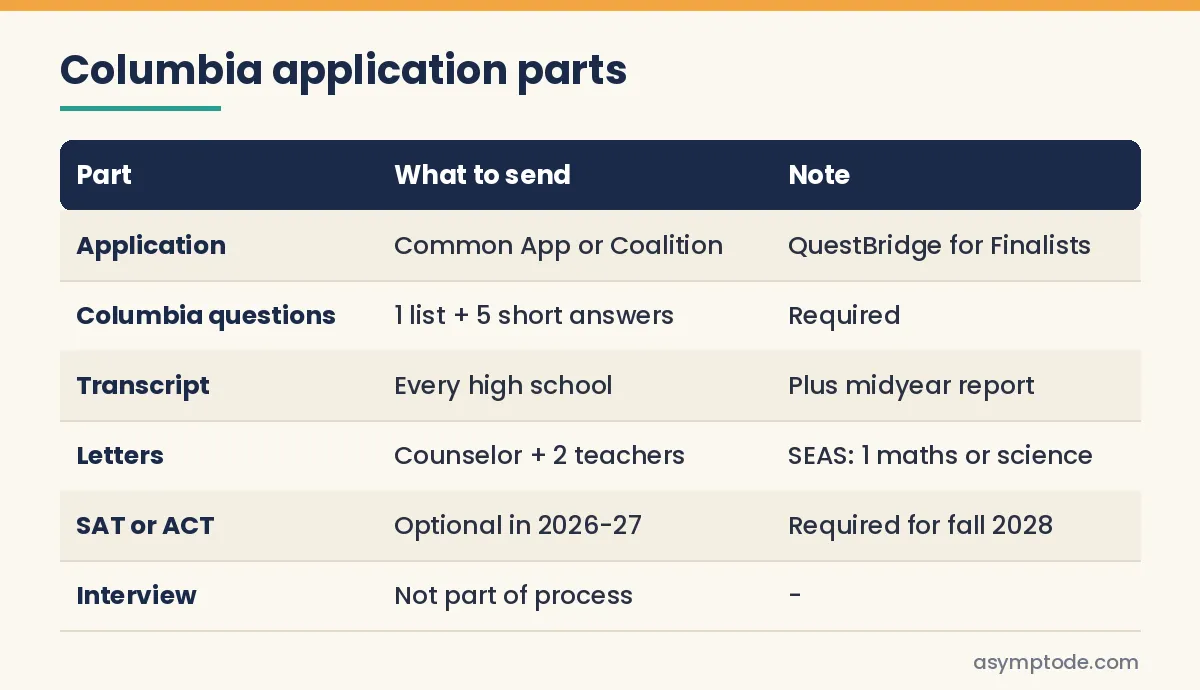 Columbia first-year application requirements, 2026-2027 cycle.
The table shows what every first-year applicant sends to Columbia. You apply with the Common App, the Coalition App on Scoir, or QuestBridge. You add the Columbia-specific questions, a transcript, a counselor letter and two teacher letters. SAT or ACT scores are optional this cycle, and there is no interview.
| Part | What Columbia asks for | Notes |
|---|---|---|
| Application | Common App, Coalition App on Scoir, or QuestBridge App | QuestBridge App is for QuestBridge Finalists only |
| Columbia-specific questions | 1 list question + 5 short answers | Required for everyone |
| Transcript | Official transcript from every high school | Plus a midyear report |
| Counselor | 1 counselor recommendation + school profile | Sent by your school |
| Teachers | 2 teacher letters from academic subjects | Engineering: 1 must be maths or science |
| Tests | SAT or ACT optional in 2026-2027 | Required from fall 2028 entry |
| Fee | $85, nonrefundable | Fee waivers available |
| Interview | Not part of the process | See the interviews page |
When are the Columbia deadlines for fall 2027?
Columbia posted its 2026-2027 application on August 1, 2026. Early Decision was due November 1, 2026, so that round has now closed. Regular Decision is still open.
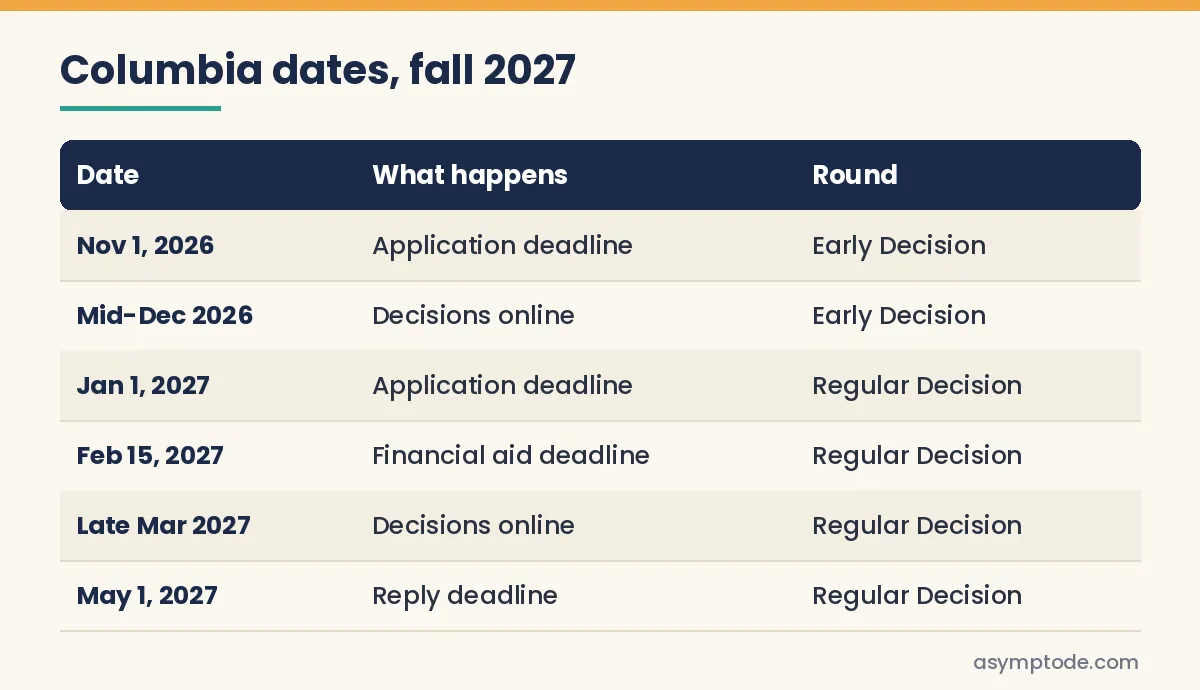 Key Columbia dates for students starting in fall 2027.
The table lists the main dates for this cycle. Early Decision closed on November 1, 2026 and decisions come in mid-December. Regular Decision is due January 1, 2027, with financial aid forms due February 15. Regular Decision results come in late March, and you reply by May 1.
| Date | What happens |
|---|---|
| November 1, 2026 | Early Decision and QuestBridge Match deadline (closed) |
| November 15, 2026 | Early Decision financial aid deadline |
| Mid-December 2026 | Early Decision decisions online |
| January 1, 2027 | Regular Decision deadline |
| January 15, 2027 | Last day to switch test answer from "no" to "yes" (RD) |
| February 15, 2027 | Regular Decision financial aid deadline |
| Late March 2027 | Regular Decision decisions online |
| May 1, 2027 | Reply deadline for admitted students |
Columbia has not given an exact day for the late March release yet. Check the official page closer to the time.
Is Early Decision at Columbia binding?
Yes. Columbia's Early Decision program is binding. If admitted, you must accept and withdraw other applications, unless released for financial reasons. Deferred students move to Regular Decision and hear by April 1.
Does Columbia require the SAT or ACT?
Not for fall 2027 entry. The testing policy page says: "We will continue to be fully test-optional for the 2026-2027 admissions cycle."
- Send the SAT or the ACT, or neither. There are no minimum scores.
- For Regular Decision, you can test as late as February 2027.
- A "yes" to sending scores cannot be changed. A "no" can switch to "yes" once, by January 15.
- Columbia superscores, and says not sending scores is no disadvantage.
Big change for younger students. Columbia has announced that students enrolling in fall 2028 must submit SAT or ACT scores. This starts with the 2027-2028 cycle. Students who face real barriers can ask for a waiver when they apply. If you are in Grade 11 or younger now, plan to test.
Not sure which test suits you? Read our SAT vs ACT guide. Then go deeper with the Digital SAT Math guide or the ACT Math test guide.
How do you apply to Columbia step by step?
 The Columbia application, one step at a time.
The animation walks through the application in order. First choose Columbia College or Columbia Engineering. Then pick your platform, write your essays and the Columbia questions, and line up your letters. Finally decide on test scores and submit by January 1, 2027.
- Choose your school: Columbia College or Columbia Engineering.
- Pick your platform and write your personal essay.
- Write the Columbia questions: one list and five short answers.
- Ask for letters early from two academic teachers and your counselor.
- Decide on test scores, pay the $85 fee (or ask for a waiver) and submit by January 1, 2027.
- Send aid forms by February 15, 2027, and have your school send the midyear report.
What are the Columbia supplemental essays for 2026-2027?
Columbia posted its 2026-2027 questions in July 2026. They are short, so every word counts.
The list question (100 words maximum). List the titles of texts, resources and outlets that shaped your thinking outside class. Think books, journals, podcasts and museums. Separate items with commas or semicolons. You do not need author names or explanations.
Five short answers (150 words or fewer each):
- An aspect of your life or lived experience that matters to you, and how it would shape your learning at Columbia.
- A time you did not agree with someone. How did you engage, and what did you learn?
- A time you navigated adversity. How did you change?
- Why Columbia? Columbia asks you to think about what is "unique and compelling" about it.
- What draws you to your chosen areas of study at Columbia College or Columbia Engineering?
 A simple plan for Columbia's short answers.
The animation shows a simple essay plan. Start by listing the books, podcasts and museums that really shaped you. Pick one true story for each prompt, and write the first draft long. Then cut each answer to 150 words and check that no two answers repeat.
How do you write strong Columbia short answers?
- Be specific. Name the exact book, lab, problem or moment.
- Make your list match you. It should fit the student in your other answers.
- Show a new side each time. Do not repeat a story.
- Tie "Why Columbia" to real things, like the Core Curriculum or the exact field you want to study.
- Write long, then cut to 150 words. Cutting makes the writing sharper.
What is the Core Curriculum and why does it matter?
The Core Curriculum is the set of shared classes every Columbia College student takes. It includes Literature Humanities, Contemporary Civilization, Art Humanities, Music Humanities and Frontiers of Science. College students also complete Foreign Language, Global Core, Physical Education and Science requirements. Engineering students follow their own school's requirements, so check the Engineering Bulletin.
If you love reading and arguing about big ideas, show it in your list question and "Why Columbia" answer. Do not fake it.
What grades and courses does Columbia look for?
Columbia does not publish a minimum GPA. Take the hardest courses your school offers, especially in your planned field. For Engineering, go as far as you can in maths and science. Keep senior-year grades strong, because Columbia needs a midyear report.
For a sense of the scores Columbia sees, the 2025-26 Common Data Set shows the middle 50% of enrolled students who sent the SAT scored 1510-1560, and 34-35 on the ACT. These are not cut-offs.
If you want to add depth to your science or maths profile, a real project helps. Our guide to research for high school students explains how to start.
How should international students apply to Columbia?
Columbia accepts all secondary school curricula.
Exams. If your school-leaving exams are required to finish school, you must submit them. Columbia names A Levels, IB, the French Baccalaureate and other final national exams. So a student in the UK sends A Level results, and a student in India or China sends the board or national exam results their school requires. If you are unsure which results count, check the official page. AP scores are not required unless your school requires them.
English tests. You may be exempt if English is your home language, if you studied in English for all of secondary school, if you scored 700+ on SAT Evidence-Based Reading and Writing, or 29+ on ACT English or Reading. Otherwise, Columbia's English proficiency page sets these minimums:
| Test | Minimum score |
|---|---|
| TOEFL iBT | 105 (MyBest not accepted) |
| IELTS | 7.5 |
| Duolingo English Test | 135 |
| Cambridge C1 Advanced or C2 Proficiency | 191 |
Videos. You can send an optional InitialView or Vericant video to show your spoken English. The Regular Decision deadline for these is January 15.
School letters. Many schools outside the US do not write US-style letters. Talk to your school early. Columbia still needs a counselor letter, a school profile and two teacher letters.
How much does Columbia cost, and is aid available?
The Columbia College estimate for 2026-2027 is:
| Item | 2026-2027 (9 months) |
|---|---|
| Tuition | $72,800 |
| Mandatory fees | $3,430 |
| Average room and board | $19,650 |
| Books and personal | $3,164 |
| Total | $99,044 + travel |
New students also pay $625 for orientation. For Columbia Engineering's 2026-2027 costs, check the official page.
Columbia meets 100% of demonstrated need for all admitted first-years, and "Loans are not a component of financial aid packages." Based on Columbia's How Aid Works page, families with typical assets and income under $66,000 pay $0 parent contribution. Under $150,000, tuition is free. There is no income cut-off for applying.
Need-blind or not? Admission is need-blind for US citizens, permanent residents and refugee-visa holders. For international students, Columbia is not need-blind. But if you are admitted, Columbia meets your full demonstrated need. Use the Net Price Calculator for an estimate.
QuestBridge. Columbia is a QuestBridge National College Match partner. Finalists who were not matched are moved to Regular Decision and reviewed from January.
Book a free demo class to plan your maths and science preparation, and see our plans and fees.
How should you plan from Grade 9 to apply to Columbia?
A strong application takes years. Here is a simple plan.
- Grade 9. Choose a strong maths path. Read widely and keep a list of books, podcasts and ideas you love.
- Grade 10. Go deeper in one or two interests. Try a first practice SAT or ACT.
- Grade 11. Take your hardest courses. Sit the SAT or ACT, since scores are required from fall 2028 entry. Get to know the teachers who will write your letters.
- Summer before Grade 12. Draft your personal essay and collect a story for each Columbia question.
- Grade 12 autumn. Ask for letters early, choose Early Decision (November 1) or Regular Decision (January 1), and keep your grades up.
Looking at other top schools too? Compare this plan with our guides on how to get into Harvard, how to get into Yale and how to get into MIT.
What are the most common mistakes Columbia applicants make?
- A generic "Why Columbia." If it could fit any city school, rewrite it.
- A lazy list question. Fill it with things you truly read, watched or visited.
- Repeated stories. Use a different event for adversity and for disagreement.
- Early Decision without a money check. ED is binding. Run the Net Price Calculator first.
- Assuming tests do not matter. They are optional for fall 2027 entry but required from fall 2028 entry.
How Asymptode helps you with getting into Columbia University
Asymptode pairs your child with a qualified mentor who teaches them one-to-one, live online. The mentor plans around Columbia's real route: the SAT or ACT, which becomes required from fall 2028 entry, and the maths and science courses that matter most for Columbia Engineering or a science path at Columbia College. Lessons are timed to Columbia's real dates, such as the January 1, 2027 Regular Decision deadline and the February 2027 last test date.
Between classes, your child gets practice built for them. It is a worksheet made from what their own last attempt showed they had not understood, at their level, never generic. This is Asymptode's AI-assisted practice. It is written to the mentor's brief and sent only after that mentor approves it. The mentor marks it, and you see what was understood and what to practise next. So preparation keeps correcting itself toward Columbia.
For the Columbia short answers and the list question, the mentor helps with planning, method and practice review. The words stay your child's own.
Book a free demo class or see our fees.
Facts checked against official sources on 12 November 2026.
FAQ
What is the Columbia Regular Decision deadline for fall 2027?
The Regular Decision deadline is Friday, January 1, 2027. Financial aid forms for Regular Decision are due February 15. Decisions come out online in late March.
Is Columbia test-optional for 2026-2027?
Yes. Columbia is fully test-optional for the 2026-2027 cycle, which is fall 2027 entry. From the 2027-2028 cycle, students enrolling in fall 2028 must submit SAT or ACT scores, with a waiver option for students who face real barriers.
Does Columbia do interviews?
No. Columbia says interviews are not part of the application process. International students can send an optional video to show their English.
How many supplemental essays does Columbia require?
Columbia asks one list question of up to 100 words. It also asks five short answers of 150 words or fewer each.
Is Columbia need-blind for international students?
No. Columbia is need-blind for US citizens, permanent residents and refugee-visa holders, but not for international students. If an international student is admitted, Columbia meets 100% of their demonstrated need, and aid packages have no loans.
What English test score does Columbia need?
If you are not exempt, Columbia's minimums are TOEFL iBT 105, IELTS 7.5, Duolingo 135, or Cambridge C1/C2 191. SAT Reading and Writing 700+ or ACT English or Reading 29+ can exempt you.
Ready to start? Book a free demo class and advisor call, or see our plans and fees.
Sources
- Columbia Undergraduate Admissions: First-Year Applicants
- Columbia: First-Year Application Now Available (2026-2027)
- Columbia: Early Decision
- Columbia: Testing Policy
- Columbia: Testing Policy Update
- Columbia-Specific Application Questions
- Columbia: Interviews
- Columbia: International Applicants
- Columbia: English Proficiency Requirements
- Columbia: QuestBridge
- Columbia Financial Aid: Our Financial Aid Program
- Columbia Financial Aid: How Aid Works
- Columbia College Bulletin: Fees, Expenses, and Financial Aid
- Columbia College: The Core Curriculum Classes
- Columbia College and Columbia Engineering Common Data Set 2025-26