
If you want to know how to become an occupational therapist, here is the short version: study a recognised occupational therapy degree, finish your supervised placements, and register with the regulator in your country. This guide is for parents and students. It explains what an occupational therapist (OT) does, which school subjects help, and the real routes in the UK, USA, India, Australia and Canada.
Key takeaways
- An OT helps people do everyday tasks after illness, injury or disability, so they can live as independently as possible.
- In the UK, "occupational therapist" is a protected title. You must be registered with the HCPC to use it.
- UK routes are a BSc, a pre-registration MSc (if you already have a degree) or a degree apprenticeship in England.
- In the USA, you need a master's or doctoral degree from an ACOTE-accredited programme, the NBCOT exam and a state licence.
- Biology, psychology and maths (for statistics) are useful school subjects. Real work experience with an OT matters too.
How to become an occupational therapist: what are the main steps?
Quick answer: To become an occupational therapist, you study a degree that is accredited for occupational therapy, complete supervised practice placements, and then register or get licensed with your country's regulator. In the UK that is the HCPC. In the USA you pass the NBCOT exam and get a state licence. The exact route depends on where you live.
Most students follow these steps:
- Choose school subjects that keep doors open, such as biology, psychology and maths.
- Get work experience. Shadow an OT, or volunteer with people who need support.
- Apply for an accredited occupational therapy degree.
- Complete the course, including supervised placements with real clients.
- Register with the regulator, or pass the licensing exam, in your country.
- Apply for your first OT job.
 The five big steps on the path to becoming an occupational therapist.
The animation shows five steps in order. First, pick useful school subjects like biology, psychology and maths. Second, study an accredited OT degree. Third, complete supervised placements. Fourth, register or get licensed. Fifth, start your first OT job.
What does an occupational therapist do?
An OT helps people do the everyday things that matter to them. That might be getting dressed, cooking, going back to school or returning to work.
The US Bureau of Labor Statistics says OTs "evaluate and treat people who have injuries, illnesses, or disabilities." They help clients develop, recover, improve and keep the skills they need for daily living and working (BLS).
In the UK, NHS Health Careers says OTs help people overcome challenges so they can live independently. Often this means learning a new way to do a task, or changing the person's environment.
A typical OT might:
- assess what a person can and cannot do;
- make a treatment plan with clear goals;
- teach new ways to do daily tasks;
- recommend equipment, such as aids at home or adapted office kit;
- check if a home, school or workplace is easy to use;
- support and teach families and carers.
OTs work in hospitals, clinics, schools, charities, prisons, social services and people's own homes.
What does a day look like for an OT?
 A simple loop that many OT sessions follow.
The animation shows four boxes in a loop. The OT assesses the person. Then they set goals together. Next, they plan an activity that works towards those goals. Finally, they review how it went and adjust the plan.
What is the difference between an occupational therapist and a physiotherapist?
People often mix these two jobs up. Both help people recover, but the focus is different.
| Occupational therapist | Physiotherapist | |
|---|---|---|
| Main focus | Doing daily tasks and taking part in life | Movement and managing pain |
| Typical question | "How can you get dressed, cook or work again?" | "How can you move better and with less pain?" |
| US entry degree | Master's or doctorate (ACOTE) | Doctor of Physical Therapy (DPT) |
The BLS says physical therapists "help injured or ill people improve movement and manage pain" and need a DPT degree in the USA (BLS physical therapists).
Which school subjects help you become an occupational therapist?
No single subject is a must everywhere. But some subjects help a lot, both for getting a place and for coping with the course.
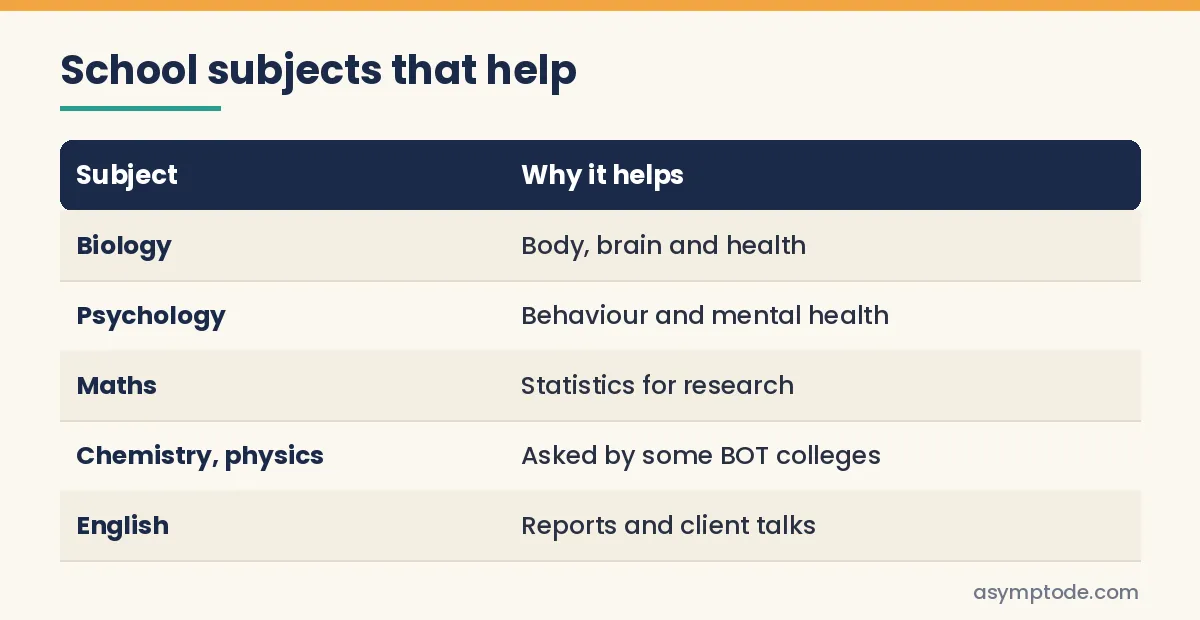 Useful school subjects for a future OT, and why each one matters.
The table lists five subjects. Biology helps you understand the body, brain and health. Psychology helps with behaviour and mental health. Maths gives you statistics for reading research. Chemistry and physics are asked for by some BOT colleges in India. English helps with reports and client talks: writing notes and explaining plans.
- Biology. OT courses include anatomy and neuroscience. The BLS lists kinesiology, neuroscience and anatomy as typical master's courses.
- Psychology. Many OTs work in mental health. US programmes often want biology, psychology or other science coursework (BLS).
- Maths. You will read research and use basic statistics. Strong GCSE maths also matters: most UK universities ask for maths at grade 4 or above (UCAS).
- Chemistry and physics. In India, some colleges ask for English, physics, chemistry and biology in Class 12. One example is Sri Ramachandra.
- English. OTs write clear notes and reports, and they explain plans to clients and families.
If your child is in Year 9 or 10, a solid science base is a good start. Our GCSE combined science guide explains what that course covers. For students thinking about sixth form, the A level chemistry guide and our IB vs A level comparison can help with subject choices.
How do you become an occupational therapist in the UK?
In the UK, you must register with the Health and Care Professions Council (HCPC) before you can practise. "Occupational therapist" is a protected title. To use it, a person must be on the HCPC Register.
To register, you complete an approved occupational therapy programme. Programmes can also be accredited by the Royal College of Occupational Therapists (RCOT). RCOT says its accreditation works alongside HCPC approval and also gives World Federation of Occupational Therapists (WFOT) approval (RCOT).
What are the UK routes into occupational therapy?
| Route | Typical length | Who it suits |
|---|---|---|
| BSc (Hons) full time | 3 years (4 in Scotland) | School leavers |
| Integrated master's | 4 years | School leavers who want a master's |
| Part-time degree | 4 to 5 years | People who need to work or study flexibly |
| Pre-registration MSc | 2 years full time | People who already have a degree |
| Degree apprenticeship (England) | 2 to 4 years | People who want to earn while they learn |
On a degree apprenticeship, you spend about 80% of your time in paid work and 20% in learning. There are no tuition fees for apprentices, and pay depends on the employer. RCOT says an NHS employer could pay the equivalent of Bands 2 to 4 (RCOT apprenticeships). The National Careers Service also notes you can start as an OT support worker and then train (National Careers Service).
What grades do you need for an OT degree in the UK?
UCAS says most universities ask for five GCSEs at grades 9 to 4, including English language, maths and science, plus three A levels or equivalent. Some accept a BTEC, a relevant T level or a science-based access course. Each university sets its own rules, so check every course page (UCAS). You will also need to show how the NHS values fit your life and work.
When is the UCAS deadline for 2027 entry?
For most courses, including occupational therapy, your application must reach UCAS by 18:00 UK time on 13 January 2027 (UCAS). Always check the course page to confirm which deadline applies.
RCOT says many universities expect you to have shadowed an OT. If that is hard, a phone or video call with an OT, or volunteering with vulnerable groups, can help show your interest (RCOT). You will also write a personal statement about why you want to be an OT.
How much do occupational therapists earn in the NHS?
Most NHS OTs start at band 5 on the Agenda for Change pay scale (NHS Health Careers). In England, from 1 April 2026, band 5 runs from £32,073 at entry to £39,043 at the top. Band 6 runs from £39,959 to £48,117 (NHS Employers).
Students on eligible courses in England can also get at least £5,000 a year from the NHS Learning Support Fund. You do not pay it back.
How do you become an occupational therapist in other countries?
The basic idea is the same everywhere: accredited degree, placements, then registration.
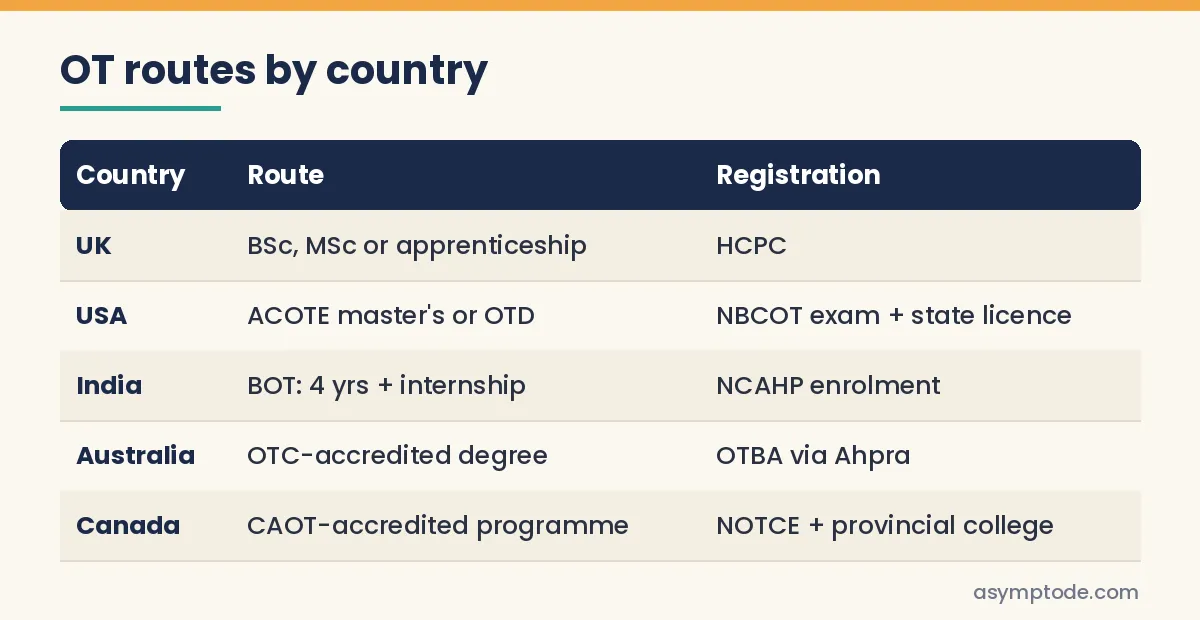 How the route and registration body differ by country.
The table compares five countries. In the UK, you take a BSc, MSc or apprenticeship and register with the HCPC. In the USA, you take an ACOTE master's or OTD, then pass the NBCOT exam and get a state licence. In India, you take a BOT of four years plus internship and enrol with NCAHP. In Australia, you take an OTC-accredited degree and register with the OTBA through Ahpra. In Canada, you take a CAOT-accredited programme, pass the NOTCE and join your provincial college.
USA: master's or doctorate, NBCOT and a state licence
- Degree. ACOTE says entry into the profession "can be achieved at the master's or doctoral degree-level" (ACOTE). The BLS says master's programmes usually take 2 to 3 years and include supervised fieldwork. Most students first finish a bachelor's degree, often in any subject.
- Exam. NBCOT runs the national certification exam. AOTA says initial NBCOT certification is a core licensure requirement (AOTA).
- Licence. OT is regulated in all 50 states, plus Washington DC, Puerto Rico and Guam.
Pay and jobs (official BLS figures): the median pay was $100,330 a year in May 2025. There were 169,600 jobs in 2025. Jobs are projected to grow 15% from 2025 to 2035, which the BLS calls "much faster than the average." That is about 10,000 openings a year (BLS).
India: BOT degree and NCAHP
In India, the usual first degree is the Bachelor of Occupational Therapy (BOT). At Sri Ramachandra, for example, it is 4 years plus a 6-month compulsory internship, and students need English, physics, chemistry and biology in Class 12 (Sri Ramachandra). Other colleges may differ, so check each one.
"Occupational Therapist" is on the list of professions under the National Commission for Allied and Healthcare Professions (NCAHP). Its FAQ says enrolment is compulsory for verification and is needed for registration (NCAHP FAQ). Check the official page for the current registration process before you apply.
Australia: OTC-accredited degree and Ahpra registration
Courses are accredited by the Occupational Therapy Council of Australia (OTC) (OTBA). Students are registered as students by their university. After you graduate, you are not registered automatically. You must apply to the Occupational Therapy Board of Australia through Ahpra (OTBA students). For example, the University of Sydney offers a four-year bachelor's and a two-year graduate-entry master's.
Canada: CAOT-accredited programme, NOTCE and a provincial college
The Canadian Association of Occupational Therapists (CAOT) accredits the university programmes on its list (CAOT). Graduates take the National Occupational Therapy Certification Examination (NOTCE), which runs three times a year. Then they register with the regulator in their province, such as the College of Occupational Therapists of Ontario (COTO). ACOTRO, the group of Canadian OT regulators, reviews degrees earned outside Canada.
Is occupational therapy a good career? An honest outlook
It can be. The work is varied and you see real change in people's lives. In the USA, official BLS figures project much faster than average job growth. In the UK, OT is a graduate profession with a clear NHS pay structure.
But be honest with yourself about the hard parts:
- It is emotionally demanding. You work with people on difficult days.
- In the USA, you need a postgraduate degree, so the training is long.
The NHS standard week is 37.5 hours, and it can include some evenings or weekends (UCAS).
If you are comparing health careers, read our guides on how to become a nurse, how to become a doctor and how to become a pharmacist. If research appeals more than patient care, see how to become a scientist.
Book a free demo class to talk through your child's science and maths plan with an advisor, or see our plans and fees.
What should you do from Grade 9 (Year 10) onwards?
Here is a simple plan by school year.
- Grade 9 / Year 10. Work hard in science, maths and English. Try volunteering, for example at a care home, a youth club or a special needs group.
- Grade 10 / Year 11. Aim for strong GCSEs (or equivalent), including English, maths and science. Choose sixth form subjects with care, such as biology and psychology.
- Grade 11 / Year 12. Research courses and apprenticeships. Contact local OT teams about shadowing. Start notes for your personal statement.
- Grade 12 / Year 13. Apply through UCAS (in the UK) before the deadline. Prepare for interviews by talking about what you saw an OT do and what you learned.
- After school. Finish your degree and placements, then register with your regulator.
What are the most common mistakes?
- Mixing up OT and physiotherapy. Show you know what an OT actually does.
- Leaving work experience too late. Shadowing can take months to arrange.
- Choosing an unaccredited course. Check that the course is approved by the HCPC (UK), ACOTE (USA), OTC (Australia) or CAOT (Canada).
- Ignoring GCSE maths and English. Most UK courses ask for grade 4 or above in both.
- Trusting old salary figures. Pay changes every year. Use the official pages linked above.
- Assuming one country's licence works everywhere. Each country has its own process.
How Asymptode helps you with becoming an occupational therapist
Asymptode supports the science and maths parts of the occupational therapist route. A qualified mentor teaches your child one-to-one, live online. Lessons follow your child's real path: GCSE or Class 10 science and maths, then biology, chemistry and the statistics an OT degree uses, planned around real dates such as the UCAS deadline of 13 January 2027.
Between classes, your child gets practice built just for them. It is a worksheet made from what their own last attempt showed they had not understood, at their level, never generic. This is Asymptode's AI-assisted practice. It is written to the mentor's brief and sent only after that mentor approves it.
The mentor marks each worksheet. You, the parent, see what was understood and what to practise next. So preparation keeps correcting itself towards the OT entry requirements. For the personal statement and interview, the mentor helps with planning, method and reviewing practice answers.
To get started, book a free demo class or see our fees.
Facts checked against official sources on 12 November 2026.
FAQ
How long does it take to become an occupational therapist?
In the UK, a full-time degree usually takes 3 years (4 in Scotland), and a pre-registration MSc takes 2 years if you already have a degree. A degree apprenticeship takes 2 to 4 years. In the USA, you usually need a bachelor's degree first and then a 2 to 3 year master's.
Can you become an occupational therapist without a degree?
No. You need an accredited degree to register. But in England you can earn a degree through an apprenticeship, with no tuition fees. You can also start as an OT support worker and train later.
Do you need A level biology to study occupational therapy?
Not always. Each university sets its own entry rules, so check every course page. Biology and psychology are useful, and most UK universities ask for GCSE science at grade 4 or above.
What is the starting salary for an NHS occupational therapist?
Most NHS OTs start at band 5. In England, from 1 April 2026, band 5 starts at £32,073 and goes up to £39,043. Pay is reviewed each year, so check the NHS Employers page.
Do occupational therapists need a licence?
Yes, in every country covered here. In the UK, you must be on the HCPC Register. In the USA, you pass the NBCOT exam and get a state licence. Australia uses OTBA registration through Ahpra, and Canada uses provincial colleges.
Is occupational therapy the same as physiotherapy?
No. Physiotherapists focus on movement and pain. OTs focus on helping people do daily tasks, such as dressing, cooking, studying or working, often by changing the task or the environment.
Ready to start? Book a free demo class and advisor call, or see our plans and fees.
Sources
- BLS Occupational Outlook Handbook: Occupational Therapists
- BLS Occupational Outlook Handbook: Physical Therapists
- HCPC: The professions we regulate
- NHS Health Careers: Occupational therapist
- UCAS: Occupational therapist career
- UCAS: 2027 entry deadline
- NHS Employers: Pay scales 2026/27
- RCOT: Routes into occupational therapy
- RCOT: Degree apprenticeships in England
- RCOT: Accreditation overview
- RCOT: How to apply for OT university courses
- National Careers Service: Occupational therapist
- ACOTE: Accredited programs
- AOTA: State licensure FAQ
- NCAHP: FAQ
- Occupational Therapy Board of Australia: Accreditation
- Occupational Therapy Board of Australia: Information for students
- CAOT: University programs
- COTO: Becoming a registered occupational therapist
- COTO: National exam information