
A-Level Chemistry is one of the most respected A-Levels in the UK. It is also one of the hardest, because it mixes facts, maths and practical skills. This guide explains the papers for AQA, Edexcel and OCR, the main topics, the 12 AQA required practicals, four worked calculations, the most common mistakes and a Year 13 revision plan.
Key takeaways
- Every major board sets 3 written papers at the end of Year 13. There is no coursework.
- AQA 7405: two 2-hour papers of 105 marks (35% each) and a 2-hour synoptic paper of 90 marks (30%), with 30 multiple-choice marks.
- Edexcel 9CH0 and OCR A H432 use different paper lengths and weightings (see the table).
- AQA has 12 required practicals. At least 15% of marks in the written papers test practical skills.
- The practical endorsement is a separate "pass" reported next to the A*-E grade.
- Maths matters: moles, pH, Kc, rates and energy all need confident calculation.
What is A-Level Chemistry?
Quick answer: A-Level Chemistry is a two-year course, usually taken in Years 12 and 13 in England, Wales and Northern Ireland, and in many British schools abroad, including in the UAE. Students sit three written papers at the end of Year 13 and get a grade from A* to E. The course covers physical, inorganic and organic chemistry, plus practical skills.
Chemistry is often needed for medicine, dentistry, veterinary science, pharmacy and chemical engineering. It also pairs well with A-Level Maths and A-Level Physics.
How many papers are in A-Level Chemistry?
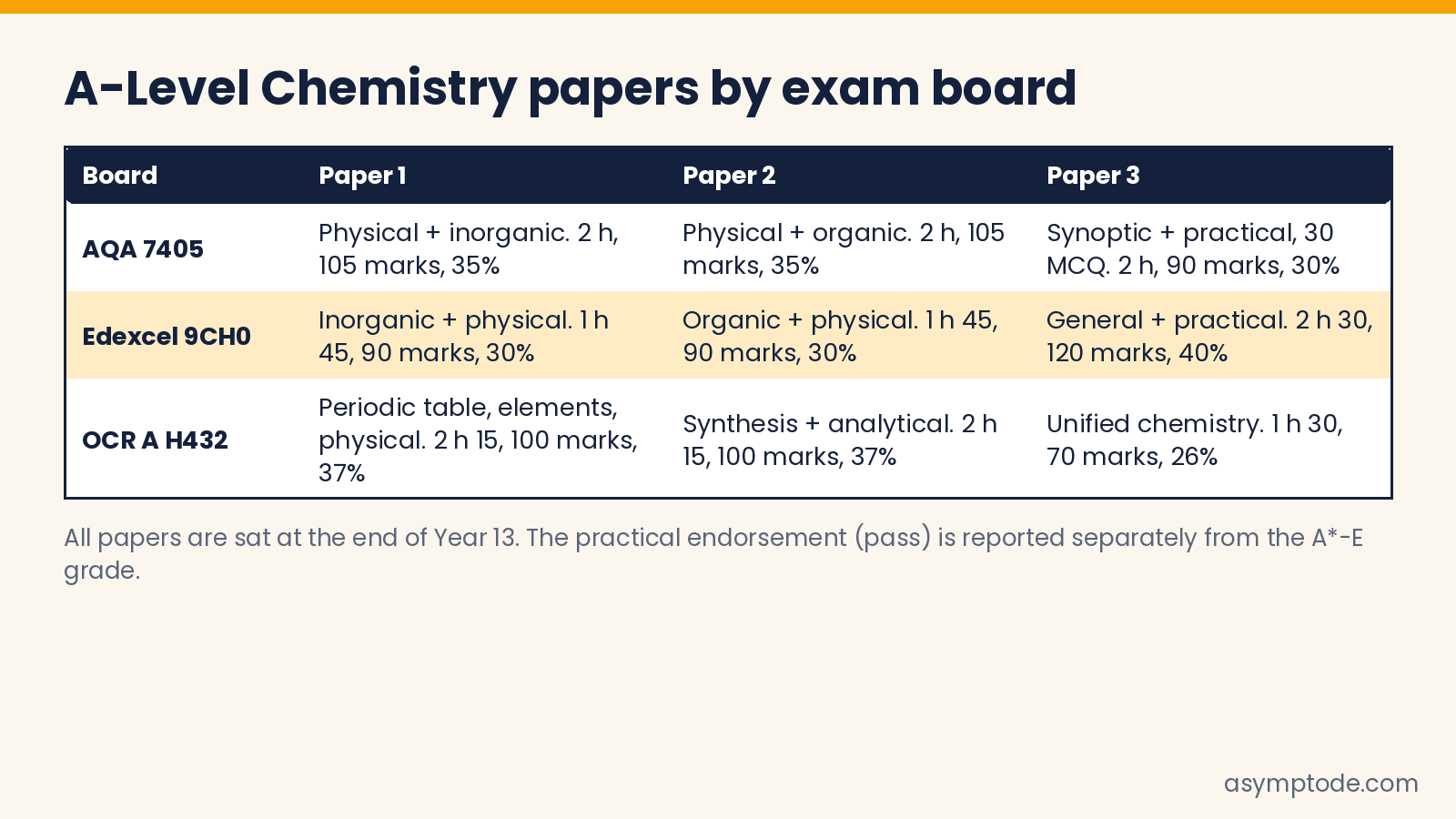
All three main boards set three papers. They differ in length and weighting.
| Board | Paper 1 | Paper 2 | Paper 3 |
|---|---|---|---|
| AQA 7405 | Physical + inorganic: 2 h, 105 marks, 35% | Physical + organic: 2 h, 105 marks, 35% | Any content + practical: 2 h, 90 marks, 30% |
| Edexcel 9CH0 | Inorganic + physical: 1 h 45, 90 marks, 30% | Organic + physical: 1 h 45, 90 marks, 30% | General and practical principles: 2 h 30, 120 marks, 40% |
| OCR A H432 | Periodic table, elements and physical: 2 h 15, 100 marks, 37% | Synthesis and analytical techniques: 2 h 15, 100 marks, 37% | Unified chemistry: 1 h 30, 70 marks, 26% |
On AQA Paper 3, 40 marks test practical techniques and data analysis, 20 marks test anything across the course, and 30 marks are multiple choice. Check your child's board on their exam timetable or ask the school. The board decides the paper style.
When are the A-Level Chemistry exams in 2027?
A-Level exams in England usually run from about mid-May to mid-June. For summer 2027, the expected window is roughly 10 May to 18 June, with results on 12 August 2027. Exact paper dates come out on each board's final timetable, so check it before planning revision.
What topics are in A-Level Chemistry?
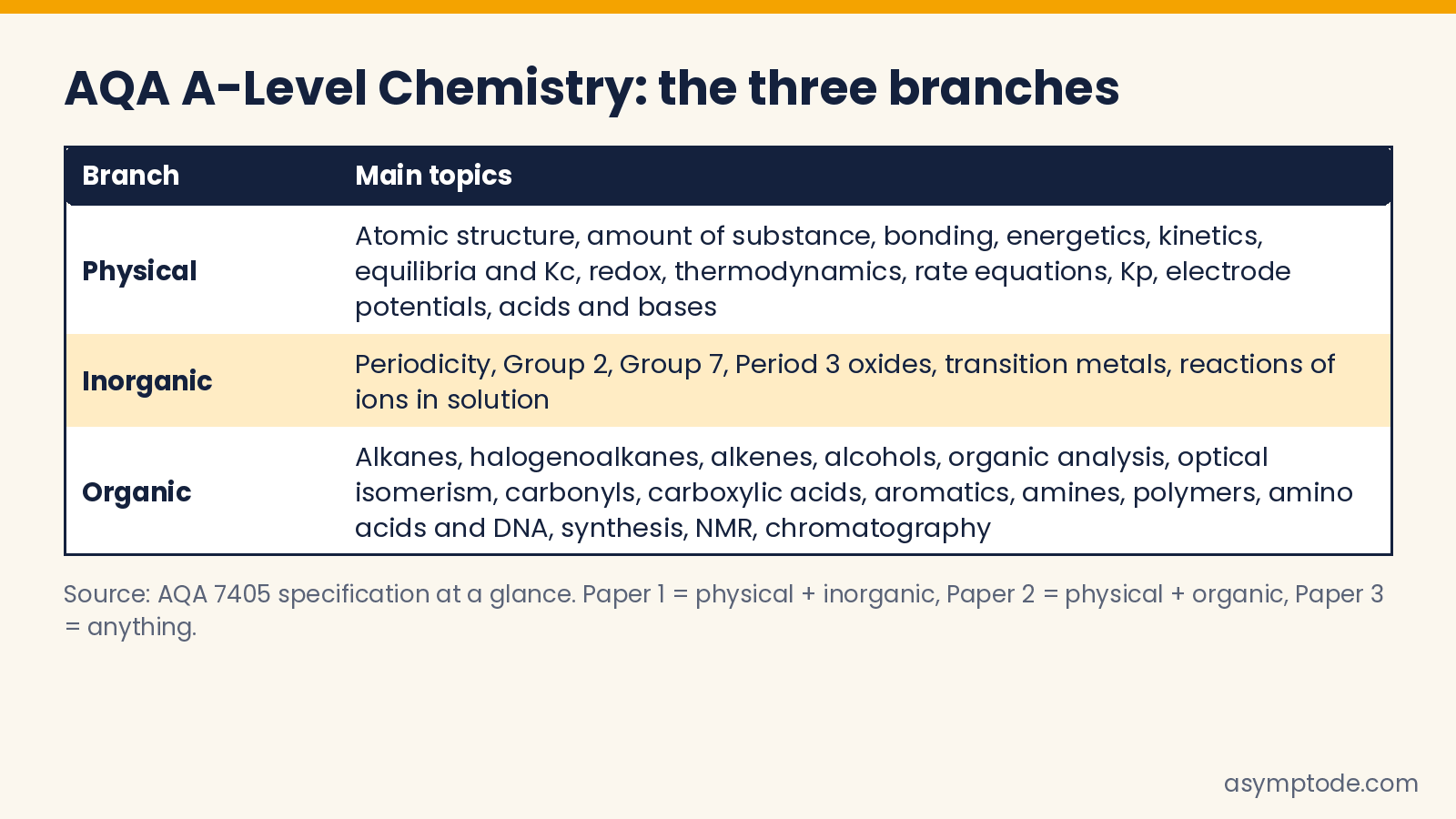
AQA splits the course into three branches. Other boards cover very similar chemistry with different names.
Physical chemistry: atomic structure, amount of substance (moles), bonding, energetics, kinetics, equilibria and Kc, redox, and in Year 13: thermodynamics, rate equations, Kp, electrode potentials, and acids and bases.
Inorganic chemistry: periodicity, Group 2, Group 7 (the halogens), and in Year 13: Period 3 elements and oxides, transition metals, and reactions of ions in solution.
Organic chemistry: alkanes, halogenoalkanes, alkenes, alcohols, organic analysis, and in Year 13: optical isomerism, aldehydes and ketones, carboxylic acids, aromatic chemistry, amines, polymers, amino acids and DNA, organic synthesis, NMR and chromatography.
On AQA, Paper 1 tests physical and inorganic chemistry. Paper 2 tests physical and organic chemistry. Paper 3 can test anything.
What are the A-Level Chemistry required practicals?
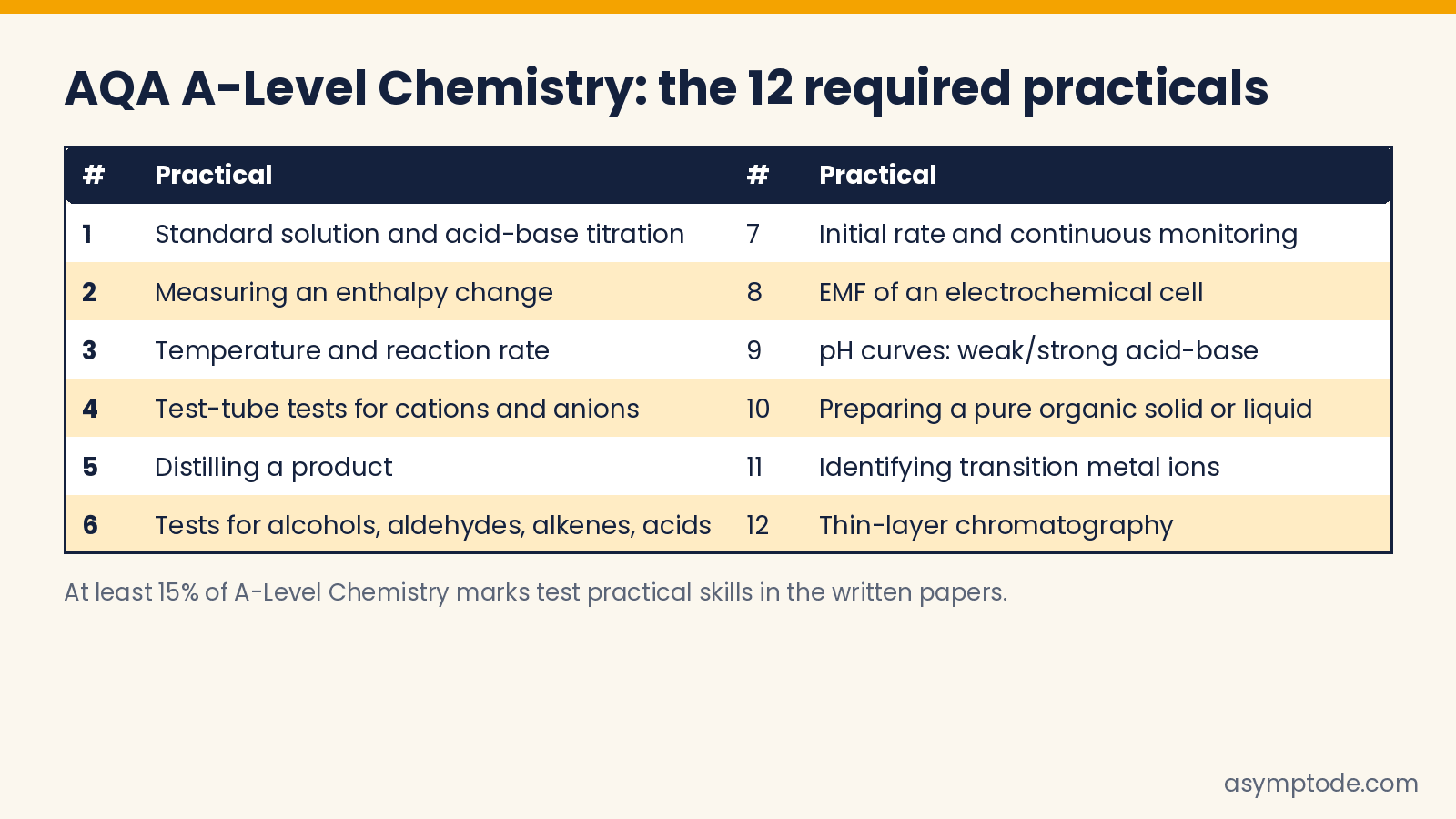
AQA lists 12 required practicals. They include titration, measuring an enthalpy change, rates of reaction, testing for ions, distillation, organic tests, measuring cell EMF, pH curves, preparing an organic product, identifying transition metal ions and thin-layer chromatography.
Two things matter:
- The practical endorsement. Teachers assess practical work in class against common criteria. Students who meet the standard get a "pass", shown separately from the A*-E grade. Many universities expect it for science courses.
- Practical questions in the exams. At least 15% of the written marks test practical skills. Students must explain methods, spot errors, and process data.
Edexcel and OCR have their own core practicals with similar content.
What maths do you need for A-Level Chemistry?
Chemistry uses a lot of GCSE-level maths in new ways. Students need to:
- rearrange equations and use standard form,
- work with ratios and percentages,
- use logarithms for pH,
- plot graphs, find gradients and work out units,
- give answers to the right number of significant figures.
If GCSE maths felt shaky, fix it early. Our GCSE Chemistry guide is a good place to refresh moles and concentration.
Worked example 1: titration
Question: 25.0 cm³ of 0.100 mol/dm³ sodium hydroxide reacts exactly with 22.50 cm³ of hydrochloric acid. What is the concentration of the acid?
- Equation: NaOH + HCl → NaCl + H₂O. The ratio is 1 : 1.
- Moles of NaOH = 0.100 × 25.0 ÷ 1000 = 2.50 × 10⁻³ mol.
- Moles of HCl = 2.50 × 10⁻³ mol.
- Concentration of HCl = 2.50 × 10⁻³ ÷ (22.50 ÷ 1000) = 0.111 mol/dm³ (3 s.f.).
Tip: always change cm³ to dm³ by dividing by 1000.
Worked example 2: enthalpy change from a calorimetry experiment
Question: A reaction of 0.0250 mol of acid with excess alkali raises the temperature of 50.0 g of solution by 6.5 °C. Use c = 4.18 J g⁻¹ K⁻¹. Find the enthalpy change in kJ/mol.
- q = mcΔT = 50.0 × 4.18 × 6.5 = 1358.5 J = 1.3585 kJ.
- ΔH = −q ÷ moles = −1.3585 ÷ 0.0250.
- ΔH = −54.3 kJ/mol. It is negative because the temperature rose, so the reaction is exothermic.
Common error: forgetting the minus sign. Many marks are lost here.
Worked example 3: equilibrium constant Kc
Question: For H₂(g) + I₂(g) ⇌ 2HI(g), the equilibrium concentrations are [H₂] = 0.020, [I₂] = 0.020 and [HI] = 0.14 mol/dm³. Find Kc.
- Kc = [HI]² ÷ ([H₂][I₂]).
- Kc = 0.14² ÷ (0.020 × 0.020) = 0.0196 ÷ 0.0004.
- Kc = 49. Here the units cancel, so Kc has no units.
Worked example 4: pH of a weak acid
Question: Find the pH of 0.10 mol/dm³ ethanoic acid. Ka = 1.8 × 10⁻⁵ mol/dm³.
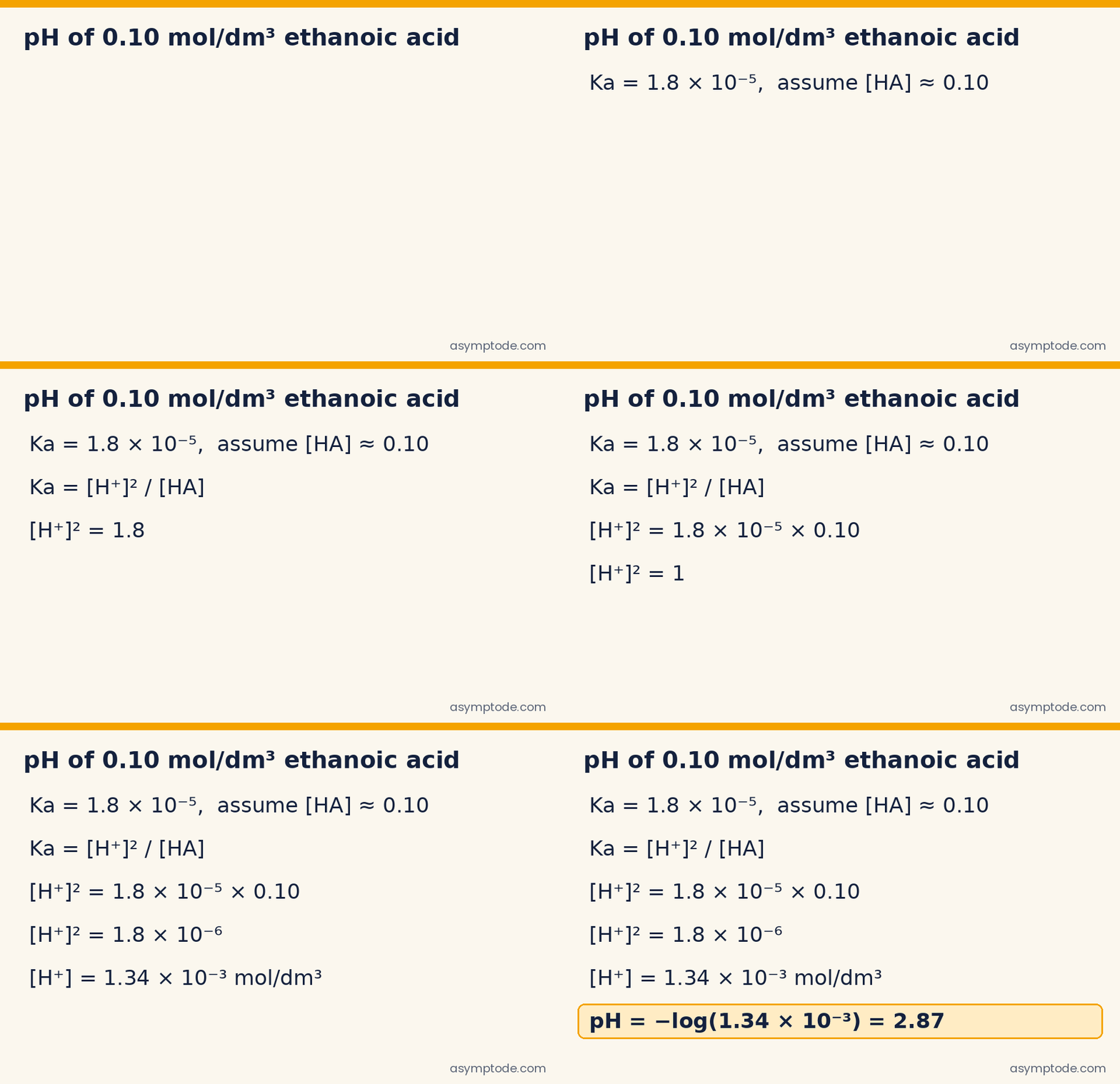
- Assume only a small amount of acid splits up, so [HA] ≈ 0.10.
- Ka = [H⁺]² ÷ [HA], so [H⁺]² = 1.8 × 10⁻⁵ × 0.10 = 1.8 × 10⁻⁶.
- [H⁺] = 1.34 × 10⁻³ mol/dm³.
- pH = −log(1.34 × 10⁻³) = 2.87.
Compare this with a strong acid of the same concentration: 0.10 mol/dm³ HCl has a pH of 1.00. A weak acid has a higher pH because it only partly splits into ions.
What are the most common A-Level Chemistry mistakes?
- Learning mechanisms as pictures. Students should know why each arrow moves. Then new molecules are easy.
- Weak moles skills. Almost every topic uses moles. Practise them all year, not just in Year 12.
- Skipping units and significant figures. These cost easy marks in long calculations.
- Ignoring the practicals. Questions on methods and errors appear on every paper.
- Revising Year 13 only. The papers test both years. Paper 3 can test anything.
- Not using the mark scheme. Examiners want key words, such as "lone pair" or "electrophile". Learn them from past mark schemes.
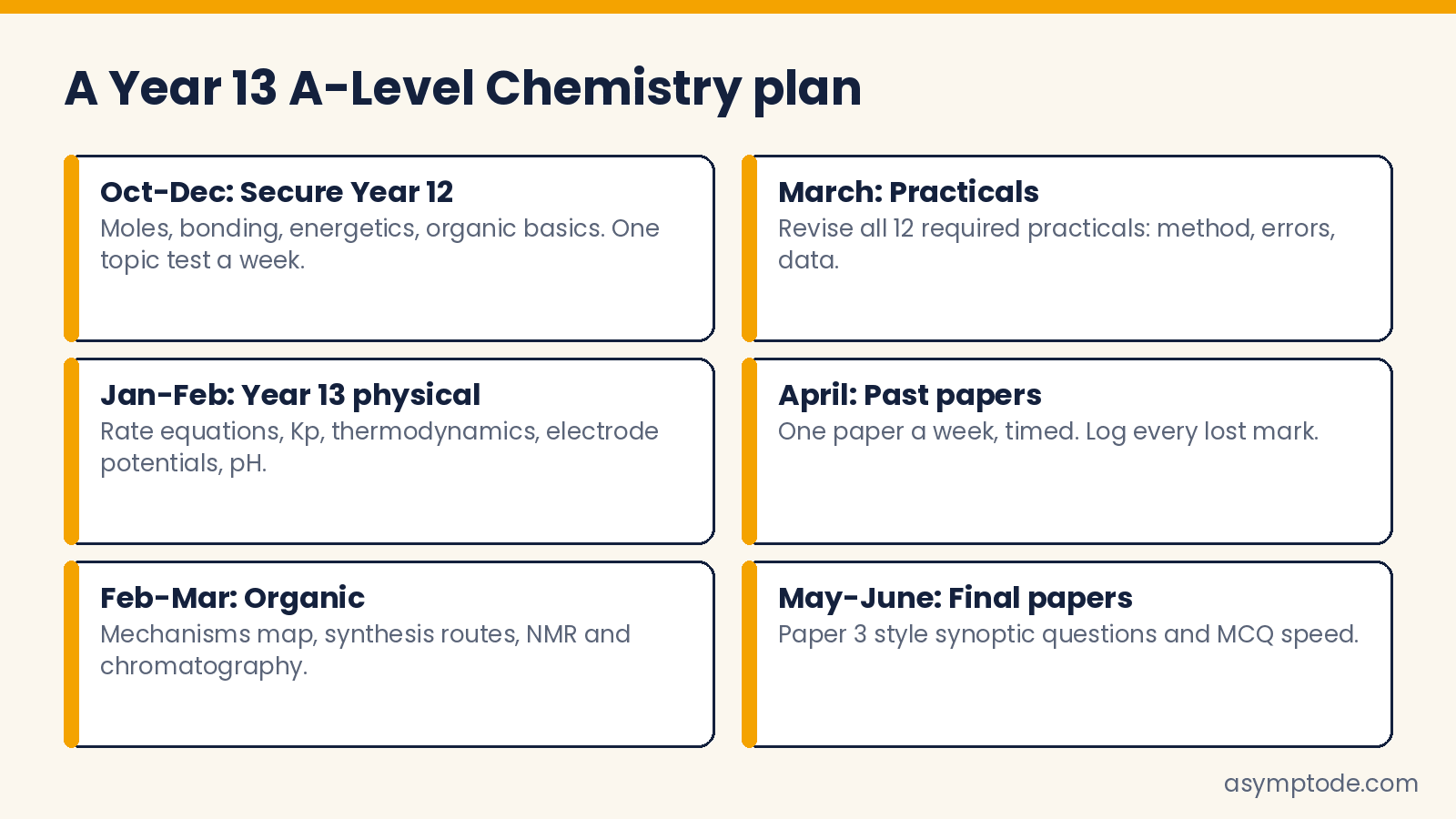
How should my child revise for A-Level Chemistry?
| When | Focus | What to do |
|---|---|---|
| October-December | Secure Year 12 | Moles, bonding, energetics, organic basics. One topic test each week. |
| January-February | Year 13 physical | Rate equations, Kp, thermodynamics, electrode potentials, pH. |
| February-March | Organic | Build one mechanism map and one synthesis map. Add NMR and chromatography. |
| March | Practicals | Go through all 12 required practicals: method, risks, errors, data. |
| April | Past papers | One full paper a week, timed. Log every lost mark by topic. |
| May-June | Final papers | Paper 3 style synoptic questions and multiple-choice speed. |
Little and often works best. Three 40-minute sessions a week, with a short quiz at the start of each, will beat one long cram on Sunday.
Need help making this plan fit your child's board and school? Book a free demo class.
How 1-on-1 tutoring helps with A-Level Chemistry
A-Level Chemistry moves fast. If one idea is missing, such as moles or electron movement, many later topics feel hard. In 1-on-1 lessons at Asymptode, one dedicated mentor teaches one student:
- The mentor follows your child's exam board and school order of topics, and plans to the summer exam dates.
- In live lessons the mentor watches every step of a calculation or mechanism and fixes the method, not just the final answer.
- When a topic will not land, the mentor looks for the smaller missing piece, such as logs behind pH or ratios behind titrations.
- Homework is set on the topics taught and marked with feedback.
- Every class is recorded, so your child can rewatch a topic before the exams.
- Parents get regular updates on progress and what to practise next.
Students coming from the US system may also find our AP Chemistry guide useful, as the content overlaps. Talk to an advisor or see our fees.
FAQ
How many papers are in A-Level Chemistry?
Three. AQA sets two 2-hour papers of 105 marks and one 2-hour paper of 90 marks. Edexcel and OCR also set three papers, with different lengths and marks.
Is A-Level Chemistry hard?
Many students find it one of the harder A-Levels, because it needs facts, maths and practical skills together. Steady practice from the start of Year 12 makes it much more manageable.
How many required practicals are in AQA A-Level Chemistry?
Twelve. They are assessed for the practical endorsement in class, and practical skills are also tested in the written papers.
What is the practical endorsement?
It is a separate result from the A*-E grade. Teachers assess practical work against common criteria, and students who meet the standard get a "pass" on their certificate.
Do you need A-Level Maths for A-Level Chemistry?
No, it is not required. But chemistry uses a lot of maths, such as logs, rearranging and standard form. Students who are confident with GCSE maths do better.
What grade at GCSE do you need to take A-Level Chemistry?
Each school or college sets its own entry rules. Many ask for at least a grade 6 in GCSE Chemistry or Combined Science, and often a grade 6 in maths. Check with your child's sixth form.