
If you want to know how to become a nurse, the short version is this: finish school with strong science, complete an approved nursing program, then pass your country's licensing step. This guide for students and parents covers the registered nurse (RN) route in the USA, UK and India, with notes on Canada and Australia, plus school subjects, skills and a real piece of nursing maths.
Key takeaways
- In the USA, registered nurses need an approved nursing program, a state license and a pass on the NCLEX-RN exam.
- In the UK, every nurse must be registered with the Nursing and Midwifery Council (NMC). Most students apply through UCAS.
- In India, B.Sc Nursing is a 4-year degree. The Indian Nursing Council asks for 10+2 with Physics, Chemistry, Biology and English.
- Biology, chemistry and maths matter most at school. Nurses use maths every day, for example to work out drip rates.
- The US job outlook for registered nurses is 6% growth from 2025 to 2035, which the BLS calls faster than average.
How to become a nurse: what are the main steps?
Quick answer: To become a registered nurse, take biology, chemistry and maths at school. Then finish an approved nursing degree or program in your country. After that, pass the licensing step: the NCLEX-RN in the USA and Canada, NMC registration in the UK, or State Nursing Council registration in India. Then you can start work.
The shape is the same in every country:
- School: Build a base in biology, chemistry, maths and English.
- Nursing program: Join an approved nursing degree or program. It mixes classroom study with supervised clinical practice in real hospitals.
- Exam or registration: Pass the licensing exam or join the official register.
- First job: Start as a staff nurse. Later, you can specialize or study further.
 The four big stages on the road to becoming a registered nurse.
The path moves from school science to an approved nursing program.
Next comes the licensing step, such as the NCLEX-RN or NMC registration.
After that, you can start your first job as a registered nurse.
What does a registered nurse do?
The US Bureau of Labor Statistics says registered nurses "provide and coordinate patient care and educate patients and the public" about health conditions. In plain words, nurses look after patients, give medicines, watch for changes, and explain care to families.
Nursing is many jobs, not one. In the UK, nursing degrees are split into four fields: adult, children's, learning disability and mental health nursing, according to NHS Health Careers.
How do you become a registered nurse in the USA?
In the USA, you need a nursing education, a state license and a pass on a national exam. Here is the route, based on the BLS Occupational Outlook Handbook.
What is the difference between an ADN and a BSN?
There are three main ways to train as an RN in the USA:
| Program | Who offers it | Key point (BLS) |
|---|---|---|
| BSN (Bachelor of Science in Nursing) | Colleges and universities | Typically takes 4 years |
| ADN or ASN (associate degree) | Colleges | Can later lead to an RN-to-BSN program |
| Diploma | Hospitals or medical centers | Typically 2 to 3 years; far fewer programs |
All three include supervised clinical experience. The BLS says licensed graduates of any of the three generally qualify for entry-level staff nurse jobs, but hospitals may require a bachelor's. A bachelor's or higher is often needed for research, teaching and management roles.
So which should you pick? A BSN keeps the most doors open, because some employers ask for a bachelor's. An ADN or diploma can still lead to an RN license, and you can top it up with an RN-to-BSN program later. Compare length and cost on each college's official page.
What is the NCLEX-RN?
The NCLEX-RN is the national licensing exam. It is made by the National Council of State Boards of Nursing (NCSBN). The official NCLEX FAQ says it measures minimum competency for safe, entry-level nursing.
Key facts:
- Length: The 2026 NCLEX-RN test plan says candidates answer a minimum of 85 items and a maximum of 150 items in a five-hour period.
- How to register: First apply to your nursing regulatory body (your state board of nursing). Then register with Pearson, the testing company.
- Fee: From 1 February 2027, the NCLEX-RN fee will be $350 in the USA. Check the official page for the current fee before that date.
Do you need a state license?
Yes. The BLS says RNs must be licensed by the state where they work, after an approved program and a qualifying exam. Other rules, such as a background check, vary by state, so check your state board of nursing.
What is the job outlook for nurses in the USA?
Here are the official figures from the BLS, with their year labels:
| Measure | Figure | Year |
|---|---|---|
| Median pay | $97,550 per year ($46.90 per hour) | 2025 |
| Number of jobs | 3,465,400 | 2025 |
| Job outlook | 6% growth (faster than average) | 2025-35 |
| Employment change | 194,700 jobs | 2025-35 |
| Openings per year | About 180,800 on average | 2025-35 |
"Median" means half of RNs earned more and half earned less. Most openings come from nurses who leave the workforce or change jobs.
How do you become a nurse in the UK?
In the UK, you must be on the NMC register to work as a nurse. The Nursing and Midwifery Council says: "All nurses working in the UK must be registered with us." To join, you must finish an NMC-approved nursing programme.
What do you need to get onto a nursing degree?
NHS Health Careers says you are likely to need:
- At least two (usually three) A levels, or equivalent level 3 qualifications.
- Supporting GCSEs including English, maths and a science (usually biology or human biology).
The National Careers Service adds that many courses ask for 4 or 5 GCSEs at grades 9 to 4, and 2 or 3 A levels including a science. Check each course page for exact grades.
How long is a nursing degree, and how do you apply?
The NMC says courses usually take a minimum of three years. The National Careers Service says full-time courses usually take 3 years. You choose one of the four fields (adult, children's, learning disability or mental health) when you apply.
Students normally apply through UCAS. NHS Health Careers says full-time nursing course applications are made through UCAS. It also mentions at least £5,000 a year of non-repayable support for eligible nursing students in England. Check the official page for the current amount and rules.
Is there an apprenticeship route?
Yes. A registered nurse degree apprenticeship lets you study and work at the same time. The National Careers Service says it takes around 4 years and needs an employer to support you.
If your child is also weighing medicine, our UCAT 2027 guide explains the admissions test for UK medical schools. Nursing courses use their own entry rules.
How do you become a nurse in India?
In India, the main degree is the 4-year B.Sc Nursing. The Indian Nursing Council (INC) lists B.Sc (Basic) Nursing as a 4-year university course. Graduates are registered as R.N. and R.M. (registered nurse and registered midwife).
What is the B.Sc Nursing eligibility?
The INC eligibility page says:
- Age: At least 17 years on 31 December of the year of admission.
- Subjects: 10+2 with Science (Physics, Chemistry, Biology) and English.
- Marks: At least 45% aggregate from a recognised board. Students who take 10+2 Science through NIOS also need 45%.
Is there an entrance exam for B.Sc Nursing?
Usually, yes. An INC notice dated 24 December 2025 says B.Sc Nursing admissions for 2025-26 were through a Common Entrance Examination. These are run by State Government Common Entrance Cells or universities. Each state and university announces its own test, so check its official page.
Is NEET needed for B.Sc Nursing?
Not for every college. But some seats do use NEET (UG). An NTA notice from February 2024 said Military Nursing Service aspirants must qualify NEET (UG), and that the NEET (UG) score is used for shortlisting for the four-year B.Sc Nursing course. Check the current year's official notice before you apply. Our NEET UG 2027 guide explains how the exam works.
What about GNM and ANM?
India also has diploma routes. The INC lists GNM (General Nursing and Midwifery) as 3 years and ANM (Auxiliary Nurse and Midwife) as 2 years.
How do you become a nurse in Canada and Australia?
Canada: Nursing is regulated by each province or territory. For example, the College of Nurses of Ontario says you must pass the NCLEX-RN before you can become an RN in Ontario. The NCLEX FAQ says the fee in Canada will be $570 CAD from 1 February 2027. Nurses trained outside Canada start with the National Nursing Assessment Service (NNAS), which calls itself "the first step towards becoming a nurse in Canada" for internationally educated nurses.
Australia: Nurses register through Ahpra, working with the Nursing and Midwifery Board of Australia (NMBA). Ahpra says graduates of Board-approved programs of study apply for registration. When your name appears on the register, you can start work.
Nursing routes by country at a glance
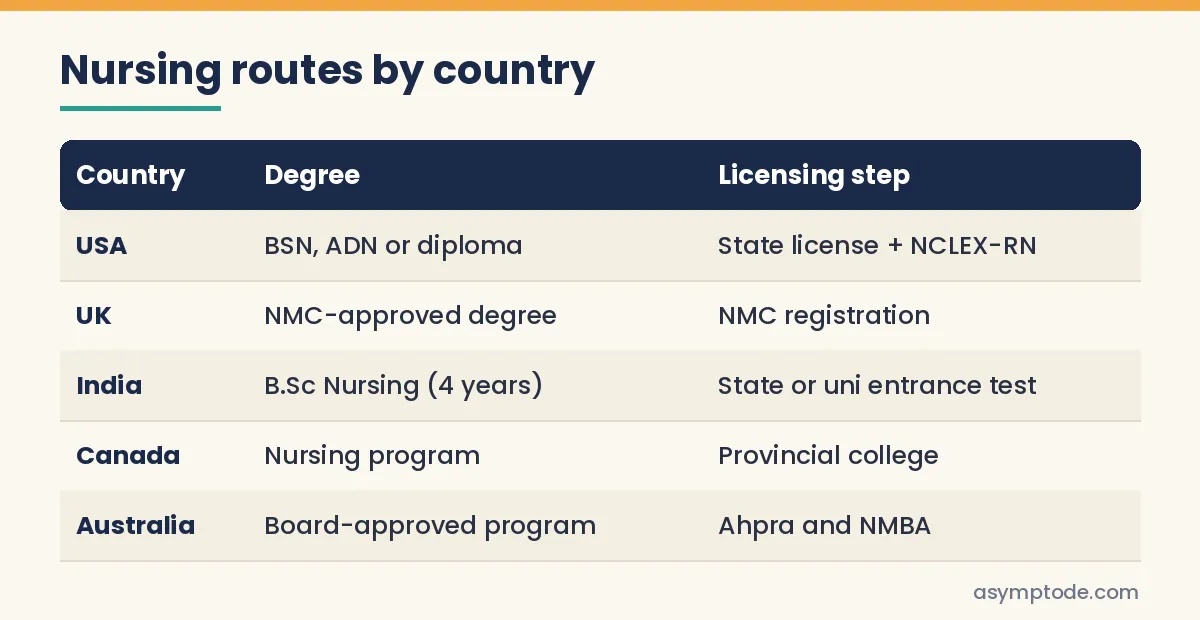 Each country has its own degree and licensing step.
USA: a BSN, ADN or diploma, then a state license and the NCLEX-RN.
UK: an NMC-approved degree through UCAS, then NMC registration.
India: a 4-year B.Sc Nursing, often through a state or university entrance test.
Canada: a nursing program, then a provincial college and, in Ontario, the NCLEX-RN.
Australia: a Board-approved program, then registration through Ahpra and the NMBA.
Which school subjects do you need to become a nurse?
Science is the core. Nursing degrees teach anatomy, physiology and medicines, so a strong school base helps.
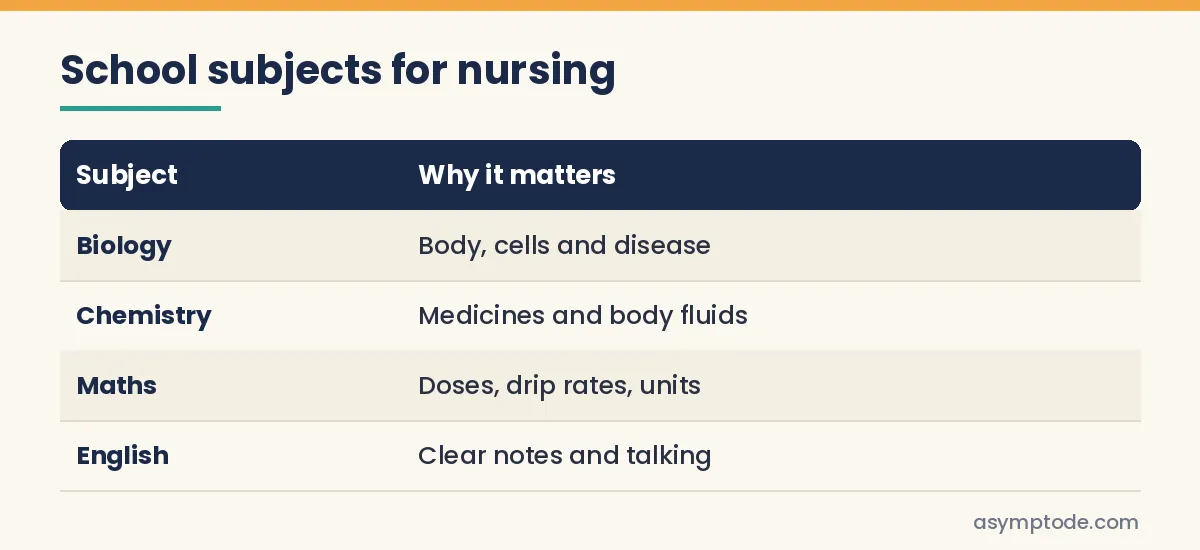 The four school subjects that help most on the road to nursing.
Biology helps you understand the body, cells and disease.
Chemistry helps you understand medicines and body fluids.
Maths is used for doses, drip rates and unit conversions.
English matters for clear notes and talking with patients.
The UK asks for GCSE English, maths and a science (usually biology). India requires Physics, Chemistry, Biology and English at 10+2.
To explore a health topic early, see our guide to research for high school students.
Do nurses use maths? A worked drip rate example
Yes, every day. One common task is working out how fast an IV drip should run when it flows by gravity. You count drops per minute.
Practice numbers, not medical advice. Real doses always come from a prescriber and the hospital's own policy.
The formula is:
Drops per minute = volume (mL) x drop factor (drops per mL) / time (minutes)
The "drop factor" is printed on the IV tubing. The Open RN Nursing Skills textbook says macrodrip tubing has drop factors of 10, 15 or 20 drops per mL, and microdrip tubing has 60 drops per mL.
Practice problem: 1,000 mL of fluid must run over 8 hours. The tubing drop factor is 15 drops per mL. How many drops per minute?
- Change hours to minutes: 8 x 60 = 480 minutes.
- Multiply volume by drop factor: 1,000 x 15 = 15,000 drops.
- Divide by time: 15,000 / 480 = 31.25 drops per minute.
- Round to the nearest whole drop: 31 drops per minute.
 A practice drip rate worked out one step at a time (practice numbers, not medical advice).
Change 8 hours into 480 minutes.
Multiply 1,000 mL by 15 drops per mL to get 15,000 drops.
Divide 15,000 by 480 to get 31.25, then round to 31 drops per minute.
This uses only school maths: unit conversion, multiplication, division and rounding. But forgetting to change hours into minutes gives a very wrong answer. That is why strong maths matters.
Book a free demo class if your child wants help with the maths and science behind nursing, or see our plans and fees.
What skills do you need to be a good nurse?
The BLS lists these important qualities for registered nurses:
- Critical thinking and attention to detail
- Communication and compassion
- Emotional stability
- Organizational skills
- Physical stamina
How can students prepare for nursing while still at school?
Start early, but keep it simple:
- Choose the right subjects. Keep biology and chemistry. Do not drop maths.
- Practise calculation skills. Ratios, percentages, units and rounding are used every shift.
- Get people experience. Volunteering or caring roles help you see if the work suits you.
- Check entry rules early. Look up entry grades, entrance tests and deadlines on official pages.
- Compare health careers. Read our guides on how to become a doctor, how to become a pharmacist and how to become a biomedical engineer to see what fits best.
How Asymptode helps you with becoming a registered nurse
Asymptode gives your child a qualified mentor who teaches them one-to-one, live online. Lessons follow the real nursing route your child is aiming for: GCSE and A level biology, chemistry and maths for a UK nursing degree, 10+2 Physics, Chemistry and Biology plus state entrance tests or NEET (UG) for B.Sc Nursing in India, or high school science and maths for a US BSN. The mentor plans around the real exam and application dates for that route.
Between classes, your child gets practice built for them. Each worksheet is made from what their last attempt showed they had not understood, such as drip-rate unit conversions or a chemistry topic, and it is set at their level, never generic. This is Asymptode's AI-assisted practice. It is written to the mentor's brief and sent only after that mentor approves it.
The mentor marks the work. You, as the parent, see what was understood and what to practise next, so preparation keeps correcting itself toward a nursing place. For personal statements or interviews, the mentor helps with planning, method and practice review.
Book a free demo class or see our fees.
Facts checked against official sources on 11 November 2026.
FAQ
How long does it take to become a registered nurse?
A US BSN typically takes 4 years, UK nursing degrees usually take at least three years, and India's B.Sc Nursing takes 4 years. After that, you still pass your licensing exam or join the register.
Can I become a nurse without a degree?
In the USA, the BLS lists the ADN and hospital diploma as routes to an RN license, though hospitals may prefer a BSN. In the UK, a registered nurse degree apprenticeship lets you earn while you study, but it still leads to a degree. Check your country's regulator for the exact rules.
Is the NCLEX-RN hard?
The NCLEX-RN tests whether you can practise safely as a new nurse. Candidates answer between 85 and 150 items in up to five hours, according to the 2026 test plan. Nursing programs prepare you for it, and steady practice makes a big difference.
Do I need NEET for B.Sc Nursing in India?
Not for every college. The INC said 2025-26 B.Sc Nursing admissions were through state or university common entrance exams. Some seats, such as Military Nursing Service seats, have used NEET (UG) scores, so check the current official notice.
Which subjects should I take at school to become a nurse?
Take biology and chemistry, and keep maths and English. The UK asks for GCSEs in English, maths and a science, plus A levels usually including a science. India requires Physics, Chemistry, Biology and English at 10+2.
Is nursing a good career choice?
Many people find it rewarding because you help people every day. In the USA, the BLS projects 6% job growth for RNs from 2025 to 2035, faster than average. If you love animals instead of people, see our guide on how to become a veterinarian.
Ready to start? Book a free demo class and advisor call, or see our plans and fees.
Sources
- BLS Occupational Outlook Handbook: Registered Nurses
- NCLEX Frequently Asked Questions
- NCLEX-RN Test Plan Effective April 2026
- NCSBN
- NMC: Becoming a nurse
- NHS Health Careers: How to become a nurse
- NHS Health Careers: Nursing careers
- National Careers Service: Nurse
- Indian Nursing Council: Eligibility criteria
- Indian Nursing Council: Nursing programs
- Indian Nursing Council Notification No. 23 of 2025
- NTA notice on NEET (UG) for B.Sc Nursing (MNS), 2024
- College of Nurses of Ontario: RN examinations
- National Nursing Assessment Service
- Ahpra: Applying for registration
- Nursing and Midwifery Board of Australia
- Open RN Nursing Skills: IV Infusion by Gravity