
If you want to know how to become a pharmacist, the short path is the same almost everywhere: do well in school chemistry, biology and maths, earn an accredited pharmacy degree, finish supervised training, and pass a licensing exam. The details change a lot by country. This guide walks students and parents through each step, with official links, so you can plan from school to licence.
Key takeaways
- Every route has four stages: school subjects, an accredited pharmacy degree, supervised training, then a licence or registration.
- In the USA you need a Pharm.D. from an ACPE-accredited program, then the NAPLEX and usually the MPJE. The PCAT entrance test was retired in January 2024.
- In the UK you study a GPhC-accredited MPharm (normally four years), do a 52-week foundation training year, and pass the Common Registration Assessment.
- In India the approved qualifications are D.Pharm, B.Pharm and Pharm.D, and you register with your State Pharmacy Council.
- Maths matters every day: dilutions, doses and unit conversions are part of the job and of the exams.
How to become a pharmacist: what are the main steps?
Quick answer: To become a pharmacist, take chemistry, biology and maths at school, then complete an accredited pharmacy degree. After that, you do supervised practice (an internship or foundation year) and pass your country's licensing exams. In the USA this means a Pharm.D. plus the NAPLEX; in the UK, an MPharm plus the GPhC assessment.
 The four stages of the pharmacist path, from school to licence.
The path has four boxes. First, school subjects: chemistry, biology and maths. Second, an accredited pharmacy degree. Third, supervised training, such as intern hours or a foundation year. Fourth, a licence or registration after you pass the exams.
What does a pharmacist actually do?
Pharmacists make sure each patient gets the right medicine, in the right amount, used the right way. The U.S. Bureau of Labor Statistics lists duties such as:
- Filling prescriptions in the right amount, based on the doctor's instructions.
- Checking a patient's allergies, health conditions and other medicines, so a new drug does not cause a bad reaction.
- Teaching patients how to use, store and handle side effects of their medicine.
- Giving vaccinations, such as flu shots.
- Supervising pharmacy technicians and pharmacists in training (interns).
- Keeping patient and pharmacy records.
- Teaching other healthcare workers about the right medicine for each patient.
Where do they work? In the USA, BLS says the largest employers are pharmacies and drug retailers (37% of jobs) and hospitals (32%). General merchandise stores, food and beverage stores, and ambulatory healthcare services each employ about 6%.
BLS also lists the qualities that help: analytical skills, communication, compassion, attention to detail, people skills and managerial skills. A pharmacist spends a lot of time talking to patients, so this is not a "lab only" career. If your child loves lab work most, also read our guide on how to become a scientist.
Which school subjects do you need to become a pharmacist?
Chemistry is the core subject. Biology comes next, and maths is the quiet third pillar. UCAS lists chemistry, biology, maths, physics and psychology as useful subjects to study before pharmacy. Each university sets its own entry rules, so always check the course page.
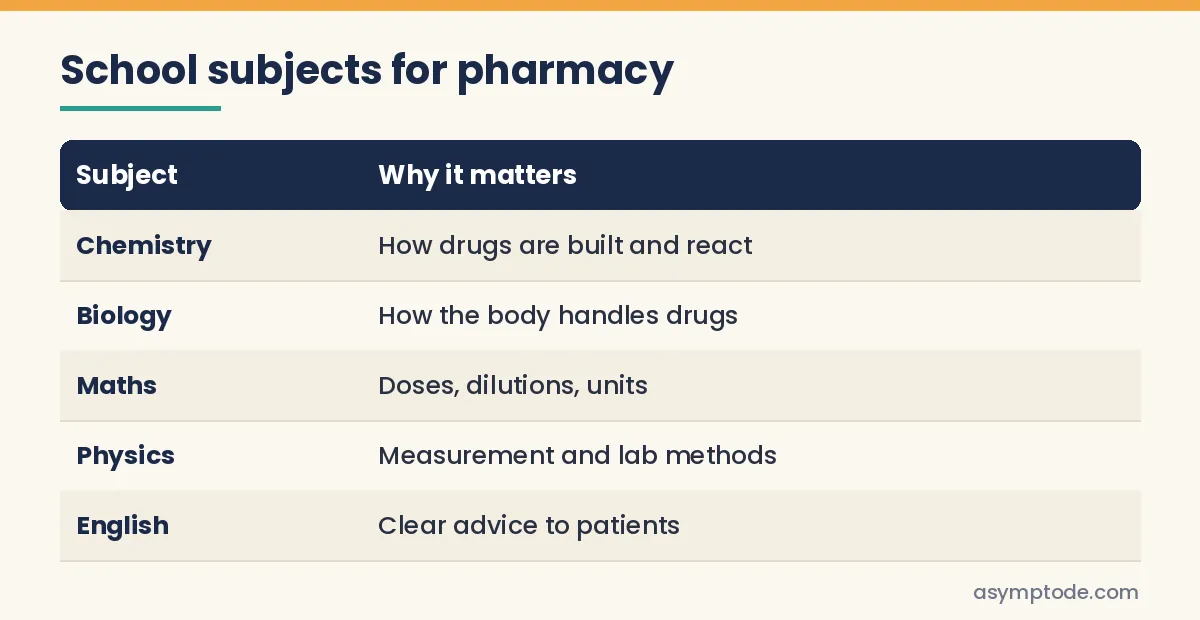 School subjects that build the base for a pharmacy degree.
The table matches each subject to its use. Chemistry explains how medicines are built and how they react. Biology explains how the body handles a drug. Maths covers doses, dilutions and unit conversions. Physics helps with lab methods and measurement. English helps you explain medicine clearly to patients.
What chemistry topics should students master early?
Start with the basics that come back again and again in pharmacy:
- Moles and amounts of substance. Our mole concept explained guide is a good start.
- Balancing equations, covered in how to balance chemical equations.
- Organic chemistry, because most medicines are organic molecules.
- Acids, bases and solutions.
Exam-specific guides can help at each stage: GCSE chemistry and A-level chemistry in the UK, or the AP Chemistry exam in the USA.
How do you become a pharmacist in each country?
The steps look alike, but the names, lengths and exams differ. Use this table as a starting map, then check the official links in each section.
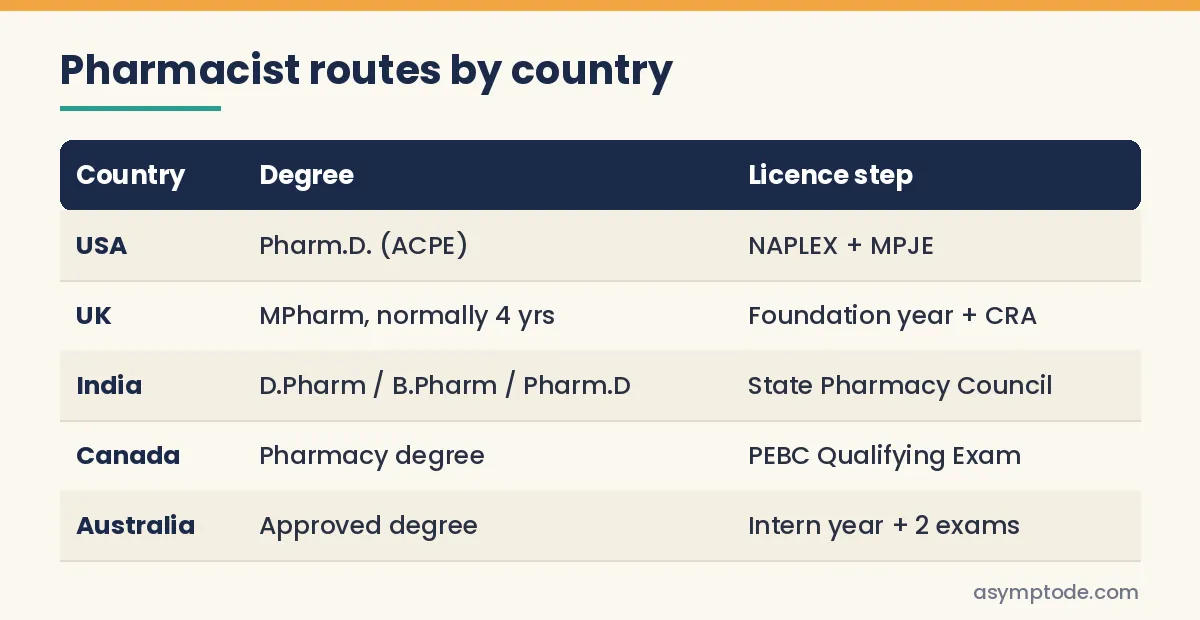 Pharmacist routes by country at a glance.
The table lists five countries. The USA uses a Pharm.D. and the NAPLEX plus MPJE. The UK uses a four-year MPharm, a foundation year and the GPhC assessment. India uses D.Pharm, B.Pharm or Pharm.D with State Pharmacy Council registration. Canada uses the PEBC Qualifying Exam, and Australia uses an intern year with written and oral exams.
| Country | Degree | Training and licence |
|---|---|---|
| USA | Pharm.D. (ACPE-accredited) | Intern hours, NAPLEX, MPJE |
| UK | MPharm, normally 4 years (GPhC-accredited) | 52-week foundation year, Common Registration Assessment |
| India | D.Pharm (2 yrs), B.Pharm (4 yrs), Pharm.D (6 yrs) | Registration with State Pharmacy Council |
| Canada | Pharmacy degree | PEBC Qualifying Exam, then provincial licence |
| Australia | Approved pharmacy degree | Intern year (min. 1,575 hours), written and oral exams |
How do you become a pharmacist in the USA?
- Take prerequisite college courses. BLS says applicants usually need at least two years of undergraduate courses such as anatomy and physiology, physics and statistics. Some programs admit high school graduates straight into a six-year program.
- Earn a Pharm.D. Programs usually take four years, and some offer a three-year option. Choose a program accredited by the Accreditation Council for Pharmacy Education (ACPE), which accredits Doctor of Pharmacy programs in the United States.
- Complete intern hours. Each state sets its own number.
- Pass two exams. The NAPLEX, run by the National Association of Boards of Pharmacy (NABP), checks general practice knowledge. The MPJE is a state-specific exam on federal and state pharmacy law. Check your state board for its exact rules.
- Keep your licence. All states require a license and continuing education.
- Optional residency. BLS notes that a one- to two-year residency helps for clinical or advanced roles.
Is the PCAT still required?
No. The Pharmacy College Admission Test (PCAT) was retired on January 10, 2024, according to the American Association of Colleges of Pharmacy. No PCAT dates are offered for the 2024-2025 cycle or later. Older guides that tell you to book the PCAT are out of date. Each school now sets its own admission rules, so check the school's page.
How do you become a pharmacist in the UK?
The General Pharmaceutical Council (GPhC) says qualifying takes at least five years and mixes study with paid work.
- Study a GPhC-accredited MPharm. It is full time and normally lasts four years. Apply through UCAS.
- Apply for a foundation training place. Places go through national recruitment schemes run by NHS England, HEIW (Wales) or PSD (Scotland). MPharm students apply in June of the year before they finish.
- Complete the foundation training year. Trainees spend 52 weeks in supervised training at an approved site.
- Pass the Common Registration Assessment (CRA). The GPhC and the Pharmaceutical Society of Northern Ireland deliver it across the UK. It is computer-based, in test centres. Part 1 has 40 calculation questions in 120 minutes, and Part 2 has 120 multiple-choice questions in 150 minutes.
- Register with the GPhC once you meet its registration criteria.
Students who study an MPharm built to the GPhC's 2021 standards, and who are signed off for prescribing in foundation training, can register as independent prescribers. That is a big change from older routes.
How do you become a pharmacist in India?
The Pharmacy Council of India (PCI) regulates pharmacy education. Its FAQ page lists three qualifications approved for registration under the Pharmacy Act, 1948:
| Course | Length after 10+2 |
|---|---|
| D.Pharm (Diploma in Pharmacy) | 2 years, plus 500 hours practical training |
| B.Pharm (Bachelor of Pharmacy) | 4 years |
| Pharm.D (Doctor of Pharmacy) | 6 years |
Entrance routes. Admission depends on your state and college. In Maharashtra, the State CET Cell runs the CAP admission rounds for B.Pharmacy and Pharm.D, and students usually sit MHT CET first. See our MHT CET 2027 guide. Some central universities use CUET UG scores for B.Pharm. Check each college's prospectus, because rules differ.
Registration. PCI says registration, renewal and transfer are handled by your State Pharmacy Council, not by PCI. You must be at least 18. Contact your state council for its forms and fees.
How do you become a pharmacist in Canada?
- Complete a pharmacy degree.
- Pass the Pharmacist Qualifying Examination from the Pharmacy Examining Board of Canada (PEBC), the national certification body for pharmacy. It has Part I (multiple choice) and Part II (OSCE, a practical clinical exam).
- Apply for a licence with the pharmacy regulator in your province.
Timing note: PEBC lists a deadline of noon Eastern Time on November 19, 2026, for February 2027 qualifying exam applications. For international pharmacy graduates, PEBC says the Evaluating Examination will no longer be required, so eligible graduates go straight to the Qualifying Examination.
How do you become a pharmacist in Australia?
The Pharmacy Board of Australia sets these steps:
- Finish an approved pharmacy degree.
- Get provisional registration and have a preceptor (supervisor) and workplace approved.
- Enrol in an intern training program accredited by the Australian Pharmacy Council (APC).
- Complete at least 1,575 hours of supervised practice (the Board says this is the current modified figure).
- Pass a written exam (run by APC) and an oral exam (run by Ahpra).
- Apply for general registration.
How much maths does a pharmacist use? (worked example)
A lot, and it must be exact. In the UK registration assessment, Part 1 is 40 calculation questions. Dilution is a classic type. Here is an original example to practise.
Practice numbers, not medical advice.
Problem: A stock solution has a concentration of 20 mg/mL. You need 250 mL of a weaker solution at 2 mg/mL. How much stock and how much water do you mix?
 Step-by-step dilution: practice numbers, not medical advice.
The animation shows the same steps as below. It writes the rule C1 x V1 = C2 x V2. It fills in 20 x V1 = 2 x 250, so V1 = 25 mL of stock. It adds 225 mL of water. Then it checks the answer: 500 mg in 250 mL is 2 mg/mL.
- Write the rule. C1 x V1 = C2 x V2. The amount of drug stays the same; only the volume changes.
- Fill in what you know. C1 = 20 mg/mL, C2 = 2 mg/mL, V2 = 250 mL.
- Solve. 20 x V1 = 2 x 250 = 500, so V1 = 500 / 20 = 25 mL of stock.
- Find the water. 250 mL - 25 mL = 225 mL of water.
- Check. 25 mL x 20 mg/mL = 500 mg. 500 mg / 250 mL = 2 mg/mL. Correct.
- Convert units. 2 mg/mL = 200 mg per 100 mL = 0.2 g per 100 mL, which is 0.2% w/v.
Notice the check step. Pharmacists always check, because a slip with units (mg vs g, mL vs L) can mean a dose that is ten or a thousand times wrong. Students who are solid in ratios, rearranging formulas and unit conversion find this part of the degree much easier.
How long does it take to become a pharmacist?
In the USA, plan for about two years of prerequisite college courses plus a Pharm.D. that usually takes four years. In the UK, it takes at least five years. In India, it is two, four or six years after 10+2, depending on the course.
What is the job outlook for pharmacists?
Here is the honest picture, using only official US figures from the BLS Occupational Outlook Handbook:
| Measure | Figure |
|---|---|
| Median pay (May 2025) | $140,910 per year ($67.75 per hour) |
| Number of jobs (2025) | 325,200 |
| Projected change, 2025-35 | 5% (faster than average) |
| Employment change, 2025-35 | 17,100 |
| Openings per year | About 12,500, on average |
"Median" means half of pharmacists earned more and half earned less. Pay depends on place, employer and experience. For pay and demand in the UK, India, Canada or Australia, check official sources in that country; we have not included figures we could not verify.
How can students prepare for a pharmacy career now?
- Build chemistry first. Aim for real understanding of moles, solutions and organic chemistry, not just memorised answers.
- Practise calculation drills. Doses, ratios, percentages and unit conversions. Do a few each week.
- Keep biology strong. Human biology links straight to how medicines work.
- Talk to a pharmacist. Ask a local pharmacist about a normal day. It helps you decide.
- Check entry rules early. Look at two or three accredited programs in your target country and note their subject rules and deadlines.
- Compare nearby careers. Pharmacy, medicine and veterinary science share a science base. See how to become a doctor if you are weighing up both.
Want a plan built around your child's school and target country? Book a free demo class, or compare our plans and fees.
How Asymptode helps you with becoming a pharmacist
At Asymptode, a qualified mentor teaches your child one-to-one, live online, following the route they are aiming for: GCSE and A-level chemistry for a GPhC-accredited MPharm, AP Chemistry and college prerequisites for a US Pharm.D., or Class 11-12 chemistry, biology and maths for MHT CET and B.Pharm or Pharm.D admission in India. Lessons follow that route's real syllabus and dates.
Between classes, your child gets practice built for them. Each worksheet is made from what their own last attempt showed they had not understood, such as mole calculations or dilution problems, at their level and never generic. This is Asymptode's AI-assisted practice: it is written to the mentor's brief and sent only after that mentor approves it.
The mentor marks the work, and you see what was understood and what to practise next. So preparation keeps correcting itself toward a pharmacy degree. For non-science parts, like personal statements or interviews, the mentor helps with planning, method and practice review.
Book a free demo class or see our fees.
Facts checked against official sources on 11 November 2026.
FAQ
Do you need a PCAT score to get into pharmacy school in the USA?
No. The PCAT was retired on January 10, 2024, and no test dates are offered for the 2024-2025 cycle or later. Each Pharm.D. program sets its own admission rules, so check the program's website.
Which A-levels do you need to study pharmacy in the UK?
Chemistry is usually the key subject, and UCAS lists biology, maths, physics and psychology as useful too. Each university sets its own requirements, so check the MPharm course page on UCAS before choosing.
Can you become a pharmacist with a D.Pharm in India?
Yes. PCI lists D.Pharm, B.Pharm and Pharm.D as qualifications approved for registration under the Pharmacy Act, 1948. You then register with your State Pharmacy Council, which handles registration and renewal.
Is pharmacy a lot of maths?
It uses steady, precise maths rather than advanced theory. Pharmacists work with doses, concentrations, dilutions and unit conversions every day. In the UK assessment, Part 1 is 40 calculation questions.
What exams do pharmacists take in the USA?
Most candidates take the NAPLEX, which checks general practice knowledge, and the MPJE, a state-specific pharmacy law exam. Both are run through NABP. Your state board of pharmacy confirms which exams and intern hours it needs.
Is pharmacy a good career for the future?
BLS projects pharmacist jobs in the USA to grow 5% from 2025 to 2035, which it calls faster than average, with about 12,500 openings a year. The median pay was $140,910 in May 2025. Outlook differs in other countries, so check local official data.
Ready to start? Book a free demo class and advisor call, or see our plans and fees.
Sources
- BLS Occupational Outlook Handbook: Pharmacists
- Accreditation Council for Pharmacy Education
- AACP: Retirement of the PCAT
- NABP: NAPLEX
- NABP: MPJE
- GPhC: Pharmacist education and training
- GPhC: Foundation training scheme
- GPhC: Common Registration Assessment specification 2026
- UCAS: Pharmacy, pharmacology and toxicology
- Pharmacy Council of India
- Pharmacy Council of India FAQs
- Maharashtra State CET Cell
- Pharmacy Examining Board of Canada
- Pharmacy Board of Australia: Internships