
IB vs A Level is one of the biggest choices a family makes before the last two years of school. The IB Diploma asks for six subjects plus a core. A-levels let a student go deep in a few subjects, usually three. This guide compares them using only official pages.
Key takeaways
- The IB Diploma has six subjects (three or four at Higher Level), plus TOK, the Extended Essay and CAS. The top score is 45 points.
- A-levels are graded A* to E per subject. Most students take three. Boards include AQA, OCR, Edexcel and Cambridge International.
- Top UK universities publish an offer for both. For example, LSE Economics asks for A*AA or 39 IB points with 766 at Higher Level.
- Maths choice matters. Some courses want IB Maths Analysis and Approaches, or A-level Further Maths.
- Neither route is "easier". The right one depends on how your child likes to learn and what they want to study.
IB vs A Level: what is the difference?
Quick answer: The IB Diploma is a broad two-year programme: six subjects, three or four at Higher Level, plus Theory of Knowledge, a 4,000-word Extended Essay and CAS. It is scored out of 45. A-levels are single subjects, usually three, each graded A* to E. IB suits breadth. A-levels suit early focus.
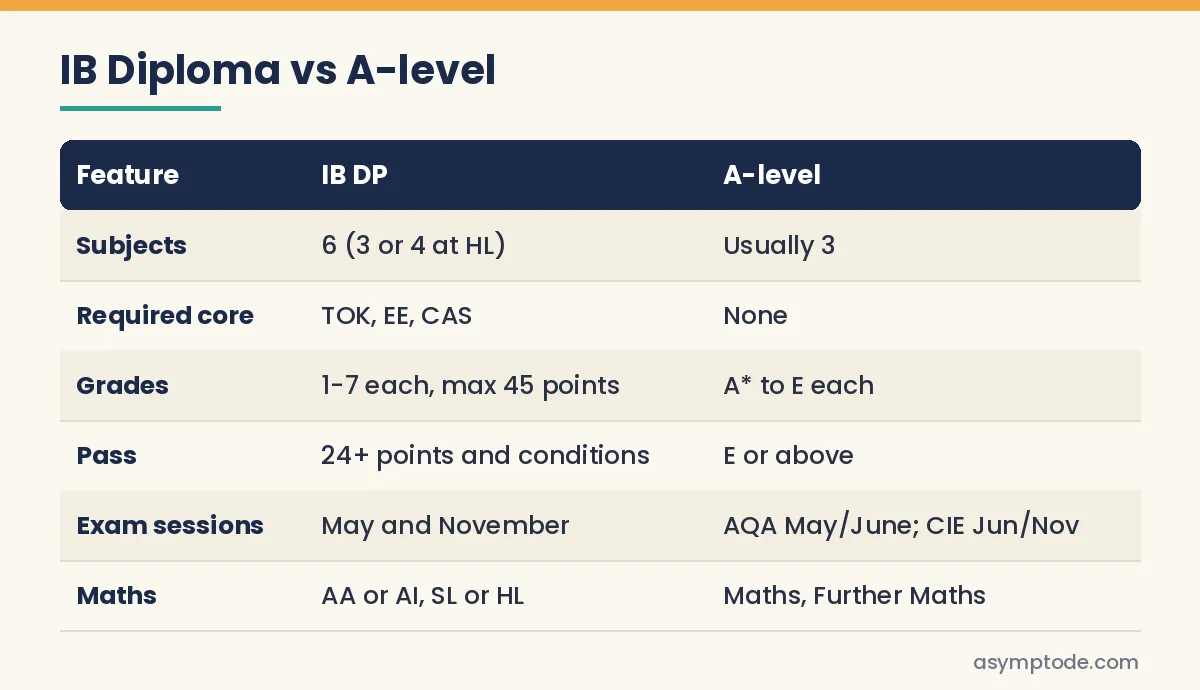 IB Diploma vs A-level at a glance.
The IB Diploma has 6 subjects, with 3 or 4 at Higher Level, while most A-level students take 3 subjects. The IB has a required core (TOK, Extended Essay, CAS). A-levels have no required core. IB subjects are graded 1 to 7 with a maximum of 45 points; A-levels are graded A* to E. IB exams run in May and November sessions. AQA A-levels sit in May/June; Cambridge International also has a November series.
What is the IB Diploma Programme?
The IB Diploma Programme is run by the International Baccalaureate (IBO). A student picks six subjects from different groups. At least three, and at most four, are taken at Higher Level (HL). The rest are at Standard Level (SL). The IB recommends 240 teaching hours for each HL subject and 150 hours for each SL subject.
On top of the subjects, there is the DP core:
- Theory of Knowledge (TOK): students think about how we know what we claim to know.
- Extended Essay (EE): an independent research project that ends in a 4,000-word paper.
- Creativity, Activity, Service (CAS): activities across three strands. CAS is not graded, but it must be completed.
More in our IB Diploma Programme guide.
How do IB points add up?
Each subject is graded 1 to 7, so six subjects give up to 42 points. TOK and the EE are graded A to E and combined in a matrix for 0 to 3 "core" points. So the top score is 45 points.
 A worked example of IB points.
Higher Level grades 7, 6 and 6 add to 19 points. Standard Level grades 6, 6 and 5 add to 17 points. The six subjects give 19 + 17 = 36 points. A B in TOK and a C in the Extended Essay give 2 core points (the IB's own example), so the total is 36 + 2 = 38 out of 45.
What do you need to pass the IB Diploma?
You need at least 24 points. But points alone are not enough. The IB's official conditions also say:
- CAS must be completed.
- Every subject, TOK and the EE must have a grade. An E in TOK or the EE is a fail.
- Every subject needs at least a 2.
- No more than two grade 2s, and no more than three grades of 3 or below.
- At least 12 points across HL subjects and at least 9 points across SL subjects.
A student who misses the Diploma still gets results for each course.
What are A-levels?
A-levels are single-subject qualifications. Most students take three. Boards in England include AQA, OCR and Pearson Edexcel. Many international schools use Cambridge International AS & A Levels, where schools choose from 55 subjects in almost any combination.
AQA A-levels are graded A*, A, B, C, D and E. Below E is a U, with no certificate. Cambridge International A Levels also run from A* to E.
How are A-levels assessed?
AQA A-levels are linear. That means all exams come at the end of the two years, in the May/June series. For example, AQA A-level Maths is three written papers. Each is 2 hours long, worth 100 marks and one third of the grade. You can see the dates in our A-level exam dates 2027 guide.
Cambridge International holds exam series in June and November, with results in August and January. In some subjects, students can sit the AS Level first and finish the A Level later.
How does assessment compare: exams, coursework and IA?
| Point | IB Diploma | A-levels |
|---|---|---|
| Exam sessions | May and November | AQA: May/June; Cambridge: June and November |
| Who marks exams | Trained IB examiners | The exam board |
| Teacher-led work | Internal assessment in most courses | Varies by subject; AQA Maths is 100% exams |
| Extra pieces | TOK, 4,000-word EE, CAS | None required |
| Retakes | Up to two retakes | Depends on board and series |
The IB says most courses have written exams plus internal assessment, run by the student's own teachers.
Which is more work, IB or A-levels?
The workload is different, not simply bigger or smaller. IB students juggle six subjects, a long essay, TOK and CAS at once, so planning is key. A-level students carry fewer subjects, but each goes deep. Ask: does your child do better spreading effort wide, or going deep?
IB Maths AA or AI vs A-level Maths and Further Maths
The IB offers two maths courses: Analysis and Approaches (AA) and Applications and Interpretation (AI). Each is at SL or HL. A student can take only one.
A-level students can take Maths alone, or add Further Maths. AQA Further Maths builds on A-level Maths, with topics like complex numbers, matrices and differential equations, plus two options from mechanics, statistics and discrete maths.
Course pages show why this matters:
- Cambridge Mathematics requests IB Analysis and Approaches and A-level Further Maths.
- Edinburgh Mathematics asks for HL Maths Analysis and Approaches only, at 7.
- Imperial Mathematics prefers AA but also accepts AI at HL.
- UCL Physics accepts either AA or AI at HL.
Read our IB Maths AA vs AI guide and our A-level Maths guide before you lock in a choice.
Not sure which maths route fits your child? Book a free demo class with an Asymptode mentor, or see our plans and fees.
How do universities treat IB vs A-levels?
Top UK universities print an A-level and an IB offer for the same course. These are official offers for 2027 entry (or the current page where no year is given).
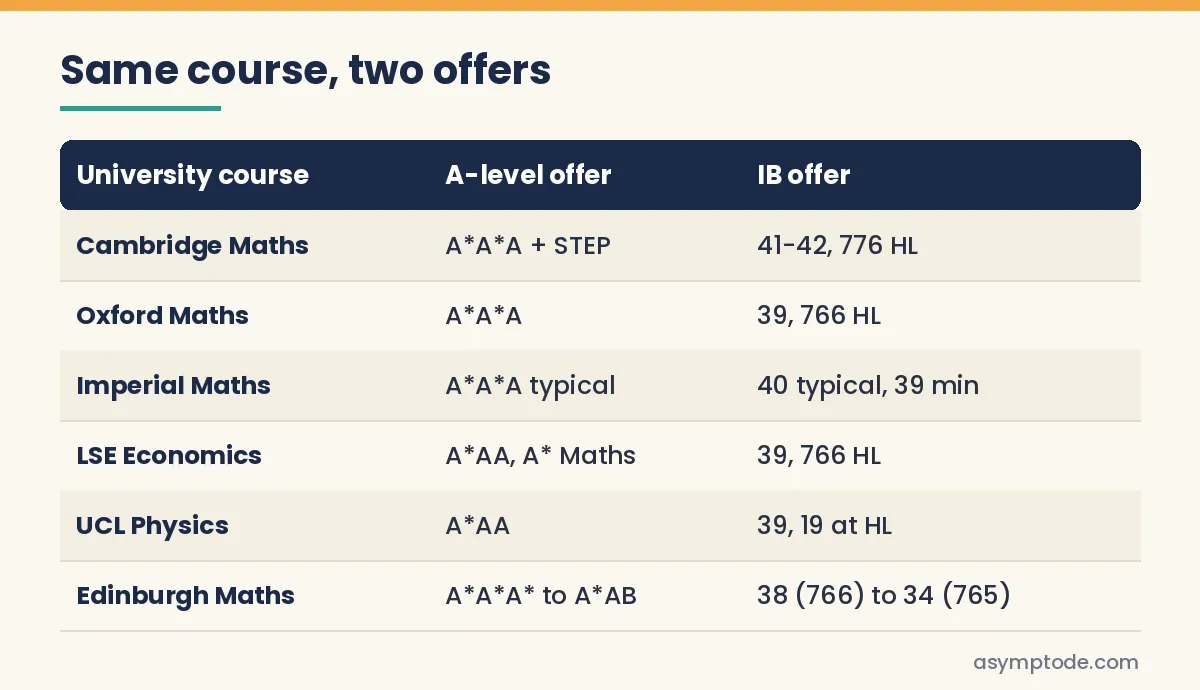 Same course, two offers: A-level vs IB.
| University course | A-level offer | IB offer |
|---|---|---|
| Cambridge Mathematics | AAA, plus STEP conditions | 41-42 points, 776 at HL |
| Oxford Mathematics | AAA (A*s in Maths and Further Maths) | 39 incl. core, 766 at HL, 7 in HL Maths |
| Imperial Mathematics | AAA typical | 40 typical (39 minimum, 7 HL Maths) |
| LSE Economics | AAA, A in Maths | 39 points, 766 at HL, 7 in Maths |
| UCL Physics | AAA (AA in Maths and Physics) | 39 points, 19 at HL |
| Edinburgh Mathematics | AAA* to AAB, A Maths | 38 (766 HL) to 34 (765 HL) |
The picture shows the same six courses: Cambridge, Oxford and Imperial Maths ask for AAA at A-level. Their IB offers are 41-42, 39 and 40 points. LSE Economics and UCL Physics ask for A*AA or 39 IB points.
Some courses add tests: Imperial Maths asks for the TMUA, and Cambridge sets STEP in its offer. Offers can change, so check each page. Our guides on getting into Cambridge, Oxford and Imperial go deeper.
UCAS Tariff: Where Tariff points are used, the UCAS Tariff tables give an A-level A* 56 points. The IB Diploma as a whole has none, but an HL 7 is 56 and an SL 7 is 28. Check the current tables on ucas.com.
What about the USA, Canada and India?
- USA: Cambridge International says many US universities give college credit or advanced standing for its AS & A Levels. The IB says many universities use a score of 4 or 5 as a minimum for admission or advanced placement.
- Canada: Cambridge says students with at least two A Levels, or at least four AS Levels, are eligible to apply. Competitive courses may want more.
- India: Three Cambridge International A Levels are equated to Grade 12. The IB says the Association of Indian Universities has recognised the IB Diploma since 1983. For engineering and medicine, students still sit entrance exams.
Who suits IB, and who suits A-levels?
| Your child... | Often fits |
|---|---|
| Enjoys many subjects and does not want to drop languages or humanities yet | IB |
| Likes essays, projects and steady work across two years | IB |
| Already knows they want maths, physics or engineering | A-levels (with Further Maths) or IB with HL Maths AA |
| Prefers going deep in three subjects | A-levels |
| Does best in a few big exams at the end | A-levels |
These are tendencies, not rules.
How do you choose between IB and A-levels?
 A simple four-step way to choose.
Step 1: list two or three target university courses. Step 2: read each course page for the A-level and IB offer and the required subjects. Step 3: check which route your school offers, with the right maths course. Step 4: pick the route that fits how your child learns best.
What are the common mistakes?
- Choosing on rumours. "IB is harder" or "A-levels are easier" are not facts. Read official offers instead.
- Picking the wrong maths. Some courses want IB AA or A-level Further Maths. Check before Year 12 or Grade 11 starts.
- Forgetting the core. In the IB, an E in TOK or the EE stops the Diploma, even with high subject grades.
- Ignoring admissions tests. TMUA or STEP can be part of the offer.
- Leaving science gaps. UCL Physics needs high grades in both Maths and Physics. See our A-level Physics guide.
How Asymptode helps you with IB or A-level maths and science
Picking IB or A-levels is just step one. Then your child must do well in their chosen courses. That might be IB Maths Analysis and Approaches or Applications and Interpretation, or A-level Maths and Further Maths with AQA, Edexcel, OCR or Cambridge International.
A qualified Asymptode mentor teaches your child one-to-one, live and online. The mentor follows the exact course and exam board your child takes, and their real exam dates.
Between classes, practice is made for your child alone. Say a calculus question went wrong last time. The next worksheet goes back to that idea, at your child's level, never generic. It is Asymptode's AI-assisted practice, written to the mentor's brief and sent only after the mentor approves it.
The mentor then marks it, and you see what was understood and what to practise next. So the work keeps correcting itself as the course goes on. For the Extended Essay, TOK or an internal assessment, the mentor helps with planning and the maths or science method only. The writing stays your child's.
Talk to an advisor to try a free demo class, or see our fees.
Facts checked against official sources on 7 November 2026.
FAQ
Is IB or A-level better for UK universities?
Neither is better. Top universities publish offers for both; LSE Economics, for example, asks for A*AA or 39 IB points with 766 at HL.
How many points do you need to pass the IB Diploma?
You need at least 24 out of 45 points. You must also meet other conditions, such as finishing CAS, at least 12 HL points and 9 SL points, and no E in TOK or the Extended Essay.
How many A-levels should my child take?
Most take three, and the offers above are written for three. Some add a fourth, such as Further Maths. Imperial Maths gives typical offers for three or four.
What is the IB equivalent of AAA?
There is no single official conversion; each university sets its own. For Cambridge Maths, AAA matches 41-42 points with 776 at HL. For Oxford Maths it matches 39 points with 766 at HL.
Can my child switch from IB to A-levels?
It depends on your school and the timing. The courses are built differently, so switching mid-way can be hard. Ask your school early.
Which maths should I pick for engineering or maths degrees?
Look at the course page first. Cambridge Maths requests IB Analysis and Approaches and A-level Further Maths. Imperial prefers AA but accepts AI at HL. UCL Physics accepts either at HL.
Ready to start? Book a free demo class and advisor call, or see our plans and fees.
Sources
- IB Diploma Programme curriculum (IBO)
- DP core (IBO)
- DP passing criteria (IBO)
- DP assessment FAQ (IBO)
- IB student assessment (IBO)
- DP mathematics (IBO)
- Recognition of the IB in India FAQ (IBO)
- AQA A-level Mathematics specification at a glance
- AQA A-level Mathematics scheme of assessment
- AQA A-level Mathematics general administration
- AQA A-level Further Mathematics
- Cambridge International AS & A Levels
- Cambridge International AS & A Level qualification
- Cambridge International recognition: India
- Cambridge International recognition: Canada
- Cambridge International recognition: USA
- UCAS Tariff tables (ucas.com)
- University of Cambridge: Mathematics
- University of Oxford Mathematical Institute: our offer
- Imperial College London: Mathematics BSc
- LSE: BSc Economics
- UCL: Physics BSc
- University of Edinburgh: Mathematics BSc entry requirements