
GCSE Combined Science is the science course most students in England take. It covers biology, chemistry and physics, and it gives two GCSE grades instead of one. This guide explains the six papers, how the double grade works, the tiers, and a revision plan that works.
Key takeaways
- Combined Science has six exams: two biology, two chemistry and two physics.
- With AQA (Trilogy, 8464), each paper is 1 hour 15 minutes and 70 marks. With Pearson Edexcel (1SC0) and OCR Gateway (J250), each is 1 hour 10 minutes and 60 marks.
- You get two grades on a 17-point scale, from 9-9 down to 1-1, such as 6-5 or 7-7.
- There are two tiers. Foundation covers 5-5 to 1-1. Higher covers 9-9 to 4-4.
- Questions on the required practicals and maths skills appear in every paper. They are where many marks are won and lost.
What is GCSE Combined Science?
Quick answer: GCSE Combined Science is a single course that covers biology, chemistry and physics and is worth two GCSEs. Students sit six written exams at the end of Year 11, two in each science. The result is a "double award" grade such as 6-6 or 6-5. It is the most common science route at GCSE in England.
The other route is Triple Science (also called Separate Sciences), where students get three separate GCSEs in Biology, Chemistry and Physics. Triple Science covers more content and has longer papers. Combined Science covers the core of all three sciences in less exam time.
Both routes can lead to A-Level sciences. Many sixth forms ask for grades like 6-6 or 7-7 in Combined Science to study a science A-Level, so check the entry rules of the sixth forms you are interested in.
How many papers are there, and how long are they?
Quick answer: Every board sets six papers: two each for biology, chemistry and physics. AQA Trilogy papers are 1 hour 15 minutes and 70 marks each. Edexcel and OCR Gateway papers are 1 hour 10 minutes and 60 marks each. Each paper is worth the same share of the final grade.
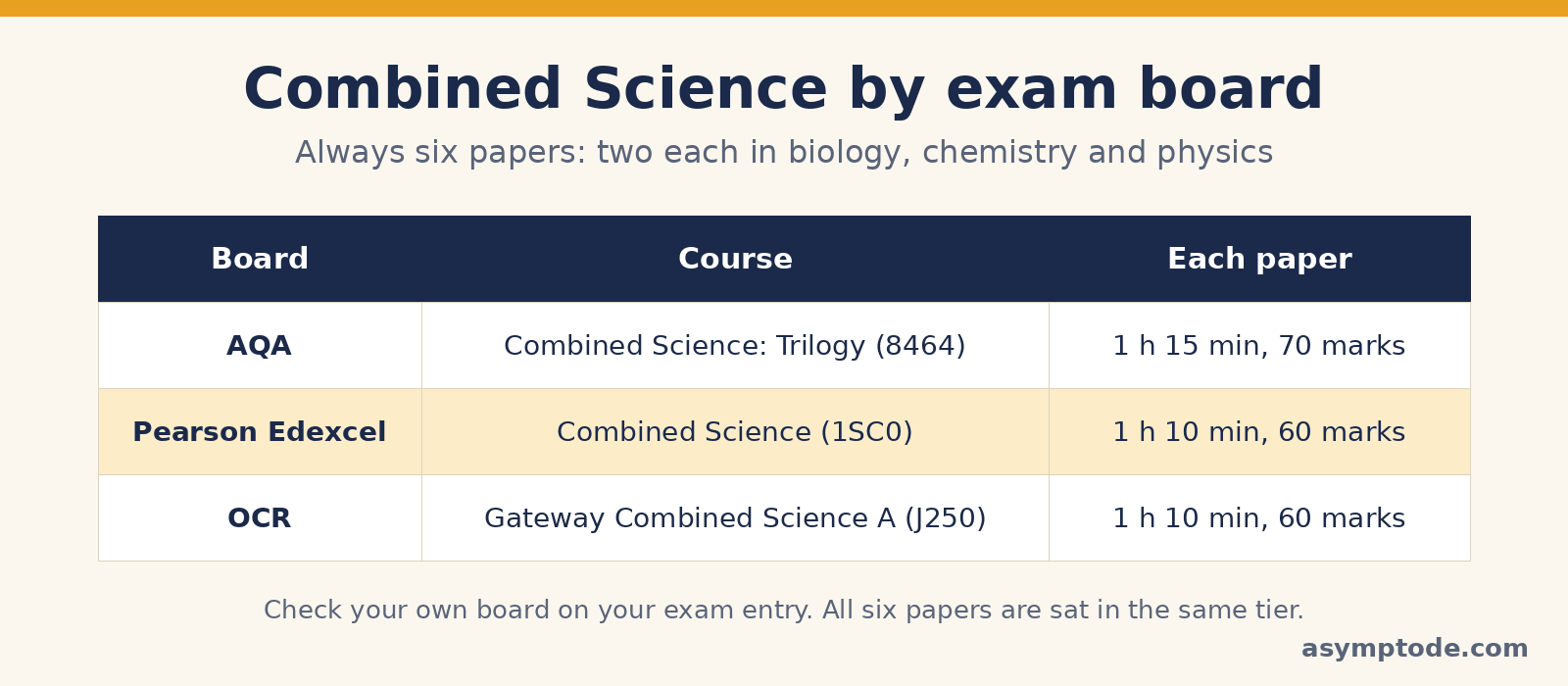
| Board | Course | Papers | Each paper |
|---|---|---|---|
| AQA | Combined Science: Trilogy (8464) | 6 | 1 h 15 min, 70 marks |
| Pearson Edexcel | Combined Science (1SC0) | 6 | 1 h 10 min, 60 marks |
| OCR | Gateway Combined Science A (J250) | 6 | 1 h 10 min, 60 marks |
Not sure which board your child sits? Look at old mock papers or ask the science teacher. It matters, because past papers and mark schemes are board-specific.
What is in each AQA Trilogy paper?
AQA is the most common board for Combined Science. Here is how its topics are split:
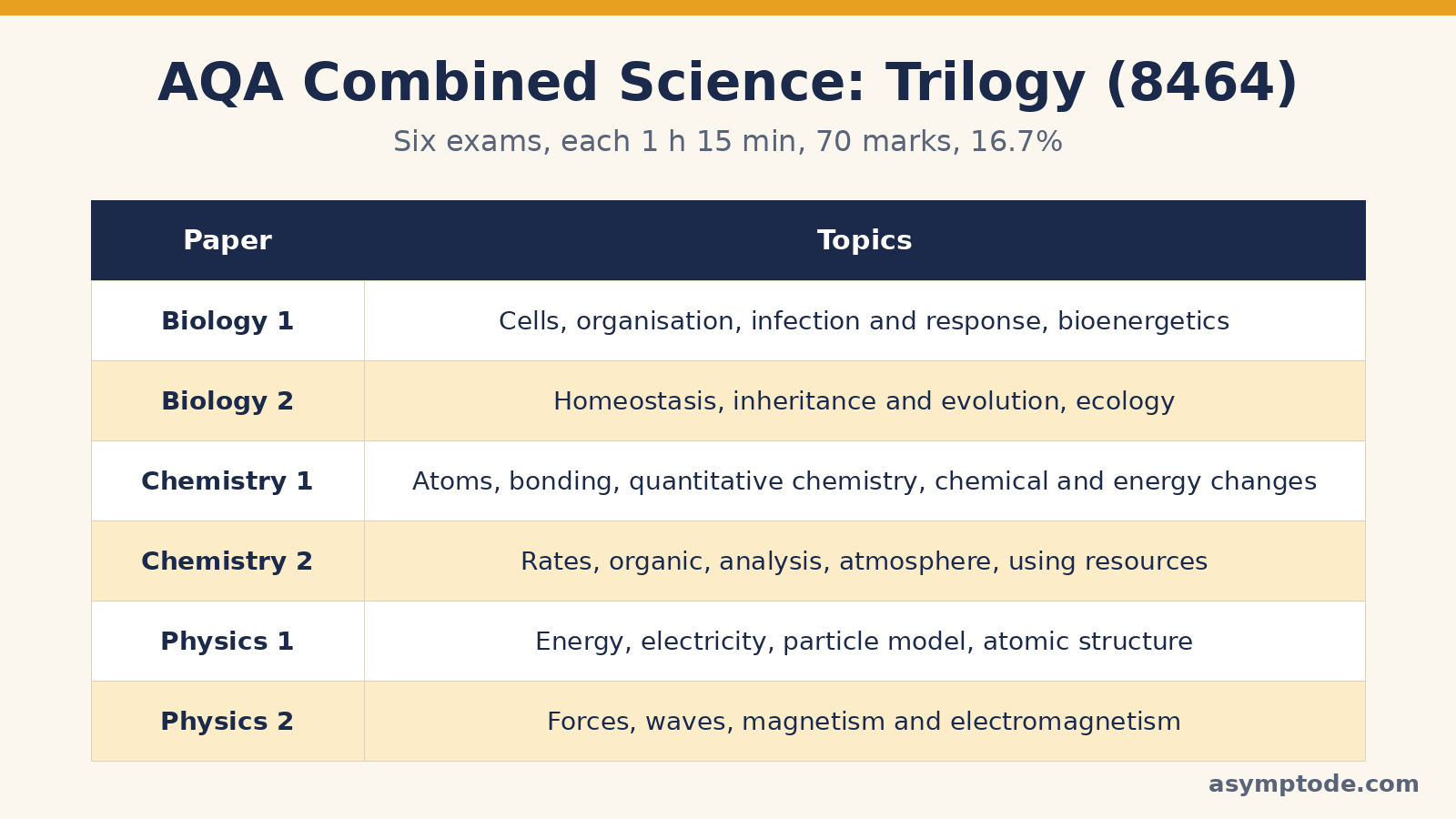
| Paper | Topics |
|---|---|
| Biology 1 | Cell biology, organisation, infection and response, bioenergetics |
| Biology 2 | Homeostasis and response, inheritance, variation and evolution, ecology |
| Chemistry 1 | Atomic structure and the periodic table, bonding, quantitative chemistry, chemical changes, energy changes |
| Chemistry 2 | Rates and equilibrium, organic chemistry, chemical analysis, the atmosphere, using resources |
| Physics 1 | Energy, electricity, particle model of matter, atomic structure |
| Physics 2 | Forces, waves, magnetism and electromagnetism |
Questions include multiple choice, short answers, calculations and longer 6-mark answers. Some questions use data, graphs or set-ups the student has never seen before.
How does the Combined Science double grade work?
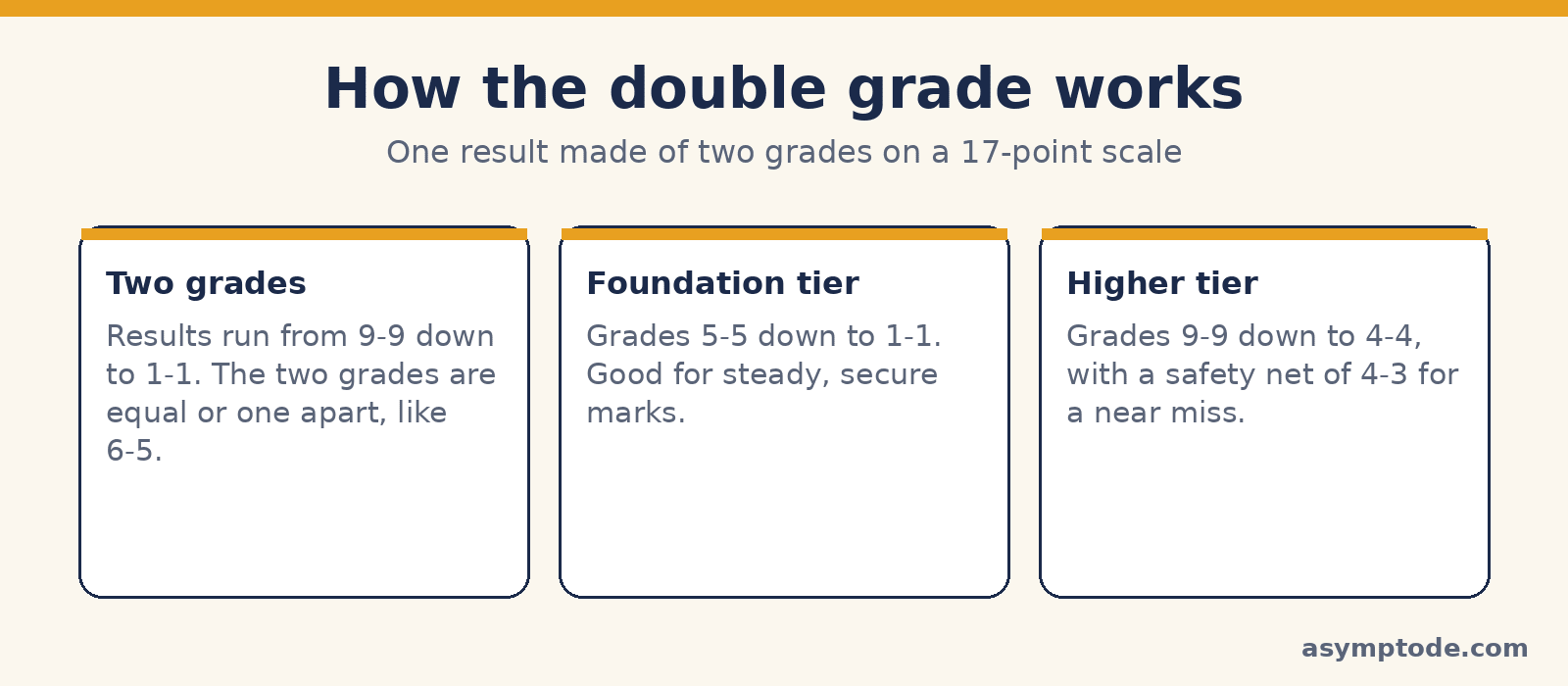
Quick answer: Combined Science gives two grades on a 17-point scale from 9-9 to 1-1. The two numbers are either the same or one apart, like 7-7 or 7-6. The grade comes from the total marks across all six papers, so a weaker paper can be balanced by a stronger one.
Because the grade is based on the total, there is no separate "biology grade" in Combined Science. A student who loves biology but struggles in physics still gets one combined result. This is why steady work on the weakest science gives the fastest rise in the overall grade.
Foundation or Higher tier: which is right?
Quick answer: Foundation tier gives grades 5-5 down to 1-1. Higher tier gives 9-9 down to 4-4, with an allowed 4-3 for a narrow miss. All six papers must be in the same tier. Choose Higher if your child is working securely at grade 5 or above in mocks; otherwise Foundation is often safer.
The school usually decides the tier after Year 11 mocks. If you are unsure, ask the teacher two questions: "What grade is my child working at now?" and "What grade do they need for their next step?" A student aiming for a science A-Level needs to be on Higher.
How much maths is in GCSE Combined Science?
Quick answer: Quite a lot. Every paper has marks set aside for maths skills, and physics and chemistry use the most. Students need to calculate, rearrange equations, convert units, read and draw graphs and use standard form. Strong maths often lifts a science grade.
These worked examples show the kind of steps examiners want to see.
Worked example 1 (physics): kinetic energy
A 2 kg ball moves at 3 m/s. Calculate its kinetic energy.
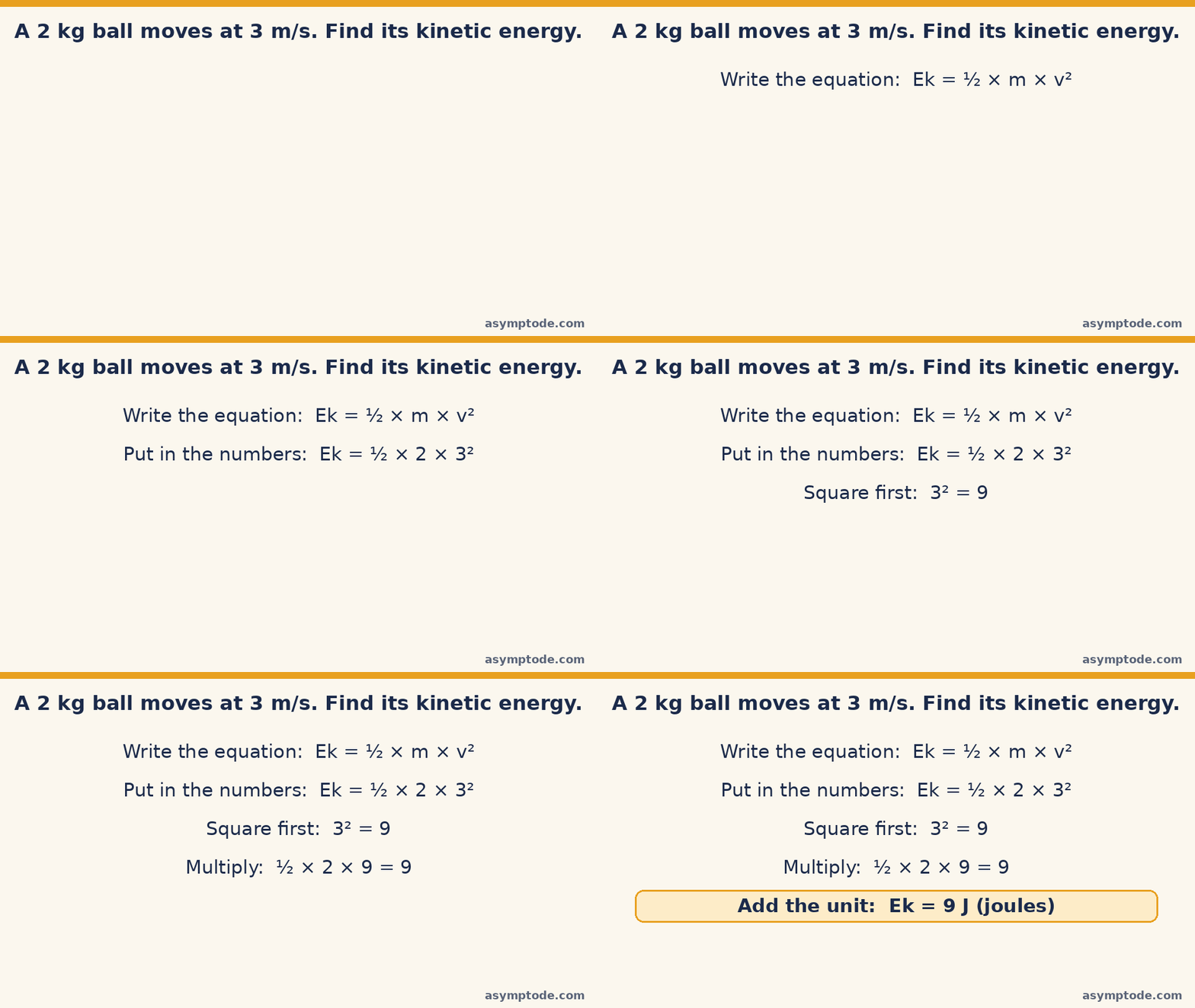
- Write the equation: Ek = ½ × m × v²
- Substitute: Ek = ½ × 2 × 3²
- Square the speed first: 3² = 9
- Multiply: ½ × 2 × 9 = 9
- Give the unit: Ek = 9 J
A common mistake is to multiply before squaring. Squaring first is the rule.
Worked example 2 (chemistry): relative formula mass
Find the relative formula mass (Mr) of carbon dioxide, CO₂. (C = 12, O = 16)
- CO₂ has 1 carbon atom and 2 oxygen atoms.
- Mr = 12 + (2 × 16) = 12 + 32 = 44
Relative formula mass has no units. If balancing equations still feels shaky, see our guide on how to balance chemical equations and our explainer on atoms and elements.
Worked example 3 (biology): magnification
A cell is 0.05 mm wide. In a drawing it is 5 mm wide. What is the magnification?
- Magnification = image size ÷ real size
- = 5 mm ÷ 0.05 mm
- = × 100
Both sizes must be in the same unit before you divide. Many lost marks come from mixing mm and µm.
What are the required practicals?
Quick answer: AQA Combined Science has 21 required practicals: 7 in biology, 6 in chemistry and 8 in physics. Students do them in class, then answer exam questions about the method, variables, results and errors. At least 15% of the marks test practical skills.
For each practical, a student should be able to:
- Name the independent, dependent and control variables.
- Write the method in clear numbered steps.
- Explain how to make the results accurate and repeatable.
- Draw and read a graph of the results, with a line of best fit.
- Spot a source of error and suggest how to reduce it.
A simple one-page summary for each practical is one of the best revision tools for Combined Science.
When are the GCSE Combined Science exams?
Quick answer: The six papers are sat in May and June of Year 11. The provisional 2027 GCSE timetable runs from Monday 10 May to Friday 18 June 2027, with results on Thursday 19 August 2027. Your child's school candidate timetable gives the exact dates and times.
Because the six papers are spread over several weeks, revision needs to be planned for all three sciences, not just the next exam.
A 12-week revision plan for Combined Science
Quick answer: In the 12 weeks before the exams, rotate the three sciences each week, do one timed past paper every week and keep an error log. Spend the last three weeks on full papers and fixing the most common mistakes.
| Weeks | Focus | Weekly routine |
|---|---|---|
| 1-4 | Content gaps | One topic per science per week; flashcards for key facts and equations |
| 5-8 | Exam skills | One past paper per week; practise 6-mark answers and calculations |
| 9-10 | Required practicals | One-page summaries; method and variable questions |
| 11-12 | Full papers | Timed papers in exam order; redo every missed question |
Simple daily habits
- 20 minutes of retrieval practice: close the book and write what you remember.
- One calculation a day: keep the maths skills sharp.
- Learn equations early: even when an equation sheet is given, knowing them saves time and builds confidence.
- Use mark schemes: check how marks are given, not just the final answer.
Common mistakes in GCSE Combined Science
| Mistake | How to avoid it |
|---|---|
| Missing units | Always write the unit in the final answer. |
| Vague 6-mark answers | Plan 4 to 6 linked points with key words before writing. |
| Revising only favourite topics | Use the error log to pick the weakest topic each week. |
| Skipping required practicals | Learn the method, variables and errors for each one. |
| Not showing working | Write every step. Method marks are often available even if the final answer is wrong. |
How 1-on-1 tutoring helps with GCSE Combined Science
Combined Science is wide. Most students are strong in one science and weaker in another, and the weak one pulls the double grade down. 1-on-1 lessons let a mentor spend time exactly where the marks are being lost.
At Asymptode, classes are live, online and 1-on-1, and they follow your child's own exam board and school timeline. For Combined Science this means:
- A short assessment first to find the weakest science, topics and exam skills.
- Step-by-step method checks. The mentor watches each step of a calculation and fixes the method, not just the answer.
- Targeted homework. Practice on taught topics, set at the right level and checked by the mentor.
- Every class recorded, so your child can replay a tricky explanation before a paper.
- Short updates for parents on what improved and what needs practice.
Many students also need help with GCSE Maths, which supports the science calculations. See our guide to GCSE Maths papers explained. Thinking further ahead? Read our A-Level Maths guide.
Want a clear science plan for Year 10 or 11? Book a free demo class with an Asymptode advisor, or see our fees.
FAQ
Is GCSE Combined Science worth two GCSEs?
Yes. Combined Science is a double award, so it counts as two GCSEs and gives two grades, such as 6-6 or 6-5.
Can you do A-Level science after Combined Science?
Yes. Many students take A-Level Biology, Chemistry or Physics after Combined Science. Sixth forms often ask for grades like 6-6 or higher, so check their entry rules.
What is the difference between Combined and Triple Science?
Triple Science gives three separate GCSEs and covers more content in longer exams. Combined Science gives two GCSEs and covers the core of all three sciences.
How many papers are in GCSE Combined Science?
Six: two biology, two chemistry and two physics. AQA papers are 1 hour 15 minutes each; Edexcel and OCR Gateway papers are 1 hour 10 minutes each.
What grade is a pass in Combined Science?
A grade 4-4 is a standard pass, and 5-5 is a strong pass. A 4-3 is not a full standard pass in both grades, so some sixth forms and courses ask for 4-4 or higher.
Can my child change tier?
The school makes the final tier entry, usually after Year 11 mocks. Talk to the science teacher early if you think the tier is wrong.