If you want to know how to become a software engineer, the short path is clear: get strong at maths and computer science at school, earn a degree in computer science or a related field, build real projects, and land an internship before your first job. This guide for students and parents covers subjects, school exams in the US, UK, India and the IB, degrees, contests and the honest job outlook, using official sources.
Key takeaways
- Software engineers design, build, test and maintain the programs that run apps, websites, banks, cars and much more.
- At school, take maths every year (up to calculus if you can) and computer science; physics is a strong extra.
- Key school exams include AP Computer Science A and AP Calculus (US), A-level Maths, Further Maths and Computer Science (UK), JEE Main and JEE Advanced (India), and HL Maths in the IB.
- Most employers look for a bachelor's degree in computer science or a related field, plus projects and internships.
- The US Bureau of Labor Statistics reports a median wage of $134,040 (May 2025) for this group and projects 10 percent job growth from 2025 to 2035.
How to become a software engineer: what are the main steps?
Quick answer: To become a software engineer, take maths and computer science at school, learn to code early, and do well in the exams your target universities ask for. Then study computer science, software engineering or computer engineering, build projects, join contests, and do at least one internship. Most people start as junior engineers and keep learning on the job.
- School: maths every year, computer science, and physics if you can.
- Exams: AP, A-level, IB or Indian entrance exams, depending on where you live.
- Degree: usually a bachelor's in computer science or a related field.
- Projects and contests: build things and test yourself, for example in USACO or an informatics olympiad.
- Internship, then first job: get real team experience, then apply for junior roles.
 The four big stages on the way to a software engineering job.
There are four stages. First, school maths and computer science. Second, a degree in computer science (CS), software engineering (SE) or computer engineering. Third, projects, contests and internships. Fourth, a first job as a junior software engineer.
What does a software engineer actually do?
A software engineer plans and builds software that works reliably for many people. The US Bureau of Labor Statistics (BLS) groups this work under software developers, quality assurance analysts and testers. It says software developers design computer applications or programs, while quality assurance (QA) analysts and testers find problems in programs and report defects.
According to the BLS, typical duties include working out what users need, designing each part of a system, testing and maintaining programs, and writing documentation. Most work full time, often on teams. The BLS says the largest employer of software developers in 2025 was computer systems design and related services (29 percent).
Software engineer vs software developer: is there a difference?
The titles overlap a lot, and many companies use both for the same job. "Engineer" often hints at larger systems and design trade-offs. The BLS page used in this guide has no separate "software engineer" category.
Software engineer vs data scientist: which fits you?
A software engineer builds the product. A data scientist studies data to answer questions and make predictions. Data science leans more on statistics; software engineering leans more on system design. If you love statistics and asking "why?", read our guide on how to become a data scientist. If you like physical machines and structures too, compare other routes in how to become an engineer.
Which school subjects should I choose to become a software engineer?
Choose maths every year and go as far as your school allows. Add computer science as soon as it is offered. Physics is a good third subject, because it trains you to model problems and work step by step.
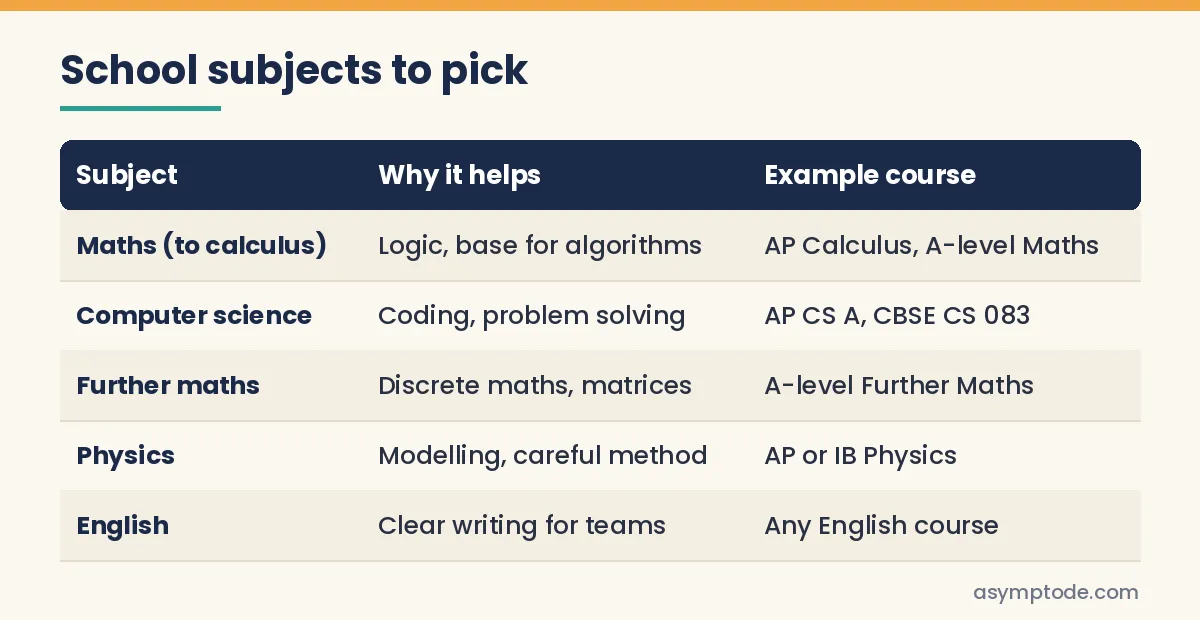 School subjects that build the software engineer skill set.
Maths up to calculus builds logic and the base for algorithms (for example AP Calculus or A-level Maths). Computer science builds coding and problem solving (for example AP Computer Science A or CBSE Computer Science 083). Further Maths adds discrete maths and matrices. Physics trains modelling and careful method. English helps you write clearly for a team.
Why maths? Coding needs logic and comfort with functions, sequences and matrices. Why English? The BLS lists communication skills next to analytical and problem-solving skills, because engineers explain their work to people who do not code.
What to choose in each school system
| School system | Core choices | Good extras |
|---|---|---|
| US high school | AP Calculus AB or BC, AP Computer Science A | AP Computer Science Principles, AP Physics |
| UK A-levels | A-level Maths, Further Maths if offered | Computer Science, Physics |
| IB Diploma | Maths at Higher Level | Computer Science (SL or HL), Physics |
| India (Class 11-12) | Mathematics, Physics, Chemistry | Computer Science (CBSE code 083) |
For UK students, our A-level Maths guide explains the papers and how to prepare.
What school exams are on the path to software engineering?
United States: AP courses and the SAT or ACT
AP Computer Science A is an introductory college-level course. The College Board says it uses a subset of Java. It recommends high school English and algebra first, plus some comfort with functions.
AP Computer Science Principles is a broader introduction with an exam plus a Create performance task that counts toward your score. No coding experience is needed. The course is being redesigned for the 2027-28 school year to teach students to work with AI responsibly.
The College Board's 2027 AP exam dates are:
| AP exam | 2027 date | Session |
|---|---|---|
| AP Calculus AB and BC | Monday, May 10, 2027 | Morning |
| AP Computer Science A | Wednesday, May 12, 2027 | Afternoon |
| AP Computer Science Principles | Friday, May 14, 2027 | Morning |
The AP Computer Science Principles Create task is due as final by Friday, April 30, 2027, 11:59 p.m. ET. See all subjects in our AP exam dates 2027 guide.
Many US colleges look at SAT or ACT scores, but each sets its own testing policy, so check every college on your list. Aiming high? Read how to get into MIT.
United Kingdom: A-levels and UCAS
Many computer science degrees ask for A-level Maths, and some top courses also want Further Maths. For example, the University of Cambridge says for 2027 entry that A-level Maths is required and that you should take Further Maths to AS or A level if your school offers it. All its applicants take the TMUA admissions test, and the typical offer is AAA.
A-level Computer Science is useful but not always required. In the OCR course (H446), there are two 2 hour 30 minute exams, each worth 40 percent, and a programming project worth 20 percent.
You apply through UCAS. For 2027 entry, the main deadline is 13 January 2027 at 18:00 UK time for courses that do not have an earlier 15 October deadline.
India: JEE Main, JEE Advanced, BITSAT and CBSE
For a B.Tech in Computer Science and Engineering, students take Physics, Chemistry and Maths in Class 12 and sit entrance exams.
- JEE Main 2027 is run by the National Testing Agency in two sessions, January 2027 and April 2027. The official notice lists Session 1 exam dates of 20, 21, 22, 23, 24 and 28 January 2027. Session 1 applications run from 24 October to 22 November 2026. Paper 1 (B.E./B.Tech) is for NITs, IIITs and other centrally funded institutes, and it is also the eligibility test for JEE Advanced. See our JEE Main 2027 guide.
- JEE Advanced is the exam for the IITs. As of 7 November 2026, the official JEE Advanced site still shows 2026 information, so 2027 dates are not yet announced. Read how to get into IIT for the full route.
- BITSAT is the BITS Pilani admission test. Check the official BITS admissions site for 2027 dates.
- CBSE Computer Science (code 083) uses Python. In the 2026-27 Class 12 syllabus, theory is 70 marks (programming 40, networks 10, databases 20) and practical work is 30 marks.
IB Diploma
Take Maths at Higher Level (Cambridge asks for HL Analysis and Approaches). The IB says Computer Science is now a group 4 science subject, offered at SL and HL. It has no set programming language; teachers choose one.
Which degree do you need to become a software engineer?
Most employers want a bachelor's degree. The BLS says employers typically look for a degree in computer and information technology or a related field such as engineering or mathematics, and some prefer a master's degree.
| Degree | Focus | Good if you like |
|---|---|---|
| Computer science | Algorithms, theory, programming, systems | Maths and solving puzzles |
| Software engineering | Building large, reliable software in teams | Design, testing and process |
| Computer engineering | Hardware plus software | Electronics and how chips run code |
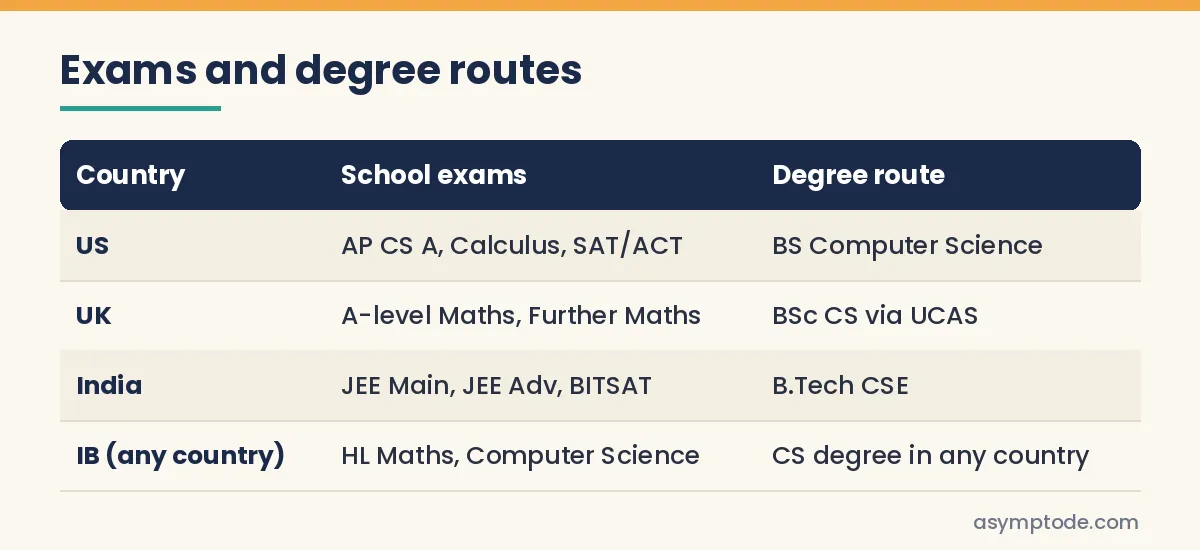 School exams and degree routes in four systems.
US: AP Computer Science A, AP Calculus and often the SAT or ACT, then a BS in Computer Science. UK: A-level Maths and Further Maths, then a BSc in Computer Science through UCAS. India: JEE Main, JEE Advanced or BITSAT, then a B.Tech in Computer Science and Engineering. IB: HL Maths and Computer Science, then a CS degree in any country.
Does accreditation matter?
Accreditation means an outside body has checked a degree's quality.
- US: ABET accredits programs (not whole universities) in computing and engineering. Its Computing Accreditation Commission has criteria for computer science programs. ABET's website lets you search accredited programs.
- UK: BCS, The Chartered Institute for IT accredits computing degrees. Graduates can meet the criteria, in full or in part, for titles such as Chartered IT Professional (CITP) or Chartered Engineer (CEng).
- India: the National Board of Accreditation (NBA) accredits engineering programmes, and its site lists accredited programmes.
What contests and projects can school students do?
- USACO (USA Computing Olympiad): USACO runs four free online contests a year in bronze, silver, gold and platinum divisions. Top students go to a summer training camp, where the US team for the International Olympiad in Informatics (IOI) is chosen. Check the site for 2026-27 dates.
- Indian Computing Olympiad: run by IARCS. The ZIO (written) and ZCO (programming in C++, Java or Python) lead to the INOI (C++ only). About 30 students reach the IOI Training Camp, and a team of four goes to the IOI.
- ICPC (later, at university): the ICPC is a programming contest for college students in teams of three.
Key Indian Computing Olympiad dates for the 2027 cycle:
| Stage | Date |
|---|---|
| ZIO-2027 | 21 November 2026 (registration closed 6 November) |
| ZCO-2027 | 12 December 2026 (register by 1 December 2026) |
| INOI-2027 | Saturday, 6 February 2027 |
| IOI-2027 | Germany (dates on the IOI site) |
It is open to students of any Indian school board, up to Class 12 in 2026-27.
Projects matter as much as contests. Build a small game or a website for a school club, put the code online and keep improving it. A research project can help too; see research for high school students.
Want a mentor to help you plan subjects, exams and contest prep around your syllabus? Book a free demo class with Asymptode.
Worked example: how does binary search work?
Binary search is a classic algorithm, and it appears in courses such as OCR A-level Computer Science. It finds an item in a sorted list by checking the middle and throwing away half the list each time.
Find 21 in this sorted list: 3, 8, 12, 17, 21, 25, 30 (positions 0 to 6).
- Search positions 0 to 6. The middle is position 3, which holds 17.
- 17 is less than 21, so 21 must be to the right. Search positions 4 to 6.
- The middle is position 5, which holds 25. 25 is greater than 21, so search position 4 only.
- Position 4 holds 21. Found, in 3 checks.
A linear search (checking from the start, one by one) would need 5 checks: 3, 8, 12, 17, then 21.
 Binary search halves the list at every step.
Start with the list 3, 8, 12, 17, 21, 25, 30 and look for 21. The middle is 17, which is too small, so go right. In the right half (21, 25, 30) the middle is 25, which is too big, so keep only 21. Binary search finds 21 in 3 checks; linear search needs 5.
Why does this matter? Each check halves the list. A sorted list of 7 items needs at most 3 checks. A list of 1,000 items needs at most 10, because 2^10 = 1,024. This "halving" idea is the same maths as logarithms, which is one reason school maths matters for coding.
Do you need an internship to become a software engineer?
It is not required, but it helps a lot. The BLS notes that students can gain software development experience through internships, such as at a software company, while in college. An internship teaches you how real teams plan, review and test code.
To get one, build two or three projects you can explain, learn basic data structures and algorithms (lists, searching, sorting), and apply early through your university careers service.
What is the job outlook for software engineers?
The outlook is positive. These figures come from the BLS Occupational Outlook Handbook, for the US only.
| BLS measure (US) | Figure |
|---|---|
| Median pay, whole group (May 2025) | $134,040 per year ($64.44 per hour) |
| Median pay, software developers (May 2025) | $135,980 |
| Median pay, QA analysts and testers (May 2025) | $104,300 |
| Jobs (2025) | 1,905,400 |
| Projected growth (2025-35) | 10 percent, much faster than the 3 percent average |
| Openings per year (average) | About 106,100 |
The median means half earned more and half less; pay varies by place and experience. The BLS expects software developers alone to grow 10 percent and QA analysts and testers 6 percent over 2025-35. Many openings replace workers who retire or change jobs.
Will AI replace software engineers?
The BLS names software for artificial intelligence as one reason demand is expected to grow. It also lists robotics, automation and cybersecurity. Tools change fast, and the BLS says developers must keep learning new tools and languages. The honest view: AI changes how engineers work, so understanding the maths, logic and design behind code matters more, not less.
How 1-on-1 tutoring helps with becoming a software engineer
- One dedicated mentor, live online 1-on-1: your mentor follows your own syllabus and exam dates, from AP Calculus and A-level Further Maths to IB HL Maths or JEE Maths and Physics.
- Method-first maths: the mentor watches each step of your working, so logic gaps are fixed before they slow down your coding and algorithm work.
- Personalised homework with feedback: practice is set at your level, and every class is recorded so you can rewatch hard ideas.
- Planning support and parent updates: for subject choices, contest timelines and applications, the mentor helps with planning and method, and parents get short updates. Start with a free demo class.
Facts checked against official sources on 7 November 2026.
FAQ
How long does it take to become a software engineer?
For most people it means school, then a bachelor's degree, whose length depends on the country. The BLS says a bachelor's degree is the typical entry-level education.
Can I become a software engineer without a degree?
Some people do, through self-study and strong projects. But the BLS says employers typically look for a bachelor's degree in computer and information technology or a related field. A degree is still the typical route.
Is maths really needed for software engineering?
Yes. Logic, functions and ideas like logarithms appear in algorithms such as binary search. Top courses such as Cambridge Computer Science require A-level Maths, and Further Maths if your school offers it.
Which programming language should I learn first?
Start with the language your school course uses: Java for AP Computer Science A, Python for CBSE Computer Science. Once you know one language well, the next is much easier.
What is the median salary for software developers?
The BLS reports a median annual wage of $135,980 for US software developers in May 2025 ($134,040 for the whole group, including QA analysts and testers). Pay in other countries differs.
Should I study computer science or software engineering?
Both lead to software jobs. Computer science is broader and more theory-based; software engineering focuses on building large systems. Compare modules and check accreditation (ABET, BCS or NBA).
Ready to start? Book a free demo class and advisor call, or see our plans and fees.
Sources
- Software Developers, Quality Assurance Analysts, and Testers, Occupational Outlook Handbook (BLS)
- AP Computer Science A (College Board)
- AP Computer Science Principles (College Board)
- AP exam dates (College Board)
- Computer Science, 2027 entry (University of Cambridge)
- A Level Computer Science H446 specification (OCR)
- 2027 entry deadline (UCAS)
- JEE (Main) 2027 (National Testing Agency)
- JEE (Advanced) official site
- DP Computer Science (International Baccalaureate)
- What is accreditation (ABET)
- Academic accreditation (BCS)
- National Board of Accreditation (NBA)
- USA Computing Olympiad (USACO)
- Indian Computing Olympiad (IARCS)
- ICPC