
If you want to know how to become a psychologist, the short version is this: study psychology at university, go on to an accredited postgraduate programme, complete supervised practice, and then register or get licensed where you want to work. The details change a lot between the US, UK, India, Canada and Australia. This guide walks through each route, the school subjects that help, and the maths skill that surprises most students: statistics.
Key takeaways
- Most practising psychologists need a postgraduate qualification. In the US, clinical and counseling psychologists typically need a PhD or PsyD.
- Each country has its own regulator: US state boards, the HCPC in the UK, the RCI in India, provincial regulators in Canada and the Psychology Board of Australia.
- The US Bureau of Labor Statistics lists a median pay of $99,110 (May 2025) and projects 6% job growth from 2025 to 2035.
- Statistics is a core skill. A-level Psychology alone puts at least 10% of its marks on maths.
- At school, focus on maths, biology, psychology (if offered), clear writing and small research projects.
How to become a psychologist: what are the main steps?
Quick answer: To become a psychologist, you earn a bachelor's degree in psychology (or a recognised conversion course), then complete an accredited master's or doctorate. After that you finish supervised practice, such as an internship, and pass any required exam. Finally you register or get licensed with the regulator in your country or state.
 The four big stages on the road to becoming a psychologist.
The four stages are school subjects, an undergraduate psychology degree, an accredited master's or doctorate with supervised practice, and a licence or registration. The order is the same almost everywhere. Only the length of each stage and the regulator change.
What does a psychologist actually do?
Psychologists study how people think, feel and behave. They use research methods to understand people, and many use that knowledge to help them. The US Bureau of Labor Statistics lists the first four groups below. Research psychologists are a fifth path many students ask about:
- Clinical and counseling psychologists assess and help people with emotional, mental and behavioural problems.
- School psychologists work with students, teachers and parents on learning and behaviour.
- Industrial-organizational (I-O) psychologists apply psychology to workplaces, such as hiring, training and teamwork.
- Other psychologists include forensic psychologists, neuropsychologists and rehabilitation psychologists.
- Research psychologists run studies, often at universities, and publish what they find.
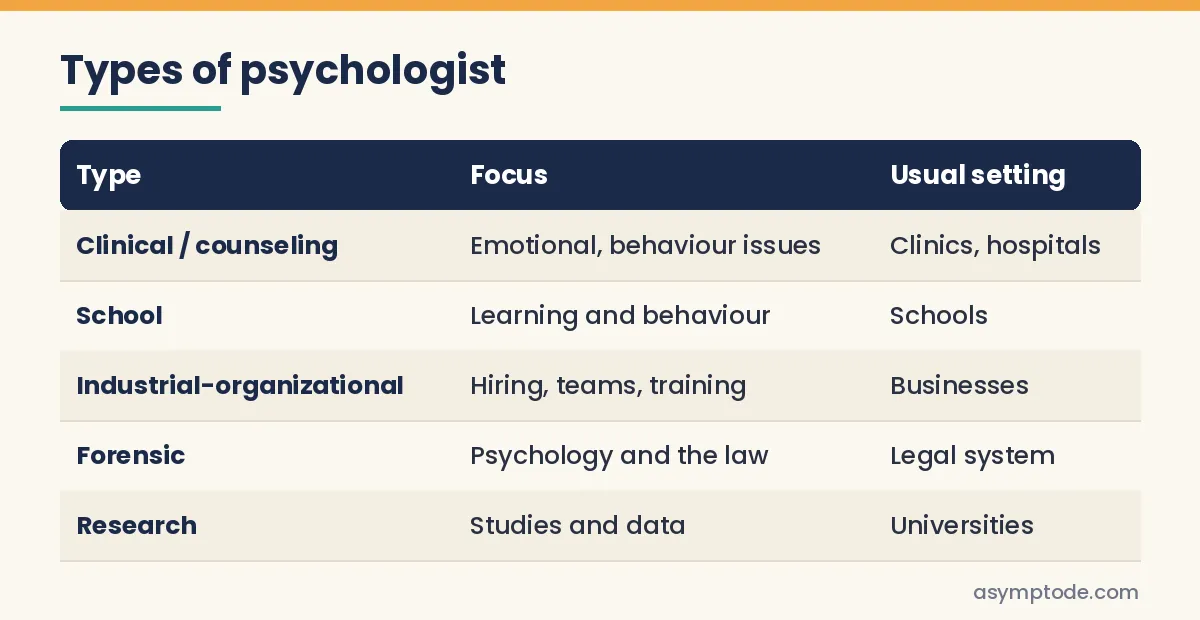 Five common types of psychologist and where they work.
The table shows clinical and counseling psychologists in clinics and hospitals, school psychologists in schools, I-O psychologists in businesses, forensic psychologists in the legal system, and research psychologists at universities.
This article covers careers and training only, not medical or mental-health advice. If you need support, speak to a doctor or qualified professional.
How much do psychologists earn, and is there demand?
Here are the official US numbers from the BLS Occupational Outlook Handbook, exactly as stated:
| Measure | Official figure |
|---|---|
| Median pay | $99,110 per year ($47.65 per hour), May 2025 |
| Number of jobs | 209,400 in 2025 |
| Job outlook | 6% growth, 2025 to 2035 ("faster than the average") |
| New jobs over the decade | About 11,600 |
| Openings per year | About 11,300 on average |
Median means half earned more and half earned less. These numbers are for the US only. For other countries, check the official labour-market pages.
How do you become a psychologist in the US?
The US route is long, but it is clear. BLS says psychologists typically need at least a master's degree, and clinical and counseling psychologists typically need a PhD or PsyD.
- Earn a bachelor's degree. A psychology major is common. Take statistics and research methods courses.
- Get into a doctoral programme. This is usually a PhD or a PsyD. For clinical, counseling or school psychology, look for programmes accredited by the APA Commission on Accreditation. It accredits doctoral programmes, doctoral internships and postdoctoral residencies.
- Complete an internship. APA also accredits doctoral internships. BLS notes most psychologists need supervised experience, such as an internship or postdoctoral training, for licensure.
- Pass the EPPP. The Examination for Professional Practice in Psychology is run by ASPPB for 66 boards in the US and Canada. All of them require Part 1 (Knowledge). Some also require Part 2 (Skills). ASPPB says a new integrated EPPP takes effect in the fourth quarter of 2027, and from 1 April 2028 it will be the only version offered.
- Get a state licence. BLS says all states and Washington, D.C. require independently practising psychologists to be licensed. You also need continuing education to keep the licence.
What about school psychologists in the US?
School psychology has its own route. According to NASP, you need specialist-level training. The degree can be called an MA, MS, MEd, EdS or similar. The programme needs at least 60 graduate semester credits and a 1,200-hour internship. Nearly all states certify school psychologists with this level of training. Some states require a doctorate, so check the state where you want to work.
How do you become a psychologist in the UK?
In the UK, the key steps are a BPS-accredited degree and HCPC registration.
- Get Graduate Basis for Chartered Membership (GBC). The British Psychological Society gives GBC to students who complete an accredited psychology degree with at least a 2:2 and pass the psychology project. If your degree is in another subject, an accredited conversion course (usually about a year) can give you GBC.
- Gain relevant experience, for example in assistant or support roles.
- Complete an accredited doctorate. For clinical psychology, this is usually the Doctorate in Clinical Psychology (DClinPsy). The careers site Prospects says it usually takes three years full-time, places are usually NHS-funded, and most applications go through the Clearing House. Other specialties, such as educational or forensic psychology, have their own training routes.
- Register with the HCPC. You then register with the Health and Care Professions Council.
Which psychologist titles are protected in the UK?
The HCPC protects nine titles: practitioner psychologist, registered psychologist, clinical, forensic, counselling, health, educational, occupational, and sport and exercise psychologist. The HCPC says the word "psychologist" by itself is not protected by law. But using a protected title without being on the Register is a criminal offence. So always check the register before you trust a title.
How do you become a psychologist in India?
India's route is changing right now, so read official notices carefully.
- Study psychology after Class 12. Take a BA or BSc in psychology. RCI has also approved a dedicated clinical psychology bachelor's.
- Do a master's degree. An MA or MSc in psychology is the usual next step.
- For clinical psychology, take an RCI-recognised programme. In the past, this was the M.Phil Clinical Psychology. A UGC letter attached to an RCI public notice says the M.Phil was discontinued under NEP 2020. It allowed admissions to M.Phil Clinical Psychology until the 2025-26 session only. From 2026-27, programmes are to be offered under a new name.
- Note the new names. An RCI Office Memorandum dated 3 May 2026 renamed the M.A. Clinical Psychology as Master in Clinical Psychology (M.Clin.Psy). It also renamed the B.Sc. Clinical Psychology as Bachelor in Clinical Psychology (B.Clin.Psy).
- Register with RCI. Under the RCI Act, 1992, clinical psychologists count as rehabilitation professionals. The Act links practice to the Central Rehabilitation Register.
Entry rules and approved colleges can change, so check the RCI circulars page before you apply.
What about Canada and Australia?
Canada. Psychology is regulated by each province and territory, says the Canadian Psychological Association. Some regulators require a doctorate. Others accept a master's, sometimes under a title such as psychological associate. The EPPP is used here too. Read your province's rules early.
Australia. The Psychology Board of Australia (working with Ahpra) requires a six-year sequence of education and training for general registration. Programmes are accredited by APAC. After a four-year accredited sequence, the current pathways are:
- Higher degree pathway: an accredited master's (fifth and sixth year) or a doctorate.
- 5+1 internship pathway: five years of accredited study, then a one-year internship. You sit the National Psychology Exam before general registration (details).
- 4+2 pathway: closed to new applicants on 30 June 2022.
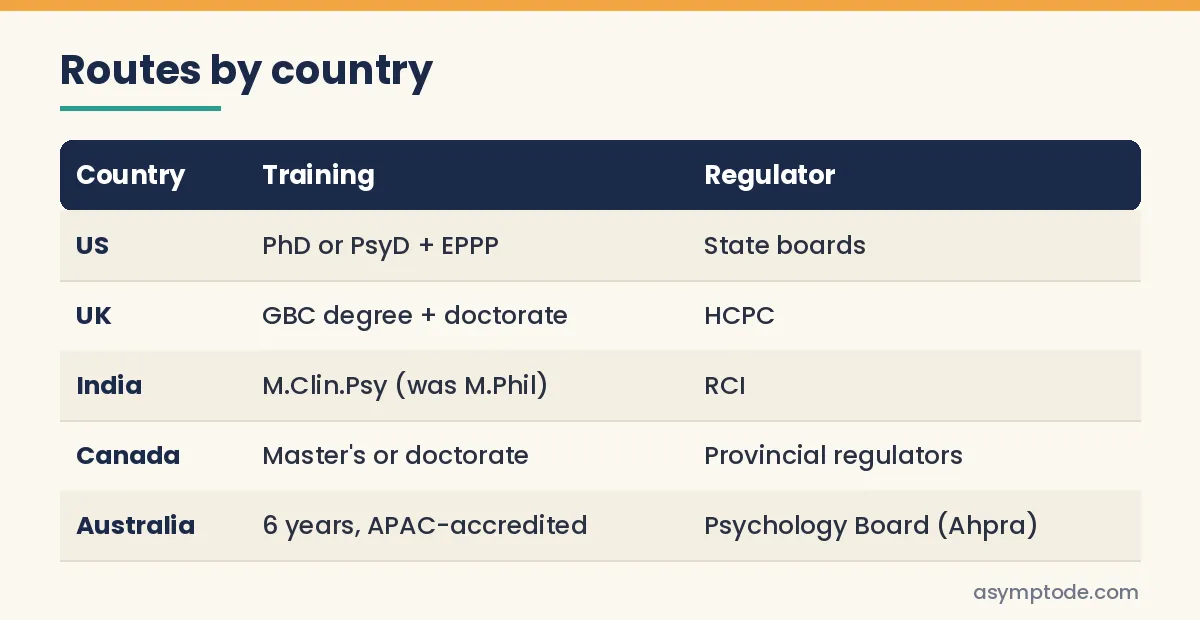 Routes and regulators by country at a glance.
In the US, you take a PhD or PsyD and pass the EPPP, then get a state licence. In the UK, you get GBC from a BPS-accredited degree, take a doctorate and register with the HCPC. In India, clinical psychologists take an RCI-recognised master's (now called M.Clin.Psy) and register with RCI. In Canada, provincial regulators decide whether you need a master's or doctorate. In Australia, you complete a six-year APAC-accredited sequence and register with the Psychology Board of Australia.
Which school subjects help you become a psychologist?
No single subject is required everywhere, but some give you a head start.
- Psychology: AP Psychology in the US covers biological bases of behaviour, cognition, development and learning, social psychology and personality, and mental and physical health. It also trains you to interpret data. See our guide to AP exam dates for 2027 to plan when to sit it. In the UK, A-level Psychology is offered by boards such as AQA.
- Statistics and maths: AP Statistics, A-level Maths or strong Class 11-12 maths. This is the subject that pays off most at university.
- Biology: helpful for brain and behaviour topics, and for neuropsychology.
- English or another essay subject: psychologists write reports and research papers.
If you are choosing between systems, our IB vs A-level comparison explains how the subject choices differ.
Why is statistics so important for psychologists?
Every psychology study collects data, and statistics shows what the data says. AQA's A-level Psychology specification says at least 10% of marks need maths at the level of higher-tier GCSE maths. One listed skill is to "calculate standard deviation". University courses go much further.
A worked example: mean and standard deviation
Five students take a short memory test. They remember 4, 6, 8, 10 and 12 words.
 Mean and standard deviation of five memory-test scores, step by step.
The animation shows the mean (40 / 5 = 8), the deviations (-4, -2, 0, 2, 4), the squares adding to 40, and a standard deviation of about 3.16. Here are the steps in full:
- Find the mean. Add the scores: 4 + 6 + 8 + 10 + 12 = 40. Divide by 5. Mean = 8.
- Find each deviation. Subtract the mean: -4, -2, 0, 2, 4.
- Square each deviation. 16, 4, 0, 4, 16.
- Add the squares. 16 + 4 + 0 + 4 + 16 = 40.
- Divide by n - 1. 40 / 4 = 10. This is the sample variance.
- Take the square root. The square root of 10 is about 3.16. This is the standard deviation.
So the average student remembered 8 words, and most scores sit about 3 words either side. Dividing by n instead gives the population version (about 2.83), so check which one your course uses.
Psychology degrees build on this with correlation and hypothesis tests. If you like this side of the subject, our guide on how to become a data scientist shows another career that uses the same skills.
What can you do at school to get ready?
These steps build real skills and show genuine interest.
- Do a small research project. Design a simple survey or experiment, collect data ethically, and write it up. Our guide to research for high school students explains how to start.
- Volunteer with people. Tutoring younger students, helping at a community centre or supporting a club teaches you to listen and communicate.
- Practise statistics. Learn mean, median, standard deviation and graphs until they feel natural.
- Talk to people in the field. Ask a psychologist what their training was like.
- Compare related careers. Psychology overlaps with medicine and science. Read how to become a doctor and how to become a scientist to see which fits you best.
Want a mentor to help you build strong maths and statistics now? Book a free demo class, or see our plans and fees.
What are the most common mistakes?
- Thinking a bachelor's degree is enough. In most countries, practising as a psychologist needs postgraduate training and registration.
- Ignoring accreditation. In the US, look for APA accreditation for clinical, counseling and school programmes. In the UK, check BPS accreditation. In Australia, check APAC.
- Avoiding maths. Statistics is part of every psychology degree.
- Following old advice in India. The M.Phil route is being replaced. Always check the latest RCI notices.
- Planning for the wrong country. Rules differ by country, state and province. Decide early where you want to work.
- Mixing up careers. Psychologists are not the same as psychiatrists (who are medical doctors) or pharmacists. If you are curious about health careers that involve medicines, see how to become a pharmacist.
How Asymptode helps you with becoming a psychologist
Asymptode helps with the maths, statistics and science that the psychologist route depends on. A qualified mentor teaches your child one-to-one, live online. Lessons follow the courses on this path, such as AP Psychology, AP Statistics, A-level Psychology and Maths, or Class 11-12 maths and biology, and the real dates of the exams your child will sit.
Between classes, your child gets practice built for them. Each worksheet is made from what their own last attempt showed they had not understood, at their level, never generic. This is Asymptode's AI-assisted practice. It is written to the mentor's brief and sent only after that mentor approves it.
The mentor marks the work. You, the parent, see what was understood and what to practise next, so preparation keeps correcting itself toward a strong psychology application. For the non-maths parts, such as personal statements, research write-ups or interviews, the mentor helps honestly with planning, method and practice review.
Book a free demo class or see our fees.
Facts checked against official sources on 11 November 2026.
FAQ
How many years does it take to become a psychologist?
It depends on the route. In Australia, the Psychology Board requires a six-year sequence of education and training. In the US, you need a bachelor's degree and usually a doctorate plus an internship. Check the regulator where you plan to work for exact requirements.
Can I become a psychologist with only a bachelor's degree?
Usually not. BLS says psychologists typically need at least a master's degree, and clinical and counseling psychologists typically need a PhD or PsyD. In the UK, Australia and India, practising roles also need postgraduate training and registration.
Do I need A-level or AP Psychology to study psychology at university?
Not always. AP Psychology has no prerequisite and is a useful start. Strong maths, science and essay skills matter a lot, so check each university's entry requirements.
What is the EPPP?
The Examination for Professional Practice in Psychology is a licensing exam run by ASPPB for 66 boards in the US and Canada. All of them require Part 1 (Knowledge), and some require Part 2 (Skills). An integrated EPPP takes effect in late 2027 and becomes the only version from 1 April 2028.
Is "psychologist" a protected title in the UK?
The word "psychologist" by itself is not protected. But nine titles are, including clinical, counselling, educational and forensic psychologist. Using one of them without HCPC registration is a criminal offence.
Is M.Phil Clinical Psychology still available in India?
A UGC letter shared by RCI allowed M.Phil Clinical Psychology admissions until the 2025-26 session only. From 2026-27, programmes are to run under a new name, and RCI now calls the master's the Master in Clinical Psychology (M.Clin.Psy). Check the RCI website for the latest approved courses.
Ready to start? Book a free demo class and advisor call, or see our plans and fees.
Sources
- BLS Occupational Outlook Handbook: Psychologists
- APA Commission on Accreditation: About
- ASPPB: Examination for Professional Practice in Psychology
- NASP: A Career in School Psychology FAQ
- BPS: Graduate membership and GBC
- HCPC: The professions we regulate
- HCPC: Understanding the regulation of psychologists
- RCI Public Notice: Continuation of M.Phil Clinical Psychology
- RCI Office Memorandum: Change of nomenclature (3 May 2026)
- Rehabilitation Council of India Act, 1992
- CPA: License to practice in Canada
- Psychology Board of Australia: General registration
- Psychology Board of Australia: 5+1 internship program
- Psychology Board of Australia: Accreditation
- College Board: AP Psychology
- AQA A-level Psychology: Mathematical requirements