
If you want to know how to become a pilot, here is the short version. Study maths, physics and English at school. Pass an aviation medical. Then earn a ladder of licences, from student pilot to commercial pilot and finally airline transport pilot. This guide covers the USA, UK, India, Canada and Australia, using official regulator rules.
Key takeaways
- Every country uses the same basic ladder: student pilot, private licence, commercial licence (plus instrument and multi-engine ratings), then an airline transport licence.
- Minimum age for a commercial licence is 18 in the USA, UK, India, Canada and Australia.
- In the USA, the full airline transport pilot (ATP) certificate needs 1,500 flight hours. The UK, Canada and Australia also set 1,500 hours for their airline licences.
- In India, you need Class 12 (10+2) with Physics and Mathematics for a commercial pilot licence.
- Get the top medical class (Class 1 or first class) checked early, before you spend money on training.
How to become a pilot: what are the main steps?
Quick answer: To become a pilot, finish school with strong maths, physics and English. Pass a top-class aviation medical (Class 1 in most countries). Train at an approved flight school to earn a private licence, then a commercial licence with an instrument rating. Airline jobs need an airline transport licence, which in most countries means about 1,500 flight hours.
The order matters: check the medical and the regulator's rules before you pick a school.
 The pilot path in four steps, from school to the airline.
Step one is school, with maths, physics and English. Step two is a medical and a student pilot permit or certificate. Step three is a private licence, then a commercial licence with an instrument rating. Step four is building flight hours until you qualify for an airline transport licence.
What does a pilot actually do?
The US Bureau of Labor Statistics (BLS) says pilots check the aircraft's condition, file flight plans, talk to air traffic control and respond to changing conditions during the flight (BLS).
Pilot jobs include airline and cargo flying, charter and survey work, helicopter flying (a separate licence track), flight instructing and military flying. Instructing is one way new commercial pilots build hours.
If you love aircraft but are not sure about flying them, read our guide on how to become an aerospace engineer. Some pilots dream even higher: see how to become an astronaut.
What subjects do you need to become a pilot?
Maths and physics matter most, and English matters everywhere.
- India. The Ministry of Civil Aviation says becoming a pilot "Requires Class 12 with Physics & Maths" (MoCA). DGCA's exam portal says every applicant, except for the PPL category, must have passed 10+2 with Physics and Mathematics (DGCA Pariksha FAQ).
- USA. The FAA rules set no school subject list. But every licence level requires that you "read, speak, write, and understand the English language" (14 CFR 61.83).
- UK, Canada and Australia. The licence rules set ages, hours, exams and medicals, not school subjects. Schools and airlines may add their own entry rules.
Even where maths and physics are not required by law, pilot exams use them. DGCA's commercial pilot exams cover Air Navigation, Aviation Meteorology, Air Regulation and Aircraft & Engines (DGCA CAR Section 7). Navigation is speed, distance, time and angles. Aircraft performance is forces and energy. Topics like projectile motion, circular motion (think of a banked turn) and the work-energy theorem build the right habits.
Can I become a pilot after 12th without Physics and Maths?
In India, not for a commercial pilot licence. Only the PPL category is exempt from the 10+2 Physics and Mathematics rule. If you missed these subjects, check the DGCA page for current options.
What is the pilot licence ladder in each country?
All five countries use the same basic ladder, but ages and hours differ.
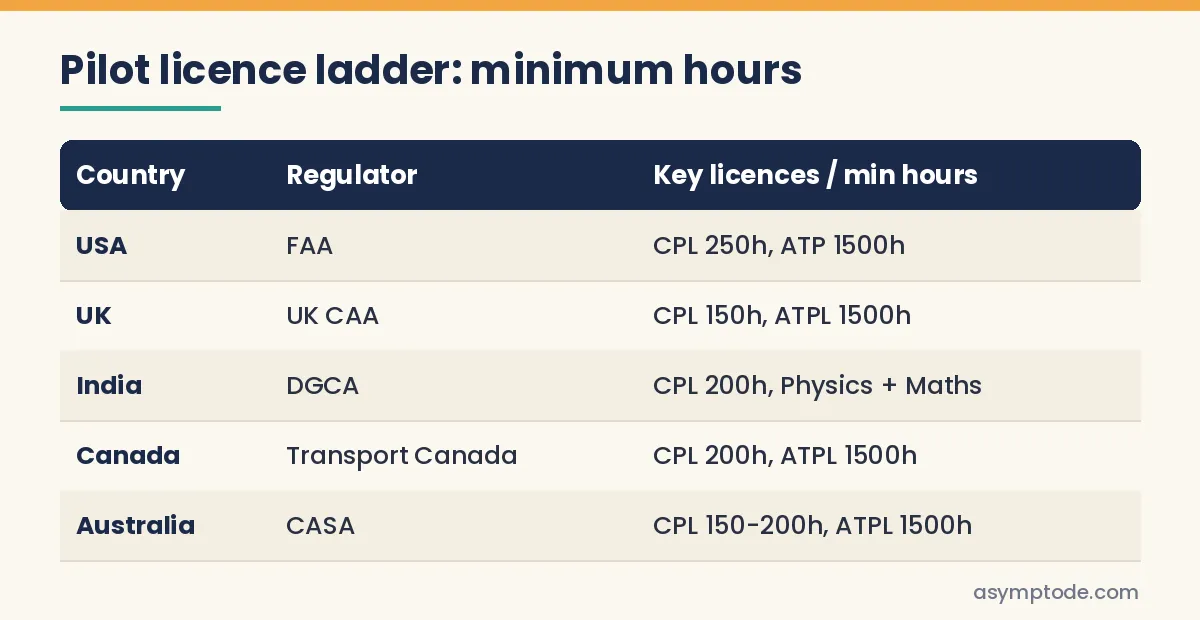 Minimum hours for the commercial and airline licences, by country.
USA (FAA): commercial pilot 250 hours, ATP 1,500 hours. UK (UK CAA): commercial 150 hours on an integrated course, ATPL 1,500 hours. India (DGCA): commercial 200 hours, with Class 12 Physics and Maths. Canada (Transport Canada): commercial 200 hours, ATPL 1,500 hours. Australia (CASA): commercial 150 to 200 hours, ATPL 1,500 hours.
| Country | Student / private | Commercial (CPL) | Airline (ATP / ATPL) |
|---|---|---|---|
| USA (FAA) | Student 16, private 17, 40 h | Age 18, 250 h | Age 23, 1,500 h (restricted ATP from 21) |
| UK (CAA) | PPL 17, 40 h instruction | Age 18, 150 h integrated | Age 21, 1,500 h |
| India (DGCA) | Check the official page | Age 18, 200 h, 10+2 Physics and Maths | Check the official page |
| Canada (TC) | Student 14, PPL 17, 45 h | Age 18, 200 h | Age 21, 1,500 h |
| Australia (CASA) | RPL 16, PPL 17 | Age 18, 150 h integrated or 200 h | Age 21, 1,500 h |
Sources: 14 CFR Part 61, UK CAA CPL, UK CAA ATPL, Transport Canada Standard 421, CASA CPL, CASA ATPL. These are minimums.
What are the FAA ATP requirements in the USA?
US airline pilots must hold an ATP certificate and a type rating for the aircraft (14 CFR 121.436). The FAA rules ask for:
- Age 23 for the full ATP, or 21 for the restricted ATP (14 CFR 61.153).
- A commercial certificate with an instrument rating.
- 1,500 hours total, including 500 cross-country, 100 night and 75 instrument (14 CFR 61.159).
- An ATP training program (for multi-engine), then knowledge and practical tests.
The restricted ATP lowers the hours for some pilots (14 CFR 61.160). It is 750 hours for qualifying US military pilots, 1,000 with an FAA-authorized aviation bachelor's degree, and 1,250 with an authorized aviation associate degree.
What are the DGCA CPL eligibility rules in India?
India's Aircraft Rules 1937 (Schedule II, Section J) set these for a Commercial Pilot's Licence (Aeroplanes):
- Age at least 18 on the date of application, and 10+2 with Physics and Mathematics.
- A medical from an approved medical board (the Ministry lists a Class 1 medical).
- At least 200 hours, including 100 as pilot-in-command, 20 cross-country, 10 instrument and 5 at night.
- DGCA written exams, a skill test and a radio telephone operator's licence.
Always confirm on the DGCA website before you apply.
How many flight hours do you need to become a pilot?
A private licence starts at about 40 to 45 hours, a commercial licence at 150 to 250 hours, and an airline licence at about 1,500 hours. The gap between a commercial licence and 1,500 hours is the hardest part. Pilots fill it with paid flying, such as instructing, so plan for it early.
Worked example: how a headwind changes flight time and fuel
Here is an example with made-up numbers.
 Example only: the numbers are invented to show the method.
A trip is 240 nautical miles. The plane's airspeed is 120 knots, and there is a 20 knot headwind. Ground speed is 120 - 20 = 100 knots. Time is 240 / 100 = 2.4 hours, which is 2 hours 24 minutes. At 30 litres per hour, fuel needed is 30 x 2.4 = 72 litres.
- Find ground speed. A headwind blowing straight at you slows you down. Ground speed = airspeed - headwind = 120 - 20 = 100 knots. (One knot is one nautical mile per hour.)
- Find time. Time = distance / speed = 240 / 100 = 2.4 hours.
- Turn decimals into minutes. 0.4 hours x 60 = 24 minutes. So the trip takes 2 hours 24 minutes.
- Find fuel. Fuel = burn rate x time = 30 litres per hour x 2.4 hours = 72 litres.
- Compare. With no wind, the trip takes 240 / 120 = 2 hours and uses 60 litres. The headwind costs 24 minutes and 12 litres.
Real pilots then add the fuel reserve their rules require. A small error in speed changes both time and fuel, so careful algebra matters.
What medical do you need to become a pilot?
Every pilot needs a medical certificate, and professional flying needs a higher class.
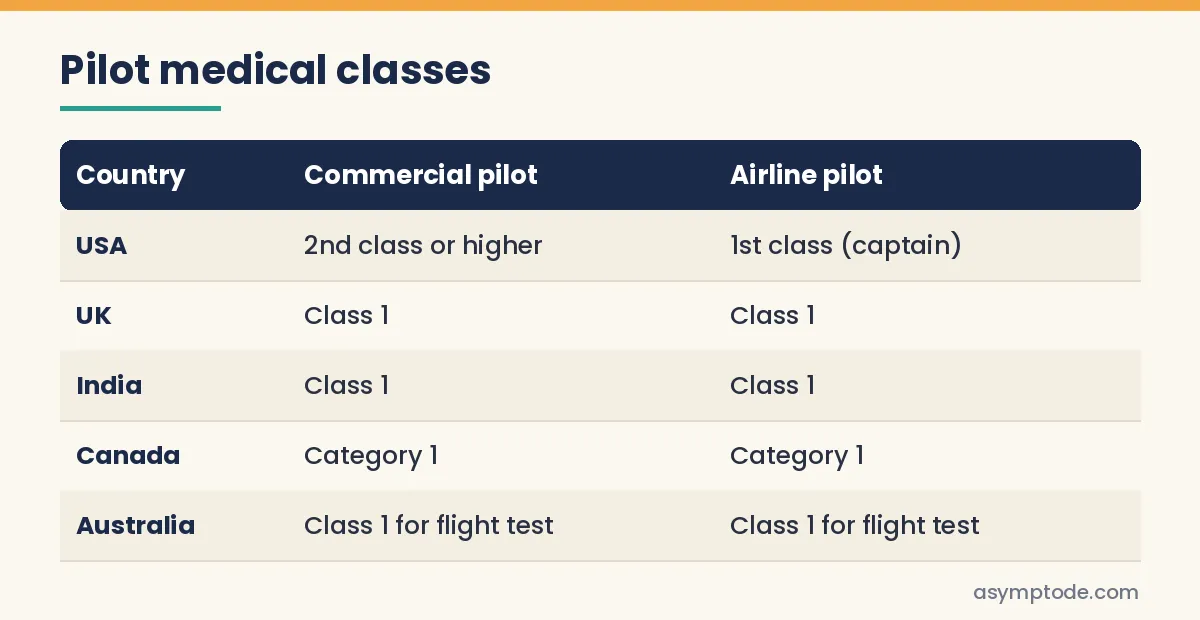 Which medical class each country asks for.
USA: at least second class for commercial flying, first class for an airline captain. UK: Class 1 for commercial and airline licences. India: Class 1 for commercial pilots. Canada: Category 1. Australia: Class 1 for the commercial and airline flight tests.
- USA. First class is designed for airline pilots, second for commercial, third for student and private pilots (FAA FAQ, 14 CFR 61.23).
- UK. Part MED Class 2 for a PPL; Class 1 for a CPL or ATPL.
- India. IGRUA, the government flying academy, asks for a Class 2 medical before joining. It advises getting a Class 1 early, since the CPL needs it (IGRUA).
- Canada. Category 3 for a PPL; Category 1 for a CPL or ATPL.
- Australia. You need an aviation reference number (ARN) to apply for a medical. Apply for a class 1 or 2 medical before your first solo (CASA).
Tip for parents: book the top-class medical before paying for a full course.
Do pilots need to speak English?
Yes, for almost every career route. ICAO says pilots flying internationally must show proficiency in English or the ground station's language, at Operational Level 4 or above (ICAO). ICAO recommends re-testing every 3 years at Level 4 and every 6 years at Level 5; Level 6 (Expert) is the top.
Integrated or modular: which pilot training route is better?
There are two main ways to train.
- Integrated (cadet-style) route. One full-time course takes you from zero to a commercial licence. The UK CAA calls it training "in a single course to the level required to fly commercially" (UK CAA). Some airlines run their own cadet programmes with partner schools.
- Modular route. You earn each licence step by step, often while working or studying. In the UK, you need a PPL first, and 150 hours of flight time before the modular CPL course.
Neither route is best for everyone. Integrated is full-time and paid in one go; modular is more flexible. Costs vary widely, so ask each school for a written breakdown. Check each school's official page for current fees.
IGRUA asks students to be at least 17 when joining, with 10+2 in Maths, Physics and English. General candidates need 50% in each (45% for SC/ST/OBC/EWS). Selection uses an online test, a pilot aptitude test and an interview.
Do you need a degree to become a pilot?
No country in this guide requires a degree for a commercial licence. But the BLS says airline pilots typically need a bachelor's degree, while commercial pilots typically complete flight training. In the US, an FAA-authorized aviation degree can also cut the ATP hours to 1,000 or 1,250.
A STEM degree is also a backup plan if a medical issue stops you flying. See how to become an engineer shows a strong second path.
Can you become a pilot through the military?
Yes. Air forces train their own pilots, with their own entry rules.
India. The Indian Air Force flying branch has several entries (IAF careers):
| Entry | Age (at course start) | Education |
|---|---|---|
| NDA | 16 1/2 to 19 1/2 | 10+2 with Physics, Chemistry and Maths |
| CDSE (men) | 20 to 24 | Graduate in any discipline |
| AFCAT | 20 to 24 | 50% each in Maths and Physics at 10+2, plus 60% in graduation |
| NCC Special Entry | 20 to 24 | NCC Air Wing Senior Division 'C' certificate, same marks as AFCAT |
DGCA CPL holders can apply for AFCAT and NCC Special Entry up to age 26.
USA. Qualifying US military pilots can get a restricted ATP at 750 hours. For entry rules, use official US military recruiting sites.
What should students do from Grade 9 onward?
- Grade 9-10: build the base in maths, physics and clear English.
- Join a youth aviation group. In the US, the Civil Air Patrol takes cadets from age 12 until they turn 19, offers orientation flights and has no military duty. In the UK, the RAF Air Cadets take ages 12 to 17, with flying among the activities. In India, the NCC Air Wing runs camps and Air Force Academy attachments.
- Grade 10-11: try an introduction flight at a local flight school.
- Age 16-17: get the medical class you will need for commercial flying.
- Grade 11-12: keep Physics and Maths (vital in India) with strong marks.
- Start training. In the US, a student pilot can be 16 and a private pilot 17.
- Age 18+: earn your commercial licence and instrument rating, then build hours.
Curious about research careers? Read how to become a scientist.
What are common mistakes on the way to becoming a pilot?
- Paying for training before the medical. Get the top-class medical first.
- Dropping physics or maths after Grade 10. In India, this blocks the CPL route.
- Trusting a school without checking the regulator. Use official pages for hours and ages.
- Forgetting the hour gap between a commercial and an airline licence.
- Weak English. ICAO Level 4 is the minimum for international flying.
Is a pilot career worth it? The honest outlook
The best official data is from the US BLS, last updated 27 August 2026 (BLS):
| BLS measure (USA) | Figure |
|---|---|
| Median pay, 2025 (all aircraft pilots and flight engineers) | $210,020 per year |
| Median pay, airline pilots, copilots and flight engineers | $232,140 |
| Median pay, commercial pilots | $123,220 |
| Jobs, 2025 | 154,900 |
| Job outlook, 2025-35 | 7% (much faster than average) |
| Openings per year | About 16,400 |
The BLS also notes that "Federal law requires pilots to retire at age 65." These are US figures only, not a promise for other countries.
Book a free demo class with an Asymptode maths or physics mentor, or see our plans and fees.
How 1-on-1 tutoring helps with becoming a pilot
- One dedicated mentor, live online 1-on-1. The mentor follows your own syllabus and exam dates, whether that is CBSE, GCSE, A-level, AP or another board.
- Method-first maths and physics. The mentor watches each step of the working for speed, distance, time, vectors and forces, the same skills pilot exams use.
- Personalised homework with feedback. Every class is recorded, and parents get short updates.
- Honest help with planning. For the licence steps, the mentor helps with planning and study method. It starts with a free demo class.
Facts checked against official sources on 4 November 2026.
FAQ
Can I become a pilot after 12th?
Yes. In India, you need Class 12 with Physics and Mathematics for a commercial pilot licence. You must also be 18 when you apply, pass the medical and DGCA exams, and log at least 200 hours.
What are the commercial pilot license requirements?
In all five countries in this guide, the minimum age is 18. You need a top-class medical, theory exams, a flight test and minimum hours. Those hours are 250 in the USA (Part 61), 200 in India and Canada, and 150 or 200 in the UK and Australia, depending on the course.
How many flight hours does it take to become an airline pilot?
For a full FAA ATP certificate, at least 1,500 hours. The UK, Canada and Australia also set 1,500 hours for the ATPL. In the US, a restricted ATP needs 750, 1,000 or 1,250 hours for qualifying military pilots or aviation graduates.
Do I need to be good at maths to become a pilot?
You need solid basics, not genius. Pilots use speed, distance, time, fuel and angles all the time. India's DGCA requires Physics and Mathematics at 10+2 for a commercial licence.
Do I need perfect eyesight to be a pilot?
The medical rules decide this, and they vary by country and class. Book an exam with an approved aviation medical examiner early to find out where you stand.
How old do you have to be to become a pilot?
In the US, you can be a student pilot at 16 and get a private certificate at 17. A commercial licence needs age 18 almost everywhere. The full FAA ATP needs age 23, while the UK, Canada and Australia set 21 for the airline licence.
Ready to start? Book a free demo class and advisor call, or see our plans and fees.
Sources
- eCFR 14 CFR 61.83 Student pilot eligibility
- eCFR 14 CFR 61.129 Commercial pilot aeronautical experience
- eCFR 14 CFR 61.153 ATP eligibility
- eCFR 14 CFR 61.159 ATP airplane experience
- eCFR 14 CFR 61.160 Restricted ATP
- eCFR 14 CFR 61.23 Medical certificates
- eCFR 14 CFR 121.436 Pilot qualification
- FAA FAQ: medical class for student pilots
- BLS Occupational Outlook Handbook: Airline and Commercial Pilots
- UK CAA: Private pilot licence for aeroplanes
- UK CAA: Commercial pilot licence for aeroplanes
- UK CAA: Airline transport pilot licence for aeroplanes
- Ministry of Civil Aviation: Career in Aviation
- DGCA Pariksha FAQs (flight crew)
- IGRUA Selection Procedure
- Indian Air Force careers by qualification
- Transport Canada Standard 421
- CASA: Getting a commercial pilot licence
- CASA: Getting an air transport pilot licence
- ICAO Personnel Licensing FAQ
- Civil Air Patrol Cadet FAQs
- RAF Air Cadets: Joining