
The work-energy theorem says that the net work done on an object equals its change in kinetic energy. It lets you find a speed or distance without the acceleration or time. Below: work, kinetic energy, four worked examples and practice questions.
Key takeaways
- Work is W = F d cos theta, measured in joules (1 J = 1 N m).
- Kinetic energy is KE = 1/2 m v^2. It is never negative.
- The work-energy theorem: net work = KE final - KE start.
- Friction usually does negative work. Gravity does positive work on a falling object.
- Use the theorem when a question links force, distance and speed but not time.
What is the work-energy theorem?
Quick answer: The work-energy theorem states that the net work done on an object equals the change in its kinetic energy: W net = KE final - KE start. If the net work is positive, the object speeds up. If it is negative, the object slows down. If it is zero, the speed stays the same.
In the words of OpenStax University Physics (7.3): "The net work done on a particle equals the change in the particle's kinetic energy."
What is work in physics?
A force does work when it moves an object. For a constant force:
W = F d cos theta
F is the force in newtons (N), d is the displacement in metres (m), and theta is the angle between the force and the motion. Work is measured in joules. One joule is done when a force of one newton moves an object one metre, so 1 J = 1 N m (AQA GCSE Physics, 4.5.2).
When is work positive, negative or zero?
The sign depends on the angle (OpenStax, 7.1).
| Angle theta | Work | Example |
|---|---|---|
| 0 to under 90 degrees | Positive | Pushing a cart forward |
| 90 degrees | Zero | Normal force on a car on flat ground |
| Over 90 to 180 degrees | Negative | Friction on a sliding box |
Work is also zero when nothing moves: holding a bag still does no work on it, even if your arms get tired.
What is kinetic energy?
Kinetic energy is the energy of motion:
KE = 1/2 m v^2
m is the mass in kilograms and v is the speed in m/s. KE is in joules. Doubling the speed makes KE four times bigger.
How do you derive the work-energy theorem?
Take a constant net force F on a mass m over a distance d, along the motion.
- Start with v^2 = u^2 + 2ad, where u is the starting speed and v the final speed.
- Rearrange: ad = (v^2 - u^2) / 2.
- Multiply by m: mad = 1/2 m v^2 - 1/2 m u^2.
- Newton's second law says F = ma, so the left side is F d, the net work.
- So W net = 1/2 m v^2 - 1/2 m u^2 = KE final - KE start.
It also holds for changing forces (that proof needs calculus). For a refresher on F = ma, see Newton's three laws.
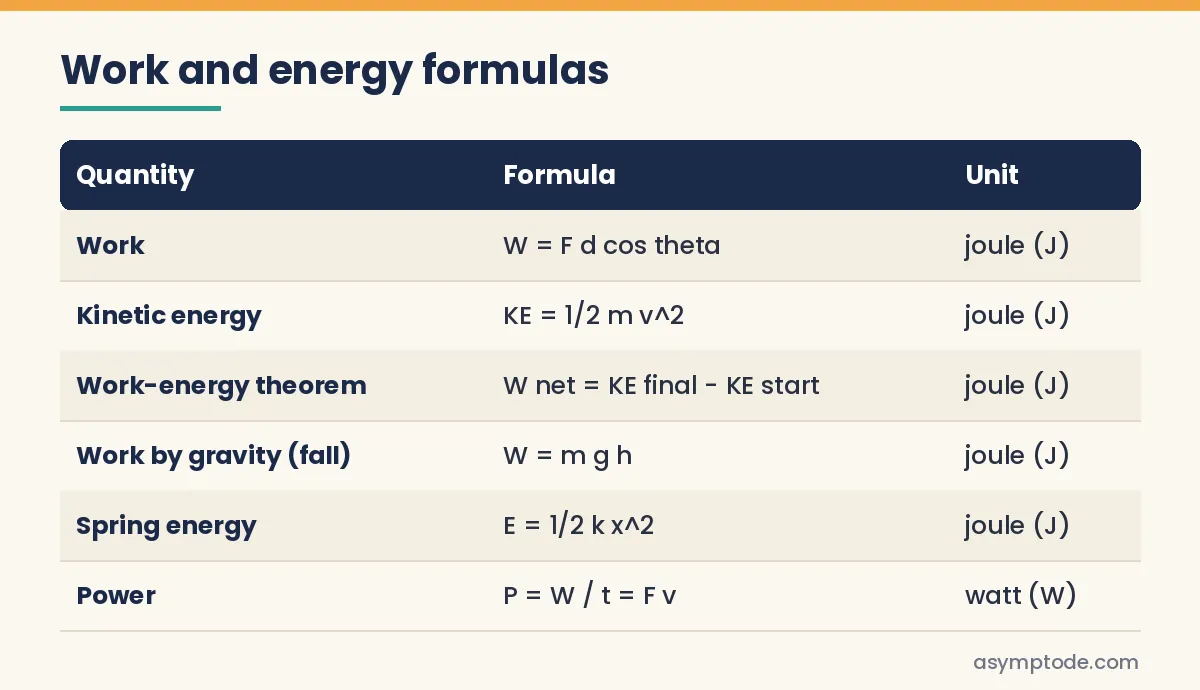 The six formulas you need for work, energy and power problems.
The table lists work (W = F d cos theta), kinetic energy (KE = 1/2 m v^2) and the work-energy theorem (W net = KE final - KE start), all in joules. It also gives the work done by gravity on a falling object (W = m g h) and spring energy (E = 1/2 k x^2), both in joules. The last row is power: P = W / t = F v, in watts.
When should you use it instead of Newton's laws?
| The question involves... | Best tool |
|---|---|
| Force, distance and speed, no time | Work-energy theorem |
| Time, or acceleration | Newton's laws and kinematics |
| A curved path, such as a slide | Work-energy theorem |
| Sideways and vertical motion at once | Kinematics in parts (projectile motion) |
Energy has no direction, so works add as plain numbers. For motion in a circle, see circular motion.
How do friction and gravity do work?
Friction acts against the motion, so its work is negative: W = -f d. On flat ground, f = mu m g, where mu is the coefficient of friction.
Gravity does positive work, W = m g h, when an object falls a height h. It does negative work, -m g h, when the object rises (OpenStax, 7.1).
What if the force is not constant?
Work is the area under the force-displacement (F-x) graph. If force rises in a straight line from 0 N to 40 N over 0.50 m, the area is a triangle: 1/2 x 0.50 x 40 = 10 J.
A spring follows F = k x, where k is the spring constant in N/m. Its graph is also a triangle, so the energy stored is E = 1/2 k x^2. A spring with k = 200 N/m stretched 0.10 m stores 1/2 x 200 x 0.10^2 = 1.0 J.
How is power linked to work?
Power is the rate of doing work: P = W / t, in watts, where 1 W = 1 J/s. For a force moving an object at speed v, P = F v (OpenStax, 7.4). A crane lifting 500 kg up 12 m in 20 s does 58,800 J (500 x 9.8 x 12), so P = 2,940 W.
Worked examples
We use g = 9.8 m/s^2.
Example 1: How much work does a force at an angle do?
A rope pulls a box 8.0 m along the floor with 50 N at 30 degrees above the floor.
- W = 50 x 8.0 x cos 30 degrees.
- cos 30 degrees = 0.866, so W = 346 J (346.4 J).
Example 2: What net force speeds up a car?
A 1,200 kg car speeds up from 10 m/s to 25 m/s over 150 m.
- KE start = 1/2 x 1,200 x 10^2 = 60,000 J = 60 kJ.
- KE end = 1/2 x 1,200 x 25^2 = 375,000 J = 375 kJ.
- Net work = 375 kJ - 60 kJ = 315 kJ.
- Net force = 315,000 J / 150 m = 2,100 N.
Check: a = (25^2 - 10^2) / 300 = 1.75 m/s^2, and F = ma = 2,100 N.
 Example 2 step by step: from two kinetic energies to the net force.
The car speeds up from 10 m/s to 25 m/s. Its kinetic energy rises from 60 kJ (0.5 x 1200 x 10^2) to 375 kJ (0.5 x 1200 x 25^2). The net work is 375 kJ - 60 kJ = 315 kJ, and dividing by 150 m gives a net force of 2,100 N.
Example 3: How far does a block slide before stopping?
A 2.0 kg block slides at 6.0 m/s. The coefficient of kinetic friction is 0.30.
- Friction: f = 0.30 x 2.0 x 9.8 = 5.88 N.
- KE start = 1/2 x 2.0 x 6.0^2 = 36 J. KE end = 0.
- -5.88 d = 0 - 36, so d = 6.1 m (6.12 m).
Example 4: How fast is a child at the bottom of a slide?
A 30 kg child starts from rest at the top of a 2.5 m high slide. Friction does -300 J of work.
- Work by gravity = 30 x 9.8 x 2.5 = 735 J. The normal force does no work.
- Net work = 735 - 300 = 435 J.
- 435 = 1/2 x 30 x v^2, so v^2 = 29 and v = 5.4 m/s (5.39 m/s).
How do you solve a work-energy problem?
 A four-step method for almost every work-energy question.
The flow chart shows four boxes. First pick the object and its start and end points, then list every force and the work it does. Add the works to get the net work, then set net work equal to KE end minus KE start and solve.
- Pick the object and the start and end points.
- List every force and its work. Use F d cos theta, m g h for gravity and -f d for friction.
- Add the works to get net work. Keep the signs.
- Set net work = KE end - KE start and solve.
What are the most common mistakes?
- Using only the applied force. You need the net work of all forces.
- Dropping signs. Friction work is negative. So is gravity's work on a rising object.
- Forgetting cos theta when the force is at an angle.
- Squaring the change in speed. The change in KE is 1/2 m (v^2 - u^2), not 1/2 m (v - u)^2.
Stuck on a step? Book a free demo class and a mentor will work through your own questions with you, or see our plans and fees.
Practice questions with answers
Use g = 9.8 m/s^2.
- A 20 N force pulls a trolley 5.0 m at 60 degrees to the motion. Find the work. Answer: 20 x 5.0 x cos 60 degrees = 50 J.
- Find the KE of a 0.20 kg ball at 15 m/s. Answer: 22.5 J.
- A 1,000 kg car at 20 m/s brakes to a stop with a force of 8,000 N. Find the net work and the stopping distance. Answer: -200,000 J; 200,000 / 8,000 = 25 m.
- You carry a 10 kg bag 20 m across a flat floor at steady speed. How much work does your upward force do on it? Answer: 0 J.
- A stone is dropped from 20 m. Ignore air resistance. Find its landing speed. Answer: v = square root of (2 x 9.8 x 20) = 19.8 m/s.
- A spring with k = 400 N/m is squashed 0.05 m. Find the stored energy. Answer: 0.5 J.
Where does the work-energy theorem appear in the syllabus?
| Course | Where it appears |
|---|---|
| AP Physics 1 | Unit 3: Work, Energy, and Power (topics 3.1 to 3.5), 18%-23% of the multiple-choice section (College Board) |
| AQA A-level Physics 7408 | 3.4.1.7 Work, energy and power, in 3.4 Mechanics and materials (AQA) |
| AQA GCSE Physics 8463 | 4.5.2 Work done and energy transfer; spring energy in 4.5.3 (AQA) |
| NCERT Class 11 Physics | Part I, Chapter 5: Work, Energy and Power (NCERT) |
| JEE Main 2027 | Physics Unit 4: Work, Energy and Power, which names the work-energy theorem (NTA) |
For exam advice, read our AP Physics 1 exam guide, A-level Physics guide, GCSE Physics guide and JEE Main 2027 guide.
How 1-on-1 tutoring helps with the work-energy theorem
- Method first, every step watched. In live online 1-on-1 classes, your dedicated mentor watches how you list forces and signs, so a missing friction term is caught at the step where it happens.
- Your syllabus, your dates. AP Physics 1, AQA, GCSE or JEE Main: the mentor follows your own course and exam calendar.
- Personalised homework with feedback. Work-energy questions at your level, with feedback on each one.
- Clear records. Every class is recorded so you can rewatch a derivation, and parents get short updates. Start with a free demo class.
Syllabus references checked against official sources on 2 November 2026.
FAQ
What is the work-energy theorem in simple words?
The total work done on an object equals its change in kinetic energy. Positive net work speeds it up; negative net work slows it down.
What is the formula for the work-energy theorem?
W net = KE final - KE start, or W net = 1/2 m v^2 - 1/2 m u^2. Here m is the mass, u the starting speed and v the final speed.
Can work be negative?
Yes. Work is negative when the force points against the motion, at more than 90 degrees. Friction on a sliding box and gravity on a rising ball both do negative work.
Why does carrying a bag across a room do no work?
Your force on the bag points up, but the bag moves sideways. The angle is 90 degrees and cos 90 degrees = 0, so no work is done on the bag.
Is the work-energy theorem the same as conservation of energy?
Not quite. The theorem links the net work of all forces to the change in kinetic energy only. Conservation of energy tracks every form of energy, such as kinetic, potential and heat.
Does the work-energy theorem work for a changing force?
Yes. Find the work from the area under the force-displacement graph. A spring is the common example, storing 1/2 k x^2.
Ready to start? Book a free demo class and advisor call, or see our plans and fees.
Sources
- OpenStax University Physics Volume 1, 7.1 Work
- OpenStax University Physics Volume 1, 7.3 Work-Energy Theorem
- OpenStax University Physics Volume 1, 7.4 Power
- College Board: AP Physics 1: Algebra-Based course
- AQA A-level Physics 7408: Mechanics and materials
- AQA GCSE Physics 8463: Forces
- NCERT Class 11 Physics Part I, Chapter 5: Work, Energy and Power
- NTA JEE Main documents (Syllabus 2027)