

Cambridge IGCSE Mathematics (0580) is one of the most widely taken maths qualifications in the world. It is common in British-curriculum schools in the UAE, in international schools, and in many UK independent schools. This guide explains the four papers, Core vs Extended, the topics, how it compares with Edexcel 4MA1, and how to revise.
Key takeaways
- Students sit two papers: Core (Papers 1 and 3) or Extended (Papers 2 and 4).
- Paper 1 and Paper 2 are non-calculator. Papers 3 and 4 need a scientific calculator.
- Core papers are 1 hour 30 minutes and 80 marks each. Extended papers are 2 hours and 100 marks each. Each paper is worth 50%.
- Core can reach grades C to G. Extended can reach A* to E.
- Exams run in June and November. A formula list is printed on page 2 of every paper.
What is IGCSE Maths 0580?
Quick answer: IGCSE Maths 0580 is Cambridge International's maths course for students aged about 14 to 16. Students take two written exams at the end of the course: either the Core tier or the Extended tier. One paper is without a calculator and one is with a calculator. Grades run from A* to G.
The current syllabus is for exams in 2025, 2026 and 2027. It covers nine topic areas, from number and algebra to statistics. There is no coursework. The whole grade comes from the two exams.
Some UK schools use Cambridge IGCSE (9-1) Mathematics, code 0980, which has the same idea but is graded 9 to 1. Check the code on your child's exam entry so you use the right papers for practice.
What are the 0580 papers and how long are they?
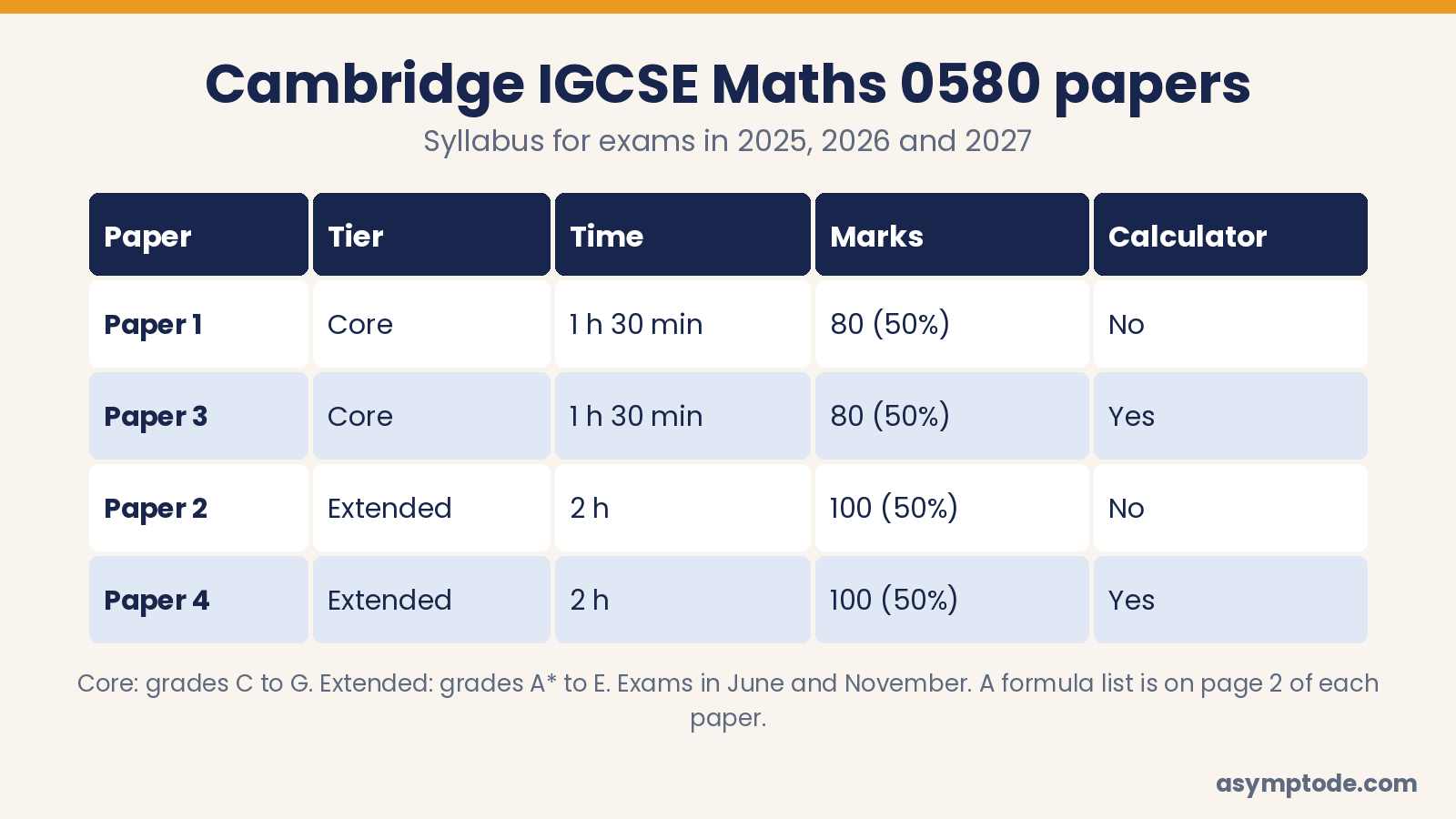
| Paper | Tier | Time | Marks | Weight | Calculator |
|---|---|---|---|---|---|
| Paper 1 | Core | 1 hour 30 minutes | 80 | 50% | Not allowed |
| Paper 3 | Core | 1 hour 30 minutes | 80 | 50% | Required |
| Paper 2 | Extended | 2 hours | 100 | 50% | Not allowed |
| Paper 4 | Extended | 2 hours | 100 | 50% | Required |
So a Core student sits Paper 1 + Paper 3. An Extended student sits Paper 2 + Paper 4. You cannot mix the two tiers.
All papers have a mix of short and longer structured questions. Students must show their working. Marks are given for method, not just the final answer.
Is there a formula sheet for IGCSE Maths 0580?
Yes. Page 2 of each paper has a list of formulae. The Extended list is longer. It includes the quadratic formula, the sine rule, the cosine rule and the area of a triangle using ½ab sin C. If a formula is not on the list, students need to know it.
Core or Extended: which tier should my child take?
| Core | Extended | |
|---|---|---|
| Papers | 1 and 3 | 2 and 4 |
| Grades available | C to G | A* to E |
| Content | Core content only | Core plus Extended content |
| Best for | Students who find maths hard and want a secure pass | Students aiming for A*, A or B, or planning A-Level or IB maths |
The top grade on Core is C. A student who wants to study maths or science at A-Level or in the IB Diploma should take Extended. The school usually decides the tier, but parents can and should ask why.
If your child is on Core but improving fast, talk to the teacher early. Moving up late leaves little time to learn the extra Extended content.
What topics are in IGCSE Maths 0580?
All students study nine topic areas. Extended students go deeper in each one.
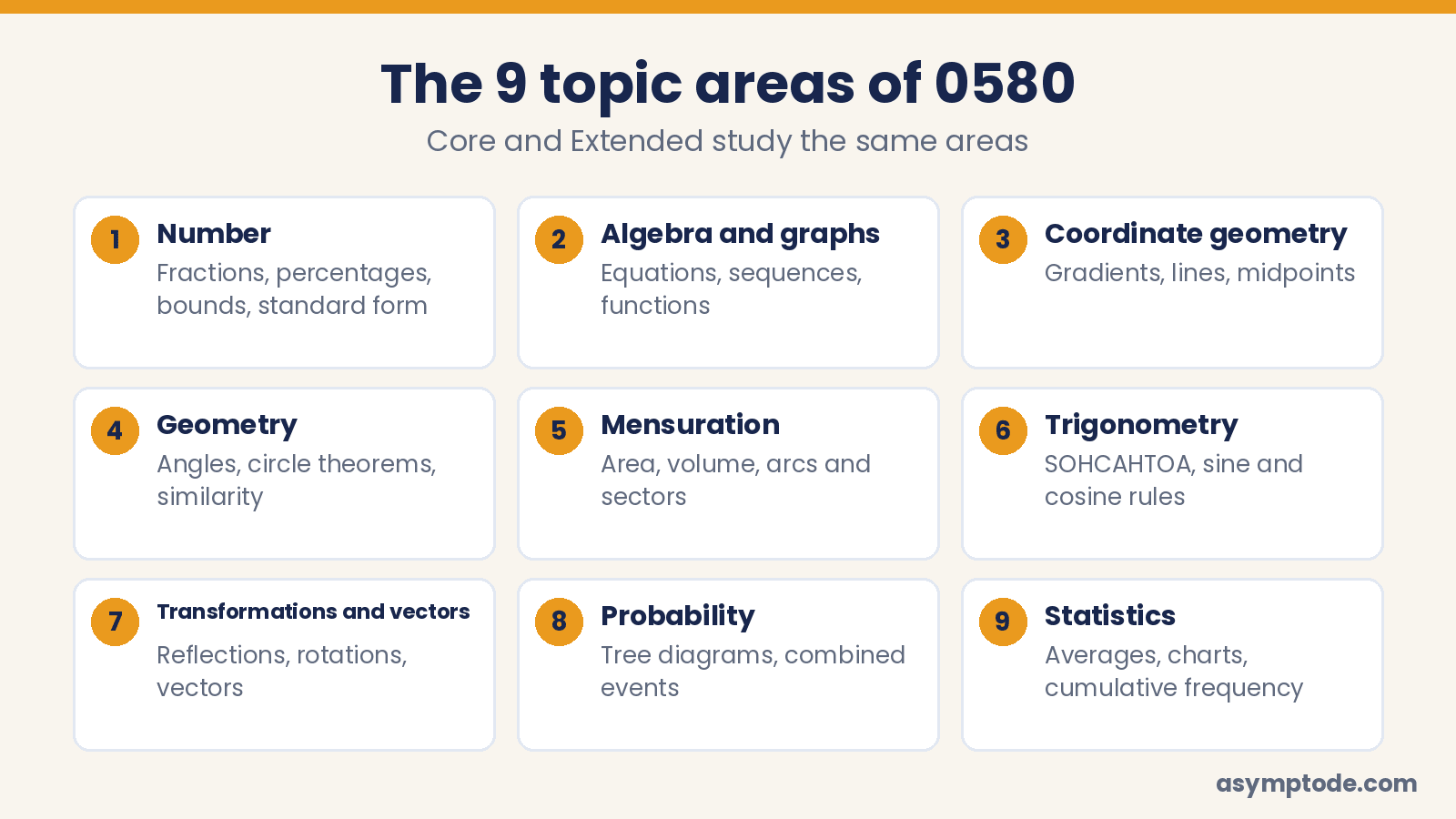
- Number: fractions, percentages, ratio, standard form, bounds.
- Algebra and graphs: equations, inequalities, sequences, functions, graphs.
- Coordinate geometry: gradients, equations of lines, midpoints.
- Geometry: angles, similarity, circle theorems.
- Mensuration: perimeter, area, volume, arcs and sectors.
- Trigonometry: right-angled triangles; Extended adds the sine and cosine rules.
- Transformations and vectors.
- Probability: tree diagrams and combined events.
- Statistics: averages, charts, cumulative frequency.
How does Cambridge 0580 compare with Edexcel 4MA1?
Many UAE and international schools choose between Cambridge and Pearson Edexcel. Both are respected. The big differences are in the papers.
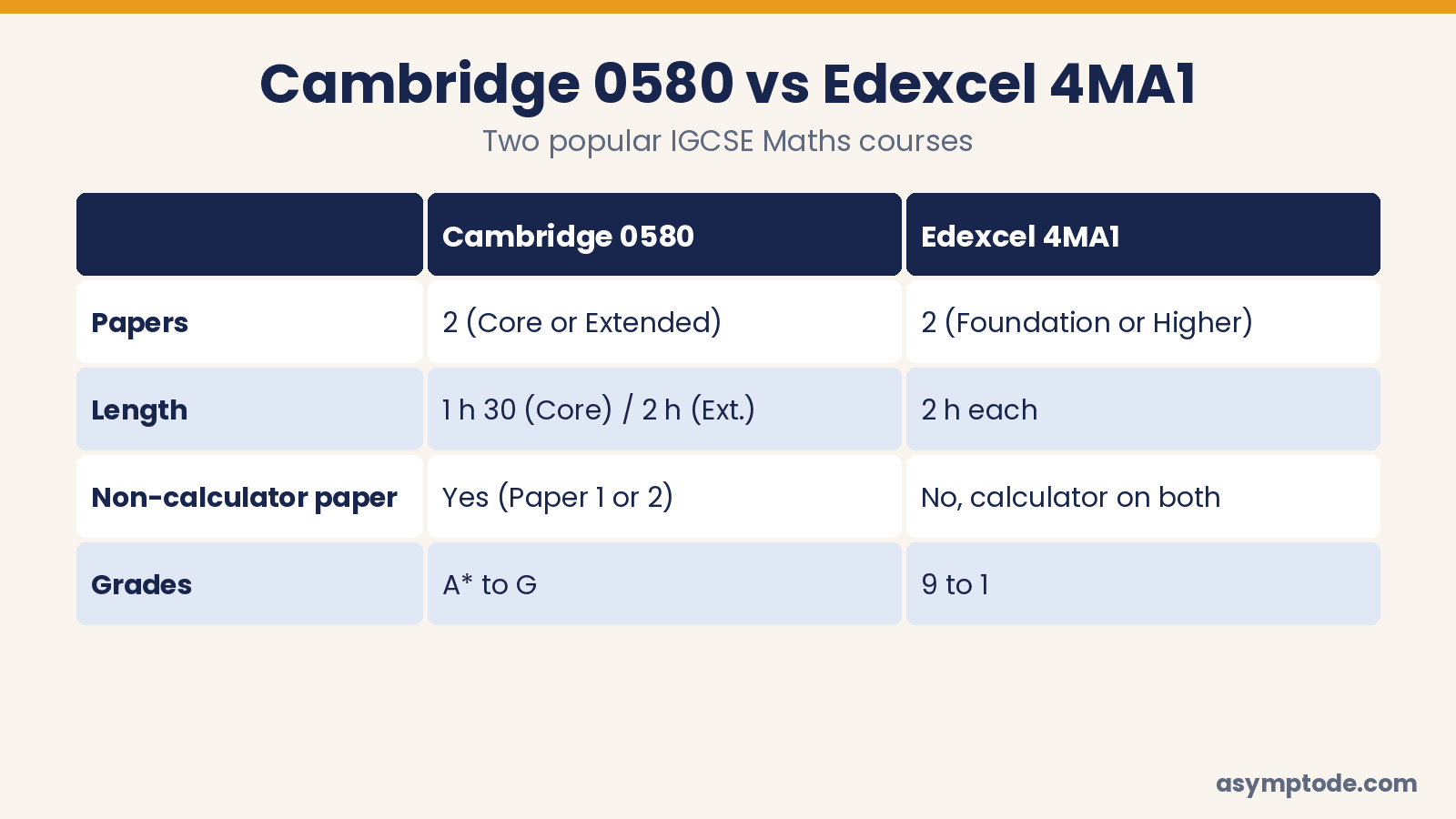
| Cambridge 0580 | Edexcel 4MA1 | |
|---|---|---|
| Number of papers | 2 (Core or Extended) | 2 (Foundation or Higher) |
| Paper length | 1 h 30 min (Core) or 2 h (Extended) | 2 hours each |
| Non-calculator paper | Yes (Paper 1 or Paper 2) | No: calculator allowed on both |
| Grades | A* to G | 9 to 1 |
| Top grade on lower tier | C | 5 |
The biggest practical difference: Cambridge has a non-calculator paper. A student who leans on the calculator for fractions, percentages and surds needs extra non-calculator practice for 0580. For UK GCSE (not IGCSE), see our GCSE Maths papers guide.
Worked examples in the IGCSE style
Example 1: Cosine rule (Extended, calculator paper)
Question: In triangle ABC, a = 7 cm, b = 5 cm and angle C = 60°. Find c.
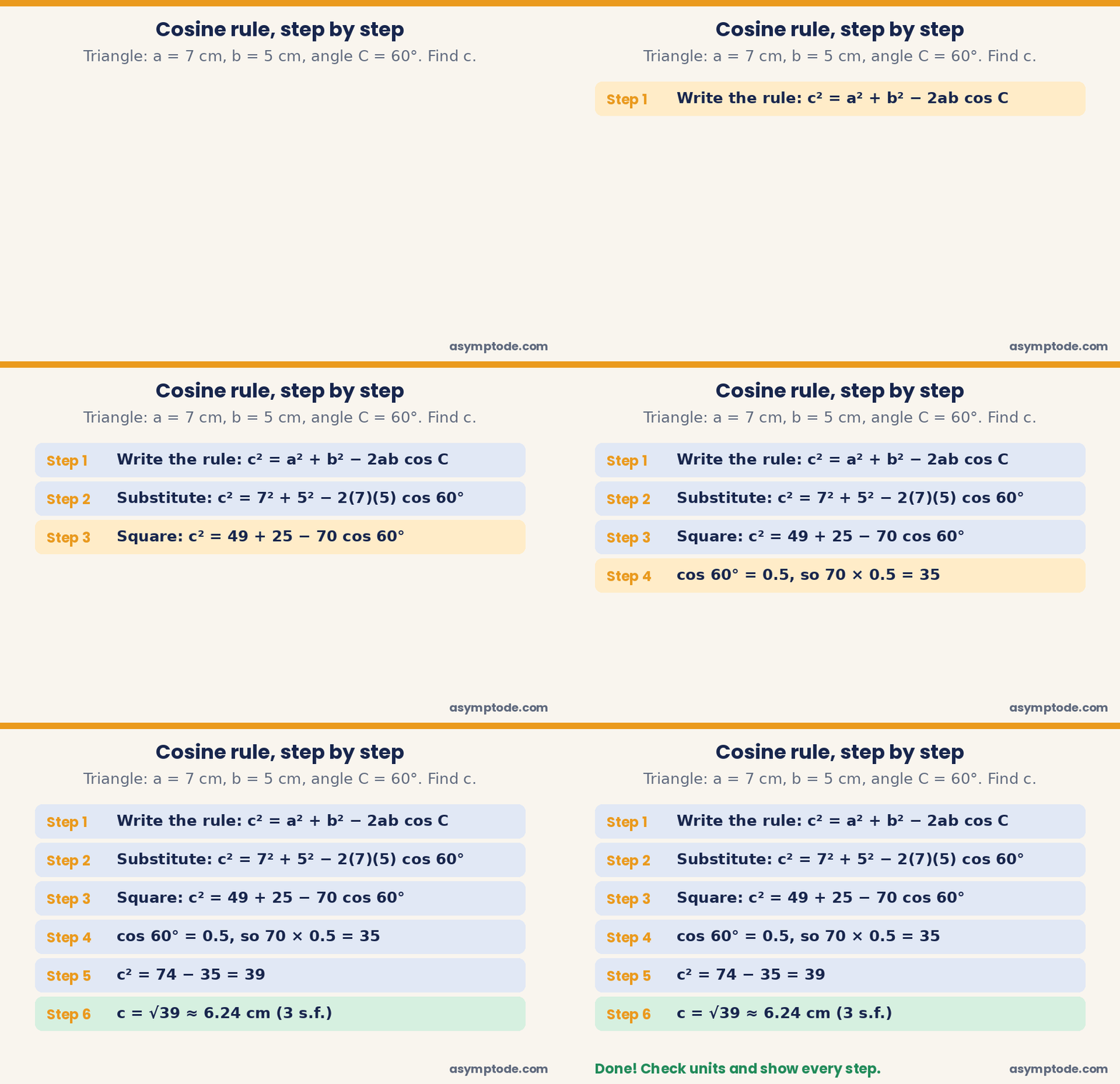
- c² = a² + b² − 2ab cos C
- c² = 49 + 25 − 2(7)(5)(0.5)
- c² = 74 − 35 = 39
- c = √39 ≈ 6.24 cm (3 significant figures)
Cambridge usually wants answers to 3 significant figures unless the question says otherwise. Giving 6.2 can lose the accuracy mark.
Example 2: Reverse percentage
Question: After a 20% price increase, a jacket costs AED 96. What was the price before the increase?
- After the increase, the price is 120% of the original, so 1.2 × original = 96.
- Original = 96 ÷ 1.2 = AED 80.
A common mistake is to take 20% of 96 and subtract it. That gives 76.80, which is wrong.
Example 3: Fractions without a calculator
Question: Work out 2¾ ÷ 1½. Give your answer as a mixed number.
- Change to improper fractions: 11/4 ÷ 3/2.
- Flip the second fraction and multiply: 11/4 × 2/3 = 22/12.
- Simplify: 22/12 = 11/6 = 1⅚.
On Paper 1 or Paper 2, every line of working should be shown. Writing only the answer can lose marks.
Example 4: Bounds
Question: A length is 12 cm, correct to the nearest centimetre. Write the lower and upper bounds.
The length could be up to half a unit either side: 11.5 cm ≤ length < 12.5 cm.
What are the most common IGCSE Maths mistakes?
- Rounding too early. Keep full values in the calculator and round only at the end.
- Not giving 3 significant figures when the question asks for it.
- Weak non-calculator skills. Fractions, negative numbers and percentages without a calculator lose many marks.
- Missing units in area, volume and speed questions.
- Not reading the formula list. Students forget it is there.
- Practising only one paper type. Do both calculator and non-calculator past papers.
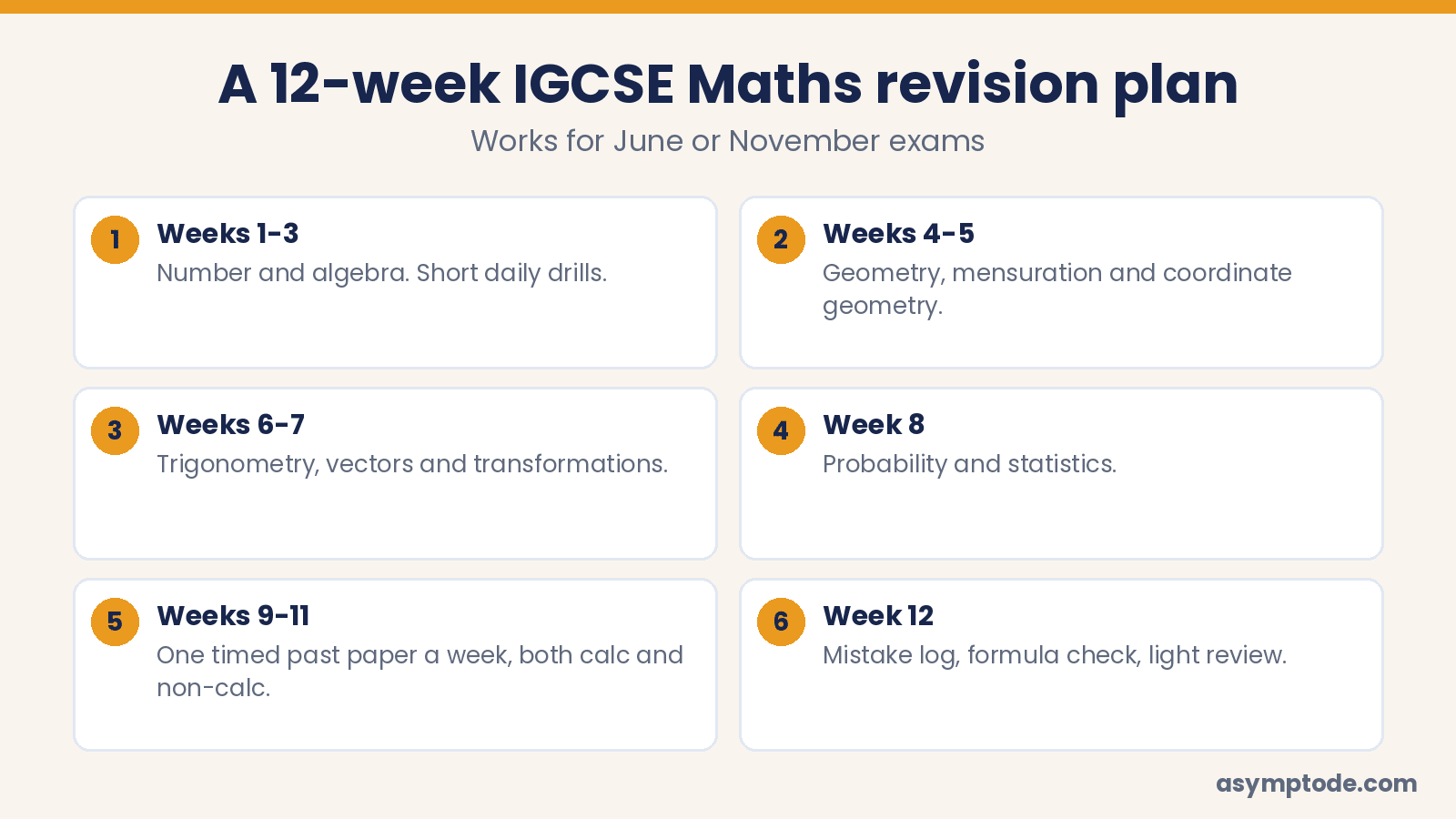
A 12-week IGCSE Maths revision plan
This plan works for the June or the November series.
| Weeks | Focus |
|---|---|
| 1-3 | Number and algebra, with short daily non-calculator drills |
| 4-5 | Geometry, mensuration and coordinate geometry |
| 6-7 | Trigonometry, vectors and transformations |
| 8 | Probability and statistics |
| 9-11 | One full timed past paper each week, alternating calculator and non-calculator |
| 12 | Mistake log, formula list check, light review and good sleep |
Mark every past paper with the official mark scheme. Write each lost mark in a mistake log, with the reason. The log becomes the revision list for the final weeks.
After IGCSE, many students move to A-Level or the IB Diploma. See our A-Level Maths guide and our IB Maths AA vs AI guide to plan ahead.
Not sure if your child is on the right tier? Talk to an advisor for a free demo class and a short assessment.
How 1-on-1 tutoring helps with IGCSE Maths
At Asymptode, every class is live, online and 1-on-1, with one mentor for one student. We follow your child's own school syllabus and exam dates. Here is how that helps with IGCSE Maths:
- We follow the right syllabus. The mentor plans around 0580 (or 0980 or 4MA1, if that is your child's course), the tier, and the exam series.
- We build non-calculator confidence. The mentor watches each line of working and fixes the method, not just the answer.
- We fill the smaller gaps. If a trigonometry topic won't land, the mentor checks the algebra or ratio skills underneath it.
- Homework fits the gap. Worksheets are on the topics your child needs, at the right tier, and checked by the same mentor.
- Parents see progress. You get short updates on what improved and what still needs practice.
- Every class is recorded, so your child can revise a method again before the exam.
We work with families across the UK, the UAE and other countries, with flexible times across time zones. See our fees or talk to an advisor to book a free demo class.
FAQ
Is IGCSE Maths 0580 calculator or non-calculator?
Both. Paper 1 (Core) and Paper 2 (Extended) are non-calculator. Paper 3 (Core) and Paper 4 (Extended) need a scientific calculator.
How long are the IGCSE Maths 0580 exams?
Core Papers 1 and 3 are 1 hour 30 minutes each. Extended Papers 2 and 4 are 2 hours each.
What is the highest grade on Core IGCSE Maths?
The highest grade on the Core tier is C. Students need the Extended tier to get A* to B.
Is Cambridge IGCSE Maths harder than Edexcel?
Neither is simply harder. Cambridge 0580 has a non-calculator paper, while Edexcel 4MA1 allows a calculator on both papers. Students weak in mental and written methods may find Cambridge harder.
When are the IGCSE Maths exams?
Cambridge runs 0580 exams in the June and November series. Your school decides which series your child enters.
Is there a formula sheet in IGCSE Maths 0580?
Yes. A list of formulae is on page 2 of each paper. The Extended list includes the quadratic formula and the sine and cosine rules.