

Key takeaways
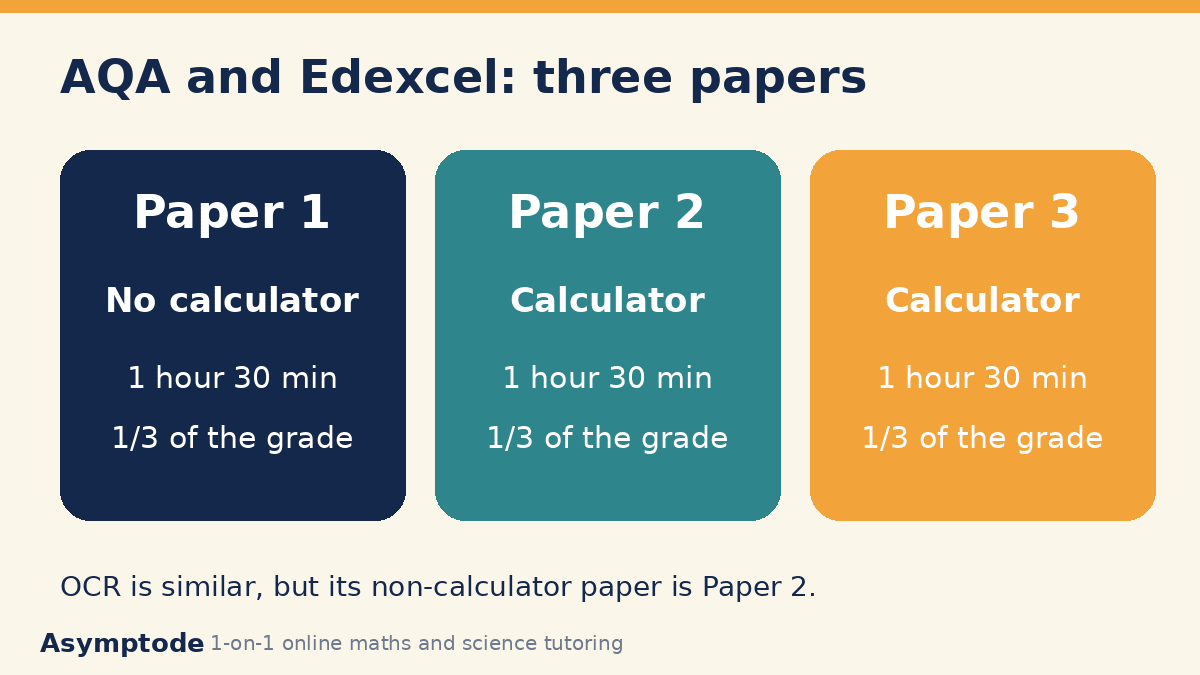
- GCSE Maths has three papers. Each one is 1 hour 30 minutes.
- Each paper is worth one third of the final grade.
- One paper is non-calculator. Which one depends on the exam board.
- There are two tiers: Foundation (grades 1 to 5) and Higher (grades 4 to 9).
- Always check your own board's specification for the latest details.
How many papers are in GCSE Maths?
Quick answer: There are three papers. Each lasts 1 hour 30 minutes, so the exams add up to 4 hours 30 minutes. Each paper counts for one third of the grade.
This is the same for the three big exam boards in England: AQA, Edexcel and OCR. The main difference is which paper is the non-calculator one.
What is different between AQA, Edexcel and OCR?
Less than most parents expect. The table shows the main points.
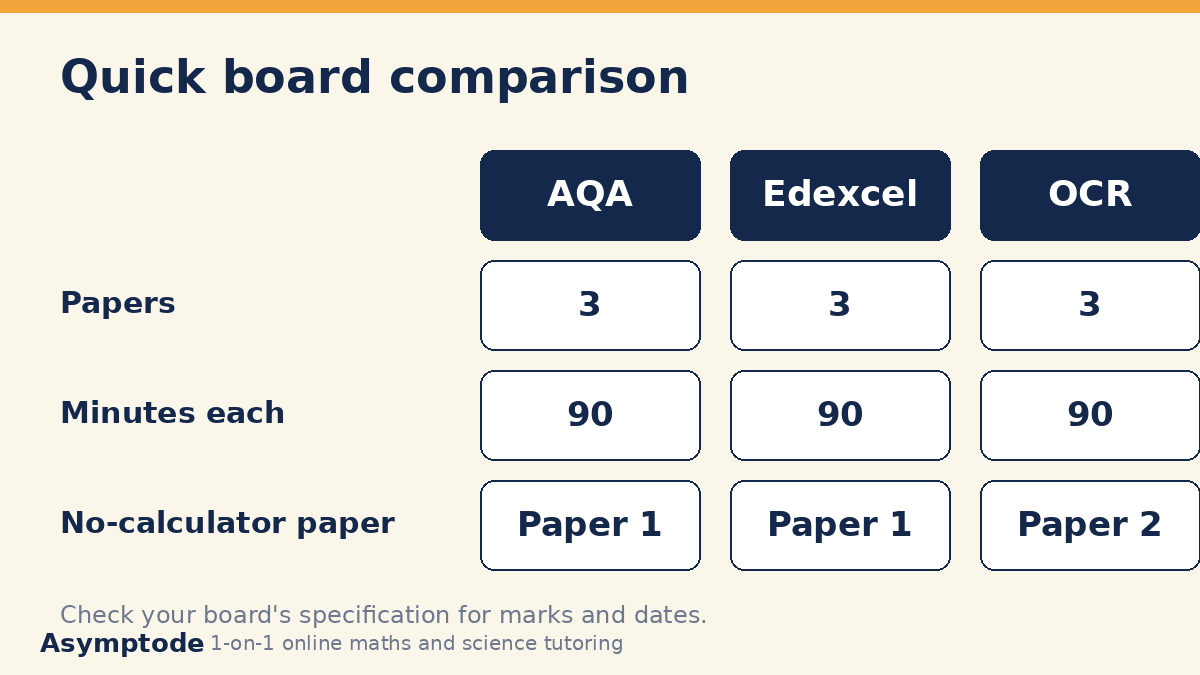
- AQA: Three papers. Each is 90 minutes and 80 marks. Paper 1 is non-calculator. Papers 2 and 3 allow a calculator. AQA says content from any part of the course can appear on any paper.
- Edexcel: Three papers of 90 minutes. Paper 1 is non-calculator.
- OCR: Three papers of 90 minutes. Paper 2 is non-calculator.
Marks per paper can differ by board, so check your board's specification. Your child's school can tell you which board they use. If you do not know, ask the maths teacher.
What are the Foundation and Higher tiers?
Your child sits all three papers at the same tier. The tier decides which grades they can reach.
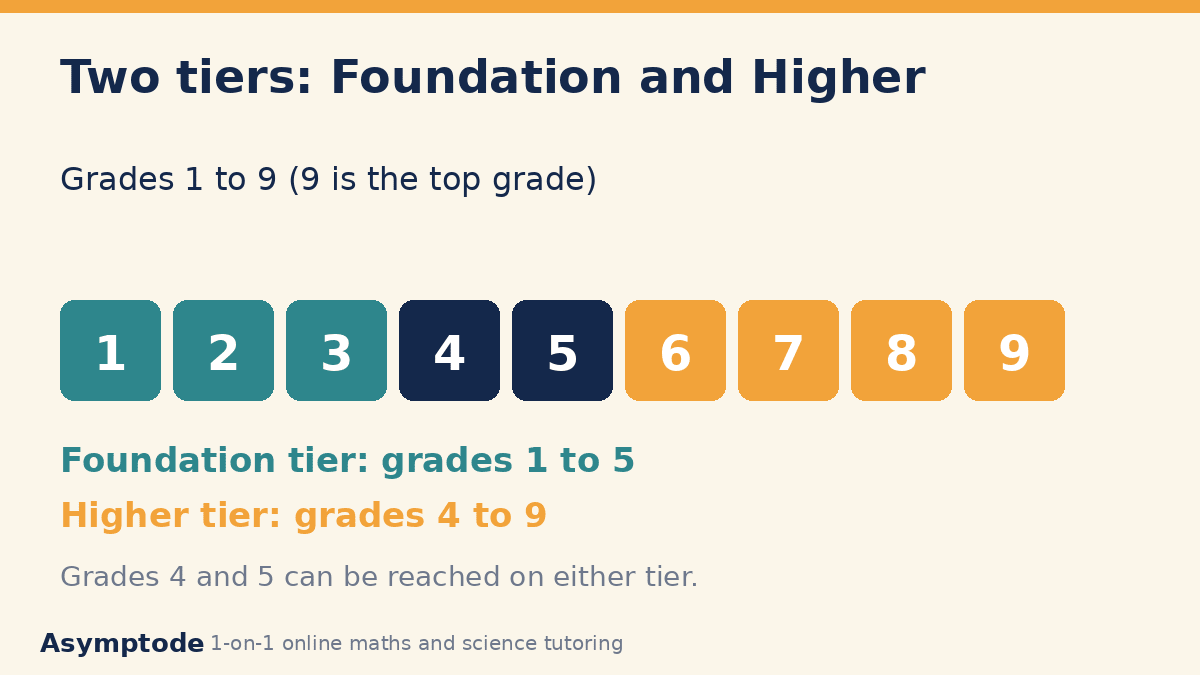
- Foundation tier: grades 1 to 5.
- Higher tier: grades 4 to 9.
Grades 4 and 5 can be reached on either tier. Higher papers are harder. A student aiming for grade 6 or above needs Higher. Talk to the teacher before the tier is chosen. Ask what grade they expect for your child and why.
What does the non-calculator paper test?
It tests number sense. Your child needs fractions, percentages, ratio and simple algebra without a calculator. Many students lose marks here because they lean on the calculator in daily homework.
Here is a typical percentage question. It is fine to do by hand.
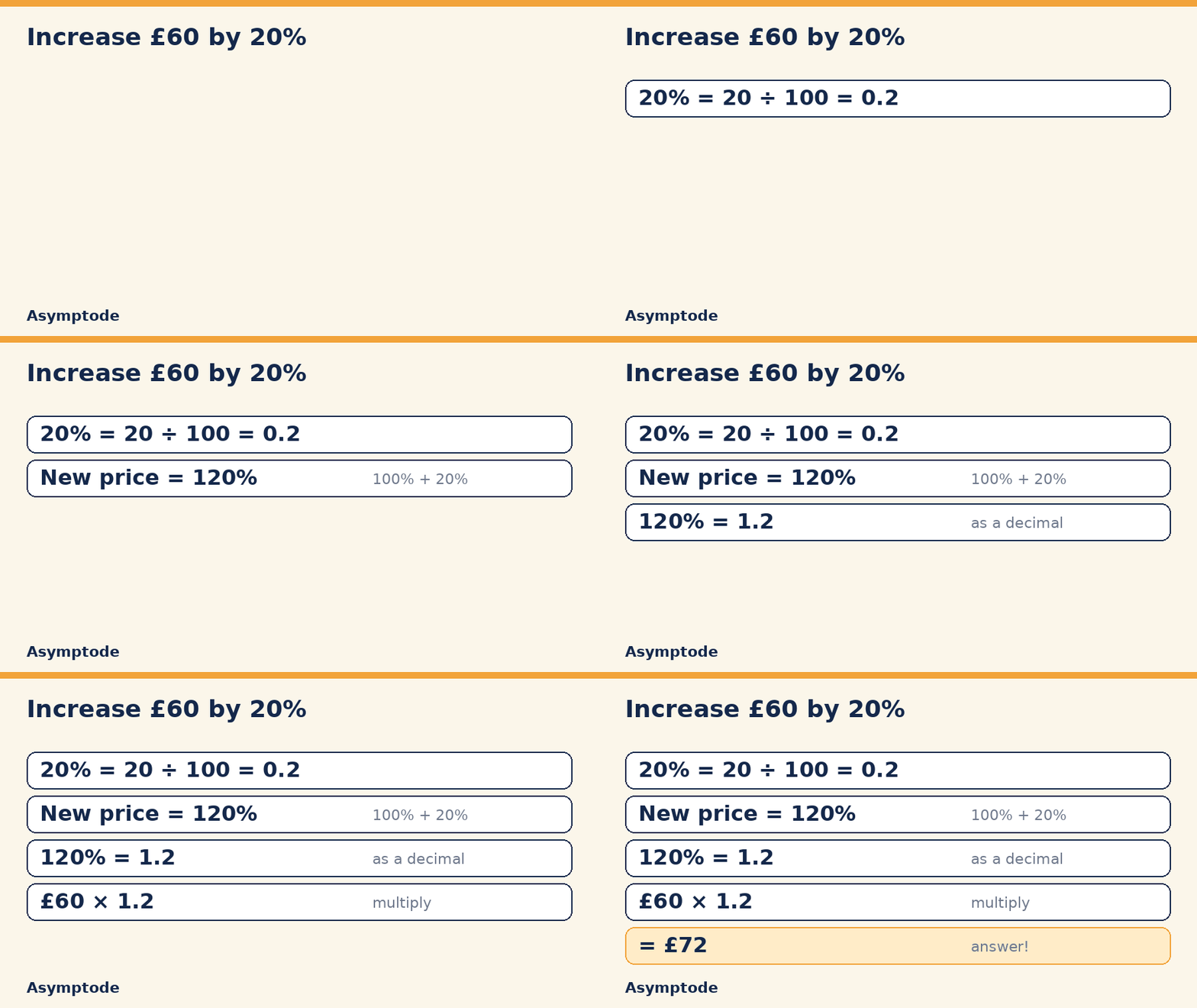
- 20% as a decimal is 0.2.
- The new price is 100% + 20% = 120%.
- 120% as a decimal is 1.2.
- £60 × 1.2 = £72.
This "multiplier" trick is a big time saver. It works for any percentage change.
For help with number skills, try our guides on adding and subtracting fractions and GCF and LCM.
How can your child prepare?
- Practise by paper type. Do one non-calculator set each week.
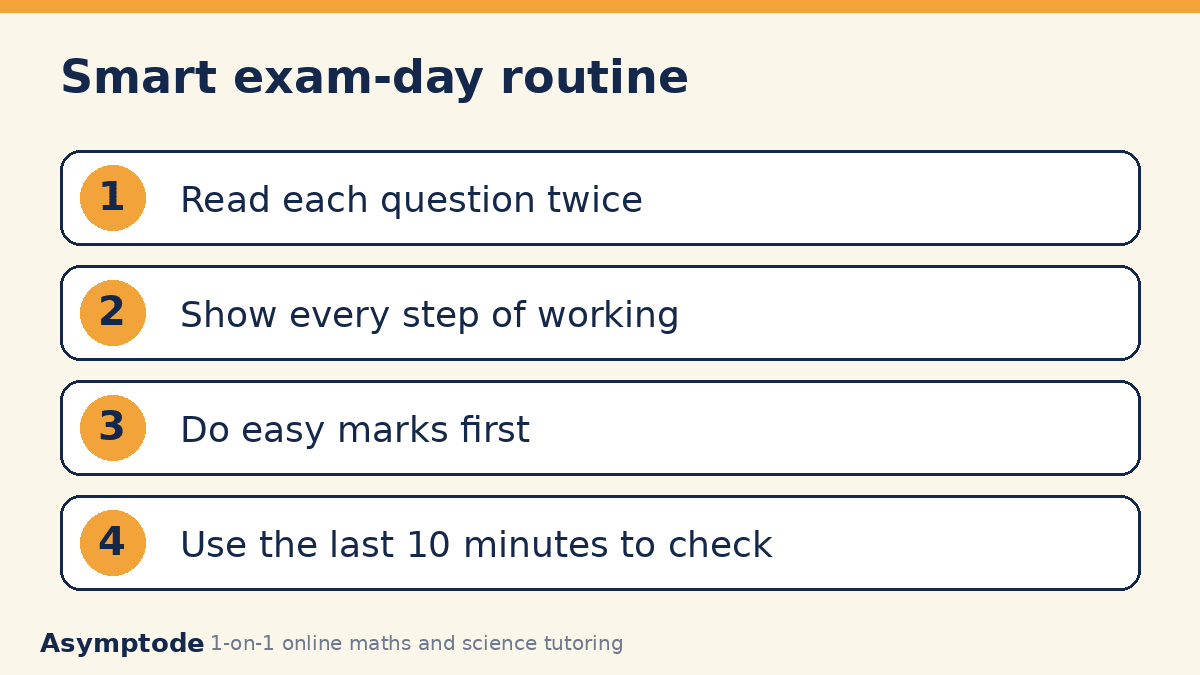
- Show all working. Marks are given for method, not only the final answer.
- Fix gaps early. Algebra and fractions problems in Year 9 become big problems in Year 11.
- Review mistakes. Keep a list of errors and look at it each week.
- Do timed papers in the last few months.
Where can 1-on-1 tutoring help?
If your child is stuck on one topic, a tutor can fix it fast. If your child is confident, a tutor can help them push for a higher grade.
At Asymptode, sessions are live, online and 1-on-1. Your child gets personalised homework with feedback, and parents can see progress. We do not guarantee grades. We make sure your child understands the method.
Ready to ask a question? Talk to an advisor or look at our fees. Also read how to choose an online maths tutor.
How should students revise for GCSE Maths?
Revision works best when it is active. Reading notes feels easy, but it does not teach much. Doing questions does.
Here is a simple plan:
- List the topics. Use your board's specification or your teacher's list. Mark each topic green, amber or red.
- Start with red topics. These are the biggest gains.
- Do questions, then check. Try a question without notes. Then mark it and note what went wrong.
- Mix the topics. In the exam, topics appear in any order. Practise that way.
- Do full papers. Do them under time, with the right calculator rules.
Use past papers from your own exam board. They show the style of questions and the mark scheme shows what earns marks. Ask your school or look on the board's website.
What are common GCSE Maths mistakes?
Many lost marks come from small habits, not from hard topics. Watch for these:
- Calculator slips. Using a calculator in the wrong mode or typing a bracket wrongly.
- Sign errors. Losing a minus sign in algebra.
- No working. A wrong answer with no method earns no marks. A wrong answer with a good method can still earn some.
- Not reading the question. Missing words such as "give your answer to 2 decimal places" or "in terms of π".
- Skipping the check. Even 30 seconds at the end can catch a slip.
Here is a quick example of why working matters. A student finds 20% of £60 and writes only "12". If the real question was "increase £60 by 20%", the answer is £72. Showing "60 × 1.2" makes the method clear to the examiner.
How do you use the calculator papers well?
Papers 2 and 3 allow a calculator for AQA and Edexcel. For OCR, Papers 1 and 3 do. A calculator is a tool, not a brain. Students still need to choose the right method.
- Learn your own calculator. Practise fractions, powers and brackets on the same model used in the exam.
- Estimate first. If your answer is far from the estimate, check it.
- Write the full calculation before the answer, so you earn method marks.
- Do not round too early. Round only at the end.
What are signs your child needs more help?
- Predicted or mock grades are lower than their target.
- They do well in class but badly in timed papers.
- They find the non-calculator paper much harder than the others.
- They say "I get it when the teacher shows me" but cannot do it alone.
- Maths homework takes very long or ends in tears.
Any of these is a good reason to look for support. The earlier you start, the more time there is to build skills slowly. A tutor can also help a strong student stretch for the next grade.
When should families start planning?
Do not wait until Year 11. GCSE Maths builds on ideas from earlier years, such as fractions, ratio and algebra. A gap in Year 8 can cause trouble in Year 10.
A good rhythm looks like this. In Years 9 and 10, check the basics and fix gaps slowly. In Year 11, move to past papers and timed practice. Ask the school for mock exam results and look at which topics lost the most marks. Those topics are your starting list.
Small, steady work is kinder to your child than a panic in the spring. It also gives time to decide on the right tier with the teacher, without pressure.
FAQ
How long is each GCSE Maths paper?
Each paper is 1 hour 30 minutes for AQA, Edexcel and OCR.
Which GCSE Maths paper has no calculator?
For AQA and Edexcel it is Paper 1. For OCR it is Paper 2.
How are the papers weighted?
Each of the three papers counts for one third of the final grade.
What are the GCSE Maths tiers?
Foundation covers grades 1 to 5. Higher covers grades 4 to 9. Students sit all papers at one tier.
Do I need to know my child's exam board?
Yes. Ask the school. It tells you which paper is non-calculator and which specification to use.
Can a tutor help with GCSE Maths?
Yes. A tutor can find gaps, explain methods and give feedback on practice papers. No one can guarantee a grade.