
The sine and cosine rules let you find missing sides and angles in any triangle, not just right-angled ones. Below: which rule to use, four worked examples, the ambiguous case and a practice set. It suits GCSE Higher, IGCSE Extended, A-level, IB, SAT and Indian Class 10 and 11 students.
Key takeaways
- Sine rule: a/sin A = b/sin B = c/sin C. Use it when you know a side and the angle opposite it.
- Cosine rule: a^2 = b^2 + c^2 - 2bc cos A. Use it for two sides and the angle between them, or for all three sides.
- Area of any triangle = 1/2 ab sin C, where C is the angle between sides a and b.
- When you find an angle with the sine rule, there may be two answers (the ambiguous case).
- Set your calculator to degrees. Keep full values in working and round only at the end.
What are the sine and cosine rules, and when do you use each?
Quick answer: The sine rule links each side to the sine of its opposite angle. The cosine rule is like Pythagoras with a correction term. Use the sine rule when you know a matching pair (a side and its opposite angle). Use the cosine rule when you have two sides and the angle between them, or all three sides.
Label the triangle first. Capital letters (A, B, C) are angles. Small letters (a, b, c) are the sides opposite them. So side a sits across from angle A.
| You know | You want | Use |
|---|---|---|
| 2 angles and 1 side | a side | Sine rule |
| 2 sides and a non-included angle | an angle | Sine rule (check for 2 answers) |
| 2 sides and the included angle | the third side | Cosine rule |
| All 3 sides | an angle | Cosine rule (rearranged) |
| 2 sides and the included angle | the area | Area = 1/2 ab sin C |
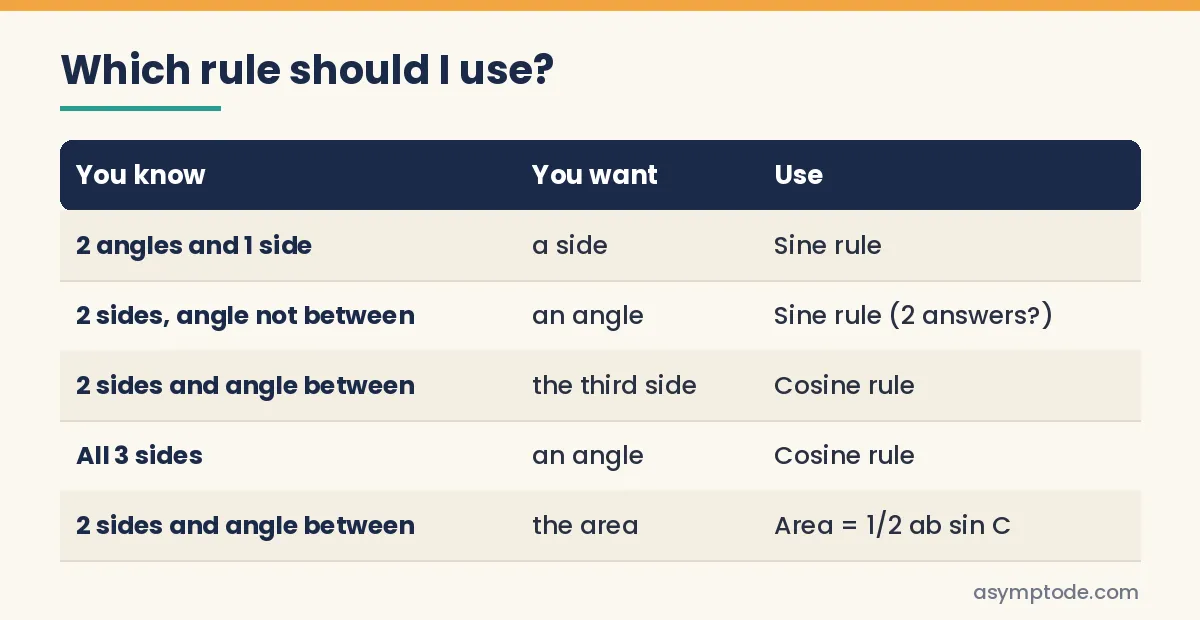 Choose the rule from what the question gives you.
Two angles and a side, or two sides and a non-included angle: sine rule.
Two sides and the included angle: cosine rule for the third side, or 1/2 ab sin C for the area.
All three sides: cosine rule for an angle.
For right-angled triangles, SOH CAH TOA and Pythagoras' theorem are faster.
Where are these rules in the GCSE and IGCSE syllabus?
- AQA GCSE Mathematics (8300): the AQA specification (Version 1.1, September 2026) lists the sine and cosine rules under G22 (page 34) and Area = 1/2 ab sin C under G23 (page 35). Both are Higher tier only. The appendix (page 48) says you must know these formulae: they are not given in the exam.
- Cambridge IGCSE Mathematics 0580: the 0580 syllabus for 2025, 2026 and 2027 covers them in E6.5 Non-right-angled triangles (Extended, page 52). It includes obtuse angles and the ambiguous case. The three formulas are printed in the Extended List of formulas (page 61).
For A-level, IB, the digital SAT, CBSE or state boards, check your current syllabus. Our guides to GCSE maths papers and IGCSE Maths 0580 explain the papers.
How do you use the sine rule? (Example 1)
Question: In triangle ABC, angle A = 42 degrees, angle B = 73 degrees and a = 9.4 cm. Find b.
- Side a and angle A are a matching pair, so use the sine rule: b/sin B = a/sin A.
- Substitute: b/sin 73 = 9.4/sin 42.
- Rearrange: b = 9.4 × sin 73 / sin 42.
- Calculate: sin 73 = 0.95630 and sin 42 = 0.66913, so b = 8.9893 / 0.66913 = 13.434...
- Round: b = 13.4 cm (3 significant figures).
Check: b faces the bigger angle, so it should be longer than a. It is.
 Example 1, one step at a time.
Start with a/sin A = b/sin B.
Put in the values: b/sin 73 = 9.4/sin 42.
Multiply both sides by sin 73: b = 9.4 sin 73 / sin 42.
The answer is b = 13.4 cm to 3 significant figures.
What is the ambiguous case of the sine rule? (Example 2)
When you find an angle with the sine rule, there can be two answers: B and 180 - B.
Question: a = 8 cm, b = 11 cm and angle A = 35 degrees. Find angle B.
- Use sin B / b = sin A / a, so sin B = 11 × sin 35 / 8.
- sin 35 = 0.57358, so sin B = 6.3093 / 8 = 0.78867.
- Calculator: B = sin^-1(0.78867) = 52.1 degrees.
- Second option: 180 - 52.06 = 127.9 degrees.
- Check: if B = 52.1, C = 92.9 degrees. If B = 127.9, C = 17.1 degrees. Both are positive, so both triangles exist.
So B = 52.1 or 127.9 degrees. If the second option makes the angles add to more than 180, reject it.
How do you use the cosine rule to find a side? (Example 3)
Question: b = 7 cm, c = 10 cm and the angle between them, A = 48 degrees. Find a.
- Two sides and the included angle, so use the cosine rule. Substitute: a^2 = 7^2 + 10^2 - 2 × 7 × 10 × cos 48.
- Work out: 49 + 100 = 149, and 140 × cos 48 = 140 × 0.66913 = 93.678.
- a^2 = 149 - 93.678 = 55.322.
- Square root: a = 7.4379..., so a = 7.44 cm.
 Example 3, one step at a time.
Start with a^2 = b^2 + c^2 - 2bc cos A.
Put in the values: a^2 = 49 + 100 - 140 cos 48.
That gives a^2 = 149 - 93.678 = 55.322.
Square root it: a = 7.44 cm to 3 significant figures.
Do 2bc cos A first, then subtract.
How do you find an angle and the area? (Example 4)
Question: A triangle has sides a = 5 cm, b = 7 cm and c = 9 cm. Find the largest angle, then the area.
- The largest angle faces the longest side, so find C (opposite c = 9).
- Rearranged cosine rule: cos C = (a^2 + b^2 - c^2) / 2ab.
- Substitute: cos C = (25 + 49 - 81) / (2 × 5 × 7) = -7/70 = -0.1.
- C = cos^-1(-0.1) = 95.739... so C = 95.7 degrees. A negative cosine means an obtuse angle.
- Area = 1/2 ab sin C = 0.5 × 5 × 7 × sin 95.739 = 17.5 × 0.99499 = 17.412...
- Area = 17.4 cm^2.
Want your working checked live? Book a free demo class, or compare our plans and fees.
Which calculator settings and rounding rules matter?
- Degrees mode. In radian mode, Example 1 gives 6.94 cm instead of 13.4 cm.
- Keep full values. Use the ANS key or memory.
- Round once, at the end. The 0580 syllabus asks for three significant figures unless a question says otherwise, and working to at least one more figure than the answer (page 63). For right-angled trigonometry it asks for angles in degrees to one decimal place, a good habit here too.
- Non-calculator papers use exact values such as sin 30 = 1/2 or cos 60 = 1/2.
What are the most common mistakes?
- Using the sine rule with no matching side-angle pair.
- Forgetting the second angle in the ambiguous case.
- Using the cosine rule with an angle that is not between the two sides.
- Subtracting before multiplying by cos A.
- Rounding mid-working, or using radians.
Practice set (with answers)
Give lengths to 3 significant figures and angles to 1 decimal place.
- A = 50 degrees, B = 64 degrees, a = 12 cm. Find b.
- Two sides are 6 cm and 8 cm with 115 degrees between them. Find the third side.
- Sides are 10 cm, 13 cm and 15 cm. Find the angle opposite the 15 cm side.
- Sides 9 cm and 12 cm with 38 degrees between them. Find the area.
- a = 5 cm, b = 7 cm, A = 40 degrees. Find both possible values of B.
- Sides 8 cm and 10 cm, area 30 cm^2. Find the angle between them (two answers).
Answers: 1) 14.1 cm 2) 11.9 cm 3) 80.3 degrees 4) 33.2 cm^2 5) 64.1 or 115.9 degrees 6) 48.6 or 131.4 degrees
Sin and cos return in mechanics, as in projectile motion. See also our A-level maths guide and IB Maths AA vs AI.
How Asymptode helps you with the sine and cosine rules
At Asymptode, a qualified mentor teaches your child one-to-one, live online, using their own course: AQA 8300 Higher (G22 and G23), Cambridge 0580 Extended (E6.5), A-level, IB or their school board. Lessons follow that course and the dates of their own mocks and exams. The mentor checks how they pick between the rules, how they label the triangle and how they handle the ambiguous case.
Between classes, your child gets practice built for them. Each worksheet is made from what their last attempt showed they had not understood, such as missing the second angle or radian mode, and is set at their level. It is never generic. This is Asymptode's AI-assisted practice, written to the mentor's brief and sent only after the mentor approves it.
The mentor marks each worksheet. You see what was understood and what to practise next, so the work keeps correcting itself. Book a free demo class or see our fees.
Facts checked against official sources on 11 November 2026.
FAQ
When do I use the sine rule instead of the cosine rule?
Use the sine rule when you know a side and the angle opposite it, plus one more side or angle. Use the cosine rule when you know two sides and the angle between them, or all three sides.
Are the sine and cosine rules given in the exam?
In AQA GCSE 8300 they are not given: the specification appendix says you must know them. In Cambridge IGCSE 0580 Extended they are printed on the List of formulas. For other exams, check the official formula booklet.
What is the ambiguous case?
It happens when you use the sine rule to find an angle. Because sin x = sin (180 - x), there can be two possible angles. Check whether the second one still leaves room for the third angle.
Can I use the cosine rule on a right-angled triangle?
Yes. With a 90 degree angle, cos 90 = 0, so the rule becomes Pythagoras' theorem.
Why did I get a strange answer on my calculator?
Your calculator is probably in radian mode. Switch to degrees and try again.
Is the area formula 1/2 ab sin C on the Higher paper only?
In AQA 8300, Area = 1/2 ab sin C is Higher tier content (G23). In Cambridge 0580 it sits in the Extended content (E6.5). Without it, you use 1/2 × base × height, which needs the perpendicular height.
Ready to start? Book a free demo class and advisor call, or see our plans and fees.