
Ohm's law explained in one line: the potential difference across a conductor equals the current through it multiplied by its resistance, or V = I x R. This guide covers the three quantities, when the law fails, I-V graphs, series and parallel resistors, power and four worked examples, for GCSE, A-level, AP Physics 2, CBSE and JEE Main students.
Key takeaways
- Ohm's law: V = I x R, with V in volts, I in amps and R in ohms (Ω).
- It holds for ohmic conductors, such as a metal resistor kept at constant temperature.
- A filament lamp and a diode are non-ohmic. Their I-V graphs are curves.
- Series: R = R1 + R2. Parallel: 1/R = 1/R1 + 1/R2.
- Power: P = V x I = I^2 x R.
What is Ohm's law in physics?
Quick answer: Ohm's law says the current through an ohmic conductor is directly proportional to the potential difference across it, as long as its temperature stays the same. So V = I x R, where R stays constant. Double the voltage and the current doubles. If R changes as the current changes, the component is non-ohmic.
AQA GCSE students must recall and apply "potential difference = current × resistance" (AQA GCSE Physics 8463, section 4.2.1).
What are voltage, current and resistance?
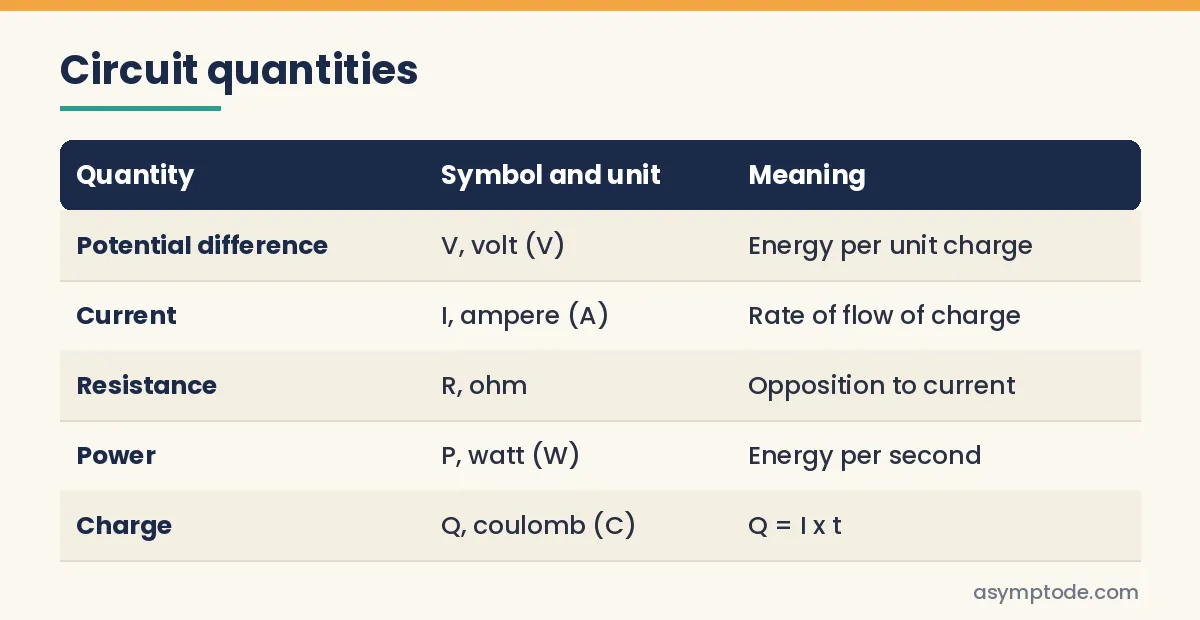 The five quantities you need for circuit questions.
- Potential difference (V) is measured in volts (V). It is the energy transferred per unit charge.
- Current (I) is measured in amperes, or amps (A). It is the rate of flow of charge.
- Resistance (R) is measured in ohms (Ω). It tells you how much a component opposes the current.
- Power (P) is measured in watts (W), which is energy transferred per second. Charge (Q) is in coulombs (C), and Q = I x t.
AQA A-level defines potential difference as work done per unit charge, V = W/Q (AQA A-level Physics 7408, section 3.5.1).
How do you use the Ohm's law formula triangle?
Put V at the top of a triangle, with I and R side by side below. Cover the quantity you want:
| You want | Cover it and you see | Formula |
|---|---|---|
| Potential difference | I next to R | V = I x R |
| Current | V over R | I = V / R |
| Resistance | V over I | R = V / I |
Always convert units first. 250 mA is 0.25 A. 2 kΩ (kilohm) is 2,000 Ω.
Worked example 1: finding current
A 12 V supply is connected across a 4 Ω resistor. Find the current and the power.
 Each step of the first worked example.
- Write the law: V = I x R.
- Rearrange for current: I = V / R.
- Substitute: I = 12 / 4 = 3 A.
- Power: P = V x I = 12 x 3 = 36 W.
- Check: 3 x 4 = 12 V, matching the supply.
Worked example 2: finding potential difference
0.5 A flows through a 20 Ω resistor. V = I x R = 0.5 x 20 = 10 V. Check: 10 / 20 = 0.5 A.
When does Ohm's law hold, and when does it fail?
Ohm's law holds only when resistance stays constant: an ohmic conductor at constant temperature. AQA A-level calls it "a special case" where I is proportional to V under constant physical conditions. AP Physics 2 calls materials with constant resistance for all currents "ohmic materials" (AP Physics 2 Course and Exam Description).
- Filament lamp. As current rises, the filament gets hotter. AQA says its resistance increases as its temperature increases.
- Diode. Current flows in one direction only. In reverse, the diode has a very high resistance.
What do I-V graphs look like?
An I-V graph plots current against potential difference. AQA GCSE Required Practical 4 investigates a filament lamp, a diode and a resistor at constant temperature.
| Component | Shape of I-V graph | Ohmic? |
|---|---|---|
| Resistor (constant temperature) | Straight line through the origin | Yes |
| Filament lamp | S-shaped curve that flattens as V rises | No |
| Diode | Almost zero current in reverse, then rises steeply forwards | No |
If I is on the y-axis, the gradient is 1/R, not R. AQA A-level questions can put either I or V on the horizontal axis, so read the axes first. Gradient skills from motion graphs apply here too.
How do you combine resistors in series and parallel?
Series (one path): the same current flows through each resistor. The supply voltage is shared. Total resistance: R = R1 + R2.
Parallel (separate branches): each branch has the same potential difference. The branch currents add up to the total current. Total resistance: 1/R = 1/R1 + 1/R2. The total is always less than the smallest single resistor.
AQA GCSE students are not required to calculate parallel totals, only explain them. AQA A-level, CBSE and JEE Main include the parallel formula.
Worked example 3: series and parallel
Take 6 Ω and 3 Ω, first in series, then in parallel.
 Series adds resistances. Parallel adds their reciprocals.
Series with a 9 V supply:
- R = 6 + 3 = 9 Ω.
- I = V / R = 9 / 9 = 1 A.
- Check: 1 x 6 = 6 V and 1 x 3 = 3 V, total 9 V.
Parallel with a 6 V supply:
- 1/R = 1/6 + 1/3 = 1/6 + 2/6 = 3/6.
- So R = 6/3 = 2 Ω.
- Total current: I = 6 / 2 = 3 A.
- Check: 1 A (6 Ω branch) + 2 A (3 Ω branch) = 3 A.
How is power linked to Ohm's law?
P = V x I. Swap V for I x R and you get P = I^2 x R. AQA A-level and NCERT also give P = V^2 / R.
Worked example 4: power in a heater
A 50 Ω heater element carries 2 A. Find its power.
- P = I^2 x R = 2^2 x 50 = 4 x 50 = 200 W.
- Check: V = 2 x 50 = 100 V, and P = V x I = 100 x 2 = 200 W. For more on energy, read our work-energy theorem guide.
What are the most common Ohm's law mistakes?
- Not converting units. Change mA to A and kΩ to Ω first.
- Wrong rearrangement. Write the formula before the numbers.
- Adding parallel resistors. 6 Ω and 3 Ω in parallel is 2 Ω, not 9 Ω.
- Forgetting to flip 1/R. If 1/R = 1/2, then R = 2 Ω, not 0.5 Ω.
- Calling a lamp ohmic. R = V / I gives its resistance at one point only.
- Misreading the gradient. With I on the y-axis, the gradient is 1/R.
Book a free demo class to work through your circuit questions, or see our plans and fees.
Where is Ohm's law in your syllabus?
- AQA GCSE Physics 8463 (Version 1.1, 30 September 2019): sections 4.2.1.3, 4.2.1.4 and 4.2.2. See our GCSE Physics guide.
- AQA A-level Physics 7408 (Version 1.3, 1 June 2017): section 3.5.1, which adds resistivity and internal resistance. See our A-level Physics guide.
- AP Physics 2: Unit 11, Electric Circuits (topic 11.3), weighted 15-18% of the multiple-choice section. The course was revised for 2024-25, with more comprehensive circuits coverage. See our AP Physics 2 exam guide.
- CBSE Class 10 Science: the NCERT Chapter 11, Electricity covers Ohm's law, series and parallel resistors and power. Check the CBSE academic website for this year's syllabus. See our CBSE board exams 2027 guide.
- JEE Main 2027: Physics Unit 12, Current Electricity, in the official syllabus, lists Ohm's law, ohmic and non-ohmic I-V characteristics, resistor combinations and Kirchhoff's laws. See our JEE Main 2027 guide.
How Asymptode helps you with Ohm's law and circuits
At Asymptode, a qualified mentor teaches you one-to-one, live online, following your own syllabus, whether AQA GCSE 4.2, A-level 3.5.1, AP Physics 2 Unit 11, CBSE Electricity or JEE Main Unit 12, and your real exam dates.
Between classes you get practice built for you. If your last attempt showed you added parallel resistors or forgot to convert milliamps, your next worksheet targets that exact gap, at your level. It is never a generic sheet. This is Asymptode's AI-assisted practice: it is written to your mentor's brief and sent only after your mentor approves it.
Your mentor marks the work. Your parent sees what you understood and what to practise next, so your circuits preparation keeps correcting itself towards your exam.
Book a free demo class or see our plans and fees.
Facts checked against official sources on 8 November 2026.
FAQ
What is Ohm's law in simple words?
Current through a conductor is proportional to the potential difference across it, at constant temperature: V = I x R. If you double the voltage across an ohmic resistor, the current doubles.
What are the units in V = I x R?
V is in volts (V), I in amps (A) and R in ohms (Ω). Convert milliamps and kilohms first: 250 mA is 0.25 A.
Does a filament lamp obey Ohm's law?
No. As current rises, the filament heats up and its resistance increases. Its I-V graph is a curve, so it is non-ohmic.
Why is a diode non-ohmic?
A diode lets current flow in one direction only and has a very high resistance in reverse. Its resistance is not constant, so it is non-ohmic.
How do you find total resistance in parallel?
Use 1/R = 1/R1 + 1/R2, then flip the answer. For 6 Ω and 3 Ω, 1/R = 1/6 + 1/3 = 3/6, so R = 2 Ω. The total is always less than the smallest resistor.
Is Ohm's law in the JEE Main 2027 syllabus?
Yes. The official syllabus lists it under Physics Unit 12, Current Electricity, with I-V characteristics, resistor combinations, electrical power and Kirchhoff's laws.
Ready to start? Book a free demo class and advisor call, or see our plans and fees.
Sources
- AQA GCSE Physics 8463 specification (section 4.2 Electricity)
- AQA AS and A-level Physics 7407/7408 specification (section 3.5.1)
- AP Physics 2: Algebra-Based Course and Exam Description (effective fall 2024)
- AP Physics revisions for 2024-25 (College Board)
- NCERT Class 10 Science, Chapter 11 Electricity
- Syllabus for JEE (Main) 2027 (NTA)