

GCSE Physics (often called "triple" or "separate" physics) is a full GCSE on its own. It goes deeper than Combined Science and adds topics such as space physics. This guide explains the papers for each exam board, the 8 topics, the equation sheet rules for 2027, and a simple plan to prepare.
Key takeaways
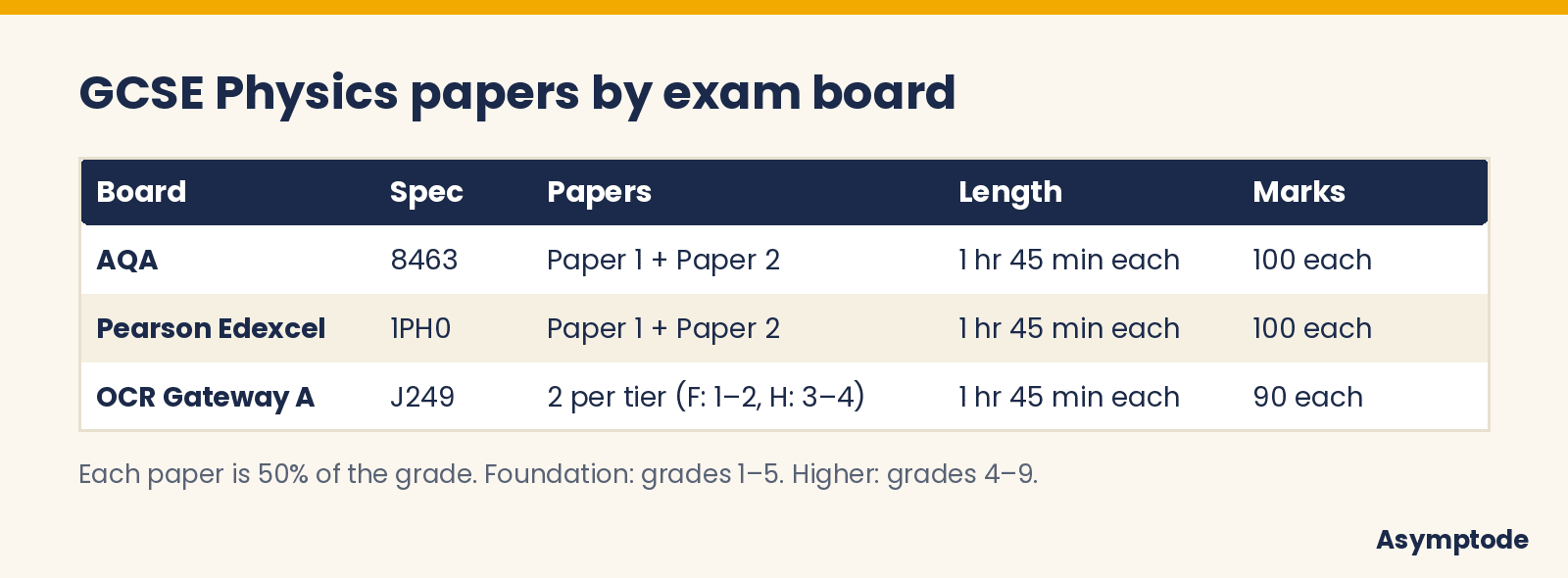
- AQA (8463) and Pearson Edexcel (1PH0) both set 2 papers of 1 hour 45 minutes and 100 marks, each worth 50%.
- OCR Gateway Physics A (J249) sets 2 papers of 1 hour 45 minutes and 90 marks per tier.
- Papers are tiered: Foundation (grades 1–5) or Higher (grades 4–9).
- For 2027 exams, students get a physics equation sheet, so they do not need to memorise equations. AQA says the sheet is unchanged from 2026.
- Required practicals are tested in the written papers. AQA GCSE Physics has 10 required practicals.
What is GCSE Physics?
Quick answer: GCSE Physics is a single-science GCSE taken in England, usually in Year 11. Students sit two written papers at the end of the course, at Foundation or Higher tier, and get one grade from 9 to 1. It covers energy, electricity, particles, atoms, forces, waves, magnetism and space.
It is different from GCSE Combined Science, where physics is one-third of a double award. If your child is choosing between the two, read our GCSE Combined Science guide first. Triple science means three separate GCSEs: biology, chemistry and physics.
What are the GCSE Physics papers for each exam board?
| Exam board | Spec code | Papers | Length | Marks | Weight |
|---|---|---|---|---|---|
| AQA | 8463 | Paper 1 + Paper 2 | 1 hr 45 min each | 100 each | 50% each |
| Pearson Edexcel | 1PH0 | Paper 1 + Paper 2 | 1 hr 45 min each | 100 each | 50% each |
| OCR Gateway A | J249 | 2 papers per tier (1–2 Foundation, 3–4 Higher) | 1 hr 45 min each | 90 each | 50% each |
Your child's school chooses the board. Ask the physics teacher which specification they follow, then use that board's past papers. The topics are very similar across boards, but the question styles are not.
What does each AQA paper cover?
| AQA paper | Topics |
|---|---|
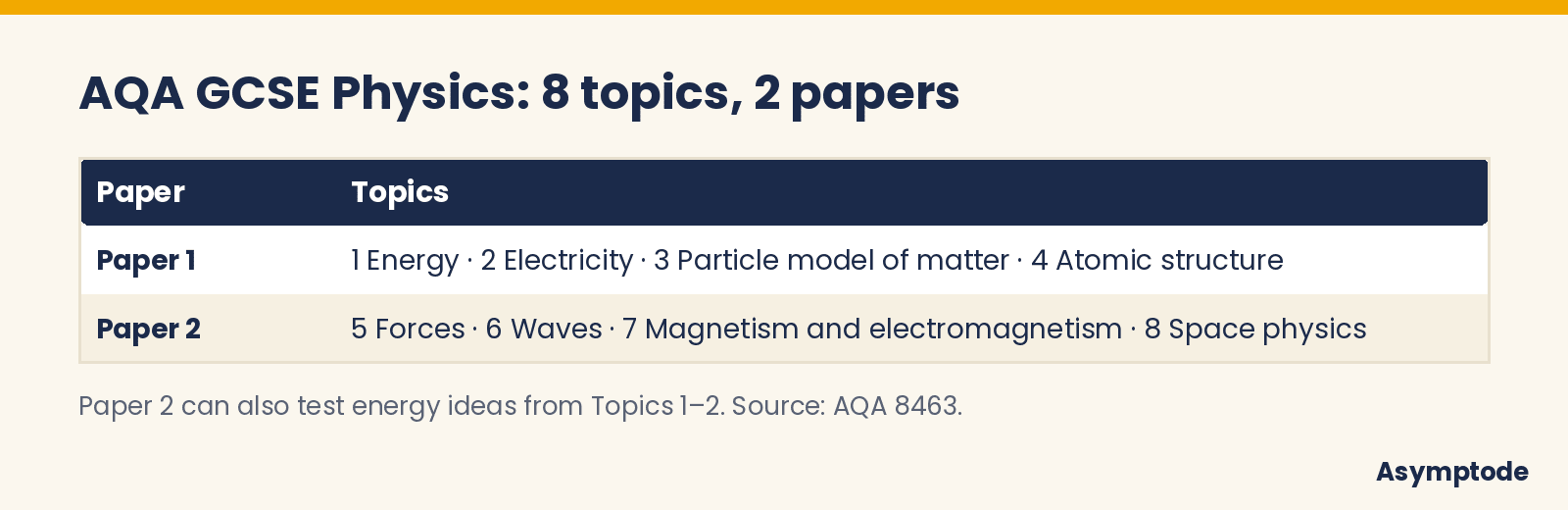
| Paper 1 | 1 Energy, 2 Electricity, 3 Particle model of matter, 4 Atomic structure |
| Paper 2 | 5 Forces, 6 Waves, 7 Magnetism and electromagnetism, 8 Space physics |
AQA notes that Paper 2 can also draw on energy changes and energy conservation from Topics 1 and 2. So energy is never "finished" after Paper 1. Questions include multiple choice, short structured answers and longer open responses (6-mark questions).
What is the difference between Foundation and Higher tier?
- Foundation tier gives grades 1 to 5.
- Higher tier gives grades 4 to 9 (with a safety-net grade 3 in some cases).
Both tiers cover the same topics, but Higher papers include harder maths, more rearranging of equations and longer reasoning questions. The school usually decides the tier in Year 11 using mock results. If your child is on the border, ask the teacher what grade range each tier makes realistic.
Do students need to learn the physics equations in 2027?
For 2027 exams, no. The Department for Education and Ofqual confirmed that students get a physics equation sheet with the papers. AQA says the 2027 sheet is unchanged from 2026.
But the sheet is not a shortcut. Students still need to:
- choose the right equation for the problem,
- rearrange it,
- convert units (for example kJ to J, or minutes to seconds), and
- know what each symbol means.
Those skills are where most marks are lost. For 2028 onwards, Ofqual has set new rules: boards cannot set questions that can be answered just by copying from the sheet.
Worked example 1: kinetic energy
A 2 kg trolley moves at 3 m/s. What is its kinetic energy?
- Equation: Eₖ = ½ m v².
- Substitute: Eₖ = ½ × 2 × 3².
- Square first: 3² = 9.
- Eₖ = ½ × 2 × 9 = 9 J.
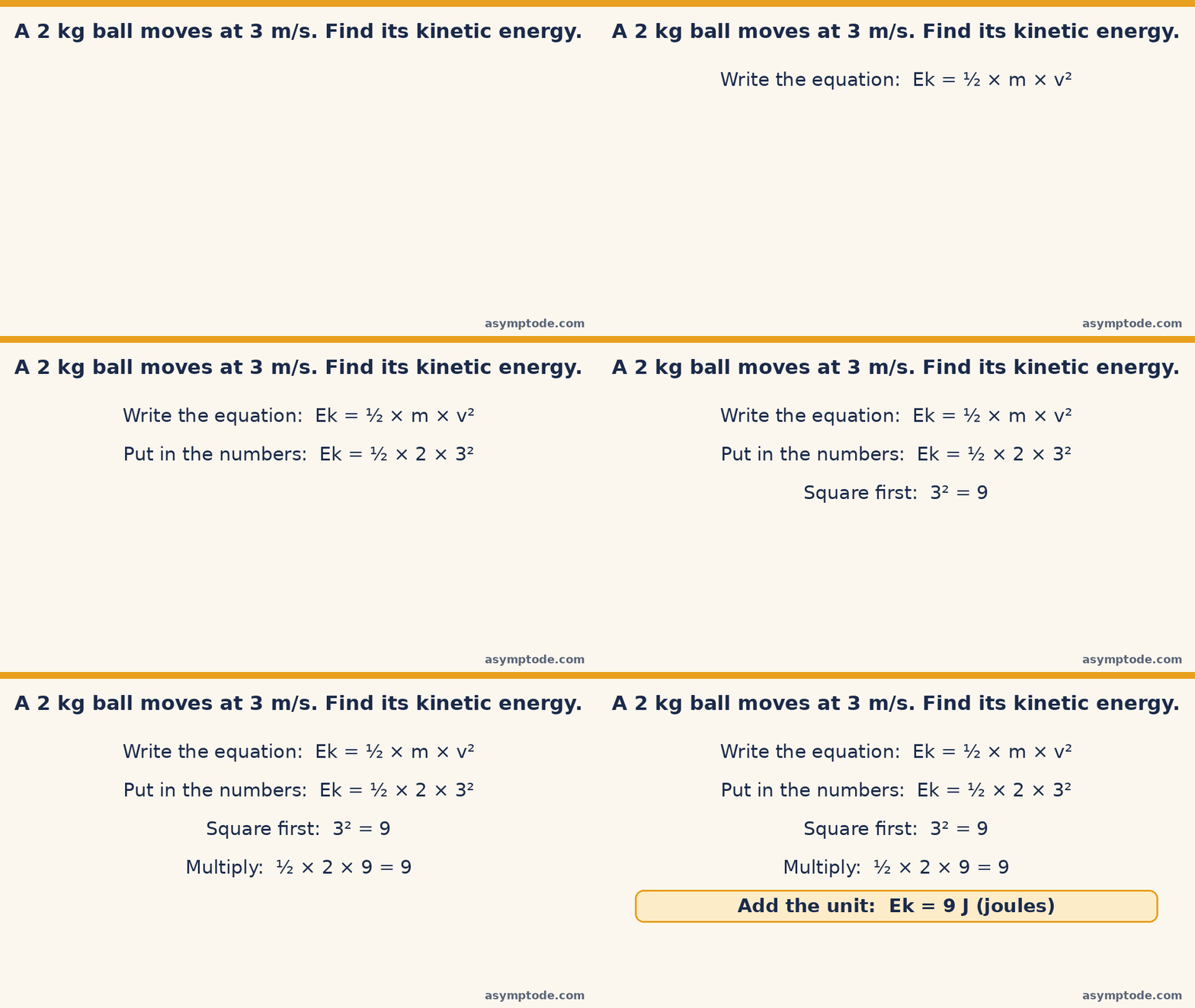
Common trap: squaring after multiplying. Always square the speed first.
Worked example 2: density
A metal block has a mass of 540 g and a volume of 200 cm³. What is its density?
- Equation: ρ = m ÷ V.
- Substitute: ρ = 540 ÷ 200.
- ρ = 2.7 g/cm³.
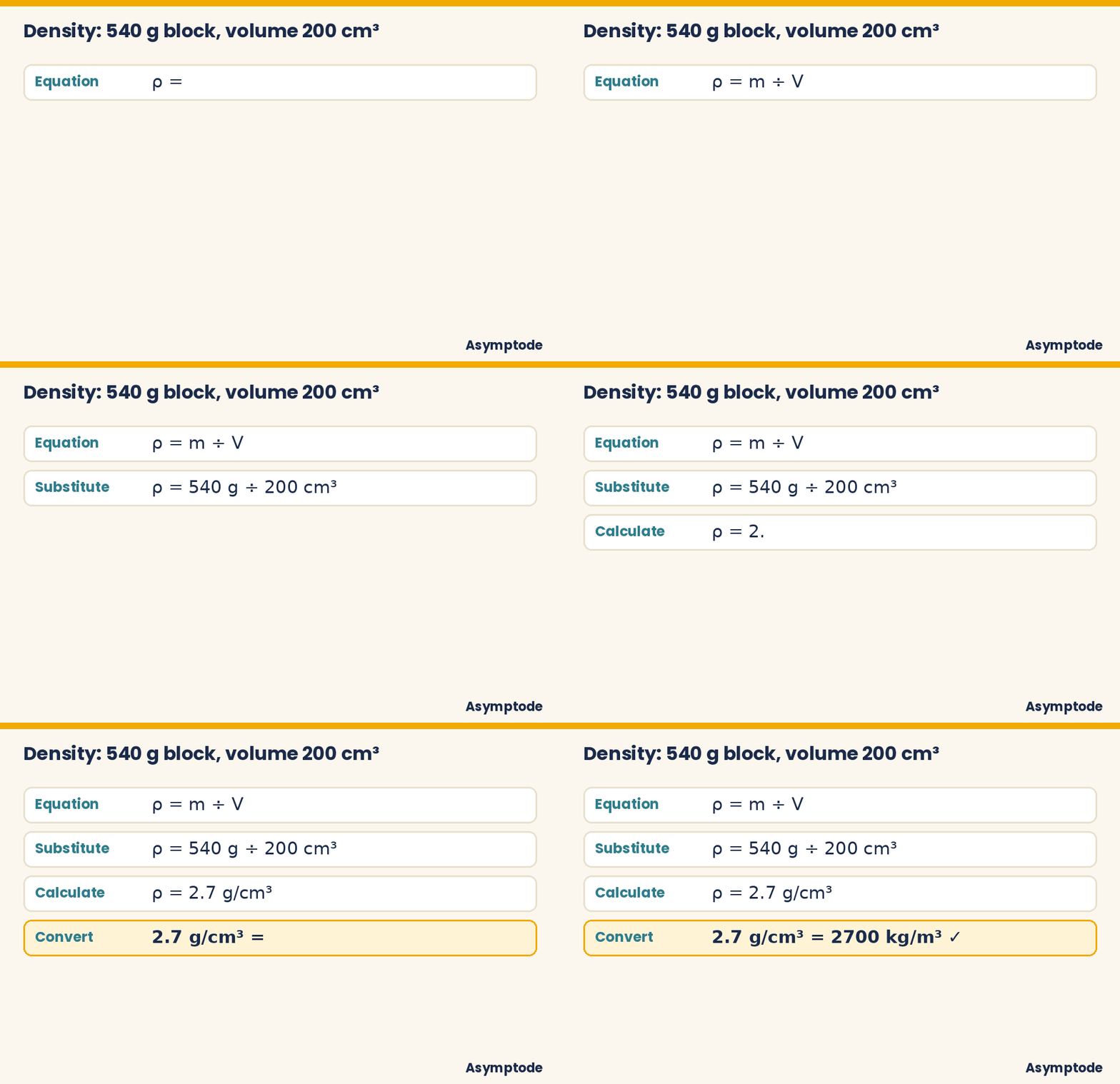
If the question asks for kg/m³, convert: 2.7 g/cm³ = 2700 kg/m³. Unit conversion is one of the most common lost marks in the Particle Model topic.
Worked example 3: charge and current
A current of 0.5 A flows for 2 minutes. How much charge flows?
- Equation: Q = I t.
- Convert time: 2 minutes = 120 s.
- Q = 0.5 × 120 = 60 C.
Many students write 0.5 × 2 = 1 C. The equation sheet will not catch that for them. Converting to seconds is the whole question.
What are the required practicals?
Required practicals are experiments students must do in class. They are not marked as coursework. Instead, the written papers ask about them: the method, the variables, the results and the errors.
AQA GCSE Physics has 10 required practicals, including specific heat capacity, resistance, I–V characteristics, density, force and extension, acceleration, waves, and infrared radiation. Edexcel calls them core practicals, and OCR uses practical activity groups (PAGs).
A good way to revise them: for each one, write the aim, the independent, dependent and control variables, two safety points, and one way to improve accuracy.
What are the most common GCSE Physics mistakes?
- Not converting units (g to kg, kJ to J, minutes to seconds, cm to m).
- Rearranging wrongly, especially with squared terms such as v².
- Vague 6-mark answers. Use a clear sequence of linked points, not a list of keywords.
- Missing units in the final answer.
- Misreading graphs. Check the axes, the units and the scale before reading a value.
- Ignoring the command word. "Describe" and "explain" need different answers.
How should you study for GCSE Physics? A 12-week plan
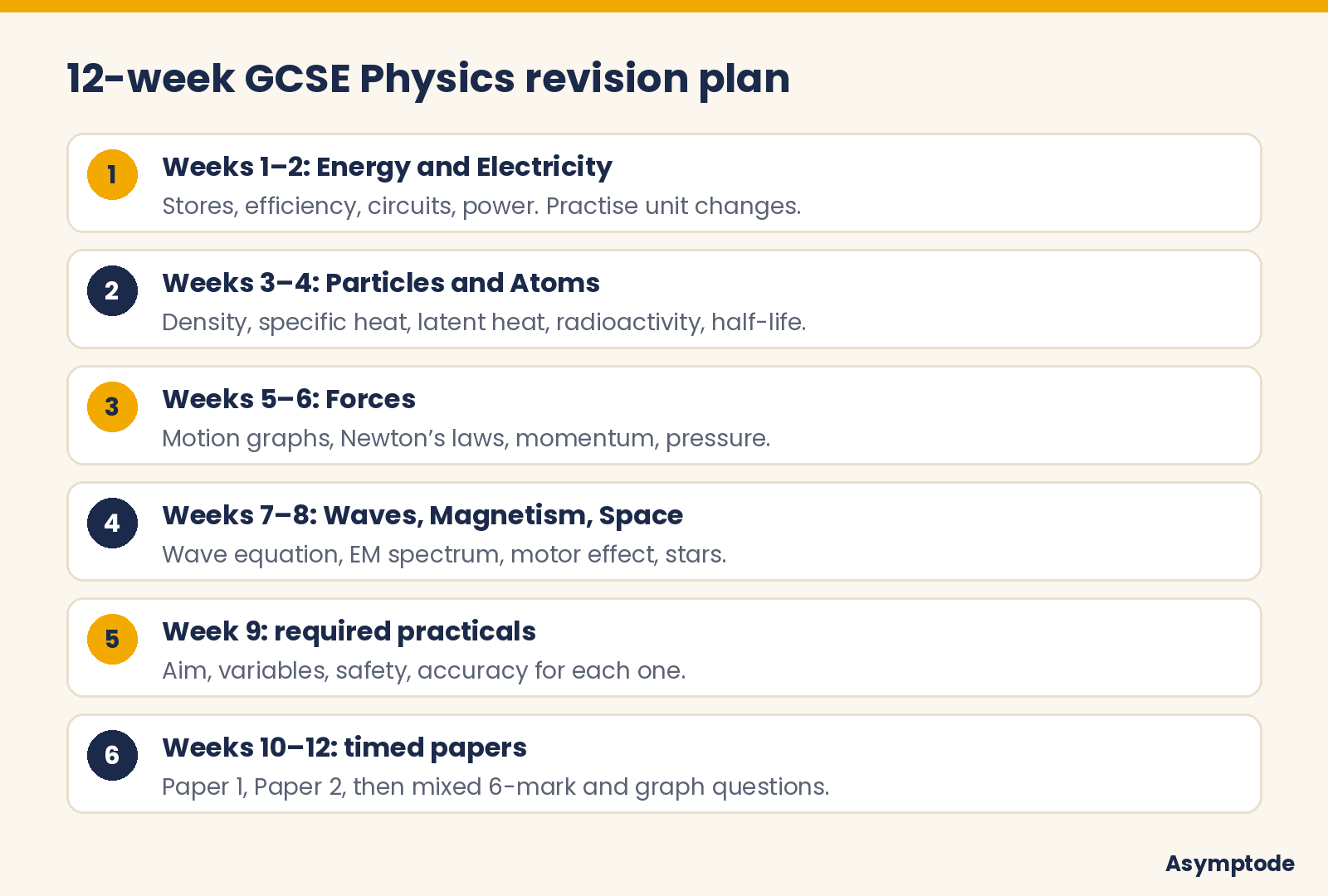
- Weeks 1–2: Energy and Electricity. Energy stores, efficiency, circuits, power. Practise every equation with unit changes.
- Weeks 3–4: Particles and Atoms. Density, specific heat capacity, latent heat, radioactivity and half-life.
- Weeks 5–6: Forces. Motion graphs, Newton's laws, momentum, pressure.
- Weeks 7–8: Waves, Magnetism and Space. Wave equation, EM spectrum, motor effect, life cycle of stars.
- Week 9: required practicals. One page per practical, then exam questions on each.
- Week 10: timed Paper 1. Full paper, marked with the mark scheme.
- Week 11: timed Paper 2. Same again, then fix every lost mark.
- Week 12: mixed questions. Focus on 6-mark answers and graph questions.
For physics laws in more depth, our post on Newton's three laws is a good starting point. Students who plan to continue should also look at our A-Level Physics guide, since GCSE Physics is the base for it. Strong maths helps a lot too: see our guide to the GCSE Maths papers.
Want an expert view of your child's physics? Book a free demo class with an Asymptode mentor.
How does 1-on-1 tutoring help with GCSE Physics?
GCSE Physics marks are usually lost in small places: a unit not converted, an equation rearranged the wrong way, a 6-mark answer that jumps a step. In a class of 30, those small habits are hard for a teacher to see. In a one-to-one lesson, they are easy to spot.
At Asymptode, each student learns live online with one dedicated mentor, following their own school's exam board and tier. The mentor watches each step of the working and fixes the method, not just the answer.
- Board-specific practice. Lessons follow your child's specification (AQA, Edexcel or OCR) and past-paper style.
- Personal homework with feedback. Worksheets on the topics just taught, approved by the mentor before your child sees them.
- Every class recorded. Your child can rewatch a lesson on circuits or radioactivity before mocks.
- Parent updates. Short notes on what improved and what still needs practice.
No tutor can guarantee a grade. One-to-one lessons give your child focused time on their own weak spots, at a pace that suits them. See our fees or talk to an advisor.
Related GCSE science guides
FAQ
How many papers are there in GCSE Physics?
Two. AQA and Edexcel each set two papers of 1 hour 45 minutes and 100 marks. OCR Gateway sets two papers per tier of 1 hour 45 minutes and 90 marks.
Is there an equation sheet for GCSE Physics in 2027?
Yes. For 2027 exams students get a physics equation sheet with the papers. They still need to choose, rearrange and use the equations correctly.
What is the difference between GCSE Physics and Combined Science?
GCSE Physics is a full GCSE with more depth and extra topics such as space physics. Combined Science covers all three sciences in less depth and gives a double grade worth two GCSEs.
What grades can you get on Foundation tier?
Foundation tier gives grades 1 to 5. Higher tier gives grades 4 to 9.
How many required practicals are in AQA GCSE Physics?
AQA GCSE Physics has 10 required practicals. They are tested through questions in the written exams.
When are GCSE results in 2027?
GCSE results are released in August. Check the JCQ key dates page for the confirmed 2027 date.