
The AP Physics 2 exam is a 3-hour, hybrid digital test that takes place on Thursday, May 6, 2027, in the morning session. It covers seven units, from thermodynamics to modern physics. Below are the format, dates, fees, scores, a study plan and two worked examples, all checked against official College Board sources.
Key takeaways
- AP Physics 2 is an algebra-based course. It matches the second semester of college physics without calculus.
- The May 2027 exam has 42 multiple-choice questions (85 minutes) and 4 free-response questions (95 minutes). Each section is worth 50%.
- The exam is hybrid. You answer multiple choice in the Bluebook app. You write free-response answers by hand in a paper booklet.
- Fluids is no longer in AP Physics 2. It moved to AP Physics 1 (Unit 8) in the 2024-25 revision.
- Schools must order exams by November 13, 2026. The fee is $99 in the US and $129 outside the US.
What is the AP Physics 2 exam?
Quick answer: The AP Physics 2 exam is the end-of-year test for AP Physics 2: Algebra-Based. It lasts 3 hours and has two sections: 42 multiple-choice questions and 4 free-response questions, each worth 50%. It tests thermodynamics, electricity, circuits, magnetism, optics, waves and modern physics. The 2027 exam is on May 6.
The College Board calls AP Physics 2 "an algebra-based, introductory college-level physics course." The official course page says it is equal to the second course in a college algebra-based physics sequence.
Who should take it? The Course and Exam Description (CED) says students should first finish AP Physics 1 or a similar intro physics course. You should also have taken, or be taking, precalculus.
At least 25% of class time must be hands-on lab work. Keep your lab notebook, since some colleges ask to see it before giving credit.
New to AP? Our complete AP guide for parents explains how it all fits together.
What units are on the AP Physics 2 exam?
AP Physics 2 has seven units. They are numbered 9 to 15, because they follow on from the eight units of AP Physics 1. The weights below are for the multiple-choice section, as listed in the CED.
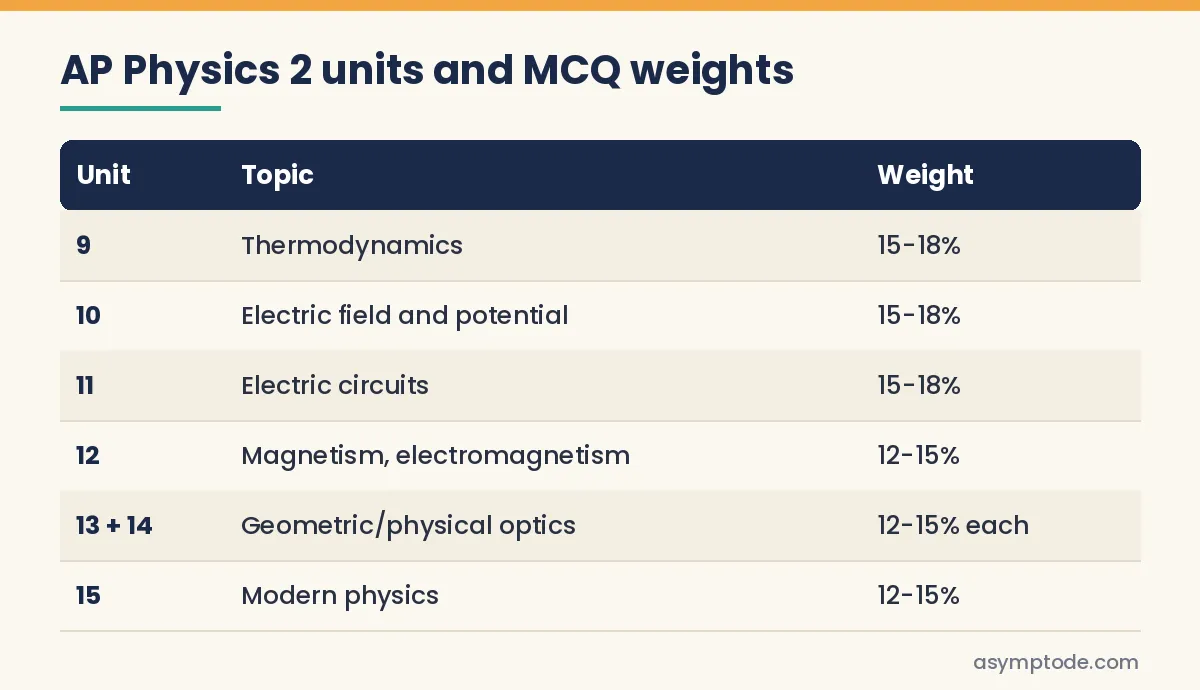 AP Physics 2 units and multiple-choice exam weightings (CED, effective fall 2024).
Thermodynamics, Electric Force, Field, and Potential, and Electric Circuits are each worth 15-18%.
Magnetism and Electromagnetism, Geometric Optics, Waves, Sound, and Physical Optics, and Modern Physics are each worth 12-15%.
The units run from Unit 9 to Unit 15.
Did the AP Physics 2 course change recently?
Yes. The College Board revised all four AP Physics courses for the 2024-25 school year. The official revisions page lists the main changes for AP Physics 2:
- Fluids moved out. Fluids was Unit 1 of AP Physics 2. It is now Unit 8 of AP Physics 1.
- Optics was split. It is now two units: Geometric Optics (Unit 13) and Waves, Sound, and Physical Optics (Unit 14).
- Waves got more space. This includes standing waves, sound and the Doppler effect.
- Circuits were expanded.
- Modern physics grew. Blackbody radiation and Compton scattering were added.
What changed for 2026-27?
The 2026-27 clarifications document makes small changes. The multiple-choice section went from 40 to 42 questions and from 80 to 85 minutes. The free-response section went from 100 to 95 minutes. The topics did not change.
What is the AP Physics 2 exam format in 2027?
Here is the official format from the AP Physics 2 exam page.
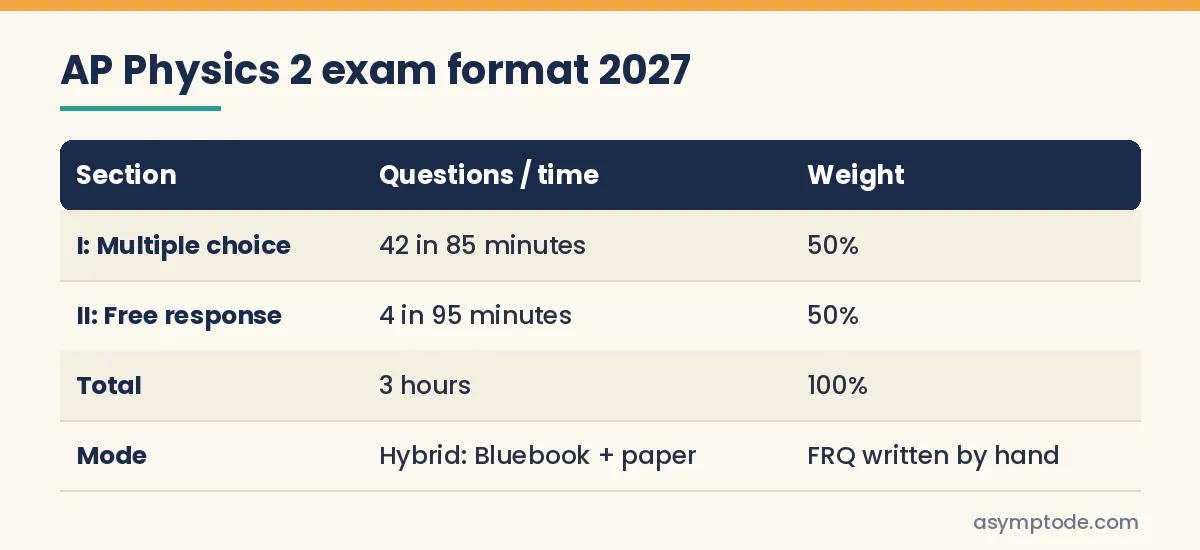 AP Physics 2 exam format for May 2027.
Section I is multiple choice: 42 questions in 85 minutes, worth 50%.
Section II is free response: 4 questions in 95 minutes, worth 50%.
The whole exam takes 3 hours.
What types of questions are on it?
Some multiple-choice questions stand alone. Others come in sets that share one graph or data table.
The four free-response questions each have a fixed type:
- Mathematical Routines - solve a problem using equations and calculations.
- Translation Between Representations - move between words, diagrams, graphs and equations.
- Experimental Design and Analysis - plan an experiment and analyze data.
- Qualitative/Quantitative Translation - explain an idea in words, then show it with equations.
The CED says drawing diagrams and graphs is tested only in free response.
Is the AP Physics 2 exam digital?
It is a hybrid digital exam. You answer multiple choice and read the free-response questions in the Bluebook app. You write free-response answers by hand in a paper booklet.
Schools install Bluebook in March 2027. Bluebook practice previews open from fall 2026 for most AP courses, so ask your teacher when you can try one.
Can I use a calculator and an equation sheet?
Yes to both. The AP calculator policy says:
- A four-function, scientific or graphing calculator is allowed on both sections. Graphing models must be on the approved list.
- Bluebook has built-in Desmos scientific and graphing calculators. Only the built-in version is allowed, not the Desmos website or app.
- You may bring up to 2 handheld calculators as well. You do not need to clear their memory.
- Not allowed: phones, smartwatches, laptops, tablets, calculators with a QWERTY keyboard, and models that can go online.
You also get the official equation tables, on paper and in Bluebook. Not every equation is on them: the CED marks some as "Derived Equations" you must build yourself.
When is the AP Physics 2 exam in 2027?
The AP Physics 2 exam is on Thursday, May 6, 2027, Session 1, according to the official 2027 AP exam dates.
Session 1 starts at 8 a.m. local time in most of the US and 7 a.m. in Alaska. Outside the US it depends on your UTC offset, for example 7 a.m. at UTC+0 and 6:30 a.m. at UTC+5:30. See the official start times page and ask your AP coordinator for your exact time.
 Key AP Physics 2 dates for 2026-27.
November 13, 2026 is the final exam ordering deadline. March 12, 2027 is the spring ordering deadline.
Bluebook is installed in March 2027. The exam is on May 6, 2027, at 8 a.m. local time.
Late testing runs May 17-21, 2027, and scores come out in July 2027.
Dates come from the AP 2026-27 key dates page. AP Chemistry is the same day, in Session 2. Our AP Chemistry exam guide covers it.
How much does the AP Physics 2 exam cost, and how do I register?
You register through your school's AP coordinator, not online by yourself. The official fee page lists these 2027 fees:
| Item | Fee |
|---|---|
| Exam in the US, US territories, Canada, DoDEA schools | $99 |
| Exam at schools outside the US | $129 |
| College Board fee reduction (significant financial need) | $37 off per exam |
| Late order (ordered Nov 14, 2026 - Mar 12, 2027) | $40 extra |
| Ordered but not taken (cancel after Nov 13) | $40 |
Some schools charge more to cover running the exam, and test centers outside the US may set their own fees. Some US states help pay.
Key deadline: your school's final order date is November 13, 2026. Many schools set an earlier internal date, so ask now.
How is the AP Physics 2 exam scored?
AP exams are scored from 1 to 5. The CED says AP exams are not graded on a curve.
| Score | Meaning | College grade equivalent |
|---|---|---|
| 5 | Extremely well qualified | A+ or A |
| 4 | Very well qualified | A-, B+ or B |
| 3 | Qualified | B-, C+ or C |
| 2 | Possibly qualified | - |
| 1 | No recommendation | - |
Source: AP score scale table.
What is the AP Physics 2 score distribution?
Here are the official numbers from the AP Physics 2 score distributions page.
| Year | 5 | 4 | 3 | 2 | 1 |
|---|---|---|---|---|---|
| 2026 | 20% | 29% | 23% | 21% | 7% |
| 2025 | 21.8% | 28.8% | 22.0% | 20.2% | 7.2% |
In 2025, 24,211 students took the exam. The 2025 and 2026 exams were the first two under the revised course, so older years are not a fair comparison. Past results do not predict your own score.
Does AP Physics 2 give college credit?
It can, but each college sets its own rule. Use the College Board's AP Credit Policy Search to see each college's rule. Then confirm on the college's own website.
Book a free demo class with an Asymptode physics mentor to plan your prep, or see how our plans and fees work.
AP Physics 2 vs AP Physics 1 vs AP Physics C: which is which?
All four AP Physics exams in 2027 use the same format: 42 multiple-choice questions, then 4 free-response questions, in a hybrid Bluebook exam. The difference is the content and the math.
| Course | Math level | Main topics | 2027 exam date |
|---|---|---|---|
| AP Physics 1 | Algebra-based | Kinematics, forces, energy, momentum, rotation, oscillations, fluids | Wed May 5, Session 2 |
| AP Physics 2 | Algebra-based | Thermodynamics, electricity, circuits, magnetism, optics, waves, modern physics | Thu May 6, Session 1 |
| AP Physics C: Mechanics | Calculus-based | Mechanics | Mon May 3, Session 1 |
| AP Physics C: E&M | Calculus-based | Electricity and magnetism | Wed May 5, Session 2 |
- AP Physics 1 comes first. It builds the mechanics you need for Physics 2. Topics like projectile motion and circular motion live here. See our AP Physics 1 exam guide.
- AP Physics C uses calculus. The College Board says Physics C: Mechanics suits students planning to study physical sciences or engineering.
AP Physics 1 and AP Physics C: E&M share the same session on May 5. If two of your exams clash, ask your AP coordinator what to do. Studying in the UK system instead? Compare with our A Level Physics guide.
How should I prepare for the AP Physics 2 exam?
Use official tools first: AP Classroom progress checks, past free-response questions, and the real equation tables. Then follow the plan for your time left.
Study plan by months left
6 months left (November-December)
- Keep up with class. Re-do every lab write-up.
- Make one page of key ideas per unit as you finish it.
- Learn the equation sheet. Mark which equations you must derive.
3 months left (February)
- Do one free-response question each week. Rotate the four types.
- Mark it with the official scoring guide. Note where you lost points.
- Review the three 15-18% units first: thermodynamics, electric force/field/potential and circuits.
1 month left (April)
- Take one full timed practice exam: 85 minutes, then 95 minutes.
- Fix your weakest two units.
- Try the Bluebook practice test so the app feels normal.
Last 2 weeks (late April-May)
- Do mixed multiple-choice sets each day.
- Re-read your one-page summaries.
- Pack approved calculators and check your start time.
What are the most common mistakes?
- Using the wrong sign in the first law. AP Physics 2 writes ΔU = Q + W, where W is work done on the gas.
- Forgetting derived equations. Not every equation is on the sheet.
- Weak lab skills. One free-response question is always experimental design. Know how to pick variables and linearize a graph.
Worked example 1: how do you solve a series-parallel circuit?
Problem: A 12 V battery is connected to a 4 Ω resistor in series with two resistors in parallel: 6 Ω and 3 Ω. Find the total current, the voltage across each part and the current in each branch.
 Worked circuit example, step by step.
The 6 ohm and 3 ohm resistors in parallel combine to 2 ohm. The total resistance is 4 + 2 = 6 ohm.
The battery current is 12 / 6 = 2 A. The 4 ohm resistor takes 8 V, leaving 4 V across the parallel pair.
The 6 ohm branch carries 0.67 A, the 3 ohm branch carries 1.33 A, and the circuit uses 24 W.
Solution:
- Combine the parallel pair. 1/R = 1/6 + 1/3 = 1/6 + 2/6 = 3/6. So R = 2 Ω.
- Find total resistance. R_total = 4 Ω + 2 Ω = 6 Ω.
- Find total current. I = V / R = 12 V / 6 Ω = 2 A.
- Voltage across the 4 Ω resistor. V = IR = 2 A × 4 Ω = 8 V.
- Voltage across the parallel pair. 12 V − 8 V = 4 V (both branches get the same voltage).
- Branch currents. 6 Ω: I = 4 / 6 = 0.67 A. 3 Ω: I = 4 / 3 = 1.33 A.
- Check. 0.67 A + 1.33 A = 2 A. This matches the total current, so the junction rule holds.
- Power. P = IV = 2 A × 12 V = 24 W.
Worked example 2: how do you use the first law of thermodynamics?
Problem: An ideal gas is kept at a constant pressure of 2.0 × 10^5 Pa. It expands from 1.0 × 10^-3 m^3 to 3.0 × 10^-3 m^3. During this, 1,000 J of energy is added to the gas by heating. Find the work done on the gas and the change in internal energy.
Solution:
- Find the change in volume. ΔV = 3.0 × 10^-3 − 1.0 × 10^-3 = 2.0 × 10^-3 m^3.
- Find the work done on the gas. W = −PΔV = −(2.0 × 10^5 Pa)(2.0 × 10^-3 m^3) = −400 J. It is negative because the gas expands and pushes outward. The gas does 400 J of work on its surroundings.
- Apply the first law. ΔU = Q + W = 1,000 J + (−400 J) = +600 J.
- Explain it. Internal energy goes up, so the temperature of the gas rises.
- Link to a graph. On a PV diagram, this is a horizontal line. The area under it (400 J) equals the size of the work.
Exam tip: Free-response questions often ask why the temperature changes. Answer with one clear first-law sentence.
How 1-on-1 tutoring helps with AP Physics 2
AP Physics 2 asks you to explain, draw and design, not just calculate. Here is how an Asymptode mentor helps:
- One dedicated mentor, live online and 1-on-1. Your mentor follows your own school's AP Physics 2 pace and plans around the May 6, 2027 exam date.
- Method first. Your mentor watches each step of your working on circuits, PV diagrams and field problems, and fixes sign and unit errors as they happen.
- Personalised homework with feedback. You practice the four free-response types, and get feedback on how clearly you explain your reasoning.
- Short parent updates, and every class is recorded. Parents see progress, and you can re-watch any tricky topic. For registration, fees and college credit choices, your mentor helps with planning, but your school's AP coordinator makes the final arrangements.
You can start with a free demo class.
Facts checked against official sources on 3 November 2026.
FAQ
Is fluids still on the AP Physics 2 exam?
No. Fluids moved to AP Physics 1 as Unit 8 in the 2024-25 revision. AP Physics 2 now covers Units 9 to 15, so check the date on any older review book.
How long is the AP Physics 2 exam?
The exam is 3 hours long. The multiple-choice section is 85 minutes for 42 questions. The free-response section is 95 minutes for 4 questions.
Can I take AP Physics 2 without taking AP Physics 1?
The CED says students should first finish AP Physics 1 or a similar intro physics course. You should also have taken, or be taking, precalculus.
Is the AP Physics 2 exam fully online?
No. It is a hybrid digital exam. You answer the multiple-choice questions in the Bluebook app. You read the free-response questions in Bluebook but write your answers by hand in a paper booklet.
What score do I need for college credit?
Each college sets its own rule. Some accept a 3, while others want a 4 or 5, or give placement instead of credit. Use the College Board's AP Credit Policy Search, then confirm on the college's website.
When do AP Physics 2 scores come out?
The College Board says 2027 AP scores will be released in July 2027. The exact day has not yet been announced, so check the official AP scores page closer to the time.
Ready to start? Book a free demo class and advisor call, or see our plans and fees.
Sources
- AP Physics 2: Algebra-Based Course (AP Central)
- AP Physics 2: Algebra-Based Exam (AP Central)
- AP Physics 2 Course and Exam Description
- AP Physics 2 CED Clarifications and Corrections (Fall 2026)
- AP Physics Revisions for 2024-25
- 2027 AP Exam Dates
- 2027 AP Exam Start Times
- AP 2026-27 Key Dates and Deadlines
- 2027 AP Exam Fees
- AP Exams Calculator Policy
- AP Score Scale Table
- AP Physics 2 Exam Score Distributions
- AP Credit Policy Search