NEST 2027 is the entrance exam for the 5-year Integrated MSc at NISER Bhubaneswar and UM-DAE CEBS Mumbai. Its official dates are not out yet. This guide gives you the NEST 2026 timeline, eligibility, pattern, cut-offs, fees and a study plan, so you know what to expect.
Key takeaways
- As of 1 November 2026, NEST 2027 has not been announced. The NEST site still shows the 2026 cycle.
- Usually, applications open around January and the exam is in June. In 2026, applications opened on 5 January and the exam was on 6 June.
- You need Class 12 science with at least 3 of Biology, Chemistry, Maths and Physics, and 60% (55% for SC/ST/Divyangjan). There is no age limit.
- The paper has four sections of 60 marks each. Only your best three sections count, so the total is out of 180.
- You do not need a JEE score. NEST is the route into NISER and CEBS.
What is the NEST 2027 exam and is it announced yet?
Quick answer: NEST (National Entrance Screening Test) is a computer-based test for the Integrated MSc at NISER Bhubaneswar and UM-DAE CEBS Mumbai. As of 1 November 2026, NEST 2027 is not yet announced. Usually applications open around January and the exam is in June. Official 2027 dates are not yet announced.
Both institutes are autonomous DAE institutions set up in 2007. NISER coordinates the exam, and TCS iON runs the portal. The official site is nestexam.in.
On 1 November 2026 there was no 2027 brochure or notice. Some websites post "tentative" 2027 dates without an official source, so treat them as guesses. In 2026, applications opened on 5 January. In 2025, the exam was on 22 June 2025, as reported by news sites.
When is the NEST 2027 exam date?
The NEST 2027 exam date is not yet announced. Use the official NEST 2026 timeline below as a guide.
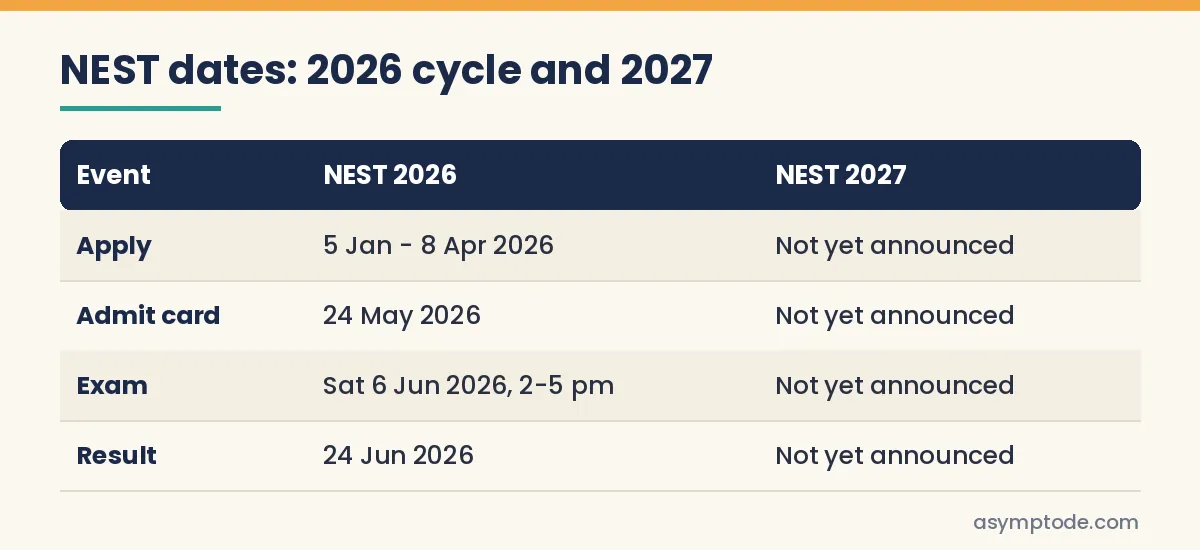 NEST 2026 key dates next to NEST 2027, which is not yet announced.
NEST 2026 applications ran from 5 January to 8 April 2026.
The admit card came out on 24 May 2026.
The exam was on Saturday 6 June 2026, and the result came on 24 June 2026.
For NEST 2027, all of these dates are not yet announced.
| Event (NEST 2026) | Date |
|---|---|
| Applications open | 5 Jan 2026, 12 noon |
| Applications close | 8 Apr 2026, 11:30 pm (extended from 6 Apr) |
| Last date for fee payment | 10 Apr 2026, 10 pm |
| Correction window | 18 to 19 Apr 2026 |
| Mock test | 14 Apr 2026 |
| Admit card | 24 May 2026, 12 noon |
| Exam | Sat 6 Jun 2026, 2:00 to 5:00 pm (one session) |
| Answer-key challenge | 10 Jun (6 pm) to 12 Jun 2026 |
| Result | 24 Jun 2026, 4 pm |
The correction window was only for paid forms, and mobile, email, category, PwD status and test cities were locked. Some site notices gave other dates for the mock test and answer-key window; we have used the official dates table. From 2019 to 2024, NEST had two sessions; 2025 and 2026 had one.
Which institutes take NEST, and how many seats are there?
Two institutes use NEST:
- NISER Bhubaneswar (niser.ac.in). Degree through HBNI.
- UM-DAE CEBS Mumbai (cbs.ac.in). Degree through the University of Mumbai.
Both offer a 5-year Integrated MSc in Biology, Chemistry, Mathematics and Physics. NISER also offers minors, including computer science.
| Seats (NEST 2026) | NISER | CEBS |
|---|---|---|
| UR | 101 | 23 |
| UR-EWS | none | 6 |
| OBC-NCL | 54 | 15 |
| SC | 30 | 9 |
| ST | 15 | 4 |
| Total | 200 | 57 |
| J&K/Ladakh supernumerary | 2 | 2 |
Reservation is 27% OBC-NCL, 15% SC, 7.5% ST, plus 5% horizontal for Divyangjan (40% or more disability). EWS seats are at CEBS only. 2027 seat numbers are not yet announced.
CEBS also has stream rules. If you did not take Maths in Class 11 and 12, you cannot major in Maths or Physics there. If you did not take Biology, you cannot major in Biology.
What is the NEST eligibility?
Here is the NEST eligibility as written for 2026:
- You studied at least 3 of these 4 subjects in Class 11 and 12: Biology, Chemistry, Mathematics, Physics.
- For 2026, you passed Class 12 in 2024 or 2025, or were appearing in 2026, from any recognised board in India. For 2027 this window would likely move forward by a year, but check the official notice.
- You scored at least 60% aggregate in Class 12 (or an equal grade). For SC, ST and Divyangjan students it is 55%. The aggregate must come from one board.
- You get a rank in the NEST merit list.
There is no age limit. Grade-only boards must issue a percentage certificate. Your CBSE board exam marks matter, because the 60% rule applies at admission.
Can NRI, OCI or foreign students apply for NEST?
The official texts only mention boards in India and say nothing clear about NRI, OCI or foreign students. We have not been able to verify this, so write to NISER (nest-exam@niser.ac.in) or CEBS before you apply.
 The path from Class 12 to a seat at NISER or CEBS.
Step 1: finish Class 12 science with at least 60%.
Step 2: apply online on nestexam.in.
Step 3: sit NEST, where your best three sections count.
Step 4: get a rank on the NISER or CEBS merit list.
What is the NEST exam pattern?
NEST is a 3-hour computer-based test. It has four sections: Biology, Chemistry, Mathematics and Physics. Each section has 20 single-correct MCQs worth 60 marks.
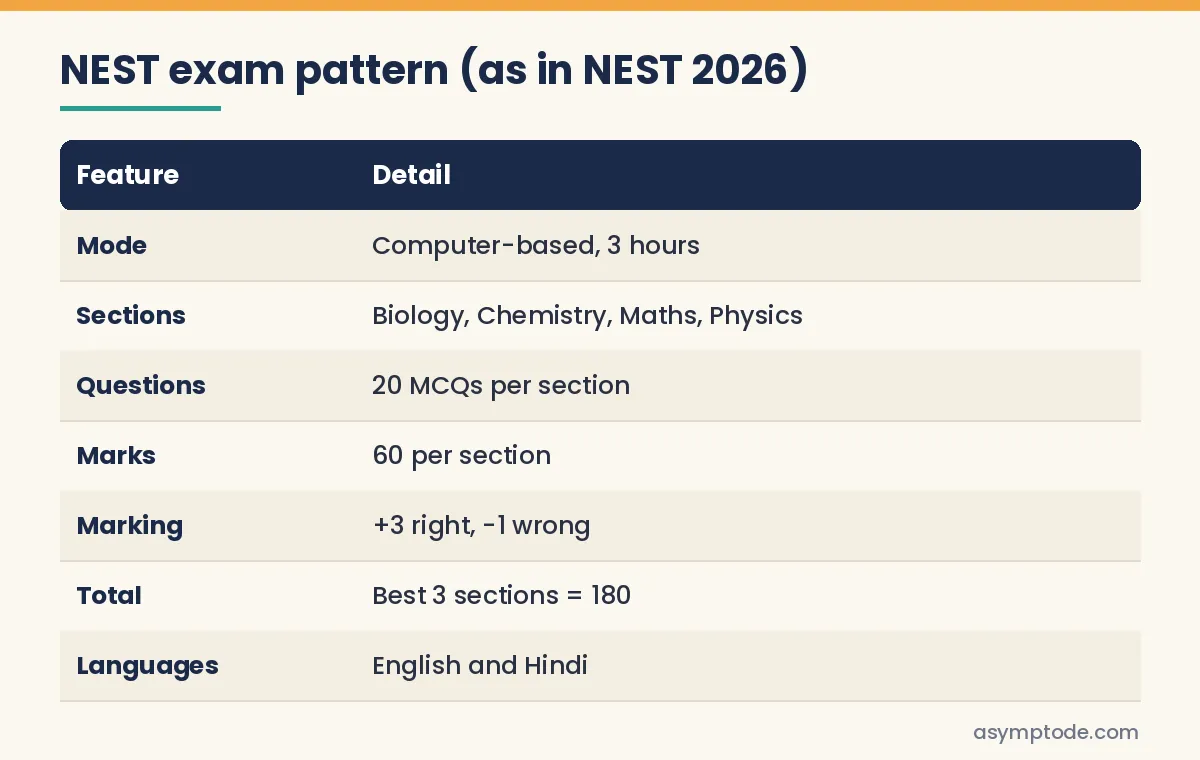 The NEST exam pattern, as in NEST 2026.
NEST is a computer-based, 3-hour test with four sections.
Each section has 20 MCQs and is worth 60 marks.
A right answer gives +3, a wrong answer gives -1, and a blank gives 0.
Only your best three sections count, so the total is out of 180.
The paper is in English and Hindi.
Key rules:
- Marking: +3 for a correct answer, -1 for a wrong one, 0 if you leave it.
- Best three: you must attempt at least 3 sections. Your total is your best 3 section scores that clear the section cut-off.
- Language: English and Hindi. If they differ, English is final.
- Calculator: an on-screen calculator is given. No log tables or physical calculators. Rough sheets and a pen are given in the hall.
How is the NEST score calculated?
 An example of how the best three sections make your NEST total.
In this example, a student scores Biology 30, Chemistry 42, Maths 36 and Physics 39.
Each section is out of 60.
The lowest score, Biology 30, is dropped.
The best three are 42 + 39 + 36 = 117 out of 180.
This is only an example. It assumes each counted section clears its cut-off. If a section does not clear its cut-off, it cannot be one of your best three.
What is the NEST syllabus?
The official site says the NEST syllabus "primarily follows the CBSE curriculum (2025-26) and NCERT books of classes XI-XII". Some Class 10 science may also be needed. The full topic list is in the brochure on nestexam.in. Check the 2027 brochure when it comes out.
What were the NEST 2026 cut-offs?
NEST has two kinds of cut off. First, you must clear the SMAS (section minimum admissible score) in at least 3 sections. Second, you must reach the MAP (minimum admissible percentile).
The SMAS is 20% of the average of the top 100 scores in that section, for UR. It is 90% of that for OBC and 50% for SC/ST. For Divyangjan it is 95% (UR), 85% (OBC) and 45% (SC/ST) of the UR SMAS.
Official NEST 2026 SMAS:
| Section | UR / UR-Divyang | OBC / OBC-Divyang | SC-ST / SC-ST-Divyang |
|---|---|---|---|
| Biology | 8.83 / 8.39 | 7.95 / 7.50 | 4.41 / 3.97 |
| Chemistry | 11.26 / 10.70 | 10.14 / 9.57 | 5.63 / 5.07 |
| Mathematics | 9.63 / 9.15 | 8.67 / 8.19 | 4.82 / 4.33 |
| Physics | 9.44 / 8.97 | 8.49 / 8.02 | 4.72 / 4.25 |
In 2026, one question each was dropped in Chemistry and Physics, and scores were scaled.
NEST 2026 MAP:
| Category | MAP | Divyang |
|---|---|---|
| UR / EWS / OBC | 80 percentile | 40 percentile |
| SC / ST | 75 percentile | 40 percentile |
Rank is by percentile of total score. Ties go to the best 2 sections, then the best section, then Class 12 % and Class 10 %. Closing ranks are only in the institutes' merit files.
How much is the NEST application fee?
NEST 2026 fees:
| Candidate | Fee |
|---|---|
| Male / other, UR and OBC | Rs 1,400 |
| All female candidates, SC, ST, Divyangjan, UR-EWS | Rs 700 |
You pay online by card, net banking or UPI. There is no refund. The 2027 fee is not yet announced.
Where are the NEST exam centres?
In 2026, NEST ran in 387 cities, all in India, from Port Blair to Leh. There were no centres abroad. You pick 3 city preferences, and changes are generally not allowed. See the official centre list.
What do you need on NEST exam day?
- A printed admit card (a copy on your phone is not allowed).
- An original government photo ID, such as Aadhaar, PAN, passport, voter ID, driving licence or Class 10 marksheet.
- A transparent pouch for these.
Phones, smart watches, wearables, opaque bottles and own pens are banned. Report 60 minutes early. There is no entry after 2:30 pm and no exit before 4 pm. Divyangjan candidates get 20 minutes extra per hour and may bring their own scribe.
What scholarship do NEST students get?
Students admitted to the Integrated MSc get the DAE DISHA scholarship of Rs 60,000 a year, plus Rs 20,000 a year for summer internships. Students chosen by DST for INSPIRE-SHE are endorsed by NISER or CEBS for the INSPIRE scholarship. Renewal rules are not stated on the NEST pages, so check with the institute.
How do you apply for NEST 2027?
The 2027 form is not open yet. Based on the 2026 process, the steps look like this:
- Go to nestexam.in when the 2027 notice is out.
- Register with your own mobile number and email. These cannot be changed later.
- Fill in your details, category and PwD status carefully.
- Pick 3 exam city preferences.
- Pay the fee online before the payment deadline.
- Download your admit card when it is released.
What happens after the NEST result?
There is no common counselling. Each institute admits separately from the merit list.
- NISER (2026): merit list on 24 June, expression of interest (EoI) email on 25 June, EoI deadline 6 July, Round 1 in person at Jatni on 28 July, Round 2 on 7 August. See NISER admissions.
- CEBS (2026): register on the CEBS portal by 8 July with up to 4 stream preferences (locked). Online rounds from 17 July, classes from 3 August. See the CEBS 2026 notice.
NEST vs IISER IAT: which one should you take?
Many students take both.
| Point | NEST | IISER IAT |
|---|---|---|
| Institutes | NISER, CEBS | IISERs |
| 2026 exam date | 6 Jun 2026 | 7 Jun 2026 (as reported) |
| JEE score needed? | No | Check IISER site |
Two exams on back-to-back days is tiring, so practise full papers on two days in a row. For NEST, you do not need JEE Main or JEE Advanced. If you are also aiming for engineering, see our JEE Main 2027 guide.
How to prepare for NEST 2027
Start with NCERT Class 11 and 12. Board and NEST study overlap a lot.
A simple study plan
- November to January: finish NCERT chapters in your 3 strongest subjects. Make short notes and formula sheets.
- February to March: focus on board exams. Keep 30 minutes a day for NEST-style MCQs.
- After boards to May: solve past NEST papers from the archive on nestexam.in, in 3-hour timed sittings.
- Last 2 weeks: revise notes, redo wrong questions, and take the mock test.
Which chapters to focus on
No official chapter weightage is published, so use NCERT and past papers. Good core areas:
- Physics: kinematics and projectile motion, laws of motion, work and energy, electrostatics, current electricity, optics.
- Chemistry: mole concept, atomic structure, chemical bonding, equilibrium, basic organic reactions.
- Mathematics: functions, trigonometry, calculus, vectors, probability.
- Biology: cell biology, genetics, human physiology, plant physiology, ecology.
Common mistakes to avoid
- Guessing wildly. A wrong answer costs 1 mark. Guess only when you can rule out options.
- Ignoring your fourth section. It is a back-up. If one section goes badly, the fourth can replace it.
- Leaving section cut-offs to chance. Each counted section must clear the SMAS.
A worked example in NEST style
Question: A ball is thrown horizontally at 10 m/s from the top of a 20 m tall tower. Take g = 10 m/s² and ignore air resistance. How far from the base of the tower does it land?
(A) 10 m (B) 20 m (C) 30 m (D) 40 m
Step 1: Find the time to fall. The ball starts with zero vertical speed. So h = ½gt². 20 = ½ × 10 × t², which gives 20 = 5t², so t² = 4 and t = 2 s.
Step 2: Find the horizontal distance. Horizontal speed stays 10 m/s, because no horizontal force acts. x = 10 × 2 = 20 m.
Answer: (B) 20 m.
Notice the trap: (D) 40 m comes from using t = 4 s, which is t², not t.
Curious where an Integrated MSc leads? Read how to become a scientist and our guide to research for high school students. The NSE 2026 guide is also good practice for science olympiad-style questions.
Want a personal plan for NEST and your boards? Book a free demo class with an Asymptode mentor, or see our plans and fees.
How 1-on-1 tutoring helps with NEST
- One dedicated mentor, live online 1-on-1. Your mentor follows your own board syllabus and your NEST and board exam dates, and builds a plan around your 3 strongest sections.
- Method-first. The mentor watches each step of your working in Physics, Chemistry and Maths, so slips like the t² error above get fixed early. For Biology and exam planning, the mentor helps with method, timing and planning.
- Personalised homework with feedback. You get NEST-style MCQs matched to your weak chapters, with feedback on each attempt and on when to skip a question.
- Short parent updates and recorded classes. Parents get brief progress notes, and every class is recorded for revision. Start with a free demo class.
Facts checked against official sources on 1 November 2026.
FAQ
Is NEST 2027 announced?
No. As of 1 November 2026, NEST 2027 is not yet announced, and nestexam.in still shows the 2026 cycle. Usually, applications open around January and the exam is in June.
What was the NEST 2026 exam date?
NEST 2026 was on Saturday 6 June 2026, from 2:00 to 5:00 pm, in one session. Results came out on 24 June 2026.
Do I need JEE to get into NISER?
No. NEST is the entrance test for the Integrated MSc at NISER and CEBS. You do not need a JEE Main or JEE Advanced score for this route.
What percentage do I need in Class 12 for NEST?
You need at least 60% aggregate in Class 12, or 55% for SC, ST and Divyangjan students. The aggregate must come from a single board. There is no age limit.
How many sections do I need to attempt in NEST?
You must attempt at least 3 of the 4 sections. Your total is your best 3 section scores that clear the section cut-off (SMAS), out of 180. Attempting all four gives you a back-up.
Can I write NEST from outside India?
In 2026, all 387 exam cities were in India, with no centres abroad. If you are an NRI, OCI or foreign student, check eligibility with NISER or CEBS first, as the official texts only mention boards in India.
Ready to start? Book a free demo class and advisor call, or see our plans and fees.