
How to get into University of Edinburgh comes down to four things: the right grades, the right subjects, a strong UCAS application, and sending it on time. For most courses starting in September 2027, the UCAS deadline is 13 January 2027 at 18:00 UK time. This guide uses Edinburgh's own figures, for students and parents in the UK, India, the US, China and beyond.
Key takeaways
- For most 2027 courses, apply on UCAS by 13 January 2027, 18:00 UK time. The Medicine and Veterinary Medicine deadline (15 October 2026) has already passed.
- Edinburgh shows two sets of grades. Standard grades are what most applicants needed in recent years. Minimum grades are only for UK applicants who get a widening access Plus Flag.
- Most Edinburgh degrees take four years. You often study three subjects in Year 1 before you specialise.
- Only Medicine, Nursing, Teacher Education and Veterinary Medicine interview. Medicine also needs the UCAT.
- For 2027/28, the Rest of UK fee is £10,050 a year. International fees depend on the course, for example £31,100 for Economics and £40,900 for Computer Science.
How to get into University of Edinburgh: what does it take?
Quick answer: You need predicted grades at or above the standard entry requirements for your course, including any required subjects such as Maths. You then send one UCAS application with a personal statement and a teacher reference by 13 January 2027 at 18:00. Most courses have no interview or admissions test, so your written application does the work.
Meeting the entry requirements enters you into selection but does not guarantee an offer (How we select applicants).
Admissions teams look at your qualifications (achieved and predicted), English language evidence, personal statement, academic reference, any portfolio or interview, and widening access data. If there are more good applicants than places, they may look at grades above the upper level and your GCSE or National 5 grades. A missing required subject ends your application.
How competitive is Edinburgh?
In the 2025 cycle Edinburgh received 68,862 applications, made 36,195 offers (an offer rate of 53%) and had 7,626 acceptances (Admissions statistics). Offer rates vary by course and fee status, partly because Scottish Government policy limits Scotland-fee-rate places.
What grades do you need for Edinburgh?
Each course lists its own grades on the degree finder. Here are standard 2027 requirements for six popular courses.
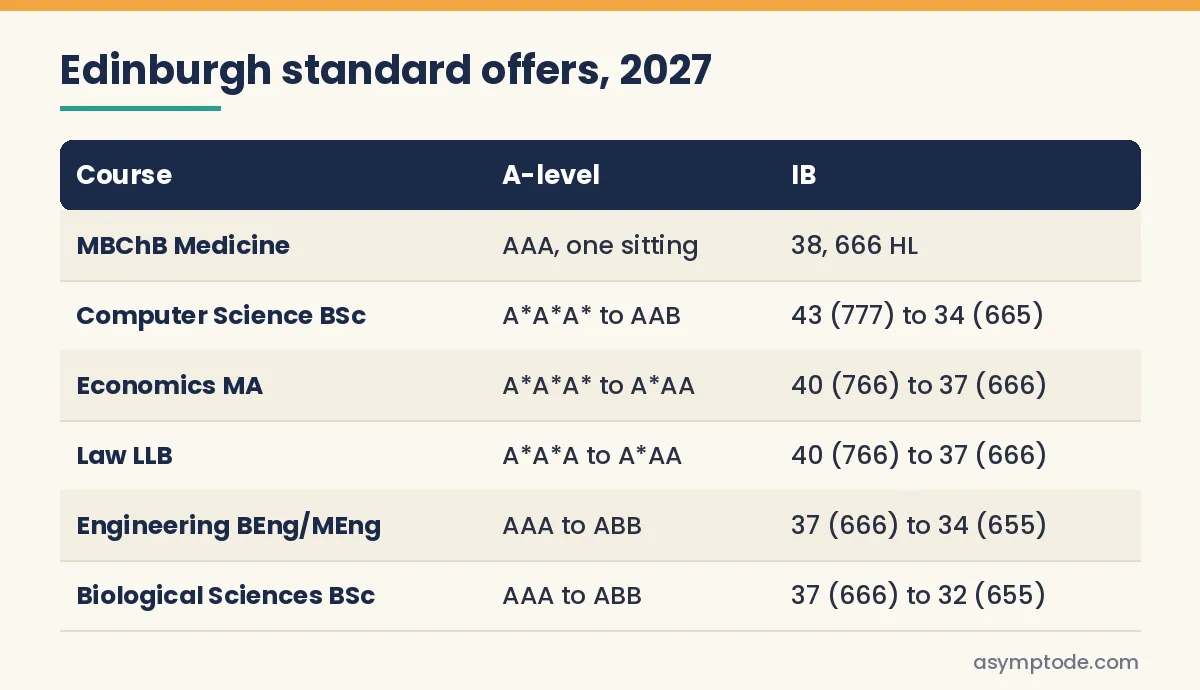 Standard A-level and IB entry requirements for six Edinburgh courses, 2027 entry.
Medicine asks for AAA in one sitting or 38 IB points with 666 at Higher Level. Computer Science ranges from A*A*A* to AAB, or 43 to 34 IB points. Economics asks for A*A*A* to A*AA, and Law for A*A*A to A*AA, both with 40 to 37 IB points. Engineering and Biological Sciences both range from AAA to ABB.
| Course (2027 entry) | SQA Highers (standard) | A-level (standard) | IB (standard) | Key required subjects |
|---|---|---|---|---|
| MBChB Medicine (6 years) | AAAAB by end of S5, plus BB at Advanced Higher in S6 | AAA in one sitting | 38 points, 666 at HL | Chemistry plus Biology, Maths or Physics |
| Computer Science BSc | AAAAA | A*A*A* to AAB | 43 (777 HL) to 34 (665 HL) | Maths at A (IB Maths AA HL 6) |
| Economics MA | AAAAA | A*A*A* to A*AA | 40 (766 HL) to 37 (666 HL) | Maths at B, or AS Maths at A |
| Law LLB | AAAAA | A*A*A to A*AA | 40 (766 HL) to 37 (666 HL) | English at B |
| Engineering BEng/MEng | AAAA | AAA to ABB | 37 (666 HL) to 34 (655 HL) | Maths plus a science at B (Physics preferred) |
| Biological Sciences BSc | AABB | AAA to ABB | 37 (666 HL) to 32 (655 HL) | Biology and Chemistry at B, plus an A in a science or Maths |
Source: Edinburgh degree finder entry requirements, checked 7 November 2026.
For Computer Science, Higher Applications of Mathematics does not count as Higher Maths, and your Maths must be no more than two academic years old when you start. Studying the IB? See our IB Diploma Programme guide for how HL choices work.
What is the difference between standard and minimum entry requirements?
Edinburgh shows two sets of grades for every course (standard and minimum).
- Standard entry requirements are the grades most applicants needed to get an offer in recent years, often shown as a range. Edinburgh usually makes offers to the highest qualified applicants, so an offer can be above the top of the range.
- Minimum entry requirements are lower and apply only if you qualify for a widening access Plus Flag offer. For example, the minimum is ABB at A-level for Computer Science, Economics, Law and Engineering. Edinburgh never makes offers below the minimum.
 Worked example: do predicted grades of AAB meet the Engineering requirements?
Engineering's standard range is AAA to ABB, and the minimum (Plus Flag only) is ABB. A student predicted A, A and B, with Maths and Physics, sits inside the standard range. They also meet the required subjects: Maths at B plus a science at B. This means they can enter selection, but an offer is still not guaranteed.
What about SQA Highers and Advanced Highers?
Most degrees ask for four or five Highers by the end of S5 or S6, with at least BBB in one year of S4 to S6 (SQA Highers). Medicine and Veterinary Medicine need at least five Highers by the end of S5, and usually two Advanced Highers in S6.
For A-levels, Edinburgh normally expects three subjects in one set of exams after two years, and resit students may get a higher offer (A levels). See our A-level exam dates for 2027 to plan revision.
What are Edinburgh's entry requirements for international students?
Edinburgh accepts A-levels and the IB worldwide and lists national qualifications by region. Region pages were last updated in November 2024, so confirm on the degree finder.
India (CBSE and CISCE)
Edinburgh accepts CBSE and CISCE Class XII (India page):
- Arts, Humanities and Social Sciences (for example Economics, Law): overall 80% with three subjects at 75%.
- Science and Engineering (for example Computer Science, Engineering): five subjects, 80% overall and 80% in required subjects, or 85% where the course asks for an A at Higher. CBSE Applied Mathematics does not meet a Maths requirement here.
- Medicine: 85% overall and 85%+ in English, Chemistry and two of Biology, Maths or Physics, plus the UCAT. With 85% in CBSE or CISCE Class XII English, no IELTS-type test is needed.
- Year 2 entry: possible for many Science and Engineering courses with 85% overall and 85% in required subjects (CBSE or CISCE only).
United States (AP, SAT, ACT)
Edinburgh asks for three standardised tests (USA page). Minimum examples are one ACT of 27 plus two APs at 4+, one SAT of 1290+ (650+ Reading and Writing, 620+ Math) plus two APs at 4+, or three APs at 4+. It does not superscore the ACT but will consider a SAT superscore. Medicine needs at least three APs at 5, including Chemistry and two of Biology, Physics or Math/Calculus, plus the UCAT. Law, for example, asks for AP English Language or Literature at 4 or above.
China
The Chinese Senior High School Certificate does not normally meet Edinburgh's minimum entry requirements (China page). Routes include A-levels, the IB or the International Foundation Programme. Science and Engineering may consider strong Gaokao results case by case.
What English language score do I need?
Every applicant must prove their English, including UK nationals. GCSE English at C or 4, National 5 English at C or IB Standard Level English at 5 count. If you use a test, most courses, such as Computer Science, ask for IELTS Academic 6.5 with at least 5.5 in each part, or TOEFL iBT (from 21 January 2026) 4.5 with at least 4.0 in each part. Test results must be under two years old when your course starts. Medicine asks for IELTS 7.5 with 7.5 in every part (English language requirements).
When is the Edinburgh application deadline for 2027 entry?
For most courses, it is 13 January 2027 at 18:00 UK time, after which most degrees close (When to apply). Late applications are not guaranteed to be considered.
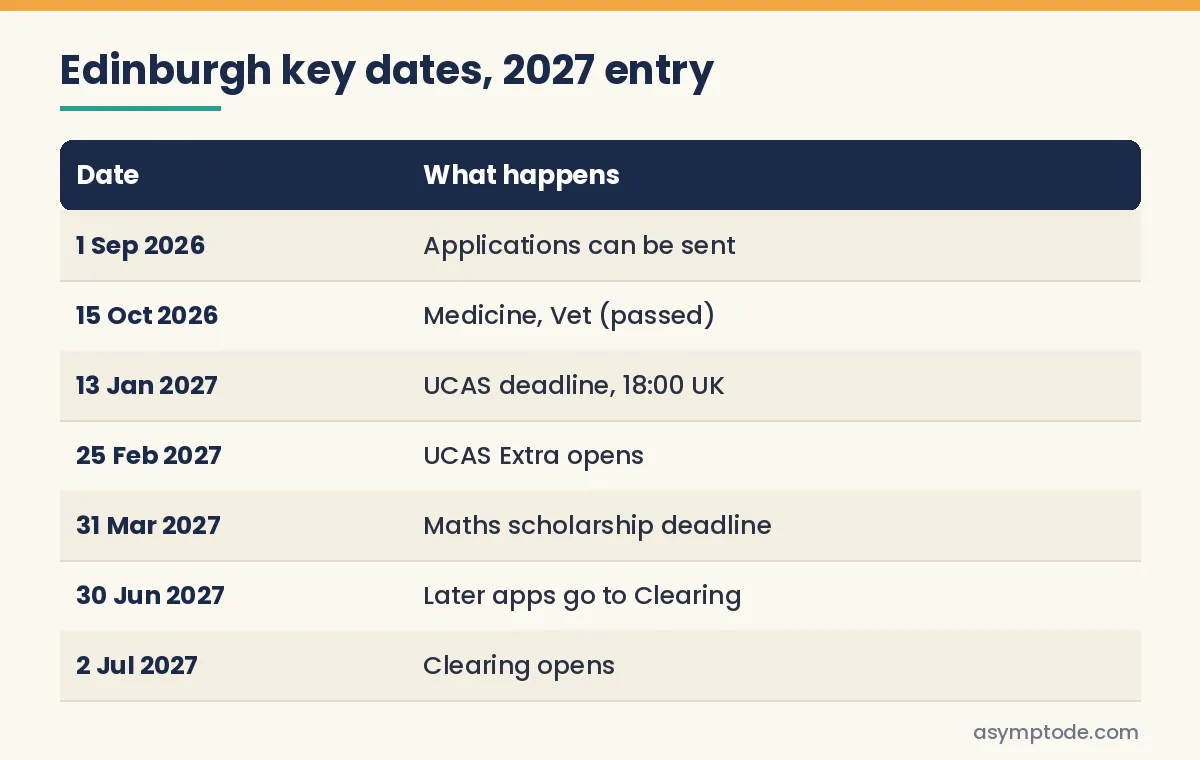 Key dates for students applying to Edinburgh for 2027 entry.
Applications could be sent from 1 September 2026. The Medicine and Veterinary Medicine deadline, 15 October 2026, has passed. The main deadline is 13 January 2027 at 18:00. UCAS Extra opens on 25 February 2027, and the Global Maths scholarship closes on 31 March 2027. Applications reaching UCAS after 30 June 2027 go into Clearing, which opens on 2 July 2027 (UCAS dates). If you apply on time, you get a decision by the UCAS reject-by-default date in May.
How do you apply to Edinburgh, step by step?
 The four stages of an Edinburgh application.
The path has four stages: pick a degree and check required subjects, compare your grades with the standard and minimum requirements, apply on UCAS by 13 January 2027 at 18:00, then get a decision by the UCAS date in May. In practice:
- Check your eligibility. UK applicants can use Edinburgh's widening access checker.
- Write your personal statement. Since 2026 entry, UCAS uses three questions: why this subject, how your studies have prepared you, and what else you have done outside education (UCAS guide). You have 4,000 characters in total, with at least 350 per answer.
- Get your reference and submit. Check your school's own deadline, as UCAS advises. You can choose up to five courses.
- Tell Edinburgh about any challenges in your statement or reference, or by email to futurestudents@ed.ac.uk before the deadline.
How does Edinburgh's four-year Scottish degree work?
Most Edinburgh degrees take four years (Degree structures). In Year 1 you usually study three subjects, and in Years 3 and 4 you specialise. MEng, MInf and MPhys take five years, as does Veterinary Medicine. Medicine (MBChB) takes six.
In many science and engineering subjects, well-qualified students can apply for direct entry to Year 2 and finish a BSc in three years. For international students, that means one fewer year of fees.
Book a free demo class if your child needs help reaching the Maths or science grades their Edinburgh course asks for, or see our plans and fees.
What do you need for Edinburgh Medicine?
For 2027 entry, the Medicine deadline was 15 October 2026 and you had to sit the UCAT in 2026. If you are planning for 2028 entry, here is how selection works (MBChB Medicine):
- Two members of admissions staff score your academic record. Only first attempts in required subjects count.
- This score is combined with your UCAT total and Situational Judgement Test results. Applicants are ranked.
- About 800 top-scoring applicants are invited to a half-day assessment day (interview), in Edinburgh or online.
- Offers follow soon after the last assessment day.
International students who accept a Medicine offer as their Firm choice pay a deposit of one-third of first-year fees. For 2026 entry, that deposit was £18,217. Read our UCAT 2027 guide to plan the test, and check the UCAT website for official dates.
How much does it cost to study at Edinburgh in 2027/28?
| Fee status | 2027/28 annual fee (most courses shown) |
|---|---|
| Scotland fee rate | £1,820 (SAAS may pay this for eligible Scottish students) |
| Rest of UK and Republic of Ireland | £10,050 |
| International: Economics MA, Law LLB | £31,100 |
| International: Computer Science BSc, Engineering | £40,900 |
| International: MBChB Medicine | £59,700 |
Sources: Edinburgh programme fee tables for 2027/8 and the Medicine fees page.
The Rest of UK fee rises from £9,790 in 2026/27 to £10,050 in 2027/28, then with the UK Government fee cap (RUK fees). International fees stay fixed each year. Check the degree finder for other courses. Edinburgh estimates 2026/27 living costs at £1,546 a month, or £13,914 for a 39-week year.
What scholarships does Edinburgh offer?
- Edinburgh Global Undergraduate Mathematics Scholarships: £5,000 each, paid towards living costs for each year of the course while you progress. They are for International/EU fee-status students on degrees run by the School of Mathematics. Apply through MyEd after your UCAS application, by 23:59 UK time on 31 March 2027 (scholarship page).
- Other international awards, such as BIG Scholarships for Olympiad medallists, are on the international funding page.
- UK students can apply for needs-based Access Awards, including the Access Edinburgh Scholarship, and some merit-based awards (Funding). Apply as early as you can after applying.
Who can get a widening access offer?
Edinburgh uses contextual data to give extra consideration to UK applicants who faced barriers (widening access offers). It looks at your home postcode, your school or college, whether you are care experienced, a refugee or asylum seeker, or an estranged student, and whether you finished SWAP, Edinburgh's Access Programme or a recognised bridging programme.
A Plus Flag means you are considered against the minimum entry requirements. A Flag means you are considered against the standard requirements, but in most cases your application is prioritised. Fill in every relevant UCAS field, as Edinburgh uses your UCAS form to decide.
How does Edinburgh compare with other top UK universities?
Edinburgh has no admissions test for most courses, while Oxford and Cambridge use an earlier 15 October deadline. Compare our guides to getting into Oxford, getting into Cambridge, getting into UCL, getting into Imperial and getting into LSE.
How 1-on-1 tutoring helps with getting into Edinburgh
- One dedicated mentor, live online 1-on-1. Your mentor follows your own syllabus (A-level, IB, Highers, AP, CBSE) and exam dates.
- Method first. The mentor watches each step of the working in Maths, Physics, Chemistry or Biology. This builds the accuracy you need for A* grades, 7s at HL or 85%+ in Class XII.
- Personalised homework with feedback, and short parent updates. Every class is recorded to rewatch before mocks.
- Planning support. For the personal statement and UCAS timeline, the mentor helps with planning and method. They do not write it for you. Start with a free demo class.
Facts checked against official sources on 7 November 2026.
FAQ
Is it hard to get into the University of Edinburgh?
It depends on the course and your fee status. In the 2025 cycle, Edinburgh made offers to 53% of all applications, but rates vary widely by selection area. Check the official statistics for your course and group.
Does Edinburgh interview applicants?
Only for Medicine, Nursing, Teacher Education and Veterinary Medicine, with multiple mini-interviews for Medicine and Veterinary Medicine. Other courses decide from your UCAS application.
Can I still apply to Edinburgh for 2027 entry?
Yes, for most courses, if you apply on UCAS by 13 January 2027 at 18:00 UK time. The Medicine and Veterinary Medicine deadline was 15 October 2026 and has passed. Late applications may be considered, but Edinburgh cannot guarantee it.
Does Edinburgh accept CBSE or ISC students from India?
Yes. Edinburgh accepts CBSE and CISCE Class XII. Arts, Humanities and Social Sciences ask for 80% overall with three subjects at 75%, and Science and Engineering ask for 80% overall and 80% in required subjects (85% where an A at Higher is needed).
Do I need the SAT or ACT for Edinburgh?
Edinburgh asks US applicants for three standardised tests. You can use three APs at 4 or above, or mix in one SAT (1290+) or ACT (27+) with two APs. Medicine needs at least three APs at 5 and the UCAT.
Why does an Edinburgh degree take four years?
Scottish degrees are designed to be broad, so you usually study three subjects in Year 1 and specialise later. Strong science and engineering applicants can often enter Year 2 and finish in three years.
Ready to start? Book a free demo class and advisor call, or see our plans and fees.
Sources
- University of Edinburgh: When to apply
- University of Edinburgh: How we select applicants
- University of Edinburgh: Interviews, tests and portfolios
- University of Edinburgh: Admissions statistics
- University of Edinburgh: Understanding standard entry requirements
- University of Edinburgh: Understanding minimum entry requirements
- University of Edinburgh: What widening access offers are
- University of Edinburgh: MBChB Medicine (6-year programme)
- University of Edinburgh: Computer Science BSc entry requirements
- University of Edinburgh: Economics MA entry requirements
- University of Edinburgh: Law LLB entry requirements
- University of Edinburgh: Engineering entry requirements
- University of Edinburgh: Biological Sciences entry requirements
- University of Edinburgh: India entry requirements
- University of Edinburgh: USA entry requirements
- University of Edinburgh: China entry requirements
- University of Edinburgh: Degree structures
- University of Edinburgh: Medicine fees 2027-2028
- University of Edinburgh: Rest of UK tuition fees
- University of Edinburgh: Edinburgh Global Undergraduate Mathematics Scholarships
- UCAS: Dates and deadlines
- UCAS: Personal statement for 2026 entry onwards