
How to get into UCL (University College London) starts with three things: top predicted grades in the right subjects, a sharp UCAS personal statement, and any admissions test or portfolio your course asks for. For September 2027 entry, most courses close on 13 January 2027 at 18:00. This guide uses official sources only.
Key takeaways
- The UCAS deadline for most UCL courses is 13 January 2027 at 18:00 (UK time). Most medicine courses closed on 15 October 2026.
- Many UCL courses now use a test: LNAT (Law), UCAT (Medicine), TMUA (Economics), ESAT (Electronic and Electrical Engineering) and TARA (Computer Science and some engineering).
- Typical offers run from A*AA to A*A*A at A-level, or 39-40 IB points, for popular courses.
- Indian applicants with CBSE or ISC need at least 90, 85, 85, 85, 85 in five subjects, and more for competitive courses.
- The Home fee for 2027/28 is £10,050 (first year). International fees depend on the course, for example £40,800 for Economics BSc.
How to get into UCL: what does it take?
Quick answer: To get into UCL, you need high predicted grades (often A*AA or above, or 39+ IB points), the subjects your course lists, a strong three-part personal statement and a good teacher reference. Many courses add a test such as the LNAT, UCAT, TMUA, ESAT or TARA. Apply through UCAS by 13 January 2027.
UCL's UCAS institution code is U80. Each course sets its own requirements, so always read your exact course page.
Why do students choose UCL?
Students pick UCL for its range: law, medicine, economics, computer science, engineering, architecture, fine art and more, in central London. Compare it with our guides on how to get into Imperial College London and how to get into Cambridge.
What does UCL look at in your application?
UCL looks at your whole UCAS application:
- GCSEs, often English Language and Maths at C/4 or B/6.
- Predicted grades and required subjects (A* in Maths for Economics; Biology and Chemistry for Medicine).
- Your personal statement and teacher reference.
- Tests, portfolios or interviews, where your course uses them.
- Context. Many courses have lower contextual offers. Check the Access UCL pages to see if you qualify.
Meeting the grades does not guarantee an offer. UCL Laws says its LLB programmes are heavily oversubscribed (UCL Laws).
What is the UCAS personal statement like now?
From 2026 entry onwards, UCAS uses three questions instead of one free essay (UCAS guide):
- Why do you want to study this course or subject?
- How have your qualifications and studies helped you to prepare for this course or subject?
- What else have you done to prepare outside of education, and why are these experiences useful?
You get 4,000 characters in total, including spaces, with at least 350 characters per answer. One statement goes to all five choices, so focus on one subject.
What are the key dates for UCL 2027 entry?
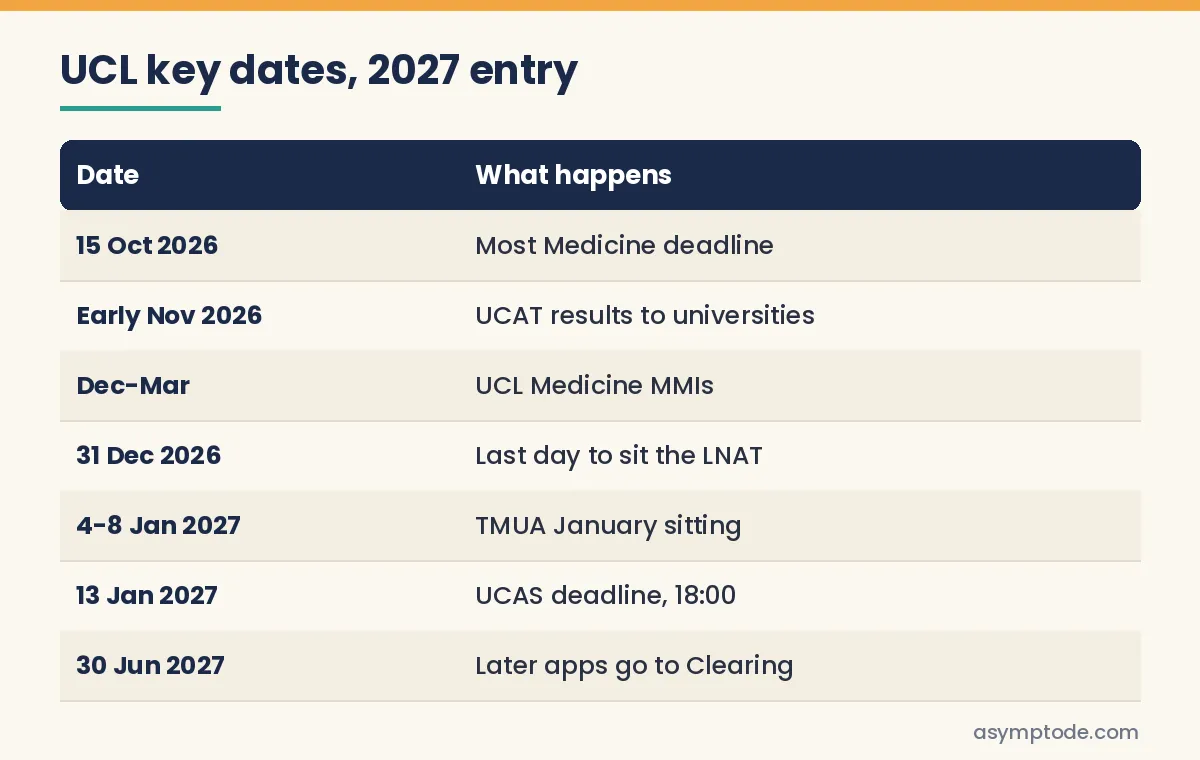 UCL key dates for September 2027 entry.
The table shows seven dates. Most medicine courses closed on 15 October 2026, and UCAT results reach universities in early November. UCL Medicine holds its interviews (MMIs) from December to March. You must sit the LNAT by 31 December 2026, and the TMUA January sitting runs 4-8 January 2027. The main UCAS deadline is 13 January 2027 at 18:00. Applications after 30 June 2027 go into Clearing.
Two more dates matter. Booking for the January TMUA closes on 21 December 2026 at 18:00 (Imperial TMUA page), and UCAS Extra opens on 25 February 2027. Sources: UCAS dates, LNAT dates and UCAT dates.
Planning Medicine for 2028 entry? Confirm the deadline on the UCL MBBS page. For exam timing, see our A-level exam dates 2027 guide.
Which admissions tests does UCL use?
UCL lists every test, task and interview for the 2027 cycle (UCL tests, tasks and interviews):
| Test | UCL courses (2027 entry) |
|---|---|
| LNAT | All UCL Laws undergraduate degrees |
| UCAT | MBBS Medicine |
| TMUA | Economics BSc; Economics with a Year Abroad BSc |
| ESAT | Electronic and Electrical Engineering BEng and MEng |
| TARA | Computer Science BSc and MEng; Computer Science and Mathematics MEng; Robotics and AI MEng; Mechanical Engineering BEng and MEng (new for 2027) |
| UCL TST | European and International Social and Political Studies BA courses |
Some courses have no test for 2027. These include Philosophy and Computer Science BA, Sociology BSc, Social Sciences BSc, Management Science BSc and MSci, and Arts and Sciences BASc.
LNAT for UCL Law
Sit the LNAT by 31 December 2026. UCL sets a yearly threshold on the multiple-choice score (out of 42). Above it, an Admissions Tutor marks your essay, which "carries considerable weight". Read our LNAT guide for practice tips.
UCAT and MMIs for UCL Medicine
All MBBS applicants sit the UCAT in the year they apply (the 2026 window ran 13 July to 24 September). UCL ranks applicants by UCAT, then holds Multiple Mini Interviews (MMIs) from December to March. See our UCAT 2027 guide to plan for next year.
TMUA, ESAT and TARA (UAT-UK tests)
UAT-UK runs these tests at Pearson VUE centres. Its slides on the UCAS site explain the format (UAT-UK slides):
- TMUA: two maths papers of 75 minutes each, multiple choice. The January 2027 sitting runs 4-8 January.
- ESAT: Maths 1 is compulsory, plus usually two of Biology, Chemistry, Physics or Maths 2. Each part is 40 minutes.
- TARA: critical thinking and problem solving (40 minutes each, multiple choice) plus a writing task of up to 750 words in 40 minutes. Total: 2 hours.
You can take each test only once per cycle. Only the TMUA and ESAT Maths 2 use AS-level maths; the rest is GCSE level. Check UAT-UK for TARA and ESAT dates.
Which courses need a portfolio or interview?
- Architecture BSc and MSci (Bartlett): portfolio, then an online interview.
- Fine Art and Art and Technology (Slade): PDF portfolio of up to 20 pages, then an interview.
- Media BA: online portfolio of up to 6 items.
- MPharm Pharmacy: a test and an interview.
- Law with a European Legal System: online interview on your language skills.
What grades do you need for UCL?
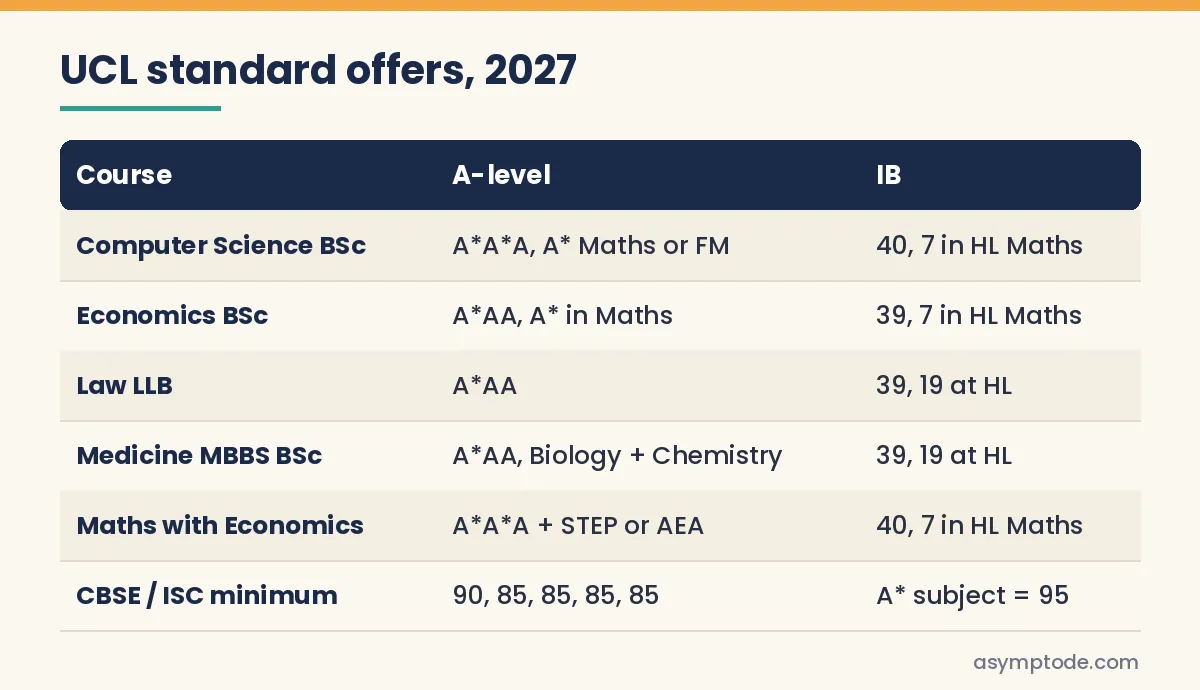 Standard UCL offers for September 2027 entry.
The table lists standard A-level and IB offers. Computer Science asks for A*A*A with an A* in Maths or Further Maths, or 40 IB points. Economics asks for A*AA with A* in Maths, or 39 points. Law and Medicine ask for A*AA, or 39 points. Mathematics with Economics asks for A*A*A plus STEP or AEA. For CBSE and ISC, the UCL minimum is 90, 85, 85, 85, 85.
Details from each 2027-entry course page:
| Course | A-level (standard) | A-level (contextual) | IB (standard) |
|---|---|---|---|
| Computer Science BSc | A*A*A, A* in Maths or Further Maths | A*AB | 40, 20 at HL, 7 in Maths |
| Economics BSc (Econ) | A*AA, A* in Maths | A*AB, A* in Maths | 39, 7 in HL Maths |
| Law LLB | A*AA | AAB | 39, 19 at HL |
| Medicine MBBS BSc | A*AA, Biology and Chemistry, one at A* | AAB | 39, 19 at HL incl. 6 and 7 in Biology and Chemistry |
| Mathematics with Economics BSc | A*A*A (A*A* in Maths and Further Maths) or A*AA (A*A in both), plus STEP grade 2 or AEA Distinction | A*A*C or A*AC | 40, 20 at HL, 7 in Maths AA |
Contextual offers also need at least two A-levels from UCL's preferred subject list. For maths-heavy courses, a strong A-level Maths grade is one of the most important things you can control. IB students can read our IB Diploma Programme guide for subject choices.
Does UCL accept resits?
It depends on the course. UCL Laws wants A-levels completed in one sitting and generally does not accept resits.
What do international applicants need?
International students apply through UCAS, like UK students. Each course page has an "International qualifications" section for your country.
Indian students (CBSE, ISC and state boards)
UCL's India page sets a minimum equal to A-level ABB (UCL India):
- CBSE or CISCE (ISC) Class 12: five subjects at 90, 85, 85, 85, 85.
- Where a course needs an A* in a subject, you need 95 in that subject. An A needs 90. A B needs 85.
- State boards: only Karnataka, Maharashtra, Tamil Nadu and West Bengal (from 2025), with the same scores and three core subjects. These are considered at the department's discretion.
- Another route is one year of a bachelor's degree at a recognised Indian university, with an average equal to a UK 2:1.
So for Economics (A* in Maths), you would need 95 in Maths, plus strong scores in your other subjects.
US students (AP, SAT and ACT)
A High School Diploma alone is not enough. UCL accepts one of these routes (UCL USA):
- Three to five AP subjects, taken in the final three years of high school.
- Two to four AP subjects plus the SAT or ACT.
- One year at a recognised US university or college with a CGPA of 3.3/4.0.
You need the AP that matches any required A-level. Calculus BC is required for Computer Science. AP Seminar and AP Research are not accepted. Choosing a US test? See SAT vs ACT.
Chinese students and other systems
UCL's China page lists A-levels or the IB, or two years at a recognised Chinese university with a 90% weighted average (UCL China). It does not list the Gaokao, so check your course page. If UCL does not accept your school qualification, its one-year Undergraduate Preparatory Certificate (UPC) foundation may suit you.
English language
UCL sets an English level for each course. Check the course page for your scores. For example, UCL Laws asks non-native speakers for IELTS Academic 7.5 overall, with at least 7.0 in each part.
Student visa basics
Most international students need a UK Student visa (GOV.UK), based on an offer from a licensed sponsor such as UCL. Once your place is confirmed, UCL gives you a CAS (Confirmation of Acceptance for Studies) number for your visa form. You can apply up to 6 months before your course starts. The fee is £558 from outside the UK, plus the healthcare surcharge, and you must show enough money to live on.
How much does UCL cost, and what funding is there?
For students starting in 2027/28, the Home (UK) fee is £10,050 for the first year, subject to parliamentary approval. International fees vary by course. For example, Economics BSc is £40,800 a year for 2027/28 (UCL Economics). Check your course page for the latest fee.
Funding options from UCL include:
- UCL Undergraduate Bursary: for UK undergraduates with household income below £42,875, paid each year and not repaid (UCL funding).
- Estranged Student and Care Leaver Bursaries: £1,000 a year for eligible UK students.
- UCL Global Undergraduate Scholarship: full and partial need-based awards for overseas-fee students from low-income backgrounds. Apply after you submit your UCL application; no offer is needed first (UCL scholarship guidance). Check the page for the 2027/28 deadline.
How do you apply to UCL, step by step?
 The four stages of a UCL application.
The animation shows four steps. First, choose your course and check its test. Next, apply on UCAS by 13 January 2027. Then sit any test, portfolio or interview. Finally, UCL makes its decision and sends any offer through UCAS.
- Pick your course. Read the UCL course page: grades, subjects, test and fees.
- Book your test early. Link your LNAT registration to UCL.
- Write your personal statement. Answer all three questions in 4,000 characters.
- Get your reference. UCAS needs it, with predicted grades, before you can send.
- Submit on UCAS. Add UCL (code U80) by 13 January 2027, 18:00.
- Complete any extra stage, such as a portfolio, interview or MMI. Offers come through UCAS.
Need help with maths or science grades? Book a free demo class with an Asymptode mentor, or see our plans and fees.
How should younger students plan for UCL (from Year 10 / Grade 9)?
 A simple UCL plan from Year 10 to Year 13.
The timeline has six stages. Year 10: strong GCSEs, especially Maths and English. Year 11: sit GCSEs and choose A-level or IB subjects. Year 12: research courses and read beyond the syllabus. Summer after Year 12: draft your statement and book any test. September to January of Year 13: sit your test and apply by 13 January. Then complete any interview, MMI or portfolio and get your decision.
Two planning tips:
- Subjects first. Economics needs Maths. Computer Science needs Maths or Further Maths. Medicine needs Biology and Chemistry.
- GCSEs count. Many UCL courses need English Language and Maths at C/4; Law and Medicine need B/6.
What are the most common UCL application mistakes?
- Missing the test. Economics without the TMUA, or Law without the LNAT by 31 December 2026.
- Wrong subjects. No A* in Maths for Economics, or no Chemistry for Medicine.
- Mixing courses. One personal statement goes to all five choices, so very different choices weaken it.
- Late applications. Applying after 13 January 2027 18:00 for most courses.
- Weak test prep. TMUA and ESAT need timed practice, not just revision.
How 1-on-1 tutoring helps with getting into UCL
At Asymptode, every student gets one dedicated mentor in live online 1-on-1 classes. Here is how that helps with UCL:
- Top grades in maths and science. Your mentor follows your own syllabus (A-level, IB, CBSE, ISC or AP) and your exam dates. The mentor watches each step of your working, so mistakes get fixed at the method stage.
- TMUA and ESAT maths. These tests reward fast, careful reasoning with GCSE and AS maths. Your mentor sets timed practice and personalised homework, and gives feedback on every attempt.
- Planning and method. For the personal statement, LNAT or TARA, your mentor helps with planning, deadlines and a clear way to work. We do not write statements for students.
- Parents stay informed. Parents get short progress updates, and every class is recorded for revision. You can start with a free demo class.
Facts checked against official sources on 5 November 2026.
FAQ
What is the UCL application deadline for 2027 entry?
For most UCL courses, the UCAS deadline is 13 January 2027 at 18:00 UK time. Most medicine courses closed on 15 October 2026. If you take the LNAT for Law, you must also sit it by 31 December 2026.
What grades do you need to get into UCL?
It depends on the course. For 2027 entry, Computer Science asks for A*A*A with an A* in Maths or Further Maths. Economics, Law and Medicine ask for A*AA, with set subjects for Economics and Medicine. IB offers for these courses are 39 or 40 points.
Does UCL require an admissions test?
Many courses do. Law uses the LNAT, Medicine uses the UCAT, Economics uses the TMUA, Electronic and Electrical Engineering uses the ESAT, and Computer Science uses the TARA. Some courses, such as Sociology BSc, have no test for 2027.
Does UCL interview applicants?
Some courses interview. Medicine uses Multiple Mini Interviews between December and March. Architecture and Fine Art interview after a portfolio, and Pharmacy uses a test and an interview.
Can Indian students apply to UCL with CBSE or ISC?
Yes. The minimum is five subjects at 90, 85, 85, 85, 85 in Class 12. Where a course needs an A* in a subject, you need 95 in that subject. Competitive courses need higher scores than the minimum.
How much are UCL tuition fees for 2027/28?
The Home fee is £10,050 for the first year, subject to parliamentary approval. International fees depend on the course, for example £40,800 a year for Economics BSc. Check your course page for the latest figure.
Ready to start? Book a free demo class and advisor call, or see our plans and fees.
Sources
- UCL: Tests, tasks and interviews
- UCAS: Dates and deadlines for uni applications
- UCAS: Personal statement for 2026 entry onwards
- UCL: Computer Science BSc
- UCL: Economics BSc (Econ)
- UCL: Law LLB
- UCL: Medicine MBBS BSc
- UCL: Mathematics with Economics BSc
- UCL Laws: Applying and entry requirements
- UCL: India
- UCL: United States of America
- UCL: China
- UCL: Funding for undergraduate courses
- UCL Global Undergraduate Scholarship application guidance
- LNAT: Dates and deadlines
- UCAT: Test dates
- Imperial College London: TMUA
- UAT-UK: Admissions testing for 2027 (UCAS)
- GOV.UK: Student visa