
UCAT 2027 is the test you sit in summer 2027 if you want to start a medicine or dentistry degree at a UK UCAT university in 2028. It is a two-hour computer test with four parts: Verbal Reasoning, Decision Making, Quantitative Reasoning and Situational Judgement. The official UCAT 2027 dates are not yet announced. The UCAT Consortium says they will be published by February 2027. This guide covers the 2026 dates for reference, format, scoring, fees, registration, a study plan and worked examples, for students in the UK, India, the Gulf, Singapore and beyond, and their parents.
Key takeaways
- Sit UCAT 2027 if you are applying for 2028 entry to medicine or dentistry at a UK UCAT university. You can sit it only once per cycle.
- UCAT 2027 dates are not yet announced. In 2026, registration opened on 20 May, testing ran from 13 July to 24 September, and results reached universities in early November.
- The test has four subtests, 184 questions and 117 minutes 30 seconds in total (including instruction time).
- You get a total score from 900 to 2700 plus a Situational Judgement band from 1 (best) to 4.
- In the 2026 cycle the fee was £70 in the UK and £115 outside the UK. A bursary covers the full fee for eligible UK candidates.
- Universities use scores in different ways. There is no single "pass mark", so check each university's own page.
What is the UCAT and do I need UCAT 2027?
Quick answer: The UCAT (University Clinical Aptitude Test) is an admissions test used by UK and partner universities to select students for medicine and dentistry. You need UCAT 2027 if you will apply through UCAS in autumn 2027 for 2028 entry to a course on the official UCAT list. You can sit it once in each testing cycle.
The official UCAT website says the test is used alongside your grades and interviews.
A key point on timing: UCAT 2026 results are valid only for 2027 entry, or for deferred entry in 2028. So most students applying for 2028 entry will sit the UCAT in summer 2027.
If you are still deciding on a medical career, read our guide on how to become a doctor first.
Is UCAT ANZ the same as UCAT?
No. UCAT ANZ is a separate, earlier test for Australia and New Zealand, run at ucat.edu.au. Content is the same. You must not sit both in one year. If you apply to both regions, sit UCAT ANZ and send it to UK universities with the UCAT ANZ Results Collection form (2026 deadline: 22 October).
Which universities use the UCAT?
The official UCAT universities page (2026 cycle, which may change for 2027) lists these UK universities and schools:
Aberdeen, Anglia Ruskin, Aston, Bangor, Birmingham, Greater Manchester, Brighton and Sussex Medical School, Bristol, Brunel, Cambridge, Cardiff, Lancashire, Chester, City St George's (University of London), Dundee, East Anglia, Edge Hill, Edinburgh, Exeter, Glasgow, Hertfordshire, Hull York Medical School, Imperial College London, Keele, Kent and Medway Medical School, King's College London, Lancaster, Leeds, Leicester, Lincoln, Liverpool, Manchester, Newcastle, Nottingham, Oxford, Pears Cumbria School of Medicine, Plymouth, Portsmouth, Queen Mary University of London, Queen's University Belfast, Sheffield, Southampton, St Andrews, St Mary's (Twickenham), Sunderland, Surrey, Swansea, UCL, Warwick, Wolverhampton and Worcester.
Partner universities outside the UK on the same page include the National University of Singapore (Yong Loo Lin School of Medicine), Nanyang Technological University (Lee Kong Chian School of Medicine), Thammasat University, the American University of the Caribbean, the National and Kapodistrian University of Athens, the University of Kurdistan Hewlêr and the University of Nicosia (graduate entry).
Check each course code, as not every course needs the UCAT. Applying to Oxford? See our guide on how to get into Oxford.
When is UCAT 2027?
UCAT 2027 dates are not yet announced. The official test dates page says 2027 dates will be published by February 2027. Registration and booking instructions are due in March 2027.
Here are the 2026 cycle dates for reference. Expect a similar pattern in 2027.
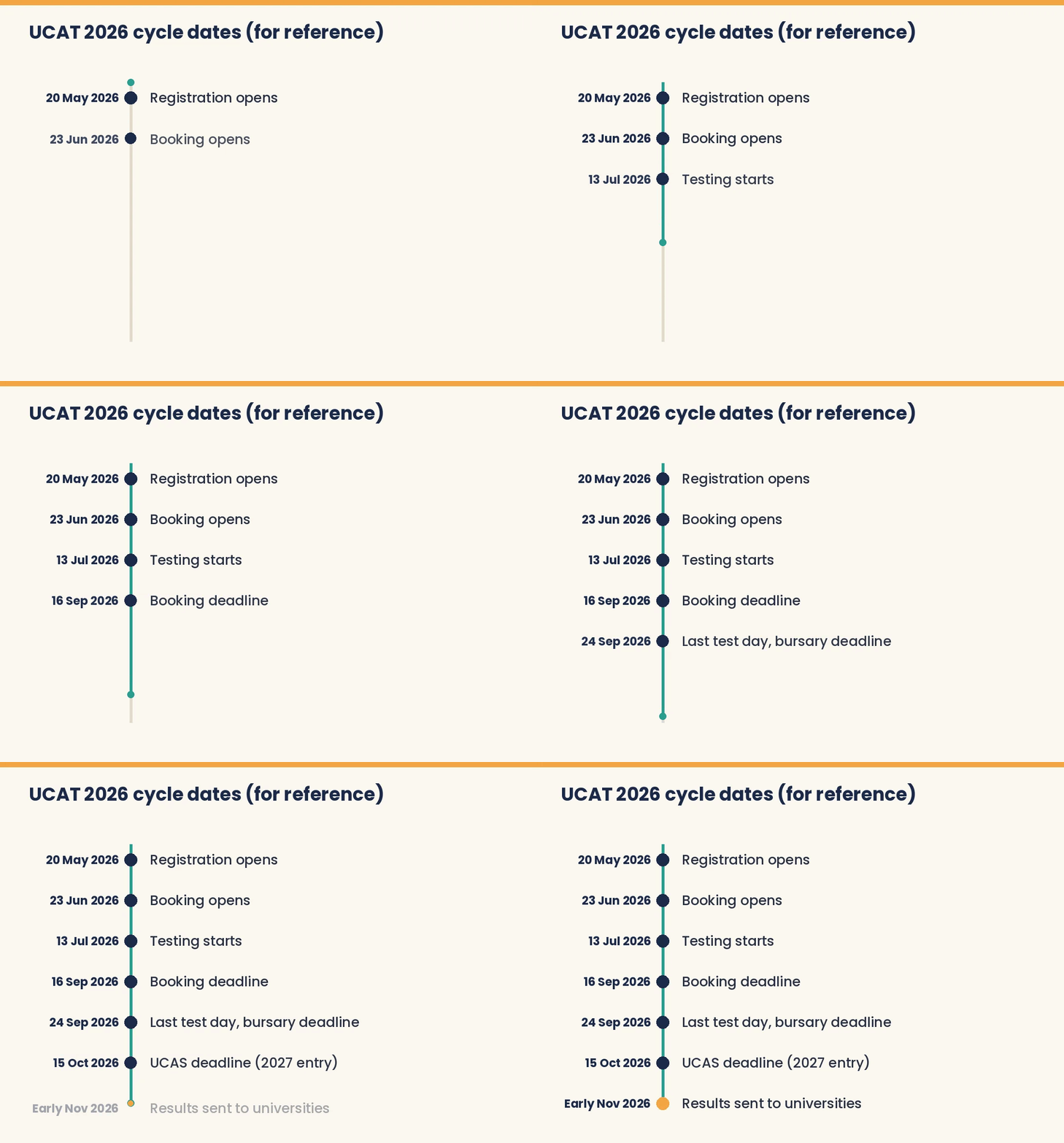
| Event (2026 cycle, for reference) | Date |
|---|---|
| Registration opens; bursary and access arrangement applications open | 20 May 2026 (14:00 UK time) |
| Booking opens | 23 June 2026 (14:00 UK time) |
| Testing starts | 13 July 2026 |
| Access arrangement application deadline | 10 September 2026 (15:00 UK time) |
| Booking deadline and registration closes | 16 September 2026 (15:00 UK time) |
| Last test day; bursary application deadline | 24 September 2026 (bursary 15:00 UK time) |
| UCAS deadline for medicine and dentistry (2027 entry) | 15 October 2026 (18:00 UK time) |
| Results delivered to universities | Early November 2026 |
For 2028 entry, the UCAS deadline for most medicine and dentistry courses has not yet been confirmed. It is usually 15 October of the year before entry, so expect mid-October 2027. Check UCAS for the official date.
What is the UCAT 2027 test format?
Since 2025 the UCAT has had four subtests. Abstract Reasoning was removed. The official format page gives these timings (2026 cycle):
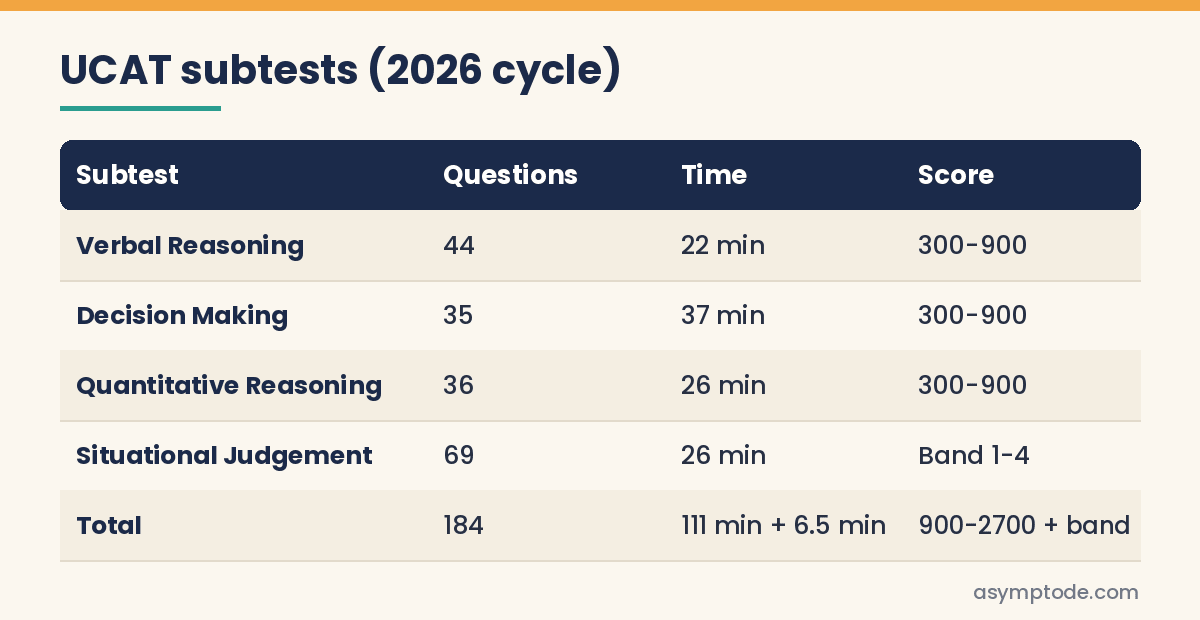
| Subtest | Questions | Time | Instruction time | Score | Time per question |
|---|---|---|---|---|---|
| Verbal Reasoning (VR) | 44 | 22 min | 1 min 30 s | 300-900 | about 30 s |
| Decision Making (DM) | 35 | 37 min | 1 min 30 s | 300-900 | about 63 s |
| Quantitative Reasoning (QR) | 36 | 26 min | 2 min | 300-900 | about 43 s |
| Situational Judgement (SJT) | 69 | 26 min | 1 min 30 s | Band 1-4 | about 23 s |
| Total | 184 | 111 min | 6 min 30 s | 900-2700 + band |
The standard test lasts 117 minutes 30 seconds. Once it starts, you cannot pause it.
What each subtest checks:
- VR: 11 passages with 4 questions each. Use only the text.
- DM: logic, arguments, Venn diagrams and data, with some five-statement yes/no questions. Calculator available.
- QR: problem solving with charts and tables. Calculator available.
- SJT: clinical or training scenarios. No medical knowledge needed.
How long is the UCAT with extra time (UCATSEN)?
If you are approved for access arrangements, you can sit a longer version. The official test timings page lists (2026 cycle):
| Version | Total time incl. instructions |
|---|---|
| Standard UCAT | 117 min 30 s |
| 25% extra time (UCATSEN) | 145 min 15 s |
| 33% extra time | 154 min 30 s |
| 50% extra time (UCATSEN50) | 173 min |
Rest breaks are also possible. Get approval through your UCAT account before you book. Universities are not told about your access arrangements. See the access arrangements page.
How is the UCAT scored?
There is no negative marking, so never leave a blank.
- VR, DM and QR each give a scaled score from 300 to 900. Added together, they make your total score of 900 to 2700.
- In DM, five-statement questions are worth 2 marks, with 1 mark for a partly correct answer.
- SJT gives a band from 1 to 4. Band 1 is the highest.
What is a good UCAT score?
There is no official "good" score. But the official test statistics for the 2026 cycle (42,359 tests) show:
| 2026 statistic | Value |
|---|---|
| Mean total score | 1918 |
| Mean VR / DM / QR | 602 / 640 / 675 |
| 5th decile (median) total | 1920 |
| 7th decile total | 2050 |
| 9th decile total | 2250 |
| SJT Band 1 / 2 / 3 / 4 | 15% / 40% / 34% / 11% |
Means shift yearly, so compare with your own cycle.
How do universities use UCAT scores?
Honestly, it varies a lot. The official guidance says:
- Some universities treat the UCAT as a major factor. Others use it less, or only for borderline cases.
- Most look at the total score. Some also look at subtest scores.
- Some set a threshold score. It may be fixed or change each year.
- Some combine the UCAT with academic results such as GCSEs.
- More universities now use the SJT band, and some exclude lower bands.
We do not quote cut-offs, because they change yearly and differ by course. You get your score on test day, before the UCAS deadline, so use it to pick universities that suit your result.
Need a calm, structured plan for UCAT maths and logic? Book a free demo class with an Asymptode mentor.
How much does UCAT 2027 cost?
UCAT 2027 fees are not yet announced. These are the 2026 cycle fees from the official FAQs:
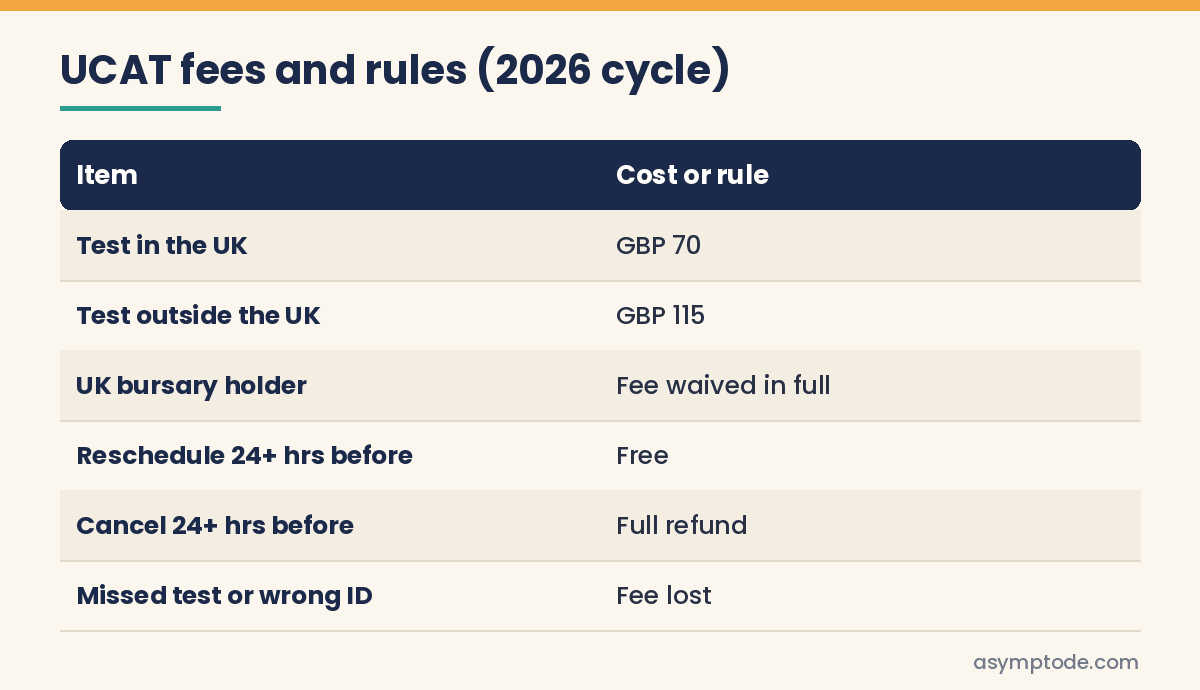
| Item (2026 cycle) | Cost or rule |
|---|---|
| Test in the UK | £70 |
| Test outside the UK | £115 |
| UK candidate with a bursary | Fee waived in full |
| Reschedule 24+ hours before | Free |
| Cancel 24+ hours before | Full refund |
| Missed test or wrong ID | Fee lost |
Who can get a UCAT bursary?
The UCAT Bursary Scheme is for UK candidates from low-income backgrounds who meet the criteria. 2027 details are due around March 2027. Apply before you book, and again every year. Universities see a flag that you had a bursary. Some use it to spot applicants from under-represented backgrounds. It does not count against you.
Who must sit the UCAT, and where?
You must sit the UCAT if a course you apply to requires it. The test is delivered at Pearson VUE centres in the UK and in 130+ countries. Use the Pearson VUE test centre locator to find yours. See the eligibility page.
For international students:
- Universities expect you to sit the test, even if that means travelling to another country.
- Online testing (OnVUE) is offered only in special cases. Examples are no nearby test centre, or war, unrest or disaster. In 2026, OnVUE testing ran from 13 July to 20 September.
- Singapore: NUS and NTU use the UK UCAT. If you also apply to Australia or New Zealand, sit UCAT ANZ instead.
- Applying to Indian medical colleges as well? Our NEET UG 2027 guide covers that exam.
What ID do I need for the UCAT?
Bring one original, unexpired photo ID with a signature. Your name must match your UCAT account exactly. A passport works at any test centre. A driving licence or national ID card works only in the country that issued it, with extra rules for Aadhaar in India. Student cards are not accepted. With the wrong ID, you cannot test and you lose your fee. See the official ID policy.
How do I register for UCAT 2027?
These steps follow the 2026 process. Check for changes in March 2027.
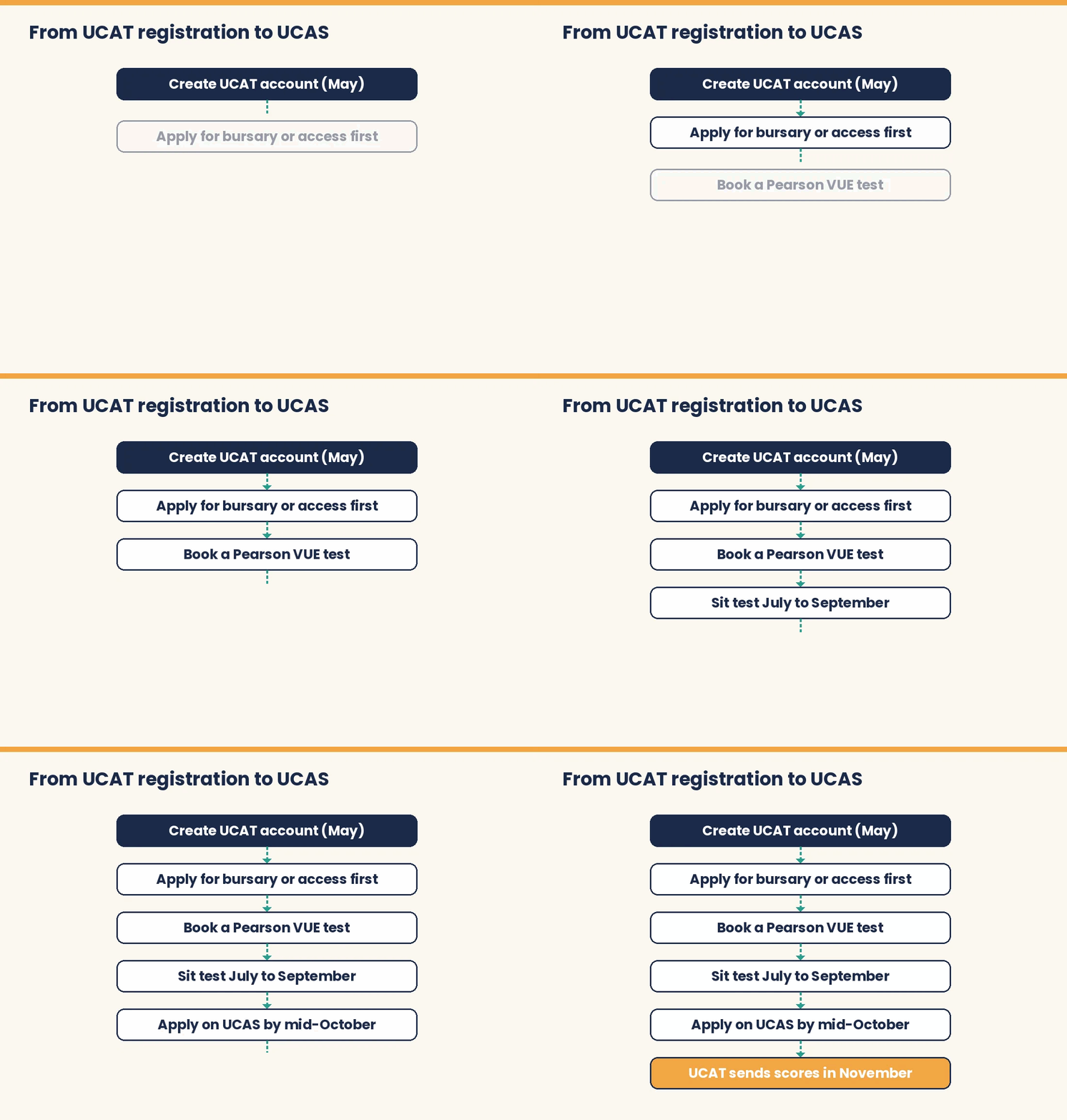
- Check your courses need the UCAT.
- Create a new UCAT account when registration opens (May in 2026). Old accounts from earlier years do not carry over.
- Apply for a bursary or access arrangements first, if they apply to you. Both need approval before booking.
- Book your test at a Pearson VUE centre through your account. Book early, as late dates fill fast.
- Sit the test in the July to September window. You see your score before you leave.
- Apply on UCAS by the October deadline (expected mid-October 2027 for 2028 entry). You do not add your UCAT score. UCAT sends it to universities in early November.
UCAT worked examples
Quantitative Reasoning example
Question: A child weighs 18 kg. The dose of a medicine is 15 mg per kg per day, split into 3 equal doses. The syrup contains 120 mg in every 5 mL. How many mL is each dose?
A) 2.5 mL B) 3.0 mL C) 3.6 mL D) 3.75 mL E) 4.5 mL
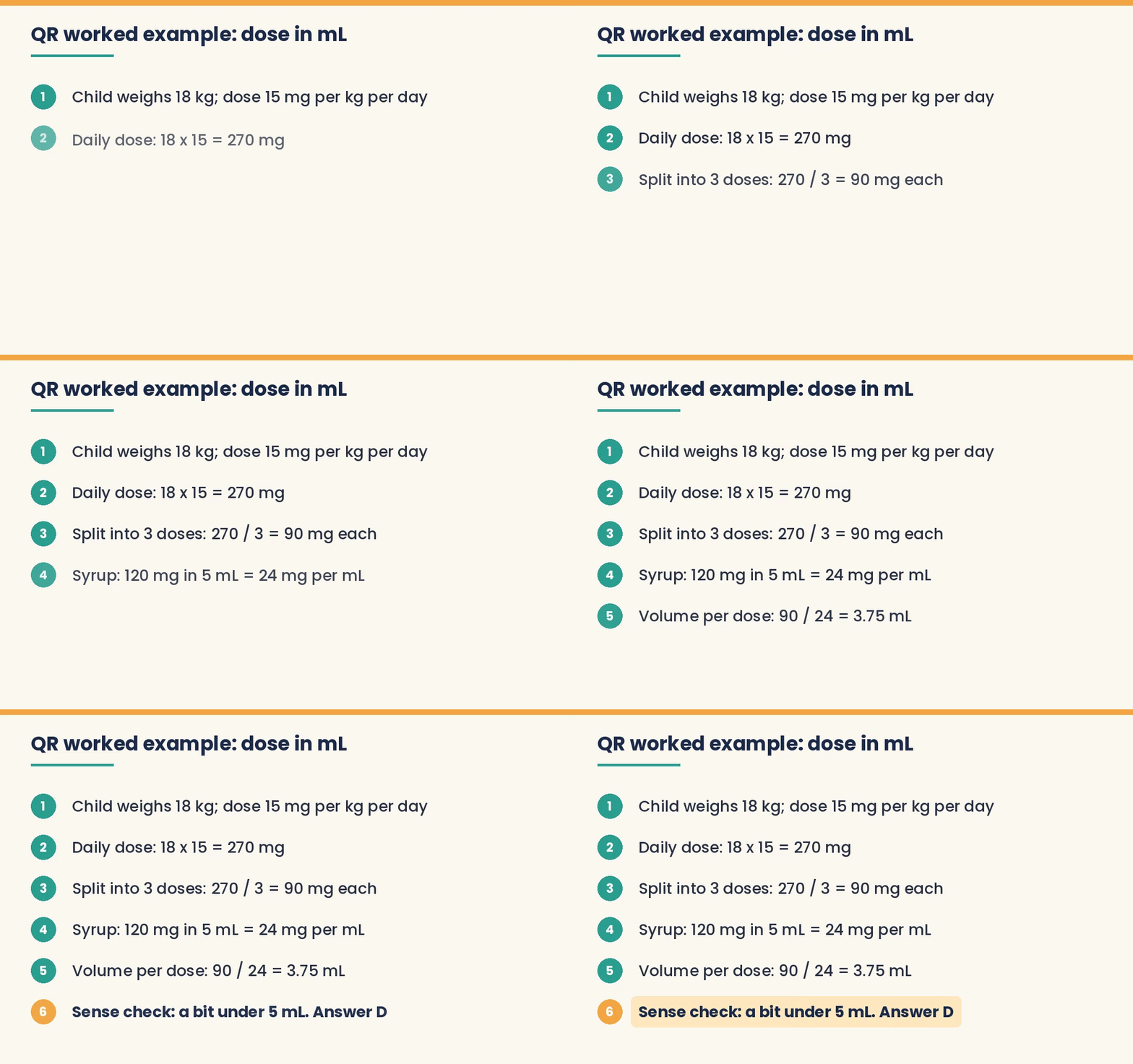
- Daily dose: 18 x 15 = 270 mg.
- Each dose: 270 / 3 = 90 mg.
- Syrup strength: 120 / 5 = 24 mg per mL.
- Volume per dose: 90 / 24 = 3.75 mL.
- Sense check: 90 mg is a bit under 120 mg, so the answer is a bit under 5 mL. Answer: D.
You have about 43 seconds per QR question, so write units as you go. Forgetting to divide by 3 gives 11.25 mL, a common trap.
Decision Making example
Facts: All choir members play an instrument. Some instrument players are in the science club. No science club member is in the drama group.
Does each statement follow? Answer Yes or No.
| Statement | Answer | Why |
|---|---|---|
| Some choir members are in the science club. | No | The players in the science club may not be choir members. |
| Some instrument players are not in the drama group. | Yes | The players in the science club cannot be in drama. |
| No choir member is in the drama group. | No | Nothing links choir to drama directly. |
| Every science club member plays an instrument. | No | We only know some do. |
| Some science club members play an instrument. | Yes | This is the second fact, read the other way. |
Draw quick circles. Say "Yes" only when the facts force it.
Common UCAT mistakes
- Booking a late test date. If you fall ill, there may be no slots left to move to.
- Spending too long on one question. Flag it, guess and move on. There is no negative marking.
- Not practising with the on-screen calculator. A slow calculator habit costs marks in QR.
- Ignoring the SJT. More universities now use the band.
- Practising with no review. Log every error and why it happened.
UCAT 2027 prep plan: what to do with the weeks you have left
The official preparation checklist says top performers report about 30 hours of preparation, starting 6 to 8 weeks before their test. Use the free official Question Tutorials, Question Banks and Practice Tests.
| Weeks left | Focus |
|---|---|
| 12+ weeks (spring 2027) | Learn the format. Sharpen mental maths, percentages, ratios and speed reading. Keep up school work. |
| 8 weeks | Do the official tutorials for each subtest. Untimed practice, then short timed sets. |
| 6 weeks | Timed sets daily, 30-45 minutes. Keep an error log by question type. |
| 4 weeks | First full practice test. Fix your weakest subtest. |
| 2 weeks | Full practice tests twice a week. Practise timing and guessing strategy. |
| Final week | Light review, check ID and test centre route, sleep well. |
A level maths and chemistry help with the numbers. See our A level maths guide and A level chemistry guide.
How 1-on-1 tutoring helps with UCAT
At Asymptode, each student works live online with one dedicated mentor, with no batches. Here is what a mentor can and cannot do:
- Quantitative Reasoning: the mentor watches each step of your working. They fix slow methods, unit errors and calculator habits, then build speed with timed drills.
- Decision Making: the mentor teaches a clear method for syllogisms, Venn diagrams and probability, so you stop guessing on logic.
- Timing: you practise a per-question pace and a "flag and move on" rule until it is automatic.
- Verbal Reasoning and Situational Judgement: these are not maths. The mentor helps honestly with a planning and practice routine and error reviews. Most of the gain here comes from your own regular practice with official materials.
- Support: flexible times across time zones, personalised homework with feedback, short parent updates and a recording of every class.
Facts checked against official sources on 27 October 2026.
Ready to start? Book a free demo class or see fees.
FAQ
When will UCAT 2027 dates be announced?
The UCAT Consortium says 2027 test dates will be published by February 2027. Registration and booking instructions are expected in March 2027. In the 2026 cycle, testing ran from 13 July to 24 September.
Can I use my UCAT 2026 score for 2028 entry?
Only if you applied in autumn 2026 for deferred 2028 entry. If you apply in autumn 2027 for 2028 entry, you need to sit UCAT 2027.
How many times can I take the UCAT?
You can sit the UCAT only once in each testing cycle. You can sit it again in a later year if you reapply. You must also not sit both UCAT and UCAT ANZ in the same year.
Is there negative marking in the UCAT?
No. The UCAT scores only correct answers, so you should answer every question. If you run short of time, make a guess and move on.
Can international students sit the UCAT in their home country?
Usually yes. Pearson VUE delivers the UCAT in 130+ countries, including India, the Gulf and Singapore. If there is no nearby centre, you may need to travel, or you may qualify for online testing in special cases.
Sources
- UCAT: About the UCAT
- UCAT: Test dates (2026 cycle)
- UCAT: Test format and scoring
- UCAT: Test timings and extended tests
- UCAT: Universities
- UCAT: Eligibility
- UCAT: FAQs (test fees)
- UCAT: Bursary Scheme
- UCAT: Access Arrangements
- UCAT: Test Centre Photo ID Policy
- UCAT: How universities use the UCAT
- UCAT: Test statistics (2026)
- UCAT: Preparation resources
- UCAT: UCAT ANZ Results Collection
- Pearson VUE: UCAT test centre locator
- UCAT ANZ Consortium
- UCAS: 2027 entry deadline for Oxford, Cambridge and medicine