
How to get into LSE (the London School of Economics and Political Science) comes down to strong grades, the right subjects, a focused personal statement and any test your course needs, sent through UCAS by 13 January 2027 for September 2027 entry. This guide uses official figures, for students applying now and younger students planning ahead.
Key takeaways
- The UCAS deadline for 2027 entry is 13 January 2027 at 18:00 (UK time).
- LSE does not interview for any undergraduate programme. Your written application does all the work.
- The TMUA is mandatory for BSc Economics and BSc Econometrics and Mathematical Economics. The LNAT is mandatory for the LLB, and you must sit it by 31 December 2026.
- Typical offers range from A*AA to AAB at A-level, or 37-39 IB points. Many courses need top grades in Maths.
- For students starting in 2027/28, the Home fee is £10,050 a year. Overseas fees depend on the programme (for example, £41,900 for BSc Economics).
How to get into LSE: what does it take?
Quick answer: To get into LSE, you need top predicted grades (usually A*AA-AAB or 37-39 IB points), the right subjects (often Maths), a strong personal statement and a supportive teacher reference. Some courses also need the TMUA or LNAT. Apply through UCAS by 13 January 2027 at 18:00. LSE does not interview.
LSE is a specialist social science university in central London. LSE says it received approximately 30,000 applications for roughly 1,900 places in 2025 (LSE admissions advice).
What undergraduate programmes does LSE offer?
LSE offers BSc degrees and an LLB (Bachelor of Laws). Most are three years full-time. Popular choices include:
- BSc Economics (UCAS code L101)
- LLB Bachelor of Laws (M100)
- BSc Mathematics and Economics (GL11)
- BSc Management (N200)
- BSc International Relations (L250)
LSE also runs degrees in areas such as data science and actuarial science. Every programme page lists its own requirements, tests and fees. For September 2027 entry, programmes start on 27 September 2027.
How does LSE choose its students?
LSE says: "We do not interview applicants for any of our programmes at LSE." Academic Selectors decide (LSE How to Apply).
Selectors look at:
- Grades you already have (such as GCSEs) and predicted grades (such as A-levels or IB).
- Your personal statement. LSE says it "forms an important part of the assessment and selection process."
- Your teacher's reference. It helps LSE understand your achievements in context.
- Contextual data. Eligible Home applicants may get an offer one or two grades lower than the standard offer.
- Admissions test scores, where your course needs one (TMUA or LNAT).
Meeting the grades does not guarantee an offer.
Does LSE look at GCSEs?
Yes. Programme pages say you will need several GCSE grades at A (7) and A* (8-9). As a minimum, LSE asks for GCSE English Language and Mathematics at grade B (6) or higher.
What is the UCAS personal statement like now?
From 2026 entry onwards, the UCAS personal statement has three questions (UCAS guide):
- Why do you want to study this course or subject?
- How have your qualifications and studies helped you prepare for this course or subject?
- What else have you done to prepare outside of education, and why are these experiences useful?
You have 4,000 characters in total, including spaces. Each answer needs at least 350 characters. You write one statement for your application, so keep it focused on one subject area.
What are the key dates for LSE 2027 entry?
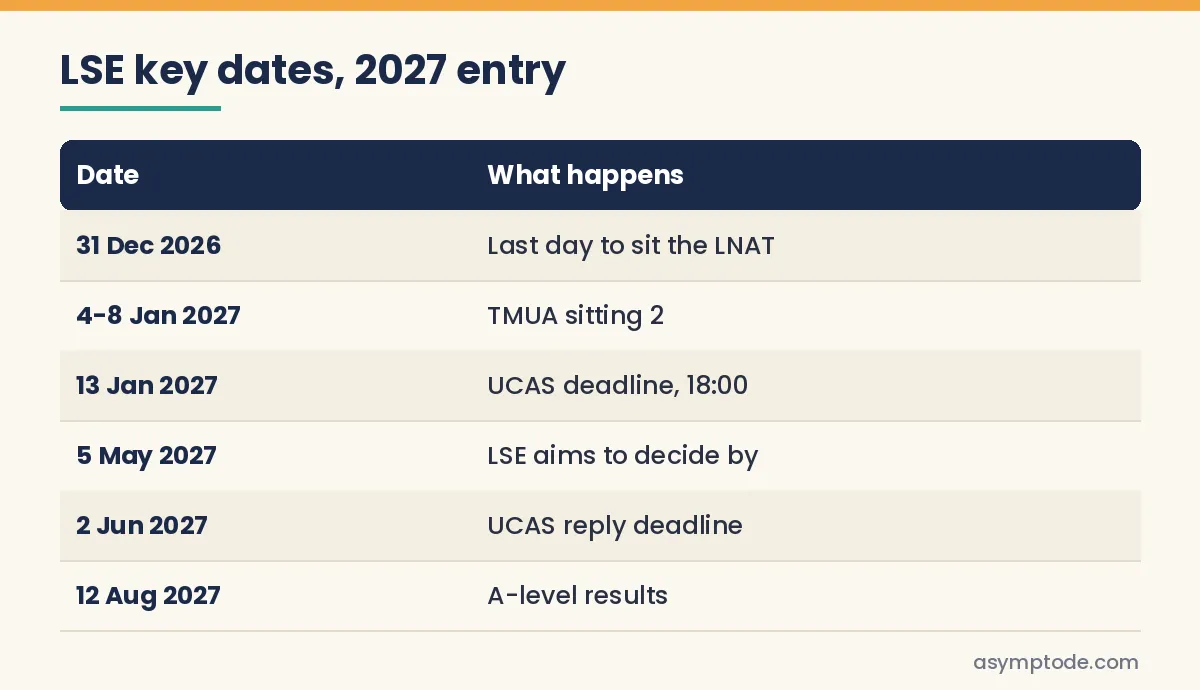 Key LSE dates for September 2027 entry.
The table shows the main dates. Sit the LNAT by 31 December 2026 and TMUA sitting 2 on 4-8 January 2027. The UCAS deadline is 13 January 2027 at 18:00. The UCAS reply deadline is 2 June 2027, and A-level results come out on 12 August 2027.
Sources: the LSE admissions calendar and UCAS. LSE sends its first decisions in November 2026, then weekly, and aims to decide on all applications by 5 May 2027.
If you are taking A-levels, see our guide to A-level exam dates 2027 to plan revision around these deadlines.
 Timeline of the main dates for 2027 entry.
The timeline runs in order. Sit the LNAT by 31 December 2026. Sit TMUA sitting 2 from 4-8 January 2027. Apply on UCAS by 13 January 2027. LSE aims to decide by 5 May 2027, you reply by 2 June 2027, and A-level results arrive on 12 August 2027.
Which admissions tests does LSE use?
TMUA (Test of Mathematics for University Admission)
For September 2027 entry, the LSE TMUA page says:
- Mandatory for BSc Economics and BSc Econometrics and Mathematical Economics.
- Recommended, not mandatory for BSc Mathematics and Economics, Mathematics with Economics, Financial Mathematics and Statistics, Mathematics with Data Science, Mathematics Statistics and Business, Data Science, Economics and Data Science, and Actuarial Science. A good score may make your application more competitive.
Key facts:
- Sitting 1 was 12-16 October 2026. Sitting 2 is 4-8 January 2027. Registration for sitting 2 closes on 21 December 2026.
- LSE accepts only your first sitting's result in an admissions cycle.
- The test has two parts of 20 multiple-choice questions, 75 minutes each. No calculator is allowed.
- LSE's page lists the fee as £78 in the UK or Ireland and £133 outside the UK.
The TMUA uses school-level maths with a focus on logic and proof. Our A-Level Maths guide covers the core topics.
LNAT (for the LLB)
All LLB applicants must sit the LNAT. For September 2027 entry (or deferred entry in 2028), you can take it between 1 September 2026 and 31 December 2026. To be sure of fair and equal consideration, you must sit it by 31 December 2026 (LSE LLB page; LNAT dates).
- Select LSE when you register your LNAT account, so LSE can get your result.
- LSE uses the multiple-choice score. The essay is not considered for most applicants.
- Check the LNAT website for current fees and test centres.
UGAA (Undergraduate Admissions Assessment)
The UGAA is LSE's own English and maths assessment for some applicants, such as those with less well-known qualifications. LSE invites you if needed (early March 2027, sat in late March). LLB applicants do not sit it.
What grades do you need for LSE?
LSE's standard offers range from A*AA to AAB at A-level or 37-39 IB points with 666 or 766 at Higher Level. Here are five popular programmes for 2027 entry, from the official programme pages:
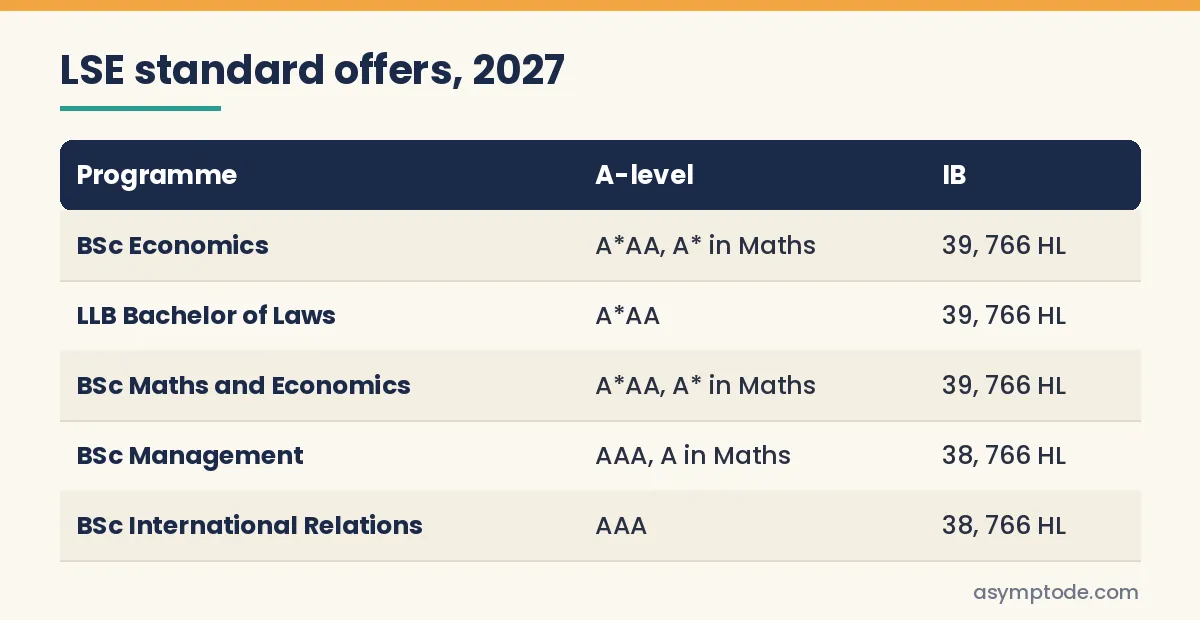 Standard offers for popular LSE programmes, 2027 entry.
The table lists standard offers. BSc Economics asks for A*AA with A* in Maths, or IB 39. The LLB asks for A*AA or IB 39. Maths and Economics asks for A*AA with A* in Maths, or IB 39. Management and International Relations ask for AAA or IB 38.
| Programme | A-level | IB Diploma | Test |
|---|---|---|---|
| BSc Economics | A*AA, A* in Maths | 39, 766 HL, 7 in Maths | TMUA required |
| LLB Bachelor of Laws | A*AA | 39, 766 HL | LNAT required |
| BSc Mathematics and Economics | A*AA, A* in Maths | 39, 766 HL, 7 in Maths AA | TMUA recommended |
| BSc Management | AAA, A in Maths | 38, 766 HL incl. Maths | None |
| BSc International Relations | AAA | 38, 766 HL | None |
Extra details:
- Economics: Further Maths is desirable. An A* in Further Maths plus an A in Maths is an acceptable alternative. If your school does not offer it, you are not disadvantaged; say so on your application.
- Mathematics and Economics: Where your school offers it, AS or A-level Further Maths is expected, with a grade A.
- Contextual offers: For example, the LLB contextual offer is AAB (IB 37, 666 HL). Economics is A*AB with A* in Maths.
Taking the IB? Our IB Diploma Programme guide explains how points and HL grades work.
How competitive are popular LSE courses?
LSE publishes application and intake figures on each programme page, with a 2025 ratio:
| Programme | Applications | Intake | 2025 ratio |
|---|---|---|---|
| LLB Bachelor of Laws | 3,102 | 193 | 16:1 |
| BSc Economics | 2,885 | 217 | 13:1 |
| BSc Management | 2,407 | 163 | 15:1 |
| BSc Mathematics and Economics | 896 | 60 | 15:1 |
| BSc International Relations | 830 | 60 | 14:1 |
These are applications per place, not offer rates.
What do international and Indian applicants need?
Indian students (CBSE and ISC)
LSE's India page maps CBSE and CISCE (ISC) Class XII results to A-level grades:
| A-level offer | CBSE / ISC equivalent |
|---|---|
| A*AA | Overall 95%+, with 3 subjects at 95%+ and 2 at 90%+ |
| AAA | Overall 90%+, with 5 subjects at 90%+ |
| AAB | Overall 85%+ (one or more subjects may need 90%+) |
For programmes that need A* in Maths, you need 95% in Mathematics. For an A in Maths, you need 90%. LSE does not accept Applied Maths (CBSE or ISC) for any Maths requirement. Our CBSE board exams 2027 guide helps with board exam planning.
US students (AP, SAT and ACT)
The LSE US page says a High School Diploma alone is not enough. For A*AA or AAA, you need five APs at grade 5 (over at most three years) plus a 3.7 GPA, or a 3.7 GPA with SAT 1450+ or ACT 32+. Maths A* or A means AP Calculus BC at 5. See SAT vs ACT.
English language requirements
You only need to prove your English after you get an offer. LSE's English language page lists:
- IELTS Academic: 7.0 overall and 7.0 in each part, in one sitting.
- TOEFL iBT: 100 overall, with 27 Writing, 25 Reading, 24 Listening and 24 Speaking.
- PTE Academic: 70 overall and 70 in every part.
Some nationals of majority English-speaking countries are exempt. Book early: LSE cannot defer an offer for a missed test.
How much does LSE cost, and what funding is there?
For students starting in 2027/28, the official programme pages list:
- Home fee: £10,050 per year. It may rise in later years in line with the UK Government maximum.
- Overseas fee: varies by programme. For example, BSc Economics is £41,900, BSc Mathematics and Economics is £39,300, the LLB and BSc Management are £37,500, and BSc International Relations is £33,800 per year. For 2027/28 entrants, the Overseas fee stays the same for every year of the programme.
LSE estimates living costs of at least £1,550 a month (LSE fees and funding).
Funding options:
- LSE Bursary (Home students): For new entrants from 2025/26, it pays £4,250 a year if household income is £30,000 or less, then £3,000, £2,250 and £1,250 in bands up to £50,000. You apply through Student Finance (LSE Bursary).
- Undergraduate Support Scheme (Overseas students): Needs-based awards for Overseas fee status students with an offer, usually between £15,000 and £25,000 a year (LSE).
- Scholarships: You apply after you get an offer. Deadlines for 2027/28 are not yet on the how to apply for funding page. For 2026/27, the Overseas deadline was 30 April 2026.
How do you apply to LSE, step by step?
 The LSE application path, from choice to offer.
The flow has four stages. First, choose a programme and check its requirements. Next, sit the TMUA or LNAT if your course needs it. Then submit your UCAS application by 13 January 2027. Finally, Academic Selectors decide, with no interview.
- Choose your programme and read its official page.
- Register for any test. TMUA sitting 2 registration closes 21 December 2026. The LNAT must be sat by 31 December 2026.
- Write your personal statement with real examples from your reading.
- Ask for your reference early.
- Submit on UCAS by 13 January 2027 at 18:00. Your school may set an earlier internal deadline.
- Watch your email for decisions or a UGAA invitation.
- After an offer: reply by 2 June 2027, apply for funding, and arrange English tests if needed.
Want help planning your maths and test prep? Book a free demo class with an Asymptode mentor, or see our plans and fees.
How should younger students plan for LSE (from Year 10 / Grade 9)?
Good choices at 14-16 make LSE much easier later.
| Stage | What to focus on |
|---|---|
| Year 10 / Grade 9 | Aim for 7-9 in GCSEs (or top marks in Class IX). Never let Maths or English slip below a 6. Start reading about economics, politics or law. |
| Year 11 / Grade 10 | Choose A-level or IB subjects. For Economics or Maths courses, take Maths and, if possible, Further Maths. Indian students: choose standard Maths, not Applied Maths. |
| Year 12 / Grade 11 | Build strong predicted grades. Read beyond the syllabus. Try the TMUA or LNAT practice papers. Shortlist courses. |
| Summer before Year 13 | Draft your personal statement. Register for the LNAT or TMUA. |
| Year 13 / Grade 12 | Sit tests, apply by 13 January, then focus on final exams. |
If you are also looking at Oxford, Cambridge or Imperial, note that their UCAS deadline was 15 October 2026 for 2027 entry. See how to get into Oxford, how to get into Cambridge and how to get into Imperial College London.
What are the most common LSE application mistakes?
- Missing the LNAT date. Sitting it after 31 December 2026 risks your LLB application.
- Skipping the TMUA for Economics. It is mandatory for BSc Economics.
- Taking Applied Maths in CBSE or ISC for a course that needs Maths. LSE will not accept it.
- Ignoring subject combinations. LSE prefers a broad mix of traditional academic subjects. Check your programme page.
- A vague personal statement. Lists of activities do not help. Show what you read, what you thought, and why it matters for the course.
How 1-on-1 tutoring helps with getting into LSE
At Asymptode, we focus on the maths and the planning. The personal statement and essays must be the student's own work. Our mentor gives method and feedback, never ghost-writing.
- One dedicated mentor, live online 1-on-1: for A-Level Maths, Further Maths, IB Maths AA, CBSE or ISC Maths, or AP Calculus BC, following your own syllabus and exam dates.
- TMUA preparation, method-first: the mentor watches each step of your working on logic, proof and problem solving, then sets personalised homework with feedback.
- Planning help: a clear timeline for test registration, practice papers and the 13 January 2027 deadline, plus short parent updates.
- Every class recorded, so you can review tricky ideas. Start with a free demo class.
Facts checked against official sources on 5 November 2026.
FAQ
Does LSE interview applicants?
No. LSE does not interview for any undergraduate programme. Selectors use your grades, predicted grades, personal statement, reference and any test score.
When is the LSE application deadline for 2027 entry?
The UCAS equal consideration deadline is 13 January 2027 at 18:00 UK time. LLB applicants must also sit the LNAT by 31 December 2026. Your school's internal deadline may be earlier.
Is the TMUA required for LSE?
It is mandatory for BSc Economics and BSc Econometrics and Mathematical Economics for 2027 entry. It is recommended for several maths, statistics and data science programmes. The last sitting for this cycle is 4-8 January 2027, and registration closes on 21 December 2026.
What A-levels do you need for LSE?
Standard offers range from A*AA to AAB. Economics and Mathematics and Economics need A*AA with an A* in Maths. Management needs AAA with an A in Maths.
Can Indian students apply to LSE with CBSE or ISC?
Yes. For an A*AA offer, LSE asks for an overall 95% or above, with three subjects at 95%+ and two at 90%+. Maths-heavy courses need 95% in standard Mathematics, and Applied Maths is not accepted for Maths requirements.
How much are LSE tuition fees for 2027/28?
The Home fee is £10,050 a year for students starting in 2027/28. Overseas fees vary by programme, for example £41,900 for BSc Economics and £33,800 for BSc International Relations.
Ready to start? Book a free demo class and advisor call, or see our plans and fees.
Sources
- LSE: How to apply
- LSE: Undergraduate admissions calendar
- LSE: Undergraduate admissions advice
- LSE: TMUA
- LSE: LLB Bachelor of Laws
- LSE: BSc Economics
- LSE: Entry requirements
- LSE for Indian students
- LSE for American students
- LSE: English language requirements
- LSE Bursary
- LSE Undergraduate Support Scheme
- UCAS: Dates and deadlines
- UCAS: Personal statement for 2026 entry onwards
- LNAT: Dates and deadlines