
The LNAT (Law National Aptitude Test) is the entrance test many top UK universities use to choose students for undergraduate law. If you are applying for 2027 entry from the UK, India, Singapore, Hong Kong, the Gulf or anywhere else, this guide covers the LNAT 2027 test dates, fees, format, scoring and booking steps, from official sources only. It ends with a week-by-week plan.
Key takeaways
- The LNAT is run by the LNAT Consortium and delivered on computer at Pearson VUE test centres. It does not test law knowledge.
- It lasts 2 hours 15 minutes: 42 multiple-choice questions in 95 minutes, then one essay (from three) in 40 minutes.
- Your LNAT score is out of 42, from Section A only. Your essay goes to universities. There is no pass mark.
- Deadlines depend on the university: 15 October 2026 for Oxford and Cambridge (passed), 31 December 2026 for KCL, LSE and UCL, 13 January 2027 for Bristol and Durham, and 25 January 2027 for the rest.
- The fee is £75 at UK/EU test centres and £120 elsewhere, charged in pounds. You can sit it only once per cycle.
What is the LNAT and who runs it?
Quick answer: The LNAT is a 2¼-hour computer-based test that UK and some overseas universities use to select undergraduate law students. It checks reading, reasoning and argument skills, not legal knowledge. The LNAT Consortium manages the content, and Pearson VUE runs the test at its centres around the world.
The official What is LNAT? page says it is used alongside your UCAS form and grades, never instead of them. The test is only in English (LNAT FAQs).
Looking at law tests elsewhere too? See our LSAT guide for US law schools, or the CLAT 2027 guide and AILET 2027 guide for India.
Which universities require the LNAT for 2027 entry?
We checked each university's own admissions page.
| University | Who must sit it | Sit by |
|---|---|---|
| Oxford | All Law applicants | 15 Oct 2026 |
| Cambridge | All Law applicants | 15 Oct 2026 |
| KCL | All Law applicants | 31 Dec 2026 |
| LSE | All LLB (M100) applicants | 31 Dec 2026 |
| UCL | All Laws applicants | 31 Dec 2026 |
| Bristol | All Law applicants | 13 Jan 2027 |
| Durham | All Law applicants | 13 Jan 2027 |
| Glasgow | Law applicants | 25 Jan 2027 |
| SOAS | Only some applicants | 25 Jan 2027 |
Deadlines come from the official LNAT dates and deadlines page. For 2027 entry, SOAS says A-level and other standard applicants do not need the LNAT, though it may make lower offers to those who sit it. Applicants with non-standard qualifications or Level 3 BTECs must sit it.
Outside the UK, LNAT lists O.P. Jindal Global University (India), Singapore University of Social Sciences (SUSS) and IE University (Spain). Rules differ, so check each one. SUSS applicants can sit between 1 September 2026 and 15 March 2027 for the July 2027 intake.
What are the LNAT 2027 test dates and deadlines?
There is no single test day: you book any free slot at a test centre. Registration opened on 1 August 2026 and testing began on 1 September 2026.
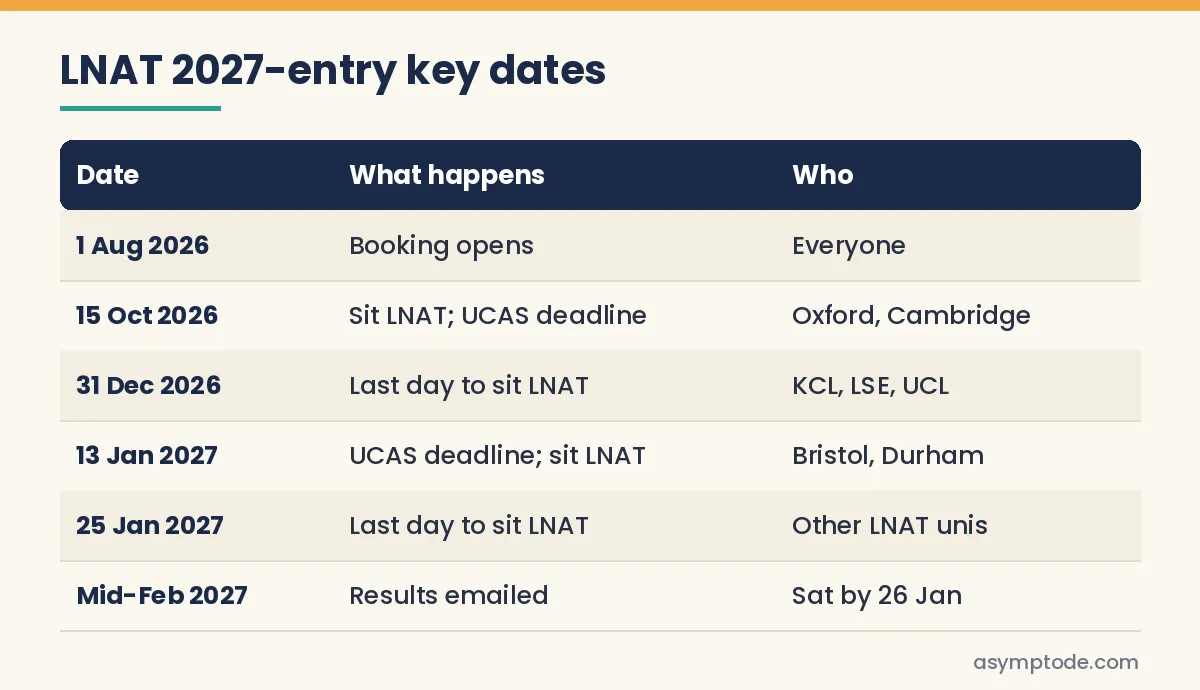 Key LNAT dates for the 2027-entry cycle.
Booking opened on 1 August 2026. Oxford and Cambridge applicants had to sit by 15 October 2026, their UCAS deadline.
KCL, LSE and UCL applicants must sit by 31 December 2026. Bristol and Durham applicants must sit by 13 January 2027, the UCAS deadline for most courses.
For all other LNAT universities, the last day is 25 January 2027. Sit by 26 January and your result is emailed in mid-February.
| Date | What happens | Who |
|---|---|---|
| 15 Sep 2026 | Register and book by now | Oxford, Cambridge |
| 15 Oct 2026, 18:00 UK | UCAS deadline; sit LNAT by now | Oxford, Cambridge |
| 31 Dec 2026 | Sit LNAT by now | KCL, LSE, UCL |
| 13 Jan 2027, 18:00 UK | UCAS deadline for most courses | Most applicants |
| 13 Jan 2027 | Book and sit LNAT by now | Bristol, Durham, Oxford Foundation Year in Law |
| 20 Jan 2027 | Register and book before now | Other LNAT universities |
| 25 Jan 2027 | Sit LNAT by now | Other LNAT universities |
| 31 Jul 2027 | Last sitting for late applicants | Check with each university |
UCAS dates are from the UCAS dates and deadlines page. Late applications (16 January to 30 June 2027) are usually for international applicants only, and universities may not accept a July LNAT result. Ask them first.
Applying to KCL, LSE, UCL or a January-deadline university? Book now. LNAT warns that slots fill up near deadlines.
How do I register and book the LNAT?
You register on the Pearson VUE system in two stages (LNAT registration).
 From sign-up to scores: the four stages of the LNAT.
First, create a Pearson VUE account and LNAT profile. Second, book and pay for a test slot.
Third, sit the test at a Pearson VUE centre. Fourth, your score and essay go straight to the universities on your UCAS form. You send nothing yourself.
- Create your account on the LNAT set-up page. Use an email you check; results come there.
- Add your UCAS Personal ID. No ID yet? Type ten zeros, then update it with the real 10-digit number (no hyphens) as soon as you have it.
- Tick every LNAT university you are applying to. Oxford and Bristol say they cannot see your result otherwise.
- Match your name exactly to your ID and UCAS form.
- Need access arrangements or a bursary? Apply for those before booking.
- Book and pay online (booking your test), and keep the confirmation email.
You can reschedule free until 12 noon UK time on the second working day before your test. After that you must pay again, and fees are not refunded.
How much does the LNAT cost?
The LNAT payment page lists £75 at UK and EU test centres and £120 at centres outside the EU. Cambridge's 2027-entry page gives the same figures, but check the official page before you pay. The fee depends on the centre's location, not your nationality. It is always charged in GBP, and a non-UK card is converted by your bank.
Pay by major credit card or a Visa or MasterCard debit card that needs no PIN. If you pay from Pakistan, Bangladesh, Nigeria, Kenya, Ghana or some other listed countries, you must use an LNAT e-voucher, which can take at least a week.
Is there an LNAT bursary?
Yes, for UK and EU applicants at UK or EU centres only. The LNAT bursary page says the fee is waived for students on certain benefits, such as the 16-19 Bursary in England, free school meals or Pupil Premium. Apply before booking; it can take up to ten days.
Where are LNAT test centres outside the UK?
There are over 500 LNAT test centres worldwide, 150 of them in the UK (test centres page). Use the live test centre locator to find one. If none is reachable, contact the LNAT Administrator, then ask each university for an exemption.
What ID do I need at the LNAT test centre?
Bring your Pearson VUE confirmation email (paper or phone) and one original photo ID (identification page).
- Hong Kong, Singapore, Malaysia, mainland China, Pakistan, Sri Lanka, South Korea and Thailand: a passport is the only accepted ID.
- Most other countries: a current signed passport, photocard driving licence, or that country's government ID card with photo and signature.
- India: Pearson VUE's Aadhaar ID policy accepts only a physical PVC card issued by UIDAI, not a paper copy. A passport is safest.
Expired passports, photocopies and digital IDs are refused. Arrive at least 15 minutes early.
What is the LNAT test format?
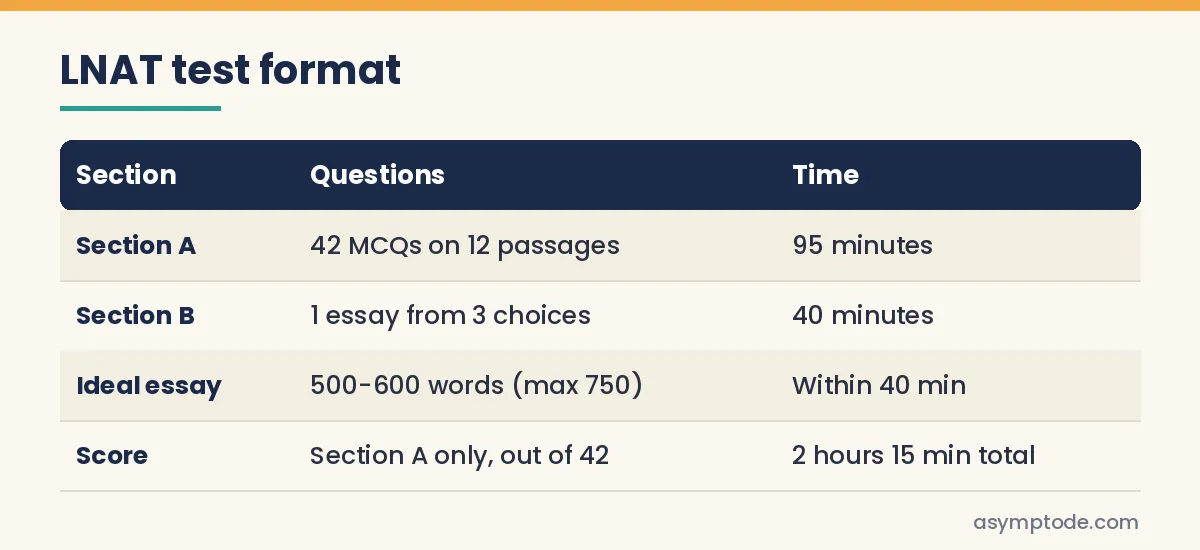 The two sections of the LNAT.
Section A has 42 multiple-choice questions on 12 passages, with 95 minutes to answer them.
Section B is one essay chosen from three questions, in 40 minutes. The ideal essay is 500-600 words, with a recommended maximum of 750.
The whole test lasts 2 hours 15 minutes. Only Section A gives your score out of 42.
The test format page adds that you cannot return to Section A once Section B starts. Essay topics are broad, such as whether the law should require people to vote (sample essays). The essay screen has a word count but no spell check.
How is the LNAT scored?
Your LNAT score is your number of correct answers in Section A, out of 42. Wrong answers lose nothing, so never leave a blank. The essay is not scored by the test centre, but universities read it. There is no pass mark (LNAT FAQs).
Each university uses it differently. Cambridge uses it to help decide who to interview; Oxford uses it for shortlisting and final decisions. UCL sets a yearly benchmark score and says the essay "carries considerable weight".
What is a good LNAT score?
There is no official "good score". UCL published that in 2025/26 the average score it received was 23, and the average for applicants given an offer was 30. It adds that no score guarantees an offer.
When do I get my LNAT results?
Universities see results first: from 21 October for early tests, then within 24 hours of your test (LNAT results). You get yours by email: in mid-February if you sit on or before 26 January, or mid-August if later. No exact dates are given.
Can I retake the LNAT?
No. You can sit it only once per application cycle; a second sitting is cancelled and void. Results do not carry over, so if you reapply next year, you sit it again (when do I take the LNAT?).
What about access arrangements?
If you need extra time (for example, for dyslexia) or a reader recorder, register online but do not book online. First send the Examination Access Requirements form with evidence. Extra time can be approved in a few days; a reader recorder takes at least three weeks.
Want a reading and essay routine built around your deadline? Book a free demo class with an Asymptode mentor, or see our plans and fees.
How should I prepare for the LNAT?
LNAT says there are no facts to learn, but you should practise. Start with the free tools on the How to prepare page: online practice tests, a tutorial of the real screen, and a preparation guide.
How do I plan by weeks left?
| Weeks left | What to do |
|---|---|
| 8 or more | Read one quality newspaper comment piece a day; find the conclusion and reasons. Try the tutorial and one untimed practice test. |
| 6-7 | Do 3-4 timed passages a week. Log why each wrong answer was wrong. Write one essay a week. |
| 4-5 | Do a full timed Section A. Write two 40-minute essays a week on a computer, 500-600 words. |
| 2-3 | Do the second practice test. Practise choosing an essay question in 2 minutes. Book and check your ID. |
| Final week | Light review of your mistake log. Plan your route to the centre. |
What are the most common LNAT mistakes?
- Using outside knowledge. LNAT's hints and tips say the answer is always in the passage.
- Picking the "almost right" option. Compare the last two choices word by word.
- Leaving blanks. Eliminate, then guess.
- Sitting on the fence. Pick a side in the essay and defend it.
- Writing too much. A very long essay is a disadvantage. Cut repetition.
Worked example: an LNAT-style reasoning question
We wrote this example ourselves. Real LNAT passages are longer.
Passage: "Last year, the council put speed cameras on the high street. Since then, there have been fewer accidents there. So speed cameras make roads safer, and the council should put them on every road."
Which of these, if true, most weakens the argument? A) Many drivers dislike speed cameras. B) The high street was also resurfaced and given new street lights last year. C) Speed cameras are expensive. D) Accidents also fell on high streets with cameras in nearby towns.
 Solving the speed-camera question step by step.
The claim is that cameras make roads safer. The evidence is that accidents fell after the cameras went in.
The gap: something else might have caused the fall. Test each option against that gap.
Option B says the road was resurfaced and lit in the same year. That is another cause, so B weakens the argument.
Answer: B. A is about feelings, C is about cost, and D supports the argument. Only B gives another reason for fewer accidents.
How should I structure the LNAT essay?
Plan for 5-8 minutes, write for 25-30, and check for the last 3-5.
- Introduction: define the key word in the question and state your answer.
- Point 1: your strongest reason, with an example.
- Point 2: a second reason, or a limit on your answer.
- Counter-argument: the best point against you, and why your answer still stands.
- Conclusion: restate your answer and what follows from it.
LNAT says you may state assumptions instead of quoting data, and need not give your personal view.
Aiming for Oxbridge? Read how to get into Oxford and how to get into Cambridge. Students weighing Indian options can compare CLAT vs AILET.
How 1-on-1 tutoring helps with LNAT preparation
Asymptode is a maths and science tutoring company. We do not teach law, and the LNAT Consortium says it does not recommend paid coaching or endorse any prep materials. We promise no score. A mentor helps you build the habits the free official materials ask for.
- One dedicated mentor, live online 1-on-1: the same person each week, planning around your own LNAT deadline and school timetable.
- Method-first reading practice: the mentor watches how you break down each argument (claim, evidence, gap) on official practice passages and shows where your reasoning slipped.
- Timed planning and essay feedback: you write 40-minute essays and get feedback on structure, clarity and length, plus personalised homework with feedback.
- Parents stay informed: short parent updates, and every class is recorded. Start with a free demo class.
Facts checked against official sources on 5 November 2026.
FAQ
What is the LNAT used for?
The LNAT helps universities choose students for undergraduate law. It tests reading, reasoning and argument, not legal knowledge. Universities use it with your UCAS form, grades and sometimes an interview.
When is the LNAT 2027 deadline?
It depends on the university. Oxford and Cambridge applicants had to sit by 15 October 2026. KCL, LSE and UCL need it by 31 December 2026, Bristol and Durham by 13 January 2027, and the others by 25 January 2027.
How much does the LNAT cost for international students?
The fee depends on the test centre, not your nationality. It is £75 at UK and EU centres and £120 outside the EU, charged in pounds. Check the official payment page before booking.
Can I take the LNAT online at home?
No. You must sit it at a Pearson VUE test centre. There are over 500 worldwide, including 150 in the UK.
Is there a pass mark for the LNAT?
No. You get a score out of 42 from Section A. Each university decides how to use your score and essay.
Can I sit the LNAT twice?
No, only once per application cycle. A second sitting is cancelled and its result is void. If you reapply the next year, you take it again.
Ready to start? Book a free demo class and advisor call, or see our plans and fees.
Sources
- LNAT: Dates and deadlines
- LNAT: What is LNAT?
- LNAT: Test format
- LNAT: Results
- LNAT: Paying for your test
- LNAT: Bursaries
- LNAT: Exam access requirements
- LNAT: Test centres
- LNAT: Identification
- LNAT: FAQs
- LNAT: Hints and tips
- UCAS: Dates and deadlines
- University of Cambridge: LNAT
- University of Oxford Faculty of Law: BA Jurisprudence
- UCL Laws: Applying and entry requirements
- LSE: Entry requirements
- King's College London: Law LLB entry requirements
- University of Bristol: LNAT for law courses
- Durham University: LNAT
- University of Glasgow: LNAT
- SOAS: LLB
- Pearson VUE: Aadhaar ID policy