
If you want to know how to get into McGill, start with one fact: McGill decides most first-year offers on grades and prerequisite courses, judged against your own school system. This guide shows families in Canada, the U.S., India, the UK, IB schools and beyond what McGill checks, the Fall 2027 deadlines, the costs, and a plan that starts in Grade 9 or 10.
Key takeaways
- You apply in the McGill Applicant Portal from 1 October. The fee is $140.16 CAD, and a second program choice is free.
- Fall 2027 deadlines depend on where you study: 15 January 2027 (U.S. and outside Canada), 1 February 2027 (Canada outside Quebec), 1 March 2027 (Quebec CEGEP).
- For most programs, there are no essays. McGill looks at your marks and prerequisites. Extra documents count only for some programs.
- SAT and ACT scores are optional for U.S.-system applicants for Fall 2027.
- Major Entrance Scholarships need their own application, due about a week after the admission deadline.
How to get into McGill: what matters most?
Quick answer: To get into McGill, pick a program, check the requirements for your curriculum, and apply in the McGill Applicant Portal before your deadline. McGill mainly looks at your grades and your prerequisite courses, such as math, chemistry and physics for Engineering. Send all documents early, and apply for scholarships on time.
McGill says grades at or above past levels "do not guarantee admission". It also reviews your full record, including failed or repeated courses. So steady marks from Grade 10 onward matter more than a late push.
For most programs, McGill does not read a personal essay. Extra documents count only for some programs, such as Music, Nursing, Education and Global Engineering. For other programs, McGill says extra documents should not be sent. Check the How to apply page for the full list.
What programs and faculties can you apply to?
McGill offers more than 300 undergraduate programs. The standard dates cover Agricultural and Environmental Sciences, Architecture, Arts, the joint B.A. & Sc., Education, Engineering, Management, Nursing, Occupational Therapy, Physical Therapy and Science. Music, Dentistry, Law and Medicine run their own schedules. Use the program finder to see each program's page.
How do you apply to McGill?
McGill uses its own application, not a shared system. You apply in the McGill Applicant Portal. (Minerva is McGill's student system. You use it later, after an offer, for things like the Entrance Bursary.)
 The McGill application in four steps.
First, you pick a program and check its requirements. Second, you apply in the McGill Applicant Portal and pay the fee. Third, you self-report your grades or upload your documents. Fourth, you send the scholarship application and track your decision in the portal.
Key details:
- Apply online from 1 October. The fee is $140.16 CAD, non-refundable, paid by credit card (a parent's card is fine).
- Add a second choice if you want. A second application for the same term is free. Each one after that costs $140.16 CAD.
- Check your checklist. Log in often to see what is missing. Your school system's rules are on the entrance requirements page.
One warning: you cannot change your program choice after you submit. If you picked the wrong one, you must start a new application. The step-by-step guide walks through each screen.
What are the McGill deadlines for Fall 2027?
Your deadline depends on where you go to school, not your citizenship.
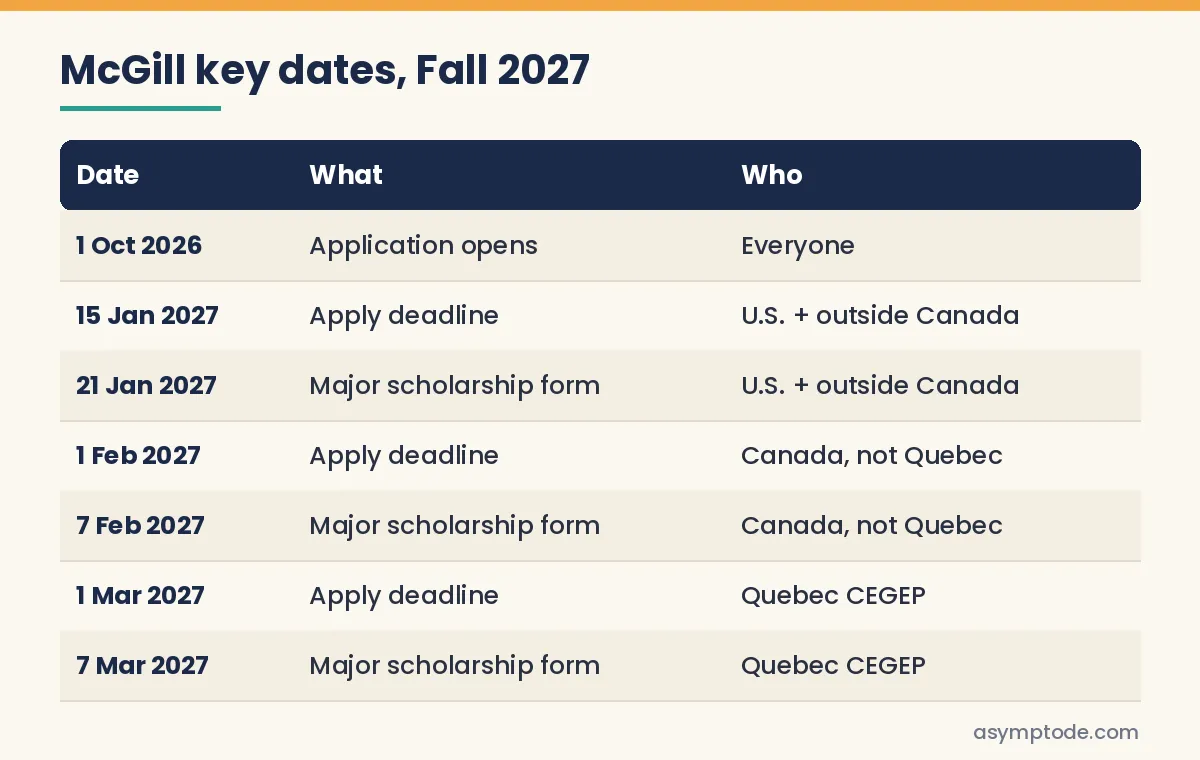 McGill key dates for Fall 2027 entry.
Applications open on 1 October 2026. U.S. and international high school students apply by 15 January 2027 and send the scholarship form by 21 January 2027. Students in Canada outside Quebec apply by 1 February 2027, with scholarships due 7 February 2027. Quebec CEGEP students apply by 1 March 2027, with scholarships due 7 March 2027.
| Where you study | Apply by | Documents by | Major scholarship by |
|---|---|---|---|
| U.S. high school or outside Canada | 15 January 2027 | 1 March 2027 | 21 January 2027 |
| Ontario | 1 February 2027 | 4 May 2027 | 7 February 2027 |
| Other Canadian provinces | 1 February 2027 | 4 May 2027 | 7 February 2027 |
| Quebec CEGEP | 1 March 2027 | 15 April 2027 | 7 March 2027 |
| Music (all groups) | 15 January 2027 | 15 January 2027 | Same as your group |
U.S. schools self-report grades from 15 November 2026 to 1 March 2027. Canadian provinces have their own windows. Apply for financial aid within 30 days of acceptance.
McGill's decision dates page gives estimates: mid-November to mid-May for international students, mid-November to end of April for U.S. students, and mid-February to end of May for Ontario. Offers go to the most competitive applicants first.
What does McGill look at for your curriculum?
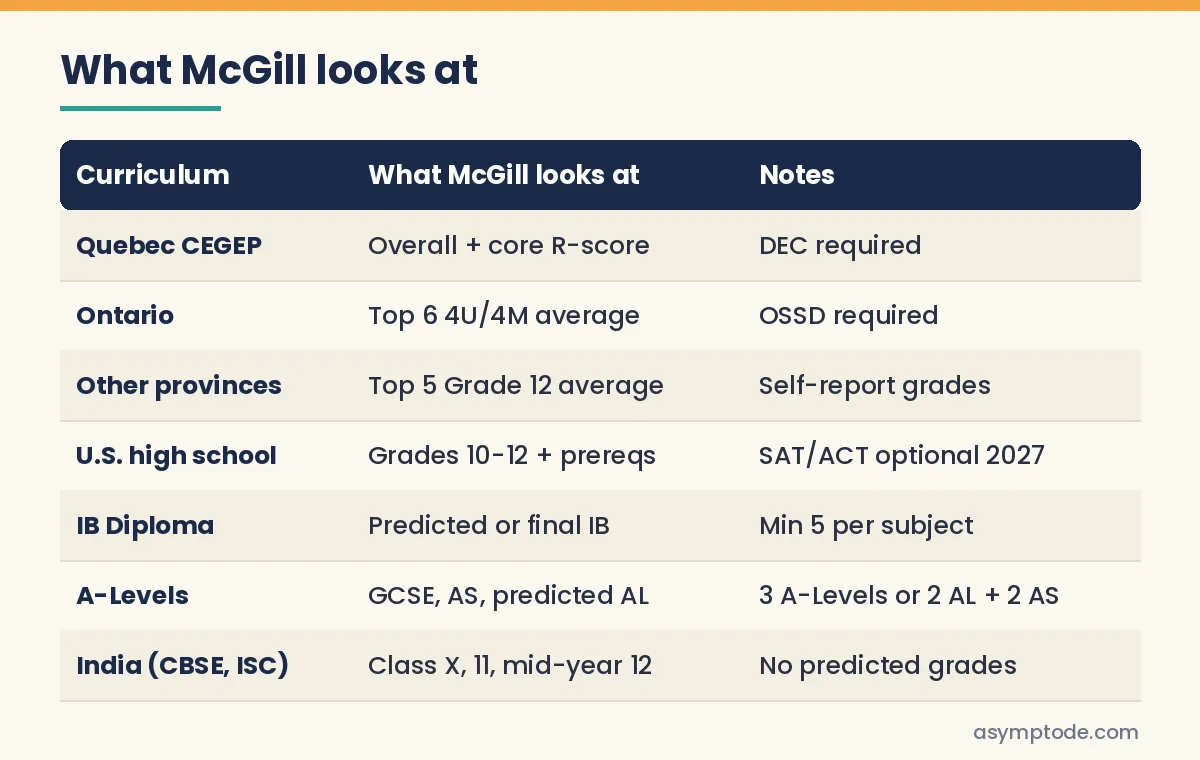 What McGill looks at, by curriculum.
For Quebec CEGEP, McGill uses your overall R-score and a core R-score, and a DEC is required. Ontario uses a "Top 6" 4U/4M average and needs an OSSD. Other provinces use a "Top 5" Grade 12 average, with self-reported grades. U.S. schools are judged on Grades 10 to 12, with the SAT or ACT optional for Fall 2027. For most programs, IB students are expected to have at least 5 in each subject. A-Level students are judged on (I)GCSEs, AS results and predicted A-Levels, and need three A-Levels, or two A-Levels plus two AS. Indian board students (for example CBSE or ISC) are judged on Class X, Class 11 and mid-year Class 12.
How does the R-score work for Quebec CEGEP students?
The R-score is McGill's main measure for CEGEP students. McGill checks your overall R-score and a core average of prerequisites: biology 101, math 201, chemistry 202 and physics 203 for Science, or math 201, chemistry 202 and physics 203 for Engineering. A Quebec Secondary V diploma alone does not give direct entry. See the Quebec page.
What about Ontario and other Canadian provinces?
Ontario uses a "Top 6" average and other provinces a "Top 5" Grade 12 average. Your prerequisites are part of that average. Both groups self-report grades and hear in two rounds. If you take IB or AP at a Canadian school, McGill still reviews your provincial marks, and IB or AP results may earn advanced standing credits later. Our guides on how to get into the University of Toronto and how to get into Waterloo cover similar Ontario courses.
Do U.S. applicants need the SAT or ACT?
No, not for Fall 2027. Applicants to Science, Engineering, Arts, Management and other listed programs can opt out. McGill says opting out "will not otherwise disadvantage you", though it may delay your decision. If you choose to send scores, they must arrive, or your file is cancelled. McGill takes your best SAT section scores, and the ACT composite plus English, Math and Reading. Codes are SAT 0935-00 and ACT 5231. See the U.S. page and our SAT vs ACT guide.
What about IB, A-Level and Indian board students?
- IB: McGill uses your school record and predicted IB grades. For math prerequisites, it accepts HL or SL Math AA, or HL Math AI, but not SL Math AI for most programs. See the IB page and our IB Diploma guide.
- A-Levels: Maths and Further Maths count as one subject, not two. See the A-Level page and our A-Level Maths guide.
- India: You upload Class X board results plus Class 11 and mid-year Class 12 marks, in numbers. See the India page and our CBSE board exams guide.
What are the prerequisites for Science and Engineering?
| Curriculum | Engineering | Science |
|---|---|---|
| Ontario | 4U English or French, Calculus and Vectors, Physics, Chemistry | 4U English or French, Calculus and Vectors, two of Biology, Chemistry, Physics |
| Other provinces | Grade 12 English or French, math (precalculus or calculus), Physics, Chemistry | Grade 12 English or French, math, two of Biology, Chemistry, Physics |
| U.S. | Pre-calculus, chemistry, physics | Pre-calculus, two of biology, chemistry, physics |
| IB | Math, Chemistry, Physics; at least one math or science at HL | Math plus two of Biology, Chemistry, Physics; at least one at HL |
| A-Levels | At least two of A-Level Math, Chemistry, Physics; all three at GCSE | A-Level Math plus one of Biology, Chemistry, Physics; all four at GCSE |
| India | Math, chemistry and physics in Class 11 and 12 | Math plus two of biology, chemistry, physics in Class 11 and 12 |
Quebec CEGEP students need the math, chemistry and physics courses on the Quebec page. For Canadian applicants, math and science prerequisites must normally be from the last five years.
What grades are needed? Admission is competitive; see the program page. McGill lists past ranges as guidelines only, and they change every year.
Do you need an English test for McGill?
Maybe. You do not need one if you lived and went to school for at least four years in a row in a country on McGill's list. That list includes Canada, the U.S., the UK, Australia, Ireland and Singapore. India is not on the list. Some school results also count, such as IB Group 1 English with a 5 or better, or A-Level English with a C or better.
| Test | McGill minimum (most programs) |
|---|---|
| IELTS Academic | 6.5 overall, 6.0 in each part |
| TOEFL (6-point scale, tests from 21 Jan 2026) | 4.5, with Reading, Listening, Writing 4.5 and Speaking 4.0 |
| TOEFL (120-point scale, older tests) | 90, with 21 in each part |
| Duolingo English Test | 125 (130 for B.Com. and B.Ed. TESL) |
| PTE Academic | 65 overall, 60 in each part |
| CAEL | 70 overall, 60 in each part |
Management and B.Ed. TESL need a higher TOEFL score. Results must come straight from the test body, and McGill does not use TOEFL MyBest scores. See the English proficiency page.
How much does McGill cost?
Tuition depends on residency and program. These are McGill's official 2026-27 figures for students who started in Fall 2026, for a typical 30-credit year. Rates for Fall 2027 entry are not yet published, so check the fee calculator again later.
| Student type (2026-27) | B.Sc. tuition | B.Sc. total fees | B.Eng. tuition | B.Eng. total fees |
|---|---|---|---|---|
| Quebec resident | $3,117.60 | $5,693.44 | $3,117.60 | $6,200.52 |
| Canadian, non-Quebec | $12,985.50 | $15,561.34 | $15,748.80 | $18,831.72 |
| International | $64,785.90 | $68,378.74 | $65,167.50 | $69,267.42 |
All amounts are in CAD and leave out housing and food. To accept an offer, you pay a non-refundable deposit that goes toward your fees: $500 CAD for Canadian citizens and permanent residents, or $1,000 CAD for international students.
What entrance scholarships does McGill offer?
McGill has two main types of central entrance scholarships:
- One-year scholarship of $3,000. You are considered automatically if you meet the minimum marks. There is no separate form.
- Major Entrance Scholarships. These are worth $3,000, $5,000, $10,000 or $12,000 a year. They can be renewed for up to four years, for a total of $12,000 to $48,000. The $12,000 award is only for Canadian citizens and permanent residents.
Major scholarships need their own application in the Applicant Portal, open from 1 October. You list three years of activities, write a general essay, and write a one-page letter about yourself in the third person. Two referees (one academic, one for an activity) send letters. Grades come first, then leadership. Finalists may be interviewed. See the entrance scholarships page.
McGill also offers need-based entrance aid, open to all new first-year students whatever their citizenship.
What do international students need: CAQ and study permit?
International degree students need a valid passport, a Quebec Acceptance Certificate (CAQ), a study permit, and a visa or eTA if their country requires one. U.S. citizens and permanent residents do not need an eTA or visa.
- Get your official offer letter. Start immigration steps only after this.
- Apply for your CAQ. McGill lists processing at 5 to 8 weeks. In Quebec, the CAQ also acts as your Provincial Attestation Letter (PAL).
- Apply for your study permit. You need a valid CAQ first. You apply through your IRCC account. U.S. citizens and permanent residents can apply at the border.
- Book travel only after approval. Wait for your CAQ, your letter of introduction and any visa. McGill does not recommend arriving more than 4 to 6 weeks before term.
Read the immigration documents page for full guides.
What is a good McGill timeline from Grade 9 or 10?
 A simple McGill timeline from Grade 10 to arrival.
In Grade 10, build marks and choose your math and science path. In Grade 11, finish prerequisites and plan any English test. Applications open on 1 October of Grade 12, and deadlines run from January to March. Decisions come between November and May, then international students get a CAQ and study permit before arriving in late summer.
- Grade 9: Pick the course stream that leads to Grade 12 calculus or pre-calculus. In Ontario, see our Grade 9 math guide.
- Grade 10: U.S.-system grades count from Grade 10. Choose sciences that match your target program.
- Grade 11: Grade 11 marks count in IB, A-Level and Indian applications. Book the SAT, ACT or an English test if you need one.
- Summer before Grade 12: Shortlist programs, draft your activities list, and ask two referees for scholarship letters.
- After an offer: Pay the deposit, apply for aid within 30 days, and start the CAQ if you are international.
What mistakes should you avoid?
- Missing a prerequisite. For example, SL Math AI in the IB does not count for Science or Engineering.
- Using the wrong deadline. A U.S.-curriculum school abroad follows the 15 January deadline for schools outside Canada and the U.S.
- Missing the scholarship deadline. It comes about a week after the admission deadline and does not move.
- Sending extra documents nobody asked for. For most programs, McGill does not consider them.
- Errors in self-reported grades. McGill checks them against official results and can revoke an offer.
- Sending documents late. When space is tight, McGill may favour complete files that arrived early.
Want help with the math and science side? Book a free demo class with an Asymptode mentor, or see our plans and fees.
How 1-on-1 tutoring helps with getting into McGill
For Science and Engineering, McGill offers rest on math and science marks. Here is how Asymptode helps:
- One dedicated mentor, live online 1-on-1. The mentor follows your child's own syllabus (CEGEP, Ontario 4U, AP, IB, A-Level or CBSE) and their exam dates.
- Method first. The mentor watches each step of the working in calculus, chemistry and physics, fixing gaps before they hurt prerequisite marks.
- Personalised homework with feedback, and short parent updates. Every class is recorded, so your child can review before a test.
- Planning help. For things outside math and science, like scholarship essays or English tests, the mentor helps with planning and study method. Start with a free demo class.
Facts checked against official sources on 2 November 2026.
FAQ
Does McGill use the Common App or OUAC?
No. McGill uses its own online application in the McGill Applicant Portal. It opens on 1 October, and the fee is $140.16 CAD. Your second program application for the same term is free.
What is the McGill application deadline for Fall 2027?
It depends on where you study. Students at U.S. high schools or schools outside Canada apply by 15 January 2027. Students elsewhere in Canada apply by 1 February 2027, and Quebec CEGEP students apply by 1 March 2027. Music applicants in all groups apply by 15 January.
Does McGill require essays or reference letters?
For most programs, no. McGill decides mainly on grades and prerequisites. Some programs, such as Music and Nursing, need extra documents, and the Major Entrance Scholarship form asks for an essay and two references.
Is the SAT required for McGill?
No, not for Fall 2027. Applicants from U.S.-system schools can opt out of sending SAT or ACT scores for listed programs, including Science and Engineering. If you choose to send scores, they must arrive, or your application is cancelled.
What grades do you need to get into McGill?
McGill does not set one fixed cut-off. Admission is competitive and changes every year. Each curriculum page lists ranges admitted in past years as a guide only. For the IB, McGill says a 5 or better in each subject is the minimum expected for most programs.
Do I need to speak French to study at McGill?
No, not for most programs. McGill says French is not a general admission or graduation requirement. A few programs, such as Nursing, Medicine, Dentistry, Dietetics and Law, require French or take it into account.
Ready to start? Book a free demo class and advisor call, or see our plans and fees.
Sources
- McGill: How to apply
- McGill: Entrance requirements
- McGill: Quebec CEGEP applicants
- McGill: Ontario high school applicants
- McGill: Canadian high school applicants (outside Quebec and Ontario)
- McGill: U.S. high school applicants
- McGill: International Baccalaureate
- McGill: A-Levels, AS and CAPE
- McGill: India Senior School Certificate
- McGill: Proof of English proficiency
- McGill: Admission decision dates
- McGill Important Dates: Fall 2027 application deadline (U.S. and overseas)
- McGill Student Accounts: Undergraduate fees
- McGill: Entrance scholarships
- McGill: Entrance scholarship application instructions
- McGill International Student Services: Immigration documents
- McGill: Important updates (deposits, French, CAQ)