

Key takeaways
- Grade 9 maths in Ontario has five strands.
- The EQAO Grade 9 maths test is online and done at school.
- It has 54 questions. 50 count towards the result and 4 are field-test questions.
- The result counts towards your child's final course mark.
- Check EQAO for the dates your school uses.
What does Grade 9 maths cover in Ontario?
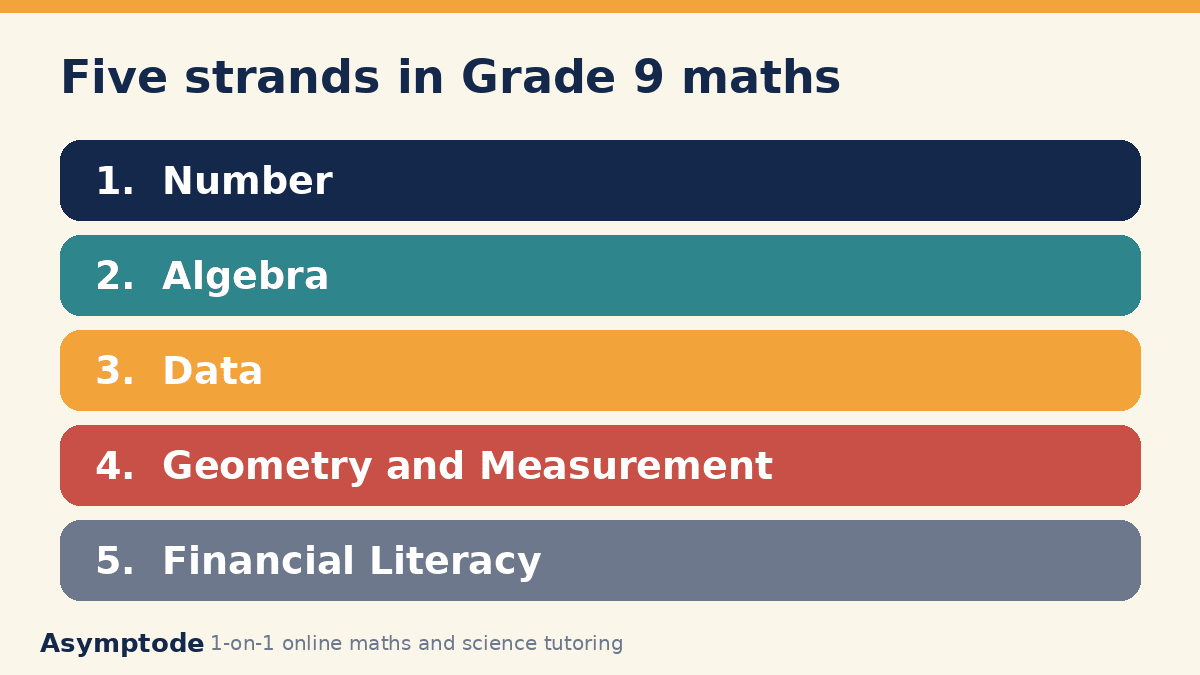
Quick answer: The EQAO Grade 9 maths assessment covers five strands: Number, Algebra, Data, Geometry and Measurement, and Financial Literacy. These are the areas to practise.
Grade 9 is a big step. Algebra gets much harder, and the work is more abstract. Many students who did well in Grade 8 feel lost in October. That is normal. It is also fixable.
What is the EQAO Grade 9 maths test?
EQAO is Ontario's testing agency. It runs the Grade 9 Assessment of Mathematics. Here are the facts from EQAO's own page.
- It is online and done at school.
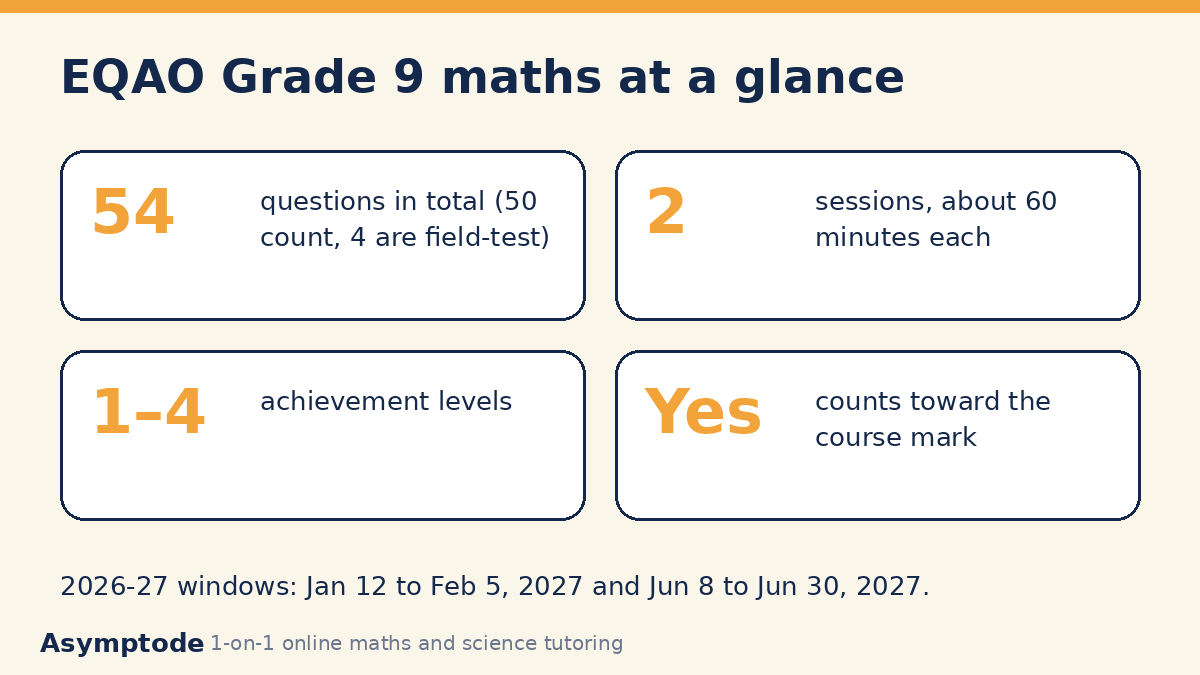
- It has two sessions, A and B. Each is designed to take about 60 minutes.
- It has 54 questions. 50 are operational and decide the result. 4 are field-test questions.
- It is adaptive. The questions change based on how your child answers.
- Question types include single-selection, multiple-selection, drag and drop, and drop-down menus.
- Results are shown on a scale of levels 1 to 4. Each student gets an individual report.
- The result is included in the final course mark.
For 2026-27, EQAO lists two windows. The winter window runs from January 12 to February 5, 2027. The spring window runs from June 8 to June 30, 2027. Your school picks which one to use. Ask the school, and check EQAO for any change.
What is the hardest part of Grade 9 maths?
For most students, it is algebra. In earlier grades, numbers do the work. In Grade 9, letters stand for numbers, and rules matter.
Here is a typical skill: simplify an expression.
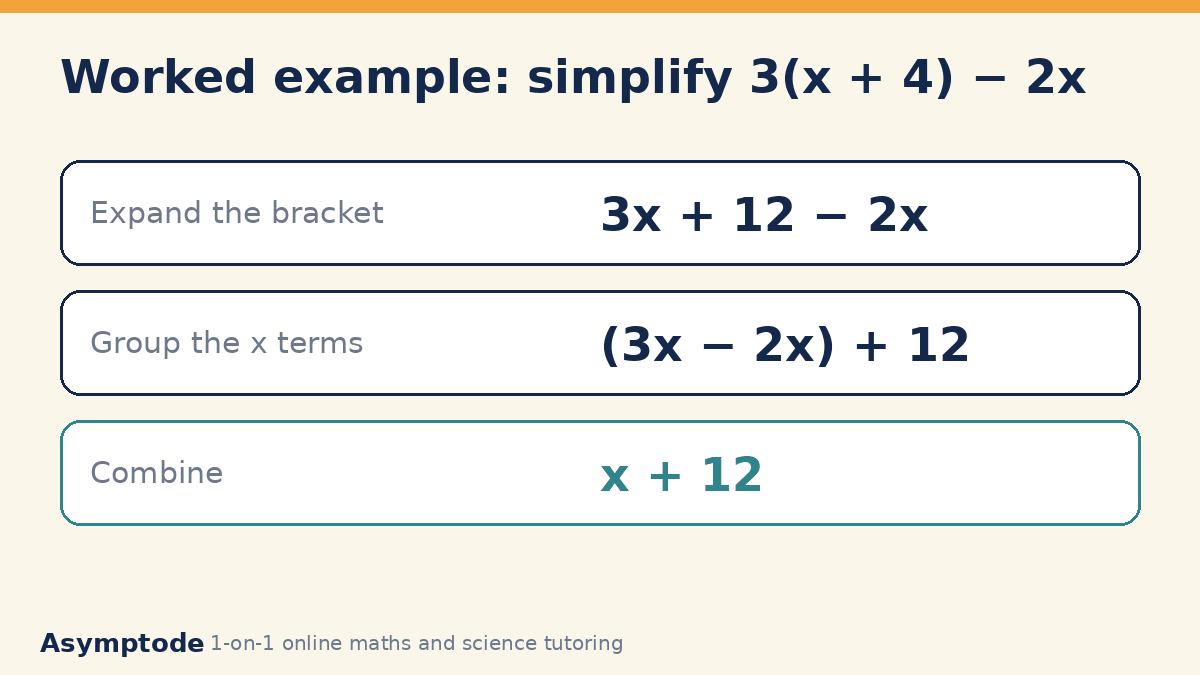
- Expand the bracket: 3(x + 4) = 3x + 12.
- Write the full expression: 3x + 12 − 2x.
- Group the x terms: (3x − 2x) + 12.
- Combine: x + 12.
If your child struggles with this, they may need to firm up earlier ideas. Our guide to understanding variables shows the basics.
How do you draw a line from an equation?
Graphing lines is another common skill. The equation y = 2x + 1 says: start at 1, then go up 2 for every 1 step to the right.
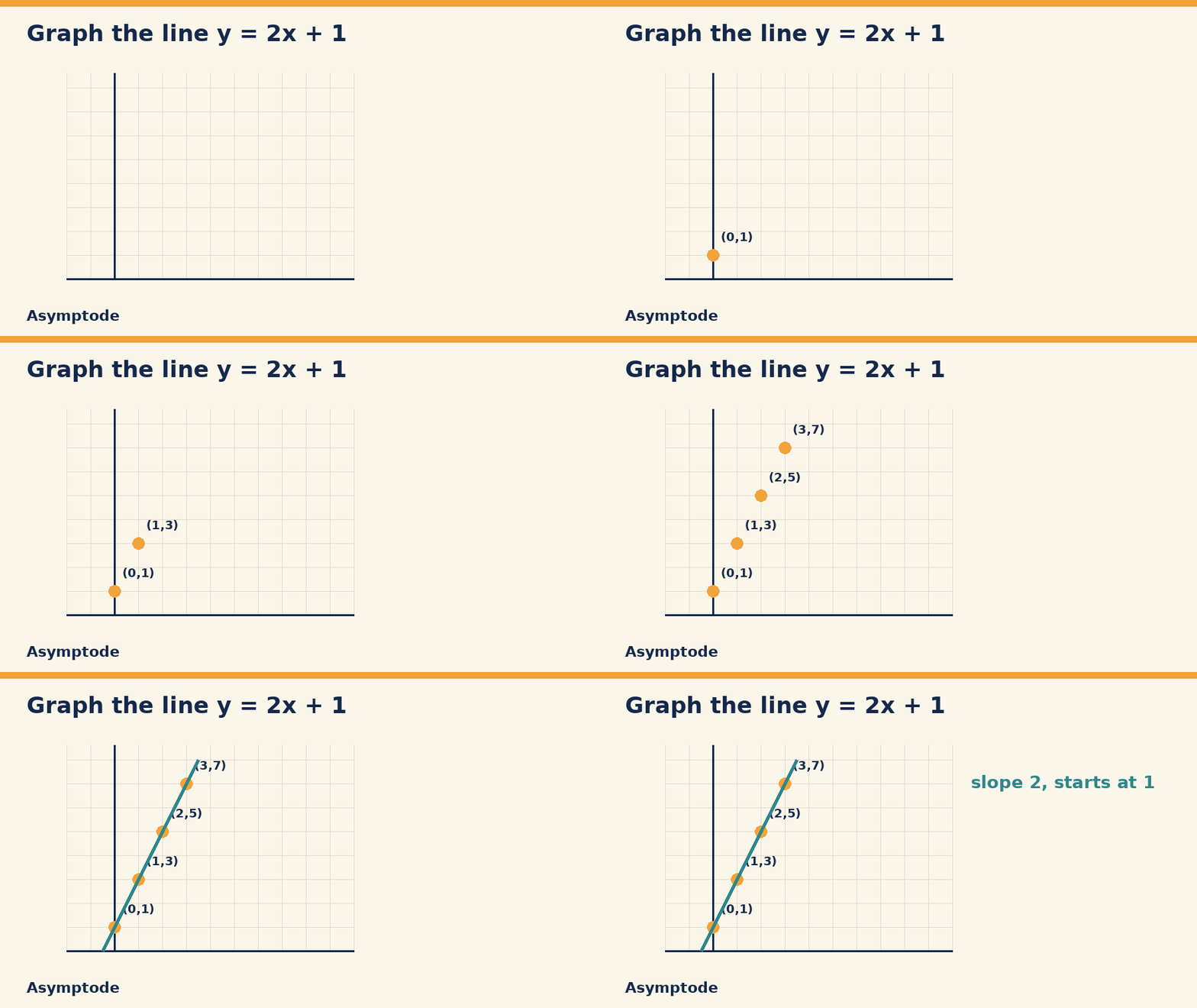
- Pick x values: 0, 1, 2, 3.
- Work out y for each one: 1, 3, 5, 7.
- Plot the points (0, 1), (1, 3), (2, 5) and (3, 7).
- Join the points with a straight line.
The number 2 is the slope. The number 1 is where the line crosses the y-axis. Once your child sees this, many graph questions get easier.
How can parents help at home?
You do not need to be a maths expert. Small habits help most.
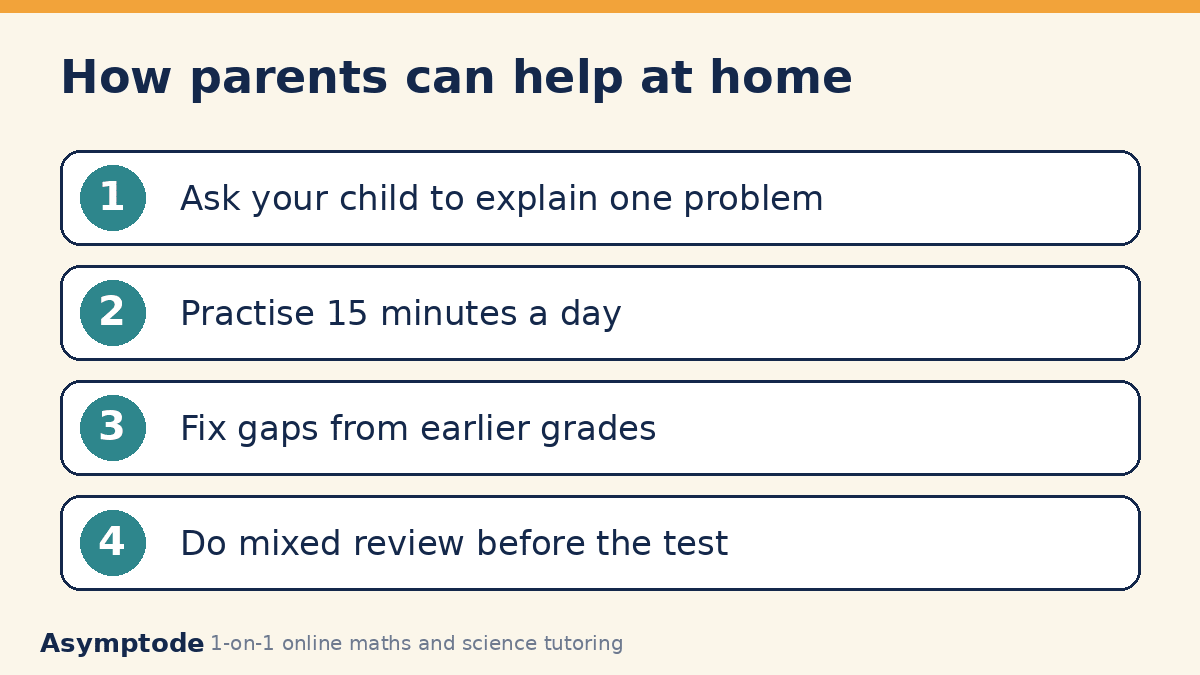
- Ask your child to explain one problem. If they can teach it, they know it.
- Practise for 15 minutes a day. It beats one long session.
- Fix gaps from earlier grades. Fractions, ratios and negative numbers matter.
- Do mixed review before the test, so topics are not seen one at a time only.
- Ask the teacher which topics are weak and what the test date is.
Financial Literacy is often the easiest strand to connect to real life. Talk about prices, discounts and simple budgets at home.
When is 1-on-1 tutoring a good idea?
Think about a tutor if your child avoids maths homework, if marks drop in Grade 9, or if one topic keeps coming back as a problem.
At Asymptode, sessions are live, online and 1-on-1. Your child gets personalised homework with feedback. Parents can see progress. We never promise a mark. We help your child understand the steps.
Have a question? Talk to an advisor or see our fees. You can also read how to choose an online maths tutor.
How does Grade 9 differ from Grade 8?
The jump is real. In Grade 8, many questions use numbers you can see. In Grade 9, letters stand for unknown numbers. Questions also ask for explanations, not only answers.
Here are the biggest changes:
- More algebra. Students simplify, solve and graph.
- More reasoning. They must show and explain steps.
- Faster pace. There are more topics in less time.
- Weak basics show up. Fractions, integers and ratios are used everywhere.
If a child had a shaky Grade 8, Grade 9 can feel like a wall. The answer is to repair the base, not to push harder on top of it.
What does Financial Literacy look like?
Financial Literacy is one of the five strands. It uses real-life money ideas. Here is a simple example. A jacket costs $80. It is 25% off. What is the sale price?
- 25% off means the student pays 75%.
- 75% as a decimal is 0.75.
- $80 × 0.75 = $60.
The sale price is $60. Talk about sales, tips and budgets when you shop with your child. Real examples make this strand much easier.
How should students practise for each strand?
A simple plan helps. Aim for a little practice every day.
- Number: work with integers, fractions, ratios and percentages. Do a few mental-maths questions each day.
- Algebra: simplify expressions, solve equations and graph lines. This strand needs the most practice.
- Data: read tables and graphs, find the mean, median and mode, and explain what the data shows.
- Geometry and Measurement: work with area, perimeter, volume and angles. Draw a diagram every time.
- Financial Literacy: do short money problems about prices, discounts and budgets.
Because the EQAO test uses different question types, such as drag and drop and drop-down menus, students should also practise reading carefully on a screen. Ask your child's teacher whether the school offers sample questions.
What are signs your child needs extra support?
- Marks fall after the first few weeks of Grade 9.
- Your child can follow the teacher but cannot do homework alone.
- They make the same algebra errors again and again.
- They avoid maths or say "I am just bad at it".
- They finish homework fast but get many answers wrong.
None of this means your child is "bad at maths". It usually means one or two ideas are missing. Find them early and the rest becomes easier. Talk to the teacher first, then decide if extra 1-on-1 help makes sense.
What should students do on test day?
- Sleep well and eat breakfast.
- Read each question slowly. Look at every part of the screen.
- Do not spend too long on one question. Move on and come back if the system allows it.
- Use any rough paper the school allows to work out steps.
- Check units, signs and the question wording before answering.
Remind your child that the test is one part of the course mark. A calm mind helps more than last-minute cramming.
FAQ
What is the EQAO Grade 9 maths test?
It is Ontario's online Grade 9 Assessment of Mathematics, done at school. It has 54 questions across two sessions.
How long does the EQAO Grade 9 maths test take?
There are two sessions. Each is designed to take about 60 minutes.
Does the EQAO result count towards my child's mark?
Yes. EQAO says the result is included in the student's final course mark.
What topics are on the test?
Number, Algebra, Data, Geometry and Measurement, and Financial Literacy.
When is the test?
For 2026-27, EQAO lists January 12 to February 5, 2027, and June 8 to June 30, 2027. Ask your school which window it uses.
Can a tutor help with Grade 9 maths?
Yes. A tutor can find gaps, explain algebra in small steps and give feedback on practice. No tutor can guarantee a level.