
If you want to know how to get into IISc, the short version is this: pick one of its two undergraduate programmes, write the right entrance exam, and then apply or register on time. The Indian Institute of Science (IISc) in Bangalore takes undergraduates into a 4-year BS (Research) or a 4-year B.Tech. Each route has its own exam, portal and calendar. This guide covers the 2026-27 cycle and what is known about 2027.
Key takeaways
- IISc has two UG routes: the 4-year BS (Research) and the 4-year B.Tech (4 programmes from 2026-27).
- BS (Research) takes students through JEE Advanced or the IISER Aptitude Test (IAT). You must also fill a separate IISc application.
- B.Tech is only through JoSAA, using your JEE Advanced rank. There is no separate IISc form.
- For students joining in 2026-27, yearly fees are Rs 85,800 (BS) and Rs 2,05,800 (B.Tech) for General/EWS/OBC. SC/ST/PwD students pay Rs 5,800.
- No 2027-28 notice is out yet. Based on 2026, expect the notice in early February and the BS portal around May to early June.
How to get into IISc as an undergraduate?
Quick answer: To get into IISc for a bachelor's degree, take JEE Advanced or the IAT for the BS (Research), and apply on the IISc portal with your rank. For the B.Tech, take JEE Advanced and choose IISc during JoSAA counselling. You need Physics, Chemistry and Maths in Class 12. For the BS, you also need at least 60%.
IISc publishes one admission notice for all its programmes. The UG part is on pages 9 and 10.
There is no NEET-UG route and no MBBS at IISc. KVPY is not mentioned.
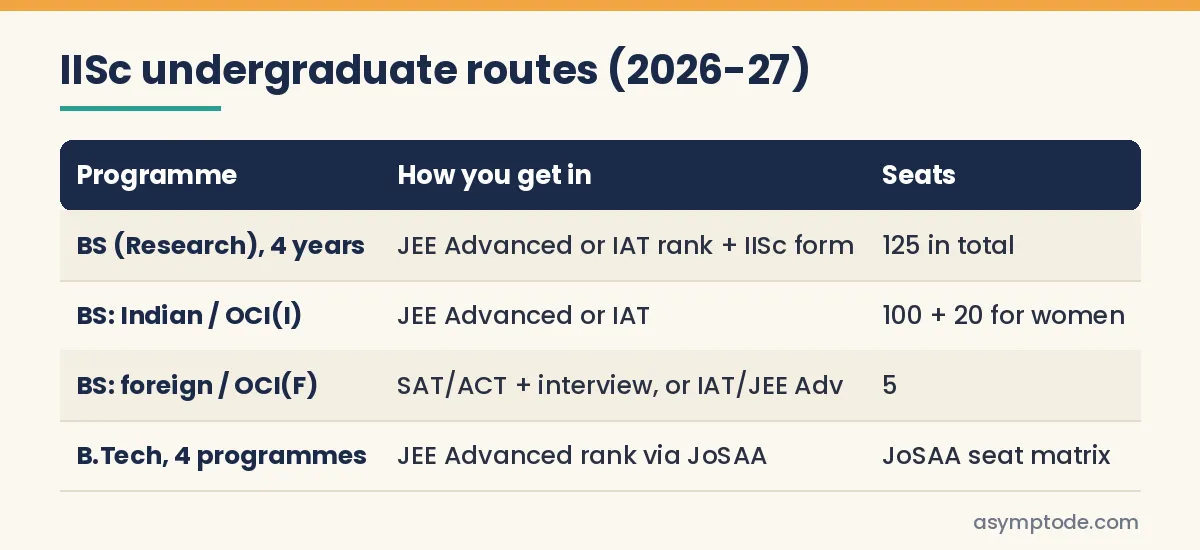 The three ways into an IISc undergraduate programme.
The table shows the three routes. BS (Research) takes Indian students through JEE Advanced or the IAT. Foreign nationals can also enter the BS through the SAT or ACT. B.Tech admission is only through JoSAA, with a JEE Advanced rank.
What undergraduate programmes does IISc offer?
Here is how the two programmes compare.
| BS (Research) | B.Tech | |
|---|---|---|
| Length | 4 years, 8 semesters | 4 years, 8 semesters |
| Entry exam | JEE Advanced or IAT | JEE Advanced only |
| How you apply | IISc portal (separate form) | JoSAA portal only |
| Choices | 5 majors, chosen in semester 4 | 4 programmes, chosen at entry |
| Intake | 125 seats in total | Not stated on IISc pages |
| Yearly fee (2026-27 joiners, General) | Rs 85,800 | Rs 2,05,800 |
What is the BS (Research) at IISc?
The first three semesters are a common course. You study physics, chemistry, maths, biology, engineering and humanities. In semester 4 you pick your major for semesters 4 to 8.
The majors are Biology, Chemistry, Earth & Environmental Science, Mathematics and Physics. Materials is only a minor from 2026-27. You can add an optional minor in any of the majors, or in Quantum Technology, Bioengineering or Materials Science.
If you want a research career, read our guide on how to become a scientist. If maths is your passion, see how to become a mathematician.
What B.Tech programmes does IISc offer?
IISc now has four B.Tech programmes:
- Mathematics and Computing (running since 2022-23)
- Aerospace Engineering (new from 2026-27)
- Mechanics and Computing (new from 2026-27)
- Materials Science and Engineering (new from 2026-27)
IISc pages do not list seats per programme, so check the JoSAA seat matrix. Foreign nationals get extra seats above the normal intake: 5 in Mathematics and Computing and 3 in each of the other three.
How many seats are there in IISc BS (Research)?
The BS (Research) intake is 125 seats in total. The BS selection process page splits it like this:
| Seat type | Seats |
|---|---|
| Gender-neutral (Indian nationals / OCI(I)) | 100 |
| Female supernumerary (20%) | 20 |
| Foreign nationals / OCI(F) | 5 |
| Total | 125 |
There is also 1 supernumerary seat for Kashmiri migrant / Pandit / Hindu families. Reservation follows the usual rules: EWS 10%, OBC-NCL 27%, SC 15% and ST 7.5%. PwD candidates (40% or more) get 5% horizontal reservation. OBC creamy layer is treated as General.
What is the eligibility for IISc BS (Research)?
You must meet all of these rules for 2026-27:
- You passed Class 12 (or equivalent) in 2024 or 2025, or you are appearing in 2026.
- Physics, Chemistry and Mathematics are all main subjects. Biology or other subjects can be extra.
- You scored at least first class / 60% (or an equal grade) in Class 12. For SC/ST students, a pass is enough.
- Your Class 12 marksheet is from a single, COBSE-recognised board. Grade-only boards must give a marks-equivalence certificate.
- You also meet the eligibility rules of the exam you use (JEE Advanced or IAT) for that year.
What is the eligibility for IISc B.Tech?
You must meet the JoSAA Business Rules for IIT admission, including a Class 12 performance rule. IISc pages give no percentage, so read the JoSAA rules for your year.
Which exams do you need to get into IISc?
For BS (Research): you need a rank in any ONE of JEE Advanced or the IAT. These are the only two channels for Indian students. You can write both to get two chances. Learn more in our JEE Advanced 2027 guide. Details on the IAT are on the official IISER admission site.
For B.Tech: you need a JEE Advanced rank, and then JoSAA counselling. To write JEE Advanced, Indian students first have to qualify through JEE Main. Our JEE Main 2027 guide explains that step. If you are also aiming for the IITs, see how to get into IIT.
JEE Advanced 2026 was held on Sunday 17 May 2026 by IIT Roorkee, as shown on the JEE Advanced site.
How to apply to IISc BS (Research), step by step?
These steps follow the 2026 cycle.
- Check eligibility. Confirm your Class 12 subjects, marks and board.
- Write JEE Advanced, the IAT, or both. Register for each exam on its own site.
- Fill the IISc application. In 2026 the portal was admissions-august.iisc.ac.in. It opened on 1 May 2026. It was due to close on 4 June and was extended to 7 June 2026, 11:59 pm IST.
- Pay the application fee online. It was Rs 500 for General/OBC/EWS and Rs 250 for SC/ST/PwD. It is non-refundable. You can pay by net banking, card or UPI.
- Update your rank. Add your JEE Advanced or IAT rank on the portal within 3 days of the result.
- Watch for offers. Check the BS news page and your email.
- Attend counselling and report. Bring your Class 12 marksheet, rank details and any category certificate (EWS/OBC-NCL certificates must be issued on or after 1 April 2026).
What were the IISc 2026 admission dates?
Here is the full BS (Research) timeline for 2026, from the important dates page.
 The 2026 BS (Research) admission cycle, from portal to first class.
The portal opened on 1 May and JEE Advanced was on 17 May. The portal closed on 7 June after the extension. Round 1 offers (JEE Advanced) came on 12 June, with counselling on 30 June. Round 2 offers (IAT) came on 9 July, with counselling on 16 July. Classes began on 3 August.
Round 1 counselling was in person at the Main Building. Round 2 was online on Microsoft Teams and was mandatory. BS students reported on 24 July. The B.Tech batch reported on 27 July.
What JEE Advanced or IAT rank do you need for IISc?
These are the 2026 BS (Research) closing ranks from the official cut-off page. They are category ranks. GN, GN-F and KM use CRL.
| Category | JEE Advanced (Round 1) | IAT (Round 2) |
|---|---|---|
| GN | 2203 | 54 |
| GN-F (female) | 6560 | 253 |
| EWS | 1391 | 46 |
| OBC-NCL | 2555 | 56 |
| SC | 1038 | 93 |
| ST | 746 | 55 |
| PwD | 207 | Not listed |
Treat these as last year's closing ranks, not predictions. For B.Tech closing ranks, check the JoSAA data for your year.
Need help with JEE Advanced physics or maths? Book a free demo class with an Asymptode mentor, or see our plans and fees.
What are the IISc fees for 2026-27?
IISc raised BS tuition sharply for new students. Batches that joined before 2026-27 pay Rs 10,000 tuition (Rs 15,800 a year). Students joining from 2026-27 pay Rs 80,000 tuition. The rates are in the IISc fee circular.
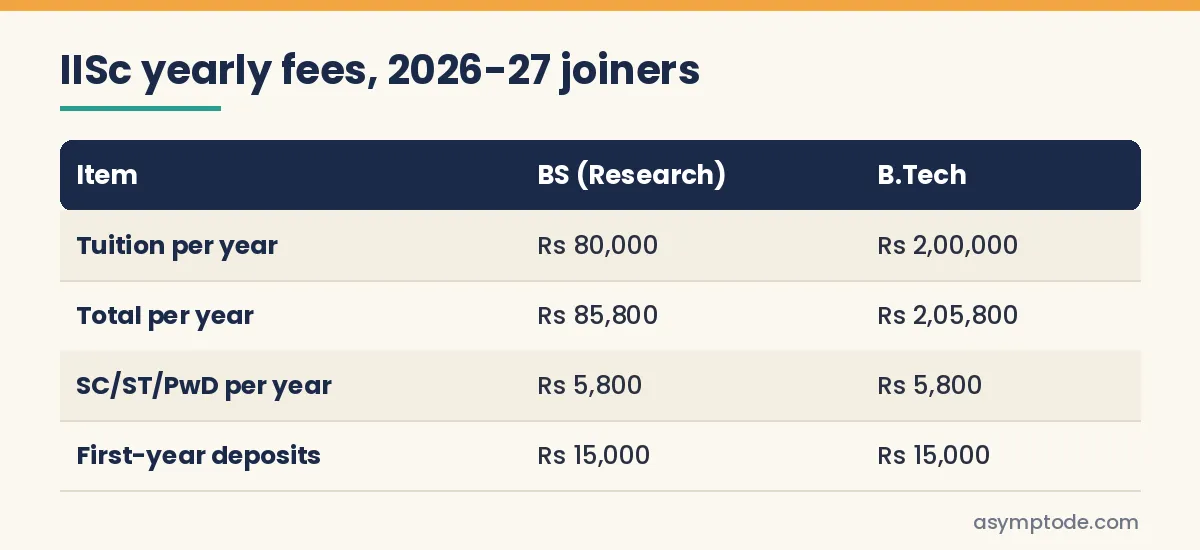 Yearly fees for students joining IISc in 2026-27.
The picture compares the two programmes. BS (Research) costs Rs 85,800 a year. B.Tech costs Rs 2,05,800 a year. These are General/EWS/OBC rates. SC/ST/PwD students pay Rs 5,800 a year for either programme.
| Fee item (per year) | BS (Research) | B.Tech |
|---|---|---|
| Tuition | Rs 80,000 | Rs 2,00,000 |
| Gymkhana | Rs 1,800 | Rs 1,800 |
| Other academic | Rs 3,700 | Rs 3,700 |
| Students Emergency Fund | Rs 300 | Rs 300 |
| Total (General/EWS/OBC) | Rs 85,800 | Rs 2,05,800 |
| Total (SC/ST/PwD) | Rs 5,800 | Rs 5,800 |
| First-year total with refundable deposits | Rs 1,00,800 | Rs 2,20,800 |
The first-year totals include Rs 15,000 of refundable deposits (statutory and library, Rs 7,500 each). For SC/ST/PwD the first-year total is Rs 20,800.
How does the BS (Research) yearly fee add up?
 A worked example of the BS (Research) yearly fee.
Start with tuition of Rs 80,000. Add Gymkhana Rs 1,800 and academic fees Rs 3,700. Add the emergency fund of Rs 300. That gives Rs 85,800 a year. Over 4 years, 4 x 85,800 = Rs 3,43,200 at 2026-27 rates, before deposits. Fees can change.
How do you pay IISc fees?
You pay in 3 instalments:
- 35% by 16 August
- 35% by 15 November
- 30% by 16 January
A late fine of Rs 20 a week applies. Foreign nationals and OCI(F) students pay General-category fees in INR. We did not find any income-based fee waiver on the official pages.
What does the IISc hostel cost?
These are BS (Research) hostel rates per student per month:
| Item | General | SC/ST |
|---|---|---|
| Single room | Rs 600 | Rs 300 |
| Double room | Rs 300 | Rs 150 |
Other charges include establishment, amenities, and electricity and water (Rs 300 each) and mess amenities (Rs 1,500); the circular does not state the period. The hostel deposit is Rs 30,000 (refundable), and Group Mediclaim is compulsory. Mess food and B.Tech room rates are not listed.
Are there scholarships for IISc undergraduates?
Yes, but amounts are not published. The UG fellowships page lists 8 named donor fellowships, several for women, such as the IISc-AANA Midwest Women in Science Fellowship, Mallika Women in Science, and Jayalakshmi & Venkataramanachar (for BS women).
- The IISc Promotional Fellowship (IIScP) is discontinued for students admitted from 2026-27.
- The B.Tech FAQ names the Square Point Foundation, Synchronoss Technologies and Kotak Women BTech Scholarship fellowships.
- MHRD/CSIR-type scholarships in the admission notice are for PG and PhD, not UG.
- INSPIRE-SHE from DST gives Rs 80,000 a year for BSc/MSc in natural and basic sciences, for ages 17 to 22. Top 1% of your Class 12 board, or a JEE Advanced top-10,000 rank, are among the eligibility routes. The INSPIRE-SHE page does not name IISc. BS students may be eligible, so check with DST.
What is hostel and campus life like at IISc?
IISc hostels house nearly 3,000 students, including about 500 girls. Girls share one hostel. First- and second-year UG boys share one hostel. All B.Tech students get on-campus hostel places.
Rooms have a wardrobe, study table, chair, cot, lights and a fan, but no mattress or curtains. There are five messes on campus. You need at least 80% attendance in every course.
Can international, OCI or NRI students apply to IISc?
Yes. Foreign nationals with a foreign passport can apply. The BS (Research) has 5 seats for international students, OCI/PIO(F) included.
BS (Research) for foreign nationals has two modes:
- Mode 1: SAT or ACT score (2025 or 2026). You are shortlisted on your score, and then an interview decides.
- Mode 2: IAT 2026 or JEE Advanced 2026 rank. Your rank must be at or above the General cut-off for that channel.
The OIR page for BS gives the 2025-26 cut-offs as SAT 1470 and ACT 31. The 2026 cut-offs are not confirmed, so check the page. International applicants pay no application fee and use admissions.iisc.ac.in. For test prep, see SAT vs ACT and our digital SAT maths guide.
B.Tech for foreign nationals: foreign nationals do not need JEE Main 2026. They can register for JEE Advanced directly. They get no reservation. The OIR B.Tech page lists a 2025-26 foreign-national cut-off of 856 for Mathematics and Computing.
OCI/PIO card holders:
- Card issued after 4 March 2021: you count as a foreign national. You compete only for foreign-national supernumerary seats.
- Card issued before 4 March 2021: choose one status. Either apply as OCI/PIO(F) through the international portal, or as OCI/PIO(I) through the regular portal (open seats only, with no EWS/OBC/SC/ST benefit). Applying both ways leads to cancellation and is treated as unfair means.
NRIs (Indian citizens living abroad): we found no separate NRI rule or quota on any IISc page. Check with IISc before you apply. International queries go to admission.oir@iisc.ac.in.
When will IISc admissions 2027 open?
As of 1 November 2026, no 2027-28 notice is out. IISc pages show only the 2026-27 cycle. The JEE Advanced site has no 2027 date or organising IIT yet.
Based on 2026, here is what to expect. The notice comes out in early February. The BS (Research) portal opens around May and closes in early June, after the JEE Advanced and IAT results. Counselling runs in late June and July, and classes start in early August. B.Tech follows the JoSAA calendar (June to July).
2027 eligibility is not yet announced. Watch the IISc admissions page for the new notice.
How 1-on-1 tutoring helps with getting into IISc
JEE Advanced and the IAT both test deep physics, chemistry and maths. Here is how Asymptode helps:
- One dedicated mentor, live online 1-on-1. Your mentor follows your own syllabus and your exam dates, whether you are aiming for JEE Advanced, the IAT, or both.
- Method first. Your mentor watches each step of your working in physics, chemistry and maths, so small errors get fixed before the exam.
- Personalised homework with feedback. You practise the topics you find hard, and you get clear feedback. Parents get short updates on progress.
- Every class is recorded, and the first one is a free demo class. For the forms, dates and counselling, your mentor helps you plan your time and stay on track.
Facts checked against official sources on 1 November 2026.
FAQ
Can I get into IISc without JEE Advanced?
Yes, for the BS (Research). You can use your IAT rank instead of JEE Advanced. For the B.Tech, you need a JEE Advanced rank and JoSAA counselling. There is no other route for B.Tech.
What JEE Advanced rank do I need for IISc?
In 2026, the BS (Research) Round 1 closing rank for GN was 2203 (CRL), and 6560 for GN-F. These are last year's figures, not predictions. For B.Tech, check the JoSAA closing ranks for your year.
Is IISc admission through NEET?
No. NEET is not a channel for any IISc programme. IISc has no MBBS. For the BS (Research), use JEE Advanced or the IAT.
What is the IISc BS (Research) fee for 2026-27?
For students joining in 2026-27, it is Rs 85,800 a year for General/EWS/OBC. This includes Rs 80,000 tuition. SC/ST/PwD students pay Rs 5,800 a year because tuition is fully waived. The first year adds Rs 15,000 in refundable deposits.
Can international, NRI or OCI students apply, and is the SAT accepted?
Yes. Foreign nationals and OCI(F) students can apply for the BS (Research) with SAT or ACT scores, or with a JEE Advanced or IAT rank. We found no separate NRI quota, so NRIs should check with IISc. OCI rules depend on whether your card was issued before or after 4 March 2021.
When will IISc UG admissions 2027 open, and what is the eligibility?
No 2027 notice is out yet. Based on 2026, expect the notice in early February and the BS portal around May to early June. In 2026, the BS needed at least 60% in Class 12 with Physics, Chemistry and Maths, and B.Tech followed the JoSAA rules. Check the 2027 notice for the final rules.
Ready to start? Book a free demo class and advisor call, or see our plans and fees.
Sources
- IISc Admission Notice AY 2026-27
- IISc BS (Research) News and Updates
- IISc BS (Research) Selection Process
- IISc BS (Research) Important Dates
- IISc BS (Research) Previous Year Cut-off
- IISc Fee Structure Circular AY 2026-27
- IISc UG Fellowships
- IISc OIR: BS (Research) Programme 2026-2027
- IISc OIR: B.Tech Programme 2026-2027
- JEE Advanced official site