
If you want to know how to get into Caltech, start with three things: take calculus, physics and chemistry, send a strong SAT or ACT score, and show real, long-term love of science in your essays. This guide covers fall 2027 entry: deadlines, tests, courses, essays, letters, costs, aid and a Grade 9-12 plan.
Key takeaways
- Caltech requires the SAT or ACT for fall 2027 applicants. It looks at each section score, not the composite.
- You need four years of math with one year of calculus, plus one year each of physics and chemistry.
- Restrictive Early Action closed on November 1, 2026. Regular Decision is due January 4, 2027.
- Caltech meets 100% of demonstrated need. It is need-blind for US students and need-aware for international students.
- Caltech says its admit rate is under 5% in both rounds, and there is no single "Caltech profile".
How to get into Caltech: what really matters?
Quick answer: To get into Caltech, you need proof that you can handle its hard first-year core: calculus, physics and chemistry on your transcript, an SAT or ACT score, and two teacher letters. Then you need essays that show "Scientific Drive": deep, self-driven STEM work. Apply by January 4, 2027 for Regular Decision.
Caltech's What We Look For page names three things: capacity for Caltech rigor, character and drive. The number of STEM activities does not matter. Depth does.
What is Caltech, and what will you study?
Caltech (the California Institute of Technology) is a small science and engineering institute in Pasadena, California. Its first-year class is only about 245 students, according to the admissions deadlines page.
At Caltech, a major is called an option. Options include Physics, Mathematics, Computer Science, Aerospace, Chemistry, Biology, Electrical Engineering and Mechanical Engineering, plus some humanities options such as Economics and History. You choose your option at the end of your first year.
Every student takes the same core curriculum first. Caltech's core curriculum page lists:
| Core subject | Units |
|---|---|
| First-year math (multivariable calculus, linear algebra) | 27 |
| First-year physics (yearlong) | 27 |
| First-year chemistry | 15 + 6 lab |
| Biology | 9 |
| Computer science (intro programming) | 9 |
| Humanities and social sciences | 36 + 27 + 36 more in either |
A 9-unit class means about 3 hours of class and 6 hours of homework each week. Your first two terms are pass/fail. This is why Caltech cares so much about your math and physics.
When are the Caltech deadlines for fall 2027?
Caltech has two plans: Restrictive Early Action (REA) and Regular Decision (RD). It also takes part in QuestBridge, which has its own process.
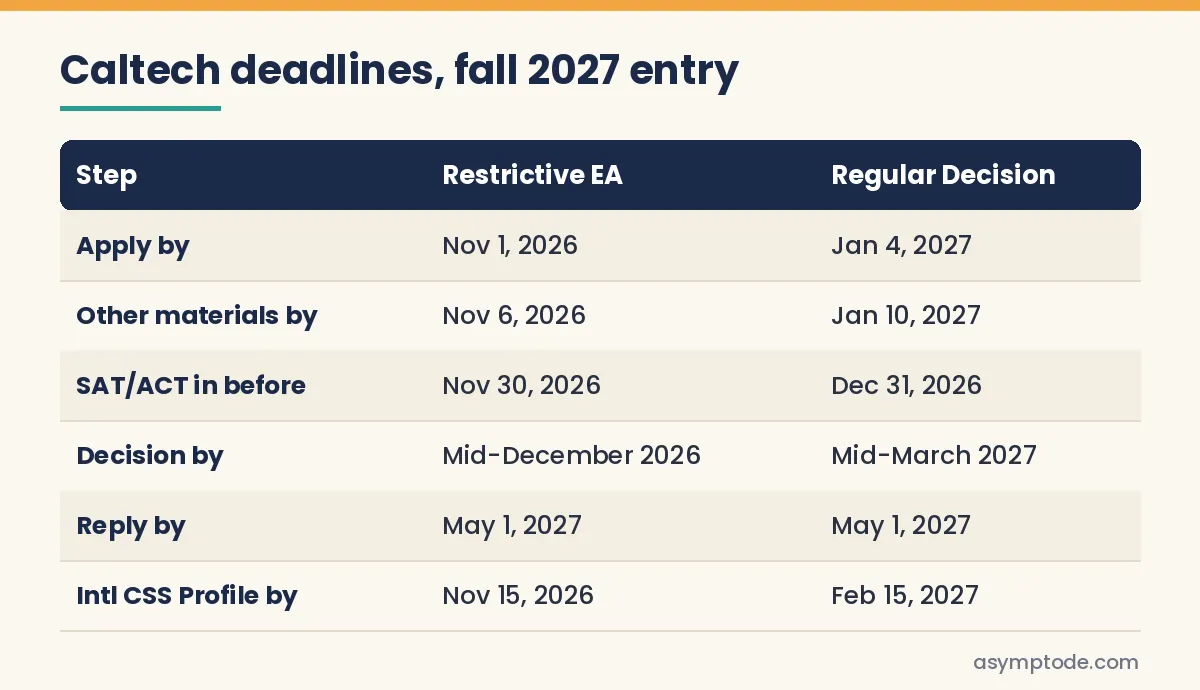 Caltech deadlines for fall 2027 entry, REA and Regular Decision side by side.
REA applications were due November 1, 2026, with other materials due by November 6. REA test scores must be in before November 30, 2026, and decisions come by mid-December 2026.
Regular Decision is due January 4, 2027, with materials by January 10. RD test scores must be in before December 31, 2026, and decisions come by mid-March 2027.
All admitted students reply by May 1, 2027. International aid applicants file the CSS Profile by November 15, 2026 (REA) or February 15, 2027 (RD).
Key rules:
- REA is non-binding, but you may not apply Early Action or Early Decision elsewhere. Exceptions include universities outside the US and public universities with non-binding fall deadlines, such as the University of California.
- REA does not raise your odds. Caltech says the difference in admit rates is "negligible", and most offers go out in RD.
- Outcomes: REA gives admit, defer or deny. RD gives admit, waitlist or deny. A denial is final for that year.
REA closed on November 1. If you applied, make sure your materials arrive by November 6. If not, aim for Regular Decision.
 The Caltech fall 2027 application cycle, step by step.
November 1, 2026: REA applications due. Mid-December 2026: REA decisions.
Before December 31, 2026: last day for RD SAT or ACT scores. January 4, 2027: Regular Decision deadline.
Mid-March 2027: RD decisions. May 1, 2027: reply deadline for admitted students.
How do you apply to Caltech?
You apply through the Common App or the QuestBridge Application. The application requirements page lists what you need:
- The application (Common App or QuestBridge).
- The $85 fee or a fee waiver.
- Caltech's supplemental essays.
- Two teacher letters (one STEM, one humanities or social science).
- A School Report from your counselor.
- Official transcripts for grades 9-11 (or the international equivalent), sent by your school, then a Mid-Year Report.
- SAT or ACT scores, plus any AP or IB exam scores.
- An English test, if you are an international applicant who needs one.
Fee waiver: The fee page says that if you apply for aid and the fee is a hardship, you can fill in the Caltech Active Transport Pass form. QuestBridge applicants never pay a fee.
Optional extras: You can add a research paper or a portfolio in the Beaver Breakroom, Caltech's applicant portal. A research paper also needs a description and a letter from someone at the research site.
QuestBridge: If you match with Caltech through the National College Match, you get a full four-year, no-loan scholarship, and the match is binding. Check the QuestBridge dates page for the current cycle.
The requirements page does not list an interview.
What SAT or ACT score do you need for Caltech?
Caltech requires the SAT or ACT for fall 2027. It brought the rule back for students entering in fall 2025. There is no preferred test and no cut-off score. See our SAT vs ACT guide to choose.
Caltech reads each section score on its own and uses "buckets", per its standardized tests page:
| Bucket | SAT section | ACT subscore | What readers see |
|---|---|---|---|
| A | 780-800 | 35-36 | "Bucket A" only |
| B | 750-770 | 33-34 | "Bucket B" only |
| C | Below 750 | Below 33 | Your exact score |
Other key points:
- Caltech superscores. Report all your sittings. ACT writing and science are not required.
- Caltech says successful applicants have traditionally scored 700+ on each SAT section or 30+ on each ACT section. Retaking to chase a perfect score is "not a good use of your time".
- Report every AP and IB exam you took, whatever the score.
- If no test center was open to you, explain this in the application.
What do admitted students score? Caltech's Common Data Set 2025-26 (fall 2025 class) prints these ranges for enrolled students:
| Section | 25th | 50th | 75th |
|---|---|---|---|
| SAT Reading and Writing | 760 | 760 | 780 |
| SAT Math | 790 | 790 | 800 |
| ACT Composite | 35 | 35 | 36 |
| ACT Math | 35 | 36 | 36 |
The same file shows 11,285 first-year applicants and 428 admits. Math is clearly the high bar. Our Digital SAT Math guide shows how to target the hardest questions.
Which high school courses does Caltech require?
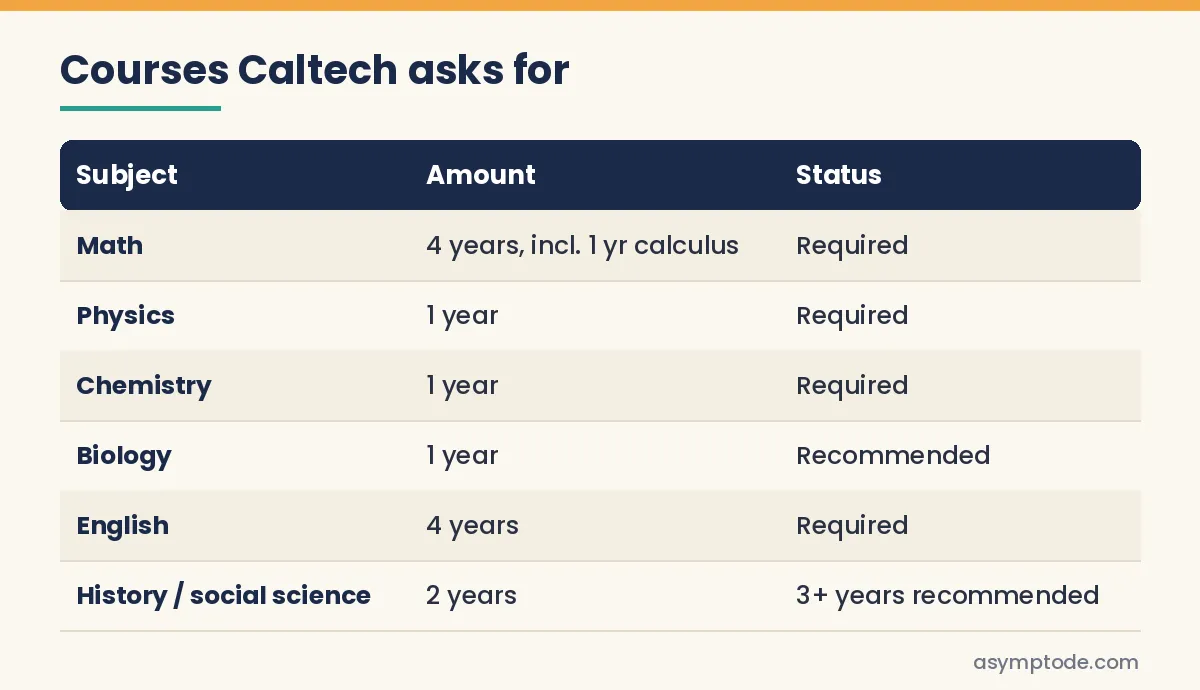 Caltech's course list for first-year applicants.
Math: four years, including one year of calculus (required).
Physics: one year, and chemistry: one year (both required). Biology: one year (recommended).
English: four years (required). History or social sciences: two years, with three or more recommended.
This list comes from the academic requirements page. Taking one of these subjects for the first time in Grade 12 is fine, if Caltech can see semester or in-progress grades by the deadline.
What if your school does not offer calculus, physics or chemistry? If the course is not available, or you have a real scheduling conflict that you and your counselor document, Caltech accepts:
- An AP score of 5 in Calculus AB or BC, Chemistry, Physics 1, Physics 2 or Physics C.
- An IB score of 6 or 7 in Mathematics HL, Chemistry SL/HL or Physics SL/HL.
- A Schoolhouse.world course challenge in AP/College Calculus BC, Chemistry or Physics 1.
Caltech does not accept Coursera or edX instead. If you are deciding on calculus level, see our AP Calculus AB vs BC guide. For physics, our AP Physics 1 exam guide is a good start.
What level of math and physics does Caltech expect?
Caltech's core includes multivariable calculus and a yearlong physics course in mechanics and electromagnetism. So you should link motion and calculus with ease. Here is a short example.
 A calculus-based physics problem: how high does the ball go?
A ball is thrown straight up with v0 = 20 m/s. Take g = 10 m/s^2.
Velocity is v(t) = 20 - 10t. At the top, v = 0, so t = 2 s.
Integrate v to get height: h(t) = 20t - 5t^2. So h(2) = 40 - 20 = 20 m.
Check with the formula h = v0^2 / (2g) = 400 / 20 = 20 m. Both methods agree.
If this feels easy, good: Caltech goes much further. If it feels hard, you have time to build the skill.
Book a free demo class with an Asymptode math or physics mentor to work through Caltech-level problems, or see our plans and fees.
How should you write the Caltech essays?
Caltech's supplemental essays page lists the fall 2027 questions:
| Essay | Choice | Length |
|---|---|---|
| STEM academic interest: why this area? | Required | 150-200 words |
| Scholarly Character | 1 of 2 (Collaboration or Process) | Up to 200 words |
| Scientific Drive | 2 of 3 (Learning, Pursuing, Making) | Up to 200 words each |
| Fun question: what will you add to Caltech? | Required | 100-150 words |
| Academic context | Optional | - |
Tips that match Caltech's own advice:
- Go deep on STEM. Caltech says there is "no way to write about too much STEM".
- Get technical. Faculty read the most competitive files, so do not dumb down your science.
- Show process. Explain what you tried, what failed and what you learned.
- Follow the AI rules. All fall 2027 applicants must review Caltech's guidelines on ethical AI use.
Who should write your Caltech recommendation letters?
You need two teachers from your last two years of high school, per the letters page:
- STEM: math (calculus or beyond preferred), physics, chemistry or biology.
- Humanities or social science: English, history, government or economics. Caltech wants this teacher to comment on your writing.
Pick teachers who know you well. An extra letter from a coach or mentor is welcome if it adds something new.
What do international applicants need to know?
You are international if you are not a US citizen or permanent resident and attend school outside the US. The international applicants page says:
- Same review, except that financial need is a factor (need-aware).
- English test is required unless English is your native language or your school teaches mainly in English. Caltech accepts Duolingo (130 minimum), IELTS (7 overall and in each part) or TOEFL (100 overall, 25 per section if taken before January 21, 2026; 5 overall and per section if taken on or after that date). Take it before the deadline.
- InitialView is recommended but not required.
- Aid timing: If you might ever need aid, apply for it when you apply for admission. If you do not, you cannot apply later (Caltech may make exceptions for citizens of Canada and Mexico).
- Grades: Do not convert grades to a US scale. Non-English documents need an English translation too.
How do IB, A-Level and Indian curricula map to Caltech?
| Curriculum | What Caltech states |
|---|---|
| IB Diploma | Higher Level Math is required. Only SL Math (when HL was not available) does not show calculus preparedness. |
| A-Levels (UK and others) | A-Level Maths (the UK course) is required. If you take only STEM in your last two years, you need two years of English and two of social studies in your first two years. You may swap the humanities letter for another STEM teacher. |
| India | You must complete both Year X and Year XII state board or CBSE exams. |
Caltech does not publish a mapping for Canadian provincial curricula. If you study in Canada or another system, email the admissions office to check.
How much does Caltech cost in 2026-27?
The on-campus cost of attendance page lists these 2026-27 figures:
| Item | Cost |
|---|---|
| Tuition | $68,574 |
| Fees | $2,655 |
| Housing | $12,711 |
| Food | $9,285 |
| Total direct costs | $93,225 |
| Books and supplies | $1,428 |
| Personal expenses | $3,969 |
| Total indirect costs | $5,397 |
Together that is $98,622 for the year. New students also pay a one-time $600 orientation fee. The student health plan ($5,388) is extra unless you have similar coverage.
How does Caltech financial aid work?
Caltech's Afford page says:
- Caltech meets 100% of demonstrated need for admitted students.
- It is need-blind for US students (including undocumented and DACA students who graduate from a US high school) and need-aware for international students.
- It gives no merit scholarships. All Caltech aid is need-based.
- Most families earning under $200,000 (with typical assets) can expect aid that covers tuition.
- Most families earning under $100,000 (with typical assets) can expect a no-loan package covering tuition, fees, housing and food.
- For the fall 2026 class, average grant aid was just under $69,000.
The aid office's priority deadlines are December 15, 2026 for REA and March 16, 2027 for RD. Try the Net Price Calculator on the Caltech site for your own estimate.
What is a good Grade 9-12 plan for Caltech?
- Grade 9: Build strong algebra and geometry. Start one science interest you follow on your own.
- Grade 10: Take chemistry or physics if you can. Try math contests with our AMC 10 and AMC 12 guide.
- Grade 11: Take calculus or pre-calculus, plus physics. Sit the SAT or ACT. Strong AMC scorers can read our AIME 2027 guide.
- Summer before Grade 12: Do research or build something. Our research for high school students guide shows how to find a mentor. Draft essays once Caltech posts them.
- Grade 12: Finish calculus, physics and chemistry. Ask your two teachers early. Apply by January 4.
Which activities fit Caltech?
Caltech's STEM preparedness page names math contests (AMC, IMO), science olympiads and fairs (USAPhO, IChO, ISEF), robotics (FIRST, VEX), and research programs. It also values students who build machines, write code or teach themselves. None of these guarantees a place. Depth and lasting curiosity count most.
What are common Caltech application mistakes?
- Skipping a required course without a documented reason and a valid substitute.
- Retaking the SAT or ACT again and again for a perfect score.
- Vague essays with no technical detail.
- Rushing an REA file for "better odds". The odds are about the same.
- International students skipping aid at the start. Most cannot apply later.
- Not checking fit. Caltech is small and intense. Compare it with another STEM-focused school in our guide on how to get into MIT.
How 1-on-1 tutoring helps with getting into Caltech
- One dedicated mentor, live online 1-on-1, who follows your own syllabus (AP, IB, A-Level, CBSE or other) and your exam dates for calculus, physics, chemistry and the SAT or ACT.
- Method-first teaching: your mentor watches each step of your working, so gaps in calculus and physics reasoning get fixed early, before Caltech-level problem sets.
- Personalized homework with feedback, plus short parent updates and a recording of every class to review.
- Planning help: for essays, timelines and activity choices, your mentor helps with planning and method. The writing and the ideas stay yours. Start with a free demo class.
Facts checked against official sources on 4 November 2026.
FAQ
Does Caltech require the SAT or ACT for fall 2027?
Yes. Caltech requires the SAT or the ACT and has no preferred test. It reads each section score separately and superscores. RD scores must arrive before December 31, 2026.
What is the Caltech acceptance rate?
Caltech says its admit rate is under 5% in both rounds. Its Common Data Set 2025-26 shows 11,285 first-year applicants and 428 admits for fall 2025.
Can I get into Caltech without calculus in high school?
Only in limited cases. If calculus was not available or you had a documented conflict, Caltech accepts an AP Calculus score of 5, an IB Math HL score of 6 or 7, or a Schoolhouse.world Calculus BC course challenge.
Is Caltech need-blind for international students?
No. Caltech is need-aware for international applicants because its aid funds for them are limited. It still meets 100% of demonstrated need for admitted students. Apply for aid when you apply for admission.
Does Caltech give merit scholarships?
No. Caltech does not award merit scholarships. All its aid is based on financial need, through grants, scholarships, work-study and loans.
Is Restrictive Early Action better than Regular Decision at Caltech?
Not for your odds. Caltech says the difference in admit rates is negligible and most admits come from RD. Apply REA only if Caltech is your first choice and your full application is ready by November 1.
Ready to start? Book a free demo class and advisor call, or see our plans and fees.
Sources
- Caltech First-Year Application Deadlines
- Caltech First-Year Application Requirements
- Caltech Standardized Tests
- Caltech Academic Requirements for First-Year Applicants
- Caltech Supplemental Application Essays
- Caltech Letters of Recommendation
- Caltech International Applicants
- Caltech Application Fee and Waiver
- Caltech Core Curriculum
- What Caltech Looks For
- Demonstrating STEM Preparedness
- Caltech On-Campus Cost of Attendance 2026-27
- Affording Caltech
- Caltech Financial Aid Deadlines
- Caltech Common Data Set 2025-26
- Caltech Restores Standardized Test Requirement