
If you want to know how to become an actuary, the short path is simple: get strong at maths and statistics at school, study a maths-heavy degree, pass your first professional exams early, and then qualify through a body such as the Society of Actuaries, the Institute and Faculty of Actuaries or the Institute of Actuaries of India. This guide for students and parents uses official sources only.
Key takeaways
- Actuaries use maths, statistics and data to put a price on risk, mostly for insurers, pension plans and consulting firms.
- At school, take maths every year, go as far as calculus, and add statistics and some coding.
- In the US, most students start with SOA Exam P (probability) and Exam FM (financial maths), often while still at university.
- In the UK, the IFoA route starts with CS1 and CM1; in India, the IAI route starts with the ACET entrance test.
- The US Bureau of Labor Statistics reports a median wage of $130,000 (May 2025) and projects 9 percent job growth from 2025 to 2035.
How to become an actuary: what are the main steps?
Quick answer: To become an actuary, build strong maths and statistics at school, take a degree in maths, statistics, actuarial science, economics or another analytical subject, and pass one or two professional exams before you graduate. Then get a trainee job, keep passing exams while you work, and qualify first as an associate and later as a fellow.
- School: maths every year, calculus, statistics, some coding.
- University: a maths-based degree, plus your first exam or two.
- Internship, then a trainee job: the IFoA notes that many employers provide study support and fund exams.
- Associate, then Fellow: pass the remaining exams while you work, then specialise.
 The four big stages of an actuary's career path.
The path has four stages. First, school maths, statistics and coding. Second, a degree plus your first one or two exams. Third, an internship and then a trainee job. Fourth, you qualify as an associate and later as a fellow.
What does an actuary actually do?
An actuary measures risk and puts a number on it. The US Bureau of Labor Statistics (BLS) says actuaries compile and analyze statistical data, estimate the probability and likely cost of events such as illness, accidents and natural disasters, and design policies that limit risk. They also explain their findings to executives, government officials, shareholders and clients.
For example: how much should a young driver pay for car insurance, or how much must a pension plan hold today to pay people for decades?
The BLS reports that finance and insurance accounted for 78 percent of actuary jobs in 2025. Others work in consulting, company management and government.
The job is not only maths. The BLS lists communication and interpersonal skills next to math, analytical, computer and problem-solving skills.
Which school subjects should I choose to become an actuary?
Choose maths every year and go as high as your school allows. The Be An Actuary site, run by the Society of Actuaries (SOA) and the Casualty Actuarial Society (CAS), tells high school students to take math every year and to take AP and advanced courses such as statistics and calculus. It also suggests data science or computer science courses or clubs.
In the UK, the Institute and Faculty of Actuaries (IFoA) says you should start with an A Level or equivalent in Maths. It suggests supporting subjects such as economics or physics, and notes that languages can help show your communication skills.
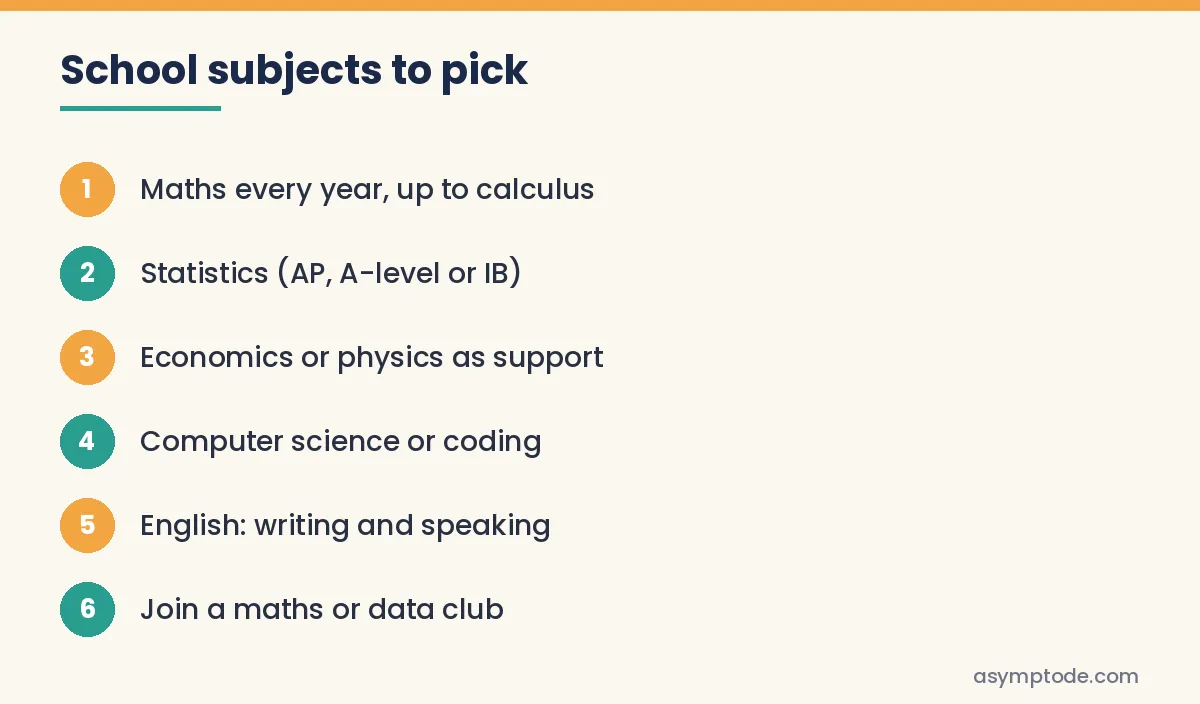 School subjects that build the actuary skill set.
Start with maths every year, up to calculus. Add statistics (for example AP Statistics, A-level Maths statistics or IB Maths). Economics or physics make good support subjects. Add computer science or coding, keep up your English writing and speaking, and join a maths or data club.
What to choose in each school system
| School system | Core choice | Good extras |
|---|---|---|
| US high school | AP Calculus and AP Statistics | AP Computer Science, AP Economics |
| UK A-levels | A-level Maths (Further Maths if offered) | Economics, Physics, Computer Science |
| IB Diploma | Maths at Higher Level | Economics, Physics, Computer Science |
| India (Class 11-12) | Mathematics | Economics, Computer Science |
If you are in the US, read our guide to AP Statistics changes for 2026-27. For UK students, our A-level Maths guide explains the papers. IB students often ask which maths course to pick; see IB Maths AA vs AI. If you want a maths-heavy degree, compare the calculus content of each course and check the entry rules of the universities you want.
What degree do you need to be an actuary?
You usually need a bachelor's degree. The BLS says actuaries typically have a degree in mathematics, business, actuarial science or another analytical field. It also says coursework in economics, statistics and corporate finance is expected for certification, and that computer science, especially programming, is important.
In the UK, the IFoA recommends a maths-based degree with a large share of maths modules. It says most employers look for a 2:1 as a minimum. IFoA-accredited actuarial science degrees can give exemptions from some exams. The IFoA also lists apprenticeships as an alternative to university: a Level 4 actuarial technician apprenticeship, then a Level 7 apprenticeship.
Accredited actuarial science degrees can also cut exams in Australia and Canada. For a UK university with strong economics and statistics, see how to get into LSE. If you love maths but are not sure about insurance, compare this path with how to become a data scientist and how to become a mathematician. The skills overlap a lot.
Which actuarial exams do you take in the US, UK and India?
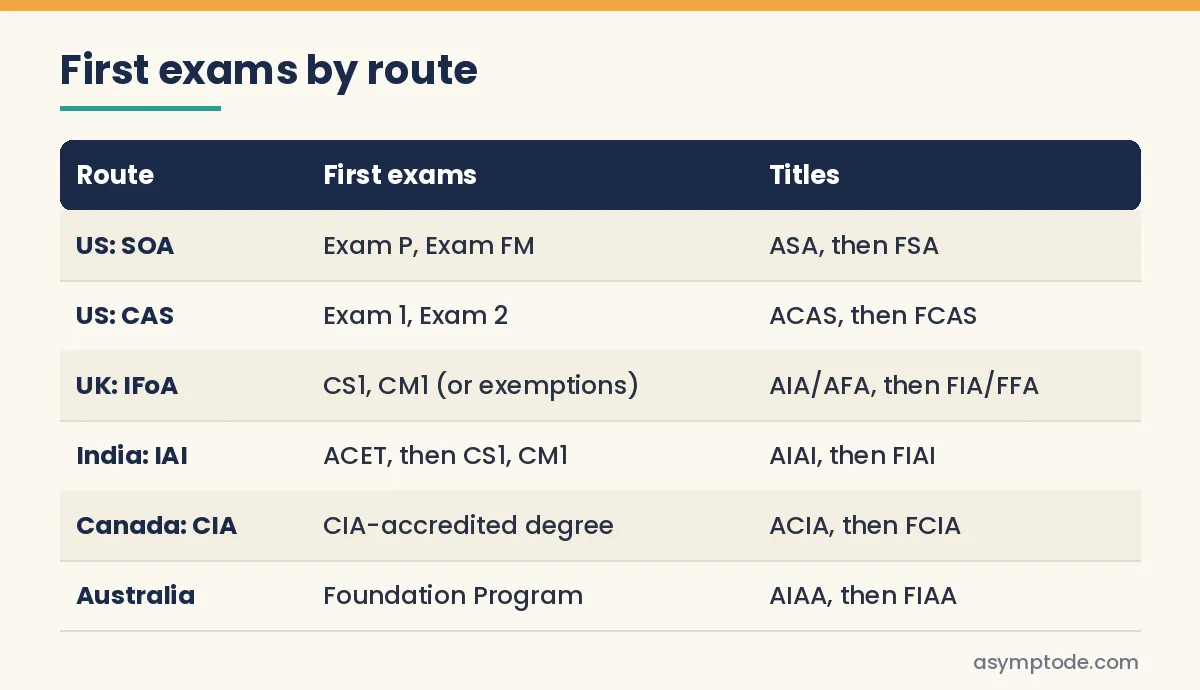 First exams and titles for six actuarial routes.
In the US, the SOA route starts with Exam P and Exam FM and leads to ASA, then FSA. The CAS route starts with Exam 1 and Exam 2 and leads to ACAS, then FCAS. In the UK, the IFoA route starts with CS1 and CM1 (or exemptions) and leads to AIA/AFA, then FIA/FFA. In India, you pass ACET, then CS1 and CM1, to become AIAI, then FIAI. Canada uses ACIA and FCIA, and Australia uses AIAA and FIAA.
United States: Society of Actuaries (SOA)
The SOA route leads to the Associate of the Society of Actuaries (ASA) and then the Fellow (FSA). The SOA ASA requirements page lists:
- Exams: P, FM, FAM, ALTAM or ASTAM, SRM, PA and the ATPA assessment.
- Modules and courses: PAF, ASF, FAP and the Associateship Professionalism Course.
- VEE (Validation by Educational Experience): Mathematical Statistics, Economics, and Accounting and Finance, earned through approved courses. The SOA says you must pass two SOA, CAS or CIA exams before you apply for VEE credit.
The SOA says the requirements can be completed in any order.
| Exam | Length | Questions | Fee listed by SOA | Next sittings |
|---|---|---|---|---|
| Exam P | 3 hours | 30 multiple choice | US$275 | Jan 14-25, 2027 (register by Dec 15, 2026); Mar 1-12, 2027 |
| Exam FM | 2.5 hours | 30 multiple choice | US$275 | Feb 4-15, 2027 (register by Jan 5, 2027); Apr 1-12, 2027 |
Both are computer-based tests. The Exam P syllabus says an understanding of calculus, including series, differentiation and integration, is assumed. Dates come from the SOA exam schedule, which says they can change, so check the fee and date before you register.
United States: Casualty Actuarial Society (CAS)
The CAS focuses on property and casualty insurance. Its credential requirements for ACAS start with Exam 1 (Probability) and Exam 2 (Financial Mathematics), credited through equivalent exams from bodies such as the SOA. Later come MAS-I, MAS-II, Exams 5 and 6 and more. Fellowship (FCAS) adds Exams 7, 8 and 9.
United Kingdom: Institute and Faculty of Actuaries (IFoA)
The IFoA Qualification Handbook 2025/2026 lists the Associate subjects:
- Core Principles: CS1 Actuarial Statistics, CS2, CM1 Actuarial Mathematics for modelling, CM2, CB1, CB2 and CB3.
- Core Practices: CP1, CP2 and CP3.
- Work experience: at least 24 months of recorded Personal and Professional Development (PPD), plus professional skills courses.
An Associate uses AIA or AFA; a Fellow uses FIA or FFA. The IFoA FAQ says "CS1 is recommended as the starting point." There are two exam sittings a year, in April and September. The IFoA says there are no academic admissions criteria for student membership, and you can take the first exams as a non-member.
Exemptions: an IFoA-accredited university course (Route A) can exempt you from some subjects. The handbook says exemptions are not granted more than 5 years after the award they are based on, such as your graduation. IFoA exam fees: check the official page.
India: Institute of Actuaries of India (IAI)
In India, the usual first step is the Actuarial Common Entrance Test (ACET), which leads to student membership. Details from the official ACET December 2026 announcement:
| ACET December 2026 | Detail |
|---|---|
| Registration | 28 July to 4 November 2026 (now closed) |
| Exam date | 5 December 2026, 10 am to 1 pm |
| Results | 16 December 2026 |
| Fee | Rs. 500 |
| Format | Home-based online exam, Windows laptop or desktop with webcam |
Eligibility: students who have appeared for 10+2 (or equivalent) and are awaiting results, students who have passed 10+2, and anyone studying higher courses. The IAI FAQ says ACET is held twice a year, tentatively in June and December, and that the result is valid for three years for student membership. Dates and fee for the next (June 2027) sitting are not yet announced.
After ACET, the IAI Associate (AIAI) exams use the same codes as the IFoA, starting with CS1 and CM1. The IAI Education Policy 2026 adds CS3 Data Science from the May 2027 exam diet. Fellowship (FIAI) also needs 3 years of relevant work experience.
Canada and Australia
- Canada: the Canadian Institute of Actuaries awards ACIA and FCIA. Its qualification pathways include a route that starts with a CIA-accredited university degree, plus routes for people who hold credentials from another recognised actuarial body.
- Australia: the Actuaries Institute route runs from the Foundation Program to the Actuary Program (Associate, AIAA) and the Fellowship Program (Fellow, FIAA). The Institute says that, on average, it takes 4-6 years to become an actuary in Australia through the most direct university path.
What does an Exam P question look like?
Here is a short Exam P style practice example (not a real exam question).
Question: An insurance policy covers a loss X. The loss is 0 with probability 0.85, 500 with probability 0.10 and 1,000 with probability 0.05. Find the expected loss. Then find the expected payment if the policy has a deductible of 200.
 Expected value with and without a deductible, step by step.
The loss X is 0, 500 or 1,000 dollars, with probabilities 0.85, 0.10 and 0.05, which add up to 1. The expected loss is E[X] = 0(0.85) + 500(0.10) + 1000(0.05) = 0 + 50 + 50 = 100. With a deductible of 200, the insurer pays 0, 300 or 800, so the expected payment is 30 + 40 = 70.
Key step: with a deductible, the policy pays the loss minus 200, but never less than 0. So 300 x 0.10 = 30 and 800 x 0.05 = 40, giving 70. Notice the answer is not 100 - 200. Exam P also assumes calculus, so practise both.
Do internships matter for future actuaries?
Yes, they help a lot. The BLS says internships may be helpful for students deciding which actuarial track to pursue, such as health, life, pension or casualty. It also says many employers expect new hires to have passed at least one or two certification exams before graduation.
- At school: the Be An Actuary site suggests actuarial career fairs and university-run actuarial summer programmes. A maths project also shows interest; see our guide to research for high school students.
- At university: apply for summer internships at insurers, pension consultancies and banks.
- Before graduation: try to pass Exam P or CS1. A pass shows employers you can handle the exams.
Need help with calculus or statistics before your first exam? Book a free demo class with an Asymptode mentor, or see our plans and fees.
How long does it take to become an actuary?
It takes years, and that is normal. The BLS says it may take up to 7 years for an actuary to earn the associate-level certification, and several more years to become a fellow. In Australia, the Actuaries Institute says 4-6 years on average through the direct university path, and around 5-7 years to become a Fellow. In the UK, the IFoA needs at least 24 months of work experience for Associate and at least 12 more months after that for Fellow. The IFoA says most people start exams once they have a graduate role, so steady study habits matter.
What is the job outlook and pay for actuaries?
Here are the official US figures from the BLS Occupational Outlook Handbook:
| Measure (US, BLS) | Figure |
|---|---|
| Median annual wage | $130,000 (May 2025) |
| Jobs | About 31,200 (2025) |
| Projected growth | 9 percent, 2025 to 2035 |
| Openings per year | About 1,500, on average |
A median means half of actuaries earned more and half earned less. The BLS calls 9 percent growth "much faster than the average for all occupations." Many openings come from people retiring or changing jobs.
An honest note: the field is small, at about 31,200 US jobs. We could not verify official pay figures for the UK, India, Canada or Australia, so we left them out.
How 1-on-1 tutoring helps with becoming an actuary
The early steps on this path are calculus, probability and statistics. That is where Asymptode helps.
- One dedicated mentor, live online 1-on-1: your mentor follows your own syllabus (AP, A-level, IB, Class 11-12 or university) and plans around your exam dates, including ACET or Exam P prep timelines.
- Method first: the mentor watches each step of your working on probability and calculus problems, like the expected value example above, so small errors get fixed early.
- Personalised homework with feedback: practice is set at your level, and short updates go to parents. Every class is recorded so you can rewatch it.
- Honest scope: for non-maths parts, such as internship applications or choosing a professional body, your mentor helps with planning and study method. You can start with a free demo class.
Facts checked against official sources on 7 November 2026.
FAQ
Do you need to be a genius at maths to become an actuary?
No, but you need to be strong and steady at maths. The work uses probability, statistics, calculus and financial maths. Regular, careful practice matters more than being "a natural".
Can I take an actuarial exam while still in high school?
In the US, we did not find an age rule on the SOA pages, but Exam P assumes calculus, including series, differentiation and integration, so most students wait until university. In India, the ACET is open to students who have appeared for 10+2 and are awaiting results. In the UK, the IFoA lets you take the first exams as a non-member, but check the official page before booking.
Is actuarial science the only degree that works?
No. The BLS lists mathematics, business, actuarial science and other analytical fields. The IFoA recommends any maths-based degree, such as maths, statistics, economics, engineering or physics. Actuarial science can give exam exemptions in some countries.
What is the difference between SOA and CAS?
Both are US actuarial bodies. The SOA covers areas such as life insurance, health, retirement and finance, leading to ASA and FSA. The CAS focuses on property and casualty insurance, leading to ACAS and FCAS. Their first exams overlap: the CAS credits its Exams 1 and 2 through equivalent exams from other bodies, such as the SOA.
How much does Exam P cost?
The SOA Exam P page lists a fee of US$275, and the Exam FM page also lists US$275. Fees can change, so check the official SOA page before you register.
When is the next ACET exam?
The ACET December 2026 exam is on 5 December 2026, and registration closed on 4 November 2026. The IAI says ACET is held twice a year, tentatively in June and December. The June 2027 dates and fee are not yet announced, so watch the IAI website.
Ready to start? Book a free demo class and advisor call, or see our plans and fees.
Sources
- Actuaries, Occupational Outlook Handbook (BLS)
- ASA requirements (SOA)
- Exam P syllabus May 2026 (SOA)
- Exam FM syllabus August 2026 (SOA)
- Exam P details (SOA)
- Exam FM details (SOA)
- Exam schedule (SOA)
- Validation by Educational Experience (SOA)
- High school students (Be An Actuary, SOA and CAS)
- Credential requirements (CAS)
- Qualification Handbook 2025/2026 (IFoA)
- Route to becoming an actuary (IFoA)
- Curriculum FAQ (IFoA)
- Student membership (IFoA)
- ACET December 2026 registration announcement (IAI)
- ACET FAQ (IAI)
- Education Policy 2026 (IAI)
- Qualification pathways (Canadian Institute of Actuaries)
- How to become an actuary in Australia (Actuaries Institute)