

AP Statistics has been revised for the 2026-27 school year. The course now has 5 units, some topics are gone, and the exam is fully digital from May 2027. Here is what students and parents need to know.
Key takeaways
- The revised course has 5 units instead of 9.
- Some topics are removed, including the geometric distribution and inference for slopes.
- The exam has 42 multiple-choice questions with 4 answer choices each.
- Free response drops from 6 questions to 4, and each one is worth 10 points.
- The whole exam is taken in the Bluebook app. The first one is in May 2027.
What changed in AP Statistics for 2026-27?
Quick answer: College Board revised AP Statistics to match current college intro statistics courses. The course moves from 9 units to 5. A few topics were removed. The exam is fully digital, with 42 multiple-choice questions and 4 longer free-response questions.
College Board also removed the second-year algebra prerequisite. That means more students can take the course, though strong algebra still helps a lot.
What are the five new AP Statistics units?
The revised course groups the content into these units:
- Exploring One-Variable Data and Collecting Data
- Probability, Random Variables, and Probability Distributions
- Inference for Categorical Data: Proportions
- Inference for Quantitative Data: Means
- Regression Analysis
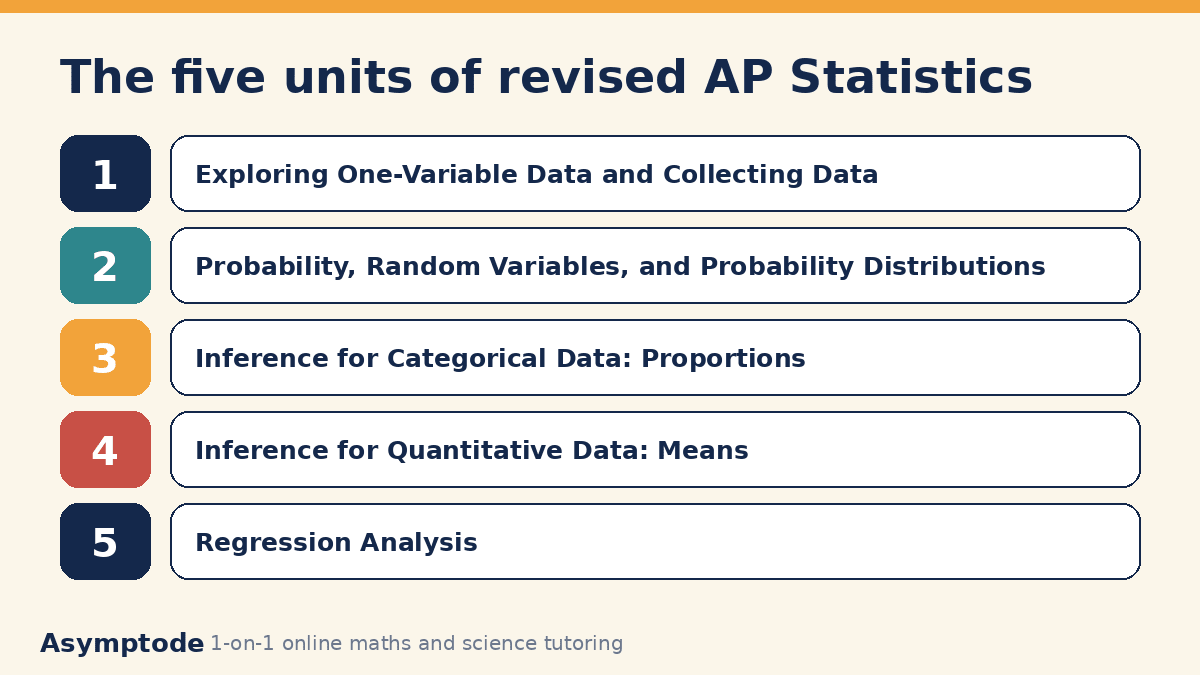
Notice that regression now has its own unit at the end. Data collection now sits in Unit 1 with exploring data.
Which topics were removed from AP Statistics?
College Board lists these topics as removed:
- Analyzing departures from linearity
- Combining random variables
- The geometric distribution
- Chi-square goodness-of-fit tests
- Inference for slopes (the old Unit 9)
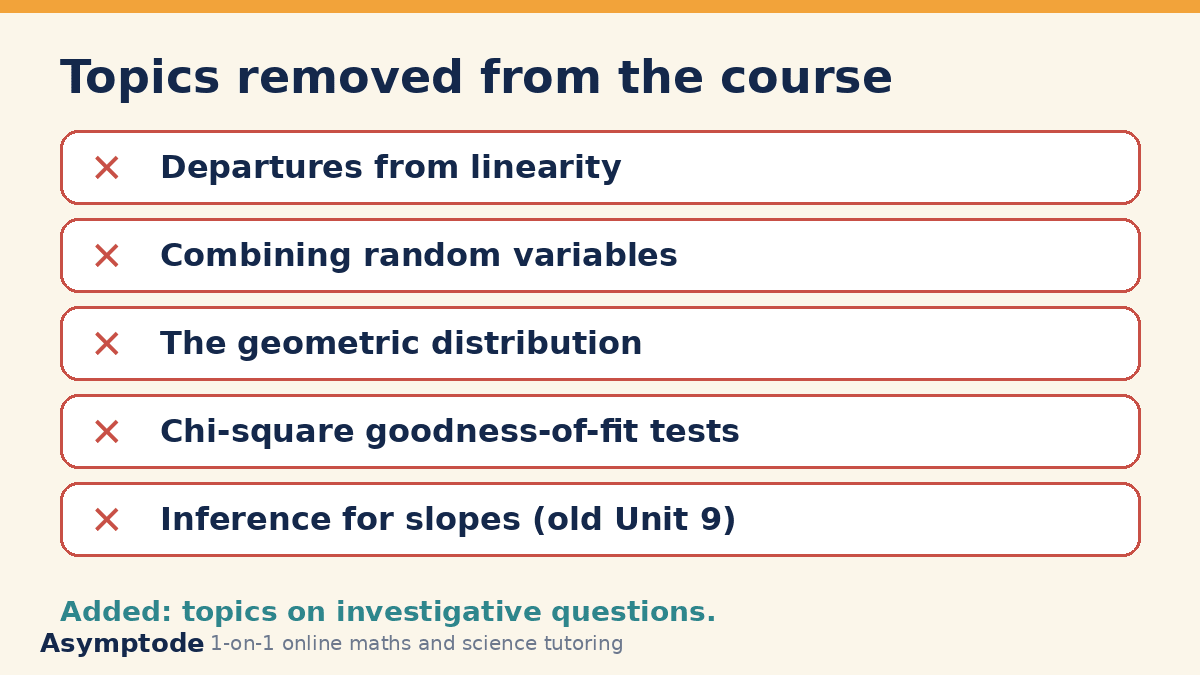
College Board also added topics on investigative questions. These are about asking a clear statistical question before collecting data.
Tip for students: Old review books and older practice exams still include removed topics. Skip those parts. Ask your teacher which practice material matches the revised course.
How is the new AP Statistics exam structured?
College Board lists the exam like this:
| Section | Questions | Time | Weight |
|---|---|---|---|
| Multiple choice | 42 | 1 hour 30 minutes | 50% |
| Free response | 4 | 1 hour 30 minutes | 50% |
Here is how it compares with the old exam:
| Feature | Before | From May 2027 |
|---|---|---|
| Multiple-choice questions | 40 | 42 |
| Choices per question | 5 | 4 |
| Free-response questions | 6 | 4 |
| Points per free-response question | 4 | 10 |
| Format | Paper free-response booklets | Fully digital in Bluebook |
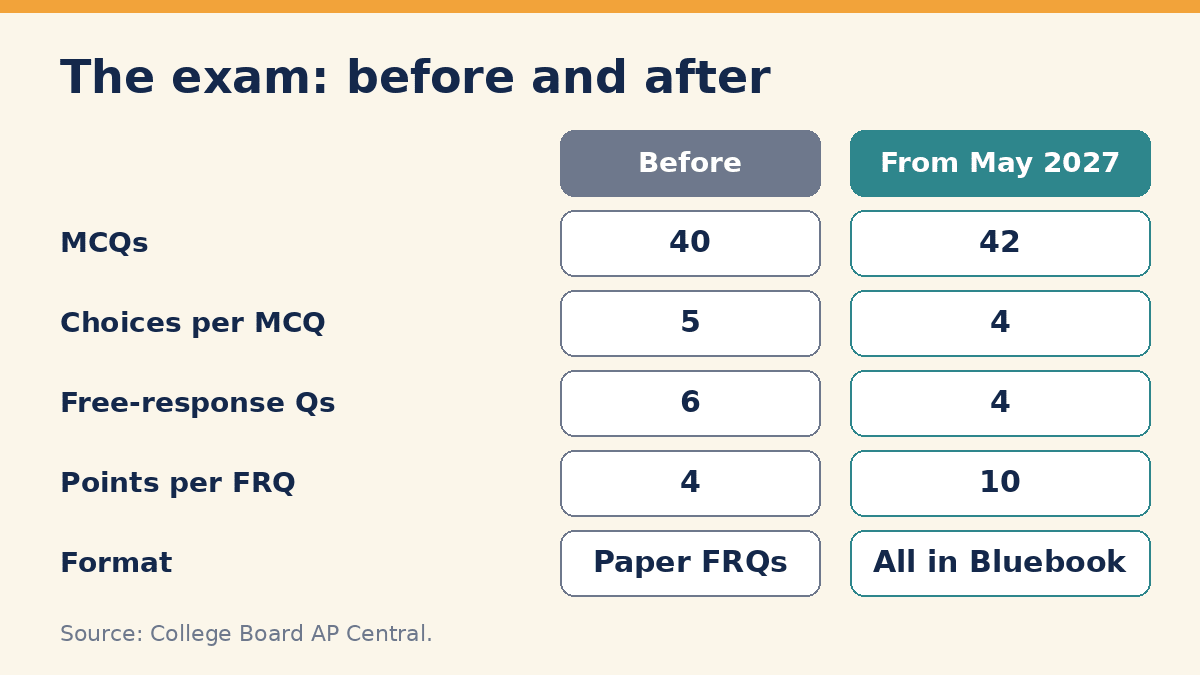
The multiple-choice section also adds two 3-question sets. One is on probability, random variables and distributions. The other is on regression.
The four free-response questions focus on:
- Skills from Practices 1 and 2
- Skills from Practices 3 and 4
- Inference (a hypothesis test or confidence interval)
- Practices 2, 3 and 4 across several content areas
College Board lists the 2027 exam date as Tuesday, May 11, 2027. Check AP Central closer to the time for any changes.
Can you use a calculator on the AP Statistics exam?
Yes. Students can use an approved handheld graphing calculator. The Bluebook app also has a built-in Desmos calculator. Practise with the tool you plan to use, so test day feels normal.
What does an AP Statistics calculation look like?
Many questions ask you to compute a value and then explain what it means. The explaining part is where many students lose points.
Example: A test has a mean of 70 and a standard deviation (SD) of 8. A student scores 82. Find the z-score.
- Formula: z = (x − mean) ÷ SD
- Substitute: z = (82 − 70) ÷ 8
- Subtract: z = 12 ÷ 8
- Divide: z = 1.5
- Meaning: the score is 1.5 standard deviations above the mean.
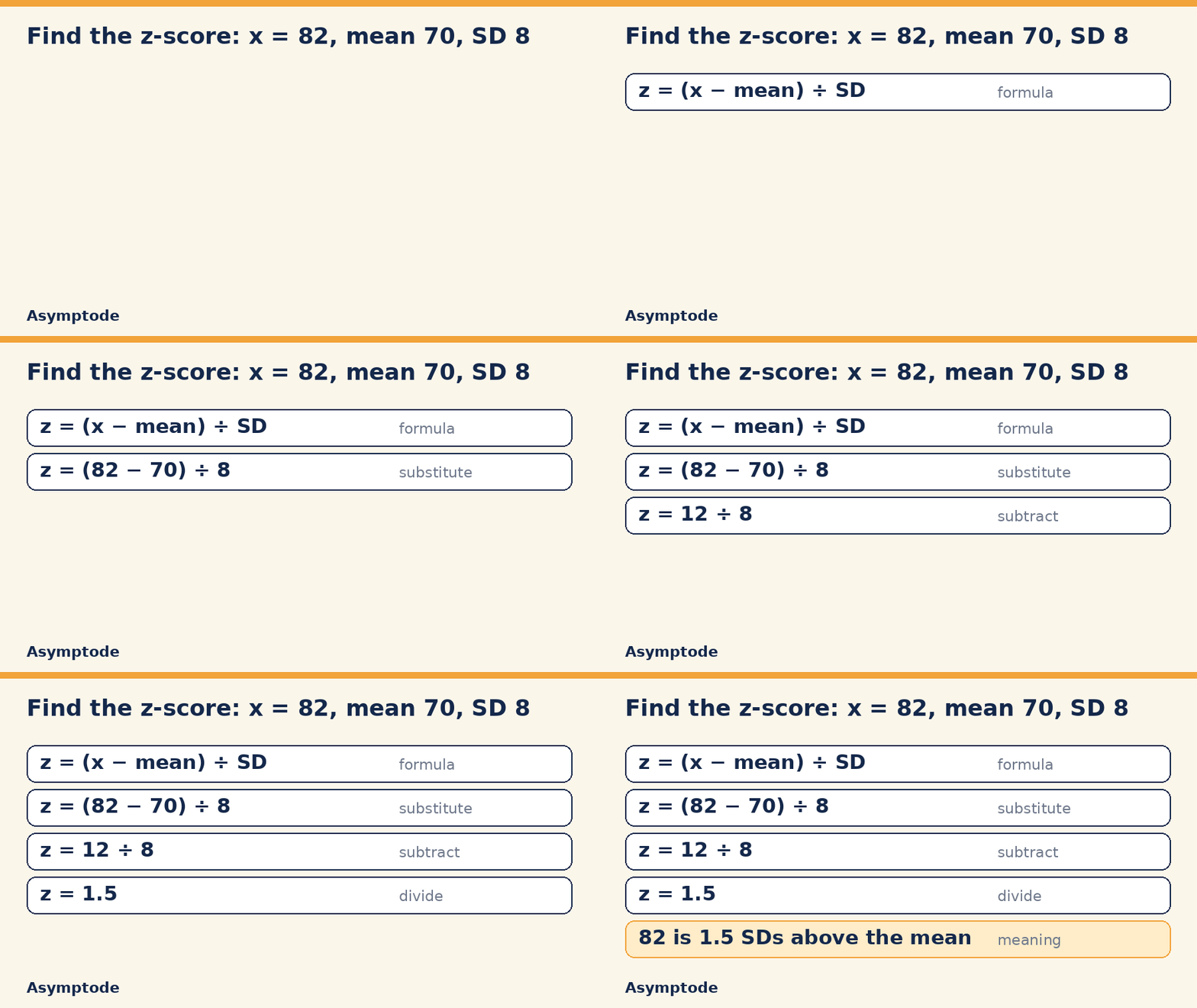
On the free-response section, step 5 matters. Always write your answer in context, using the words from the question.
How should students prepare for the revised AP Statistics exam?
- Use the new unit list. Organize notes by the 5 new units.
- Skip removed topics. Do not spend time on the geometric distribution or slope inference.
- Practise long free-response questions. Each is now worth 10 points, so each one needs a full, clear answer.
- Learn to write in context. Explain every number in the words of the problem.
- Get used to Bluebook. Try College Board's digital practice so the format is not new on exam day.
- Review regression well. It now has its own unit and its own question set.
Not sure where your child stands? Talk to an Asymptode advisor about a 1-on-1 AP Statistics plan.
Who should take AP Statistics?
AP Statistics is a good fit for many students, not only future math majors. Statistics is used in psychology, biology, business, economics, medicine and the social sciences.
It may suit your child if they:
- Like real-world data, surveys and experiments
- Want a math AP course that is different from calculus
- Plan to study a field that uses data in college
- Write clearly and enjoy explaining their thinking
It can be harder for students who dislike writing. The exam rewards clear, complete sentences, not just correct numbers.
Many colleges give credit or placement for qualifying AP scores. Each college sets its own policy, so check the college's AP credit page before you count on it.
How can a tutor help with AP Statistics?
AP Statistics is less about long calculations and more about clear thinking and clear writing. Many students know the formulas but lose points on explanations.
At Asymptode, a tutor works with your child in live 1-on-1 online sessions. They practise real free-response style questions and get personalized homework with feedback on their written answers. Parents can see progress along the way. See our plans on the fees page.
For a wider view of the AP program, read our AP guide for parents. If your child is also taking calculus, see our AP Calculus AB vs BC guide.
FAQ
When does the revised AP Statistics course start?
The revised course starts in the 2026-27 school year. The first fully digital exam is in May 2027.
How many questions are on the new AP Statistics exam?
There are 42 multiple-choice questions and 4 free-response questions. Each section is 1 hour 30 minutes and worth 50% of the score.
Is the geometric distribution still on AP Statistics?
No. College Board lists the geometric distribution as removed from the revised course.
Do you still need Algebra 2 before AP Statistics?
College Board removed the second-year algebra prerequisite. Good algebra skills still make the course easier.
Is the AP Statistics exam on paper or digital?
It is fully digital. Students answer both sections in the Bluebook app, and paper free-response booklets are no longer used.
Can old AP Statistics practice tests still help?
Yes, for most topics. But skip questions on removed topics, and remember the old tests had 5 answer choices and 6 free-response questions.
Ready to build a plan? Book a free chat with an advisor or see our fees.