
If you want to know how to become a veterinarian, the short version is this: do well in school science and maths, earn a recognised veterinary degree, then get licensed or registered in the country where you want to work. The details change a lot from country to country. This guide covers the USA, the UK, India, Canada and Australia, using official sources.
Key takeaways
- Every route needs a recognised veterinary degree plus a licence or registration before you can practise.
- In the USA, the DVM takes about 4 years and you must pass the NAVLE and meet state rules.
- In the UK, vet degrees take 5 or 6 years, and you must register with the RCVS.
- In India, the BVSc & AH takes five and a half years, and NEET-UG is used for the 15% All India Quota.
- Biology and chemistry matter most at school, but maths and physics count too, for example when you work out drug doses.
How to become a veterinarian: what are the main steps?
Quick answer: To become a veterinarian, take biology, chemistry, maths and physics at school, gain hands-on animal experience, and earn a veterinary degree from an accredited school. Then pass the licensing exam or register with the national regulator. In the USA that means a DVM and the NAVLE. In the UK it means RCVS registration.
The steps look similar everywhere:
- Choose strong science and maths subjects at school.
- Get real experience with animals and, if you can, with a vet.
- Apply to a recognised veterinary programme (directly from school in the UK and India, usually after some college study in the USA).
- Complete the veterinary degree, including clinical training.
- Pass the licensing exam or join the official register.
- Start work, and keep learning for your whole career.
 The four big stages on the path to becoming a vet.
The path starts at school with biology, chemistry and maths. Next comes a pre-vet stage or a vet degree, depending on your country. After the degree, you pass a licence exam or join the official register. Only then can you practise as a vet.
What does a veterinarian actually do?
The US Bureau of Labor Statistics puts it simply: "Veterinarians care for the health of animals and work to protect public health." (BLS)
That covers more than pets. The AAVMC notes that vets also help keep the food supply safe, control the spread of diseases, and do research that helps both animals and people. Many work where human and animal health meet, such as food safety and diseases that can jump from animals to humans. (AAVMC VMCAS 2027 Applicant Guide)
The job needs science, careful maths and clear communication. If your child is also weighing up human medicine, our guide on how to become a doctor is a useful comparison.
Which school subjects should you choose to become a vet?
Pick biology and chemistry first, then maths and physics. This advice is consistent across the official sources we checked:
- The AAVMC tells US high school students to take biology, chemistry and physics, and says maths is also important: algebra, geometry, trigonometry, and precalculus or calculus. It also suggests four years of English and public speaking if your school offers it.
- The RCVS says most UK vet schools "require science-related subjects, usually biology and chemistry", plus good GCSEs in maths, English and science. (RCVS)
- India's Veterinary Council (VCI) asks for 10+2 with Physics, Chemistry, Biology or Biotechnology, and English. (VCI bulletin 2026-27)
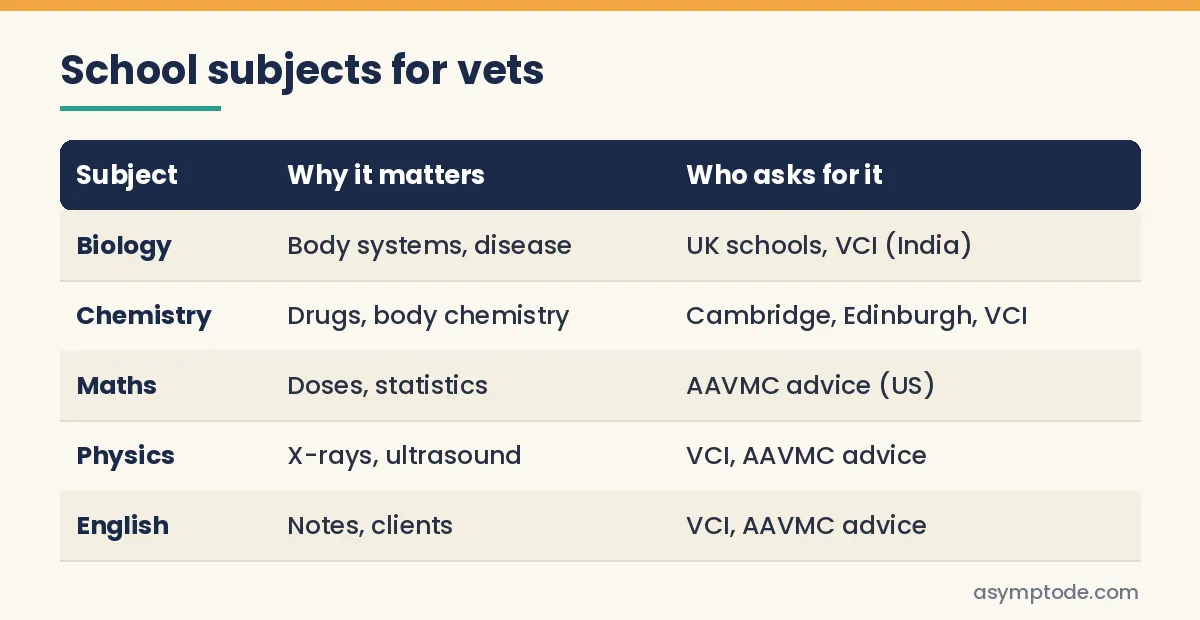 Which school subjects matter for vet school, and why.
Biology covers body systems and disease, and UK schools and the VCI in India ask for it. Chemistry helps you understand drugs and body chemistry; Cambridge, Edinburgh and the VCI ask for it. Maths is used for doses and statistics, and the AAVMC advises it for US students. Physics supports imaging such as X-rays and ultrasound; the VCI requires it and the AAVMC advises it. English matters for notes and talking with clients; the VCI requires it and the AAVMC advises it.
US students can read our AP Biology exam guide and AP Chemistry exam guide. The AAVMC says each vet school has its own rules on AP or IB credit, so check. In the UK, see our A-level Chemistry guide.
Why does maths matter for vets? A dosage example
Vets often dose medicine by body weight, in milligrams per kilogram (mg/kg). A slip with a decimal point can mean a big mistake. Here is a practice example with made-up numbers, for maths only, not medical advice.
Problem: A dog weighs 12 kg. The dose is 5 mg/kg. The medicine is a liquid with 25 mg in every mL. How many mL should be given?
- Find the total dose: 12 kg x 5 mg/kg = 60 mg.
- Find the volume: 60 mg / 25 mg per mL = 2.4 mL.
- Check: 2.4 mL x 25 mg/mL = 60 mg. Correct.
 A worked dosage example using mg/kg (practice numbers only).
The dog weighs 12 kg and the dose is 5 mg per kg. Multiply: 12 x 5 = 60 mg in total. The liquid has 25 mg in every mL. Divide: 60 / 25 = 2.4 mL, then check by multiplying back.
This is simple ratio and unit work, but it must be right every time.
How do you become a veterinarian in the USA?
In the USA you need a Doctor of Veterinary Medicine (DVM) degree from an accredited college, then a licence. The BLS lists the entry-level education as a "Doctoral or professional degree". (BLS)
Step 1: Pre-vet college study
The AAVMC says a DVM "generally takes 4 years, following 3-4 years of undergraduate prerequisites." (AAVMC PreVet FAQs) Some useful points from the AAVMC:
- Most schools do not require a full bachelor's degree before you start, and some students may apply after two years if they finish the prerequisites. Even so, most admitted students have completed four years of study.
- Your major is not a factor in admissions. Most applicants study animal science or biology.
- There is no common list of prerequisites. Check the Veterinary Medical School Admission Requirements (VMSAR) at applytovetschool.org and each school's website.
Step 2: Apply through VMCAS
VMCAS is the AAVMC's central application service. You fill in one application and it goes to many vet schools. VMCAS does not make admission decisions; each school does. For the 2027 cycle, the deadline was September 15 at 11:59 p.m. Eastern Time. Dates for the next cycle are not yet announced in the guide we checked, so check the AAVMC site. (VMCAS 2027 Applicant Guide)
Step 3: Earn a DVM at an accredited school
The AVMA Council on Education (COE) accredits DVM programmes. In the USA, graduating from a COE-accredited college is an important requirement for a licence. The AAVMC says almost all US and Canadian programmes last four years, usually three years of classroom study and one year of clinical training.
Step 4: Pass the NAVLE and get a state licence
The NAVLE (North American Veterinary Licensing Examination) is run by the ICVA. It is required for a licence in all licensing jurisdictions in the USA and Canada. (ICVA) Students usually take it in November or December of their fourth year. The 2026-2027 testing windows are:
| Window | Testing dates |
|---|---|
| Autumn 2026 | 12 October - 14 November 2026 |
| Spring 2027 | 1 - 20 March 2027 |
| Summer 2027 | 12 July - 7 August 2027 |
The BLS adds that "In addition to passing the national exam, most states require that veterinarians pass a state licensing exam."
How do you become a vet in the UK?
In the UK, "you must study for a veterinary degree at university," says the RCVS. Then the law requires registration: "You must register with the Royal College of Veterinary Surgeons to practise as a veterinarian in the UK." Practising without registration can lead to a fine. (GOV.UK)
The RCVS lists 13 schools that are accredited or going through accreditation: Cambridge, Edinburgh, Glasgow, the Royal Veterinary College, Liverpool, Nottingham, Surrey, Bristol, Lancashire, Harper and Keele, Aberystwyth, Scotland's Rural College, and University College Dublin in Ireland.
Course length is usually five years, and Cambridge's course is six. Science graduates may be able to take a compact four-year course. Two official examples show how entry requirements differ:
| University | Length | A-level subjects |
|---|---|---|
| Cambridge | 6 years | Chemistry plus at least one of Biology, Maths or Physics; typical offer A*AA; ESAT test |
| Edinburgh | 5 years | AAA in one sitting, including Chemistry and Biology (or Human Biology) plus one other subject |
Neither university sets a minimum number of work experience days. Edinburgh still expects both vet practice and animal experience, and UCAS applicants send a Work Experience Summary form by 22 October.
How do you become a vet in India?
In India the degree is the BVSc & AH (Bachelor of Veterinary Science and Animal Husbandry). The VCI says it lasts five and a half years, including a one-year compulsory internship. (VCI bulletin 2026-27)
Key points from the 2026-27 VCI bulletin:
- 15% of seats in recognised vet colleges are filled by the VCI on an all-India basis.
- The VCI uses the NEET (UG) merit list from the National Testing Agency to fill these seats.
- There were 858 seats in the 15% All India Quota for 2026-27 (this can change).
- You must be at least 17 by 31 December of the admission year.
- You need 10+2 with Physics, Chemistry, Biology or Biotechnology, and English. General category students need 50% aggregate in these subjects; SC/ST and some other categories need 47.5%.
- Counselling happens online in three rounds: Round 1, Round 2 and a Stray Round, based on NEET rank and your choices.
The other seats are not part of the VCI quota. For those, check your own state's veterinary admission authority. For NEET preparation, read our NEET-UG 2027 guide.
How do you become a vet in Canada or Australia?
Canada: Canada also uses the NAVLE. Candidates who want a Canadian licence register through the CVMA's National Examining Board (NEB). The NEB issues a Certificate of Qualification after proof of graduation, and provincial bodies grant licences. (CVMA)
Australia: The AVBC says you must be registered with your State or Territory Veterinary Registration Board to practise. There are seven AVBC-accredited vet schools in Australia: Melbourne, Queensland, Sydney, Charles Sturt, Murdoch, James Cook and Adelaide. New Zealand has one, at Massey. (AVBC)
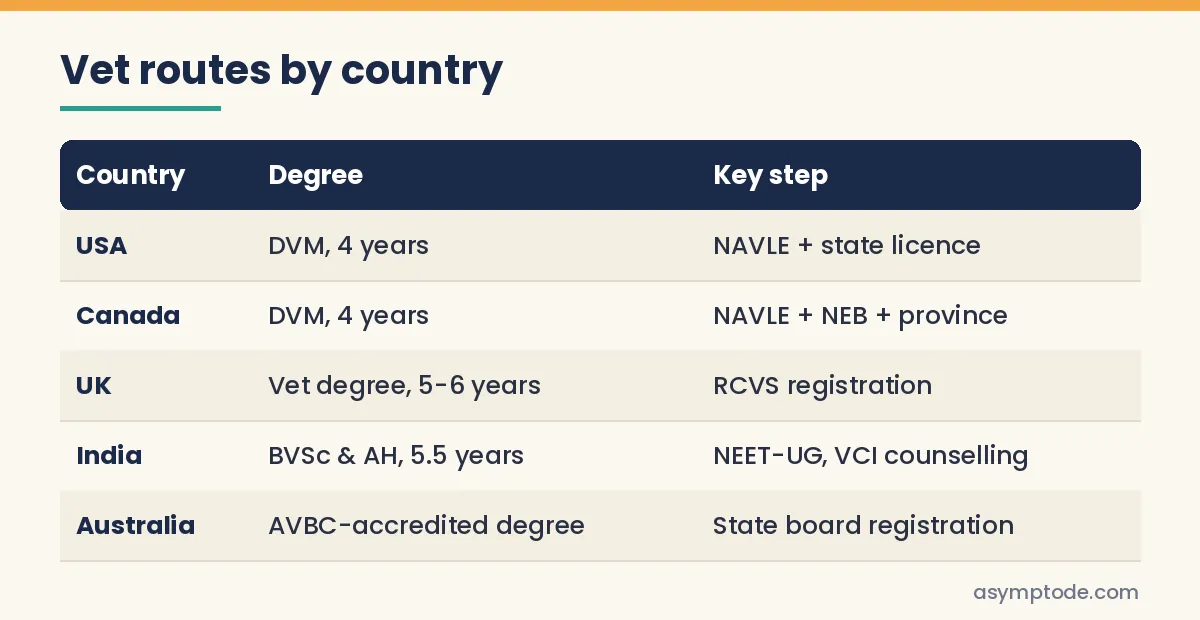 Vet routes at a glance in five countries.
USA: a 4-year DVM, then the NAVLE and a state licence. Canada: a 4-year DVM, then the NAVLE, the NEB and a provincial licence. UK: a 5 or 6-year vet degree, then RCVS registration. India: a five-and-a-half-year BVSc & AH, with NEET-UG used for VCI counselling. Australia: an AVBC-accredited degree, then state or territory board registration.
Want help with the science and maths behind any of these routes? Book a free demo class with an Asymptode mentor, or see our plans and fees.
How much animal and vet experience do you need?
The AAVMC says most US vet schools do not have a required minimum number of veterinary experience hours, but you should check each school. Most schools do want a letter of recommendation from a vet. So you need enough time with one vet for them to know you well.
Good experience ideas from the AAVMC include nature centres, rescues and farms, plus time shadowing more than one vet. A vet in a large clinic may have a very different job from a vet in a small mixed-animal practice.
Only do tasks that match your skills: the AAVMC reminds students it is illegal to practise veterinary medicine without a licence. Keep a log of dates, places, tasks, hours and contacts.
Research experience can also help. Our guide to research for high school students explains how to find a project, and how to become a scientist covers research careers with animals and disease.
What is the job outlook and pay for veterinarians?
The BLS Occupational Outlook Handbook (page updated 29 October 2026) gives these US figures:
- Median pay: "The median annual wage for veterinarians was $130,100 in May 2025."
- Job outlook: "Employment of veterinarians is projected to grow 9 percent from 2025 to 2035", which the BLS calls much faster than average.
- Jobs: about 91,100 in 2025.
- Openings: "About 3,100 openings for veterinarians are projected each year, on average, over the decade."
These are US numbers only; we have not quoted figures for other countries that we could not verify. Vet school is long, so plan finances early. The AAVMC lists scholarships, federal loans and loan repayment programmes as options.
What research steps should students take now?
Use this checklist, starting in Grade 9 or Year 10:
- Pick the right subjects. Keep biology, chemistry, maths and physics.
- Choose your country. Your degree should be recognised where you want to work.
- Read official requirements. Use VMSAR (USA), each university's page (UK), the VCI bulletin (India), and the AVBC (Australia).
- Make a spreadsheet. List each school's subjects, tests, experience rules and deadlines.
- Start experience early. Volunteer with animals and ask to shadow a vet.
- Check dates every year. Deadlines and exam windows change.
How Asymptode helps you with becoming a veterinarian
Every vet route starts with school science. Biology and chemistry come first, but maths and physics matter too, as the mg/kg dosage example showed. These are the parts Asymptode teaches.
A qualified mentor teaches your child one-to-one, live and online. The mentor follows your child's own syllabus, whether that is AP, A level, CBSE or NEET-UG, and plans around their real exam dates.
Between classes, your child gets practice built for them. Each worksheet is made from what their last attempt showed they had not understood, such as a unit slip in a dose problem. It is set at their level, never generic. It is Asymptode's AI-assisted practice, written to the mentor's brief and sent only after the mentor approves it. The mentor marks it, and you see what was understood and what to practice next. So the preparation keeps correcting itself toward vet school.
Personal statements and animal experience are not maths or science. There, the mentor helps with planning only. Talk to an advisor to book a free demo class, or see our fees.
Facts checked against official sources on 7 November 2026.
FAQ
How many years does it take to become a veterinarian?
It depends on the country. In the USA, the AAVMC says a DVM generally takes 4 years after 3-4 years of undergraduate prerequisites. UK vet degrees take 5 or 6 years, and India's BVSc & AH takes five and a half years, including a one-year internship.
Do I need a bachelor's degree before vet school in the USA?
Not always. The AAVMC says most US schools do not require a bachelor's degree, and some students may apply after two years if they finish the prerequisites. However, most admitted students have completed four years of study.
What A levels do I need to be a vet in the UK?
The RCVS says most vet schools usually ask for biology and chemistry. Cambridge asks for Chemistry plus at least one of Biology, Maths or Physics. Edinburgh asks for AAA including Chemistry and Biology. Always check each university's own page.
Is NEET required for BVSc in India?
For the 15% All India Quota, yes. The VCI fills those seats using the NEET (UG) merit list and online counselling in three rounds. For other seats, check your state's admission authority.
How much do veterinarians earn?
In the USA, the BLS says the median annual wage for veterinarians was $130,100 in May 2025. Pay varies by country, job type and experience. We do not quote figures for other countries that we could not verify.
Can I study veterinary medicine abroad and practise at home?
Sometimes. The AAVMC notes that some international schools hold AVMA COE accreditation, so their graduates can take the NAVLE. Each country has its own rules, so check the regulator where you want to work before you apply.
Ready to start? Book a free demo class and advisor call, or see our plans and fees.
Sources
- BLS Occupational Outlook Handbook: Veterinarians
- AAVMC VMCAS 2027 Applicant Guide
- AAVMC PreVet FAQs
- ICVA: NAVLE
- CVMA: NAVLE and the National Examining Board
- RCVS: How do I become a vet?
- GOV.UK: Register to practise as a veterinarian
- University of Cambridge (Downing College): Veterinary Medicine
- University of Edinburgh: BVM&S five-year entry requirements
- Veterinary Council of India: Information Bulletin 2026-27 (15% quota)
- AVBC: Veterinary Science in Australia