

GCSE Chemistry (also called "triple" or "separate" chemistry) is a full GCSE on its own. It goes deeper than Combined Science and adds extra content. This guide explains the papers for each exam board, the 10 AQA topics, the 8 required practicals, the key calculations with worked examples, and a 12-week revision plan.
Key takeaways
- AQA (8462) sets 2 papers of 1 hour 45 minutes and 100 marks, each worth 50%.
- AQA Paper 1 covers topics 1–5 (atoms, bonding, quantitative chemistry, chemical changes, energy). Paper 2 covers topics 6–10 (rates, organic, analysis, atmosphere, resources).
- Papers are tiered: Foundation (grades 1–5) or Higher (grades 4–9).
- AQA GCSE Chemistry has 8 required practicals, tested in the written papers.
- Unlike physics, there is no equation sheet. A periodic table is provided, but students must know the formulas.
What is GCSE Chemistry?
Quick answer: GCSE Chemistry is a single-science GCSE taken in England, usually at the end of Year 11. Students sit two written papers at Foundation or Higher tier and get one grade from 9 to 1. It covers atomic structure, bonding, moles, reactions, energy, rates, organic chemistry, analysis, the atmosphere and resources.
It is different from GCSE Combined Science, where chemistry is one-third of a double award worth two GCSEs. If your child is choosing between the two, read our GCSE Combined Science guide. Separate chemistry suits students who enjoy science or plan to take A-Level Chemistry, Biology or Medicine-related courses.
How many papers are there in GCSE Chemistry?
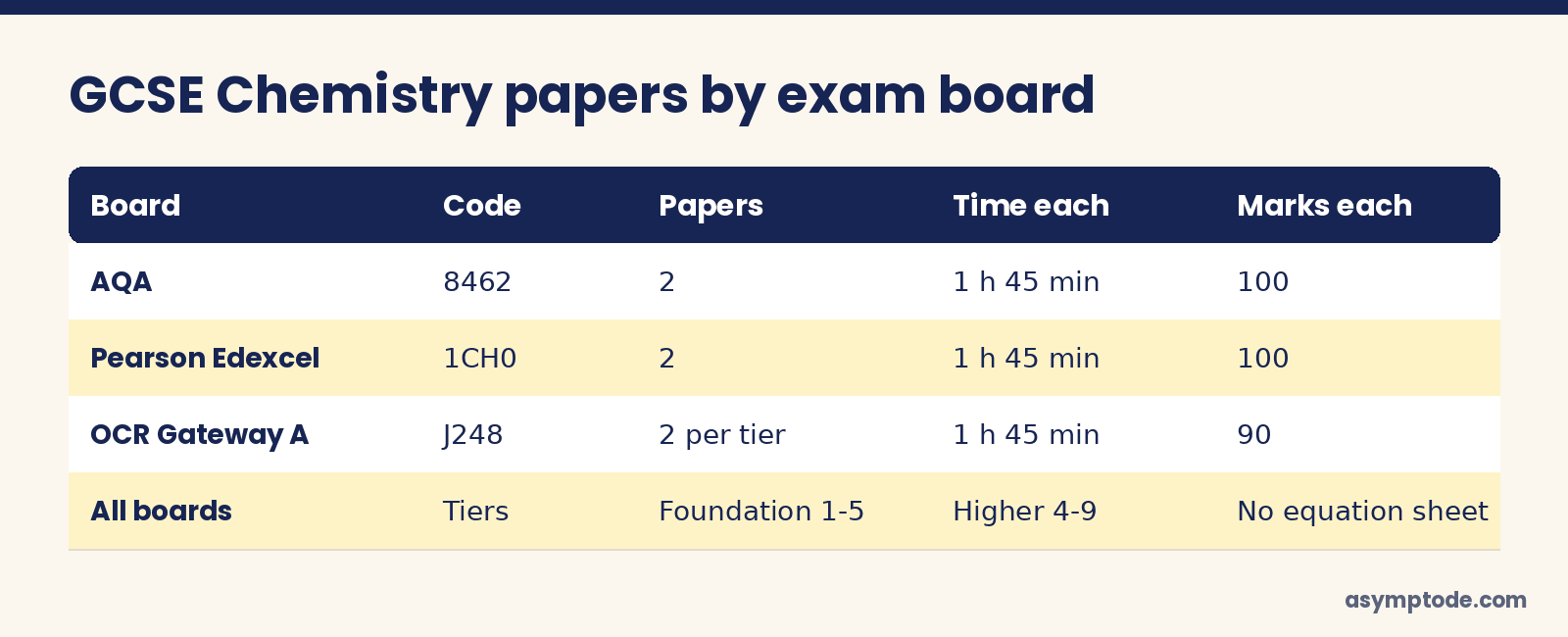
Quick answer: Two. AQA and Pearson Edexcel each set two papers of 1 hour 45 minutes and 100 marks, worth 50% each. OCR Gateway Chemistry A sets two papers per tier of 1 hour 45 minutes and 90 marks. All exams are taken at the end of the course.
| Exam board | Code | Papers | Time each | Marks each |
|---|---|---|---|---|
| AQA | 8462 | 2 | 1 h 45 min | 100 |
| Pearson Edexcel | 1CH0 | 2 | 1 h 45 min | 100 |
| OCR Gateway A | J248 | 2 per tier | 1 h 45 min | 90 |
Check your child's exam board with their school. The content is similar across boards, but the order of topics and the style of questions differ.
Questions include multiple choice, short structured answers, calculations and longer "6-mark" open answers. Long answers need a clear, logical explanation, not a list of keywords.
What topics are in AQA GCSE Chemistry?
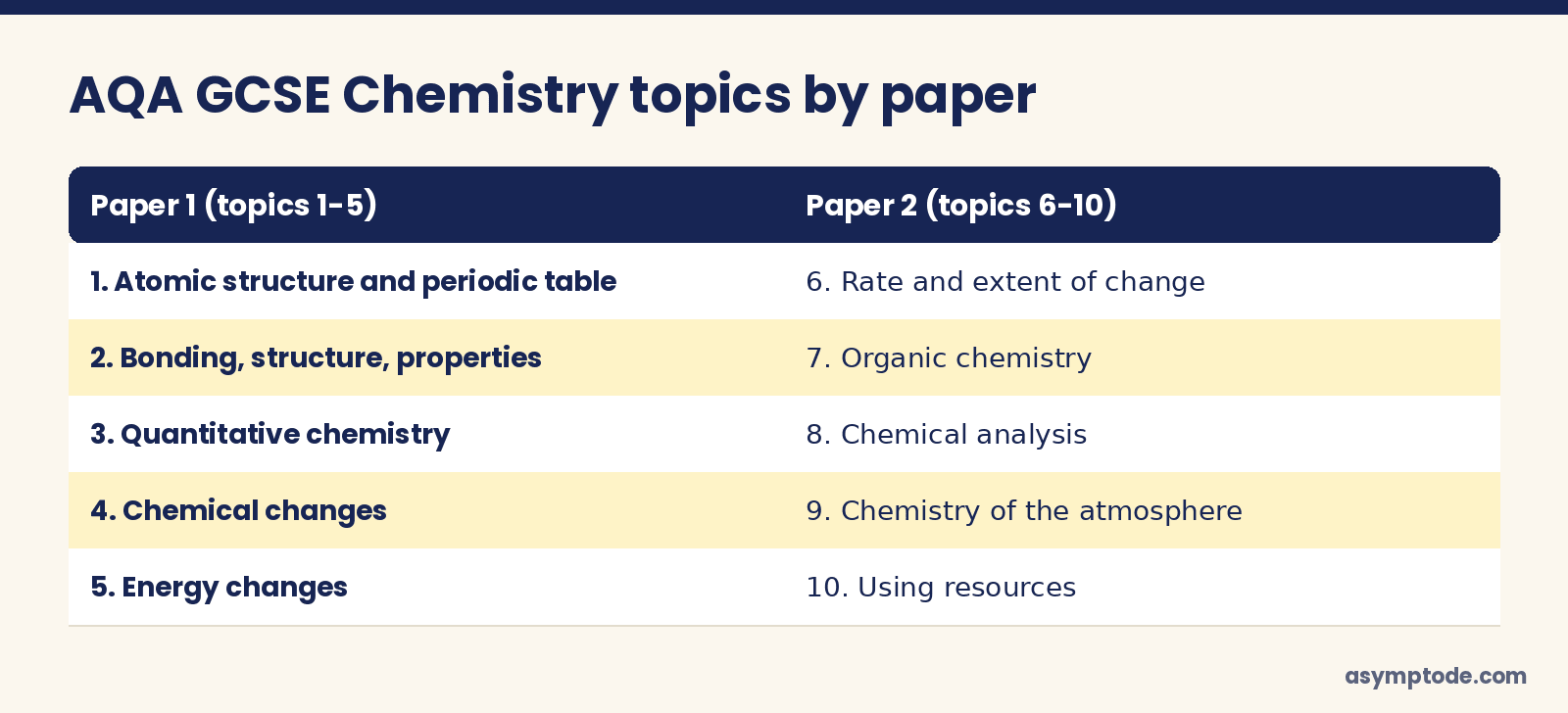
| Paper 1 (topics 1–5) | Paper 2 (topics 6–10) |
|---|---|
| 1. Atomic structure and the periodic table | 6. Rate and extent of chemical change |
| 2. Bonding, structure and properties of matter | 7. Organic chemistry |
| 3. Quantitative chemistry | 8. Chemical analysis |
| 4. Chemical changes | 9. Chemistry of the atmosphere |
| 5. Energy changes | 10. Using resources |
AQA notes that Paper 2 can also draw on ideas from topics 1–3. So atoms, bonding and moles matter for both papers.
What are the AQA GCSE Chemistry required practicals?
Quick answer: AQA GCSE Chemistry has 8 required practicals. Four are linked to Paper 1 (making a salt, titration, electrolysis, temperature changes) and four to Paper 2 (rates, chromatography, identifying ions, water purification). Questions test the method, variables, results and errors.
| Practical | Paper |
|---|---|
| Making a pure, dry soluble salt | 1 |
| Titration of a strong acid and strong alkali | 1 |
| Electrolysis of aqueous solutions | 1 |
| Temperature changes in reactions | 1 |
| Rates of reaction | 2 |
| Chromatography and Rf values | 2 |
| Identifying ions | 2 |
| Analysing and purifying water samples | 2 |
For each one, students should be able to describe the method in steps, name the independent, dependent and control variables, and suggest one improvement.
What calculations come up in GCSE Chemistry?
Calculations carry a lot of marks, and Higher tier has more of them. The key ones are relative formula mass, moles, concentration, percentage yield, atom economy and Rf values. Here are worked examples with every step.
Worked example 1: Moles from mass
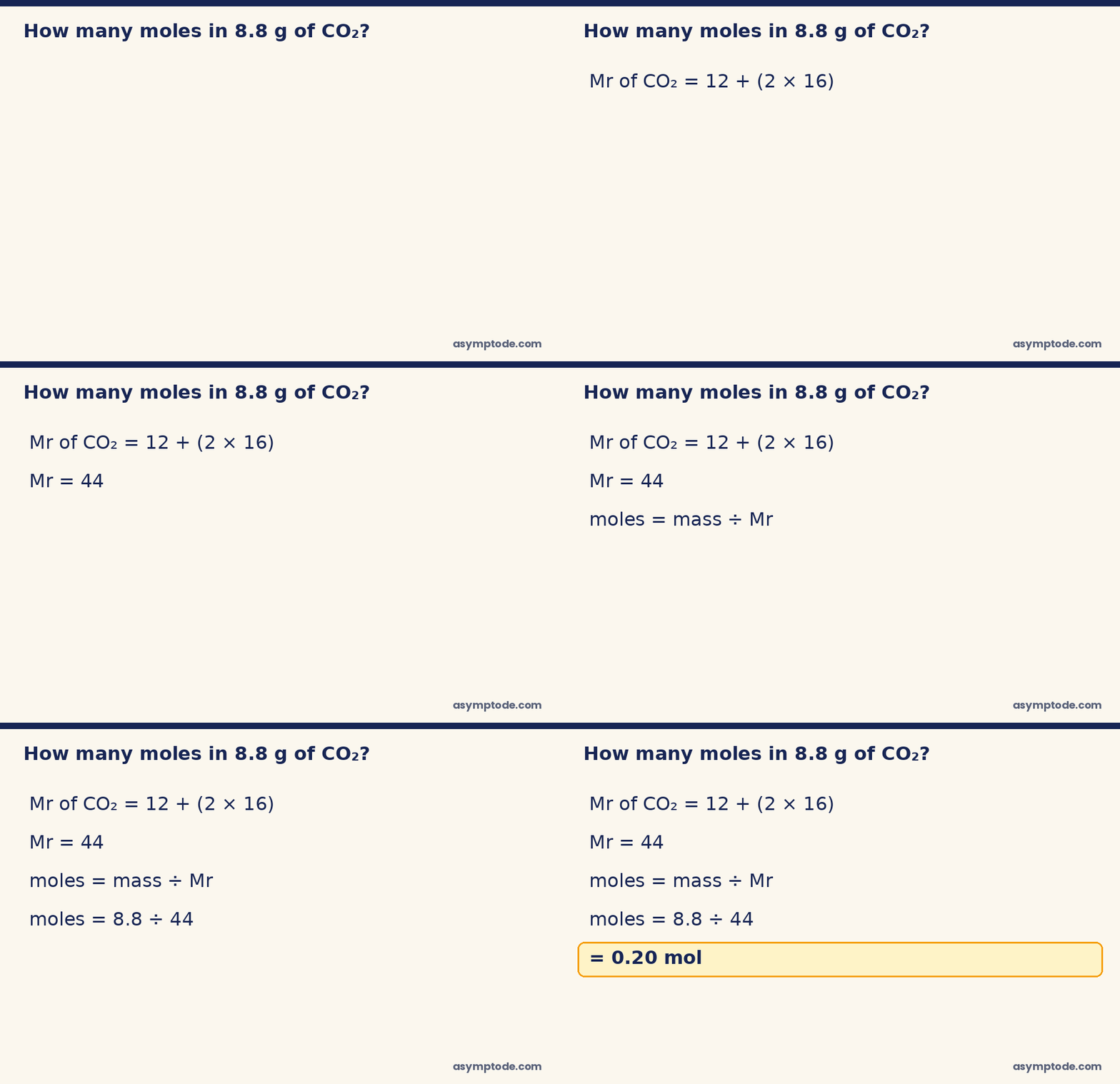
Question: How many moles are in 8.8 g of carbon dioxide, CO₂? (C = 12, O = 16)
- Mr of CO₂ = 12 + (2 × 16) = 44.
- moles = mass ÷ Mr.
- moles = 8.8 ÷ 44 = 0.20 mol.
Worked example 2: Concentration
Question: 4.0 g of sodium hydroxide, NaOH, is dissolved to make 250 cm³ of solution. What is the concentration in mol/dm³? (Na = 23, O = 16, H = 1)
- Mr of NaOH = 23 + 16 + 1 = 40.
- moles = 4.0 ÷ 40 = 0.10 mol.
- Volume = 250 cm³ = 250 ÷ 1000 = 0.250 dm³.
- concentration = 0.10 ÷ 0.250 = 0.40 mol/dm³.
The most common mistake is forgetting to change cm³ into dm³. Divide by 1000 first.
Worked example 3: Percentage yield
Question: A reaction should make 5.0 g of product. It actually makes 4.2 g. What is the percentage yield?
- percentage yield = (actual ÷ theoretical) × 100.
- = (4.2 ÷ 5.0) × 100 = 84%.
Then explain why yield is below 100%: the reaction may be reversible, some product is lost when separating it, or there are side reactions.
Worked example 4: Rf value
Question: In chromatography, a spot moves 3.0 cm and the solvent front moves 7.5 cm. What is the Rf value?
- Rf = distance moved by spot ÷ distance moved by solvent.
- Rf = 3.0 ÷ 7.5 = 0.40.
Rf has no units and is always less than 1.
What are the most common GCSE Chemistry mistakes?
- Not learning formulas. There is no chemistry equation sheet, so moles, concentration and yield formulas must be memorised.
- Unbalanced equations. Practise balancing until it is automatic. Our guide to balancing chemical equations walks through it.
- Mixing up ionic and covalent bonding, or saying ionic compounds have "molecules".
- Forgetting units or not converting cm³ to dm³.
- Weak 6-mark answers. Write in a logical order: what happens, then why.
- Learning practicals as stories instead of steps with variables.
A 12-week GCSE Chemistry revision plan
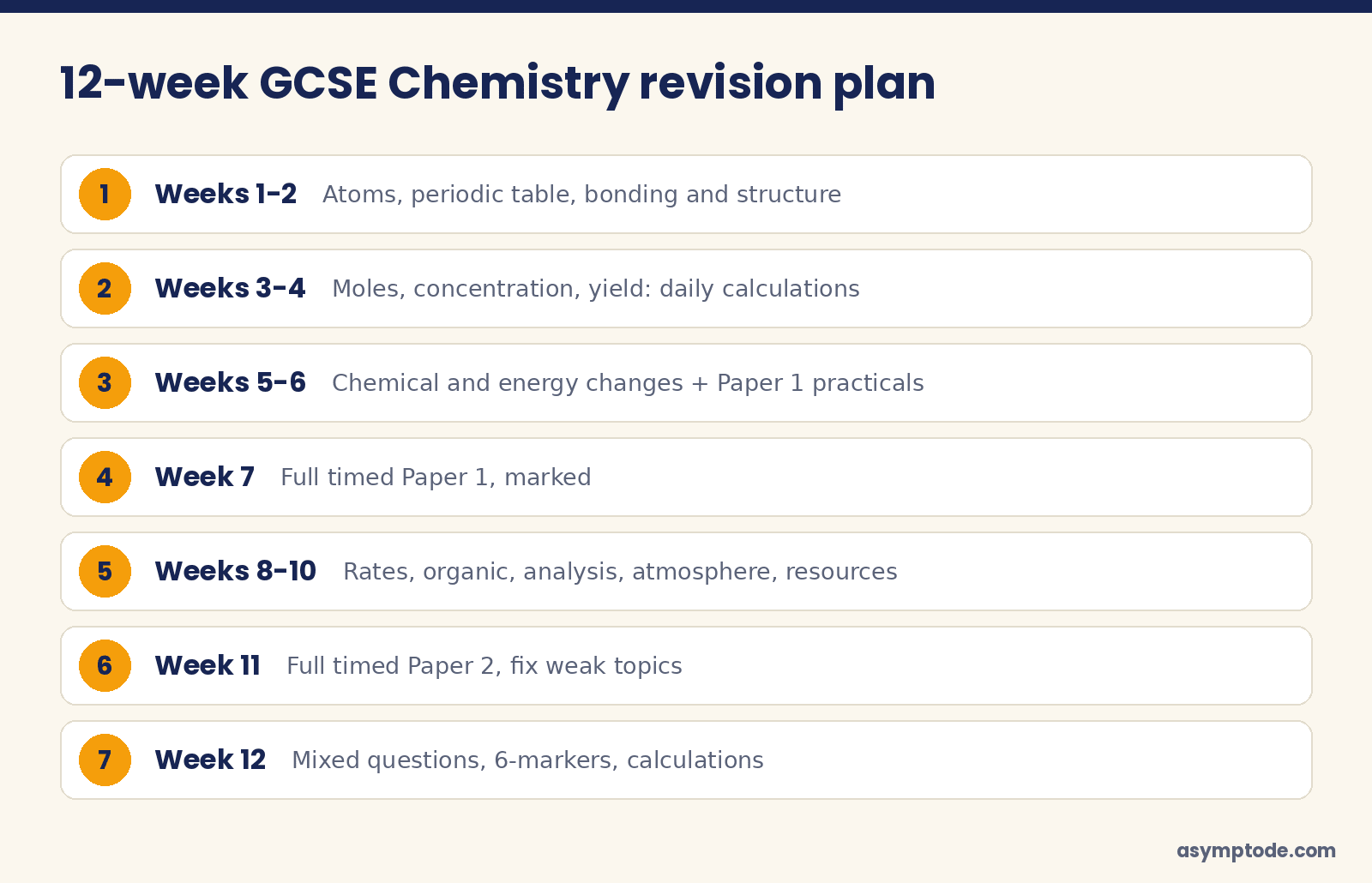
| Weeks | Focus |
|---|---|
| 1–2 | Atomic structure, periodic table, bonding and structure |
| 3–4 | Quantitative chemistry: Mr, moles, concentration, yield (daily calculation practice) |
| 5–6 | Chemical changes and energy changes, plus the 4 Paper 1 practicals |
| 7 | Full timed Paper 1, marked with the mark scheme |
| 8–9 | Rates and equilibrium, organic chemistry, chemical analysis |
| 10 | Atmosphere and using resources, plus the 4 Paper 2 practicals |
| 11 | Full timed Paper 2, then fix weak topics |
| 12 | Mixed past-paper questions, 6-mark answers and calculations |
Short daily practice beats long weekend sessions. Spend 10 minutes a day on calculations, and keep an error log of every lost mark. If chemistry basics feel shaky, start with our explainer on atoms and elements. For maths support, see our GCSE Maths papers guide.
How 1-on-1 tutoring helps with GCSE Chemistry
Chemistry builds step by step. If moles or bonding do not make sense, later topics feel impossible. In 1-on-1 lessons at Asymptode, one dedicated mentor teaches one student:
- The mentor follows your child's exam board, tier and school order of topics, and plans to the summer exam dates.
- In each lesson the mentor watches every step of a calculation and fixes the method, such as a missed cm³ to dm³ conversion.
- The mentor finds the smaller missing piece behind a topic that will not land, for example ratios behind mole calculations.
- Homework is set on the topics taught and marked with feedback.
- Every class is recorded and can be rewatched by topic before the exams.
- Parents get regular updates on progress and next steps.
Book a free demo class or see our fees.
Related GCSE science guides
FAQ
How many papers are in GCSE Chemistry?
Two. AQA and Edexcel set two papers of 1 hour 45 minutes and 100 marks each. OCR Gateway sets two papers per tier of 1 hour 45 minutes and 90 marks each.
Is there an equation sheet for GCSE Chemistry?
No. A periodic table is provided, but students must remember the chemistry formulas, such as moles = mass ÷ Mr.
How many required practicals are in AQA GCSE Chemistry?
Eight. Four link to Paper 1 and four to Paper 2. They are tested through questions in the written exams.
What is the difference between GCSE Chemistry and Combined Science?
GCSE Chemistry is a full GCSE with more depth and extra content. Combined Science covers biology, chemistry and physics together and gives a double grade worth two GCSEs.
What grades can you get on Foundation tier?
Foundation tier gives grades 1 to 5. Higher tier gives grades 4 to 9.
What is the hardest topic in GCSE Chemistry?
Many students find quantitative chemistry (moles and concentration) hardest. Daily short practice with worked steps makes it much easier.