
If you want to know how to become a biomedical engineer, the short path is this: take maths, physics, chemistry and biology at school, earn an accredited engineering degree, and build real experience through internships or research. Biomedical engineers use engineering to solve health problems. This guide explains the job, the school subjects to pick, and the degree routes in the USA, UK, India, Canada and Australia. It also gives the honest US job outlook from official data. Every fact here comes from an official source.
Key takeaways
- Biomedical engineers design medical devices, equipment and software, and many work in research, device makers or hospitals.
- At school, take maths up to calculus, physics, chemistry and biology. Computer programming helps too.
- A bachelor's degree is the typical entry point. Check that the program is accredited (ABET in the US, Engineering Council in the UK, CEAB in Canada, Engineers Australia).
- In India, look at B.Tech Biomedical Engineering at IIT Hyderabad (via JEE Advanced and JoSAA) or NIT Rourkela (via JEE Main).
- The US Bureau of Labor Statistics reports a median pay of $109,370 in May 2025 and 8% projected job growth from 2025 to 2035.
How to become a biomedical engineer: what are the steps?
Quick answer: To become a biomedical engineer, study maths, physics, chemistry and biology in high school. Then complete an accredited bachelor's degree in biomedical engineering, bioengineering or a related engineering field. Gain experience through internships, co-ops or research. A professional licence is optional in many roles, and some jobs need a master's degree.
Here are the steps in order:
- Pick the right school subjects. Maths, physics, chemistry and biology are the core. Add computer science if you can.
- Choose an accredited degree. Accreditation shows a program meets the standards of the engineering profession.
- Get hands-on experience. Internships, co-ops and lab research teach you how real devices are built and tested.
- Start work, and think about a licence or further study. Licences and graduate degrees open more senior roles.
 The four stages on the path to biomedical engineering.
The path has four boxes. First, school subjects: maths, physics, chemistry and biology.
Second, an accredited degree in biomedical engineering or a related field.
Third, internships and research to gain real experience.
Fourth, work as an engineer, with a licence as an option later.
What does a biomedical engineer actually do?
Biomedical engineers mix engineering with biology and medicine. The US Bureau of Labor Statistics (BLS) says they design equipment and devices such as artificial internal organs, replacements for body parts, and diagnostic machines. They also install and maintain biomedical equipment, train clinicians to use it, build statistical models or simulations, and write technical reports and research papers. See the official BLS Occupational Outlook Handbook page.
What are the main types of biomedical engineering?
The BLS lists several specialty areas. Here are the main ones in plain words:
| Specialty | What they work on |
|---|---|
| Bioinstrumentation | Electronic tools to diagnose and treat illness, like monitors |
| Biomaterials | Natural or lab-made materials for implants and devices |
| Biomechanics | How forces and motion work in the body, like joint movement |
| Clinical engineering | Using medical technology to improve hospital care |
| Rehabilitation engineering | Devices that help people adapt to physical or cognitive impairments |
| Systems physiology | Using engineering tools to understand how body systems work |
Some university programs also teach newer areas. For example, the B.Tech in Biomedical Engineering at IIT Hyderabad offers electives in medical optics and imaging, 3D bio-printing (a step toward tissue engineering), nanomedicine, neurotechnology and healthcare data analytics.
Where do biomedical engineers work?
According to the BLS, the largest employers in the US are:
- Research and development in the physical, engineering and life sciences: 22%
- Medical equipment and supplies manufacturing: 10%
- Healthcare and social assistance: 10%
- Educational services (state, local and private): 9%
- Navigational, measuring, electromedical and control instruments manufacturing: 8%
Most work full time in labs and clinical settings, in teams with scientists and healthcare workers.
Biomedical engineer vs doctor: which fits you?
A doctor treats patients. A biomedical engineer builds the tools doctors use. If you want to treat people every day, read how to become a doctor.
Which school subjects should I choose to become a biomedical engineer?
Choose maths, physics, chemistry and biology. The BLS says high school students should take chemistry, physics and biology, and study maths including algebra, geometry, trigonometry and calculus. It adds that drafting, mechanical drawing and computer programming are also useful.
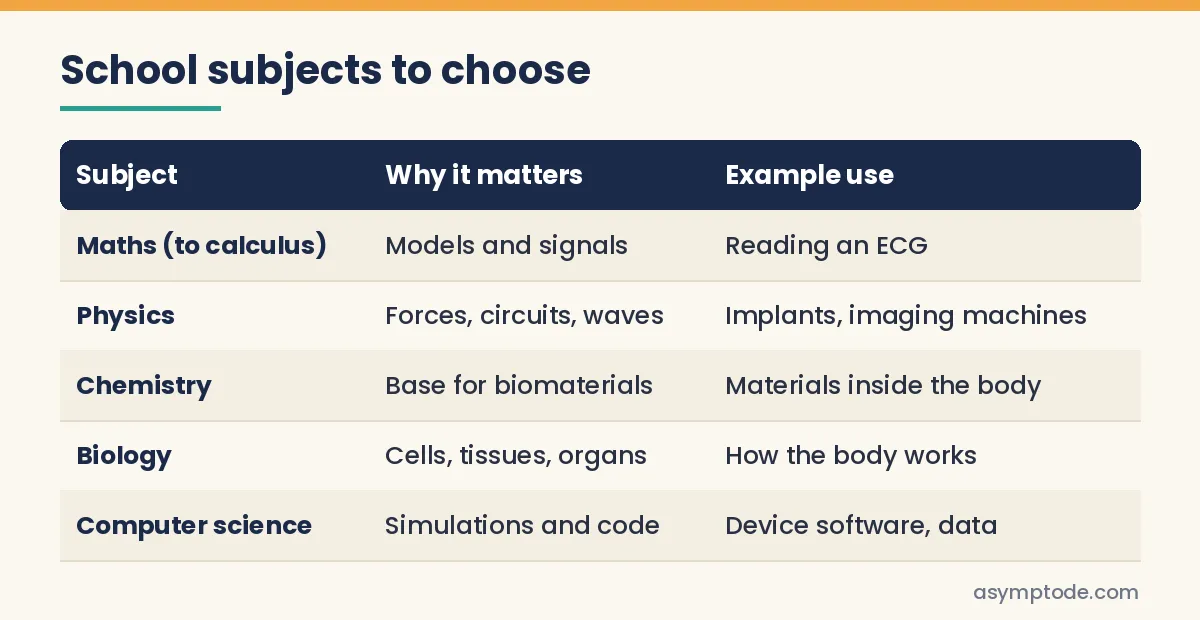 The five school subjects that matter most, and where each one shows up in the job.
Maths (up to calculus) is used for models and signal analysis, such as reading an ECG.
Physics explains forces, circuits and waves, which matter in implants and imaging machines.
Chemistry is the base for biomaterials and how a material reacts inside the body.
Biology teaches how cells, tissues and organs work.
Computer science helps with simulations, device software and medical data.
Why is maths so important?
Engineers use calculus to model blood flow, statistics to test whether a device works, and algebra to turn sensor signals into numbers a doctor can read.
What should I pick in my school system?
- USA: The highest maths offered (ideally calculus), plus physics, chemistry and biology, at AP or honors level if possible.
- UK: A-level Maths, Physics and Chemistry or Biology. Check each university's entry requirements.
- India: PCM (Physics, Chemistry, Mathematics) in Class 11 and 12 for JEE, with Biology as an extra if you can.
- IB: Maths and Physics at Higher Level, plus Chemistry or Biology.
Read our guide on physics, chemistry and biology to see how the three sciences link together.
Which degree do you need to become a biomedical engineer?
The BLS says the typical entry-level education is a bachelor's degree in bioengineering, biomedical engineering, or a related engineering field. Some positions need a graduate degree. Courses usually cover biological sciences, fluid and solid mechanics, circuit design and biomaterials. Many programs include co-ops or internships with hospitals and device or drug companies.
Some students start with mechanical or electrical engineering and specialise later. For a wider view of all engineering branches, see how to become an engineer.
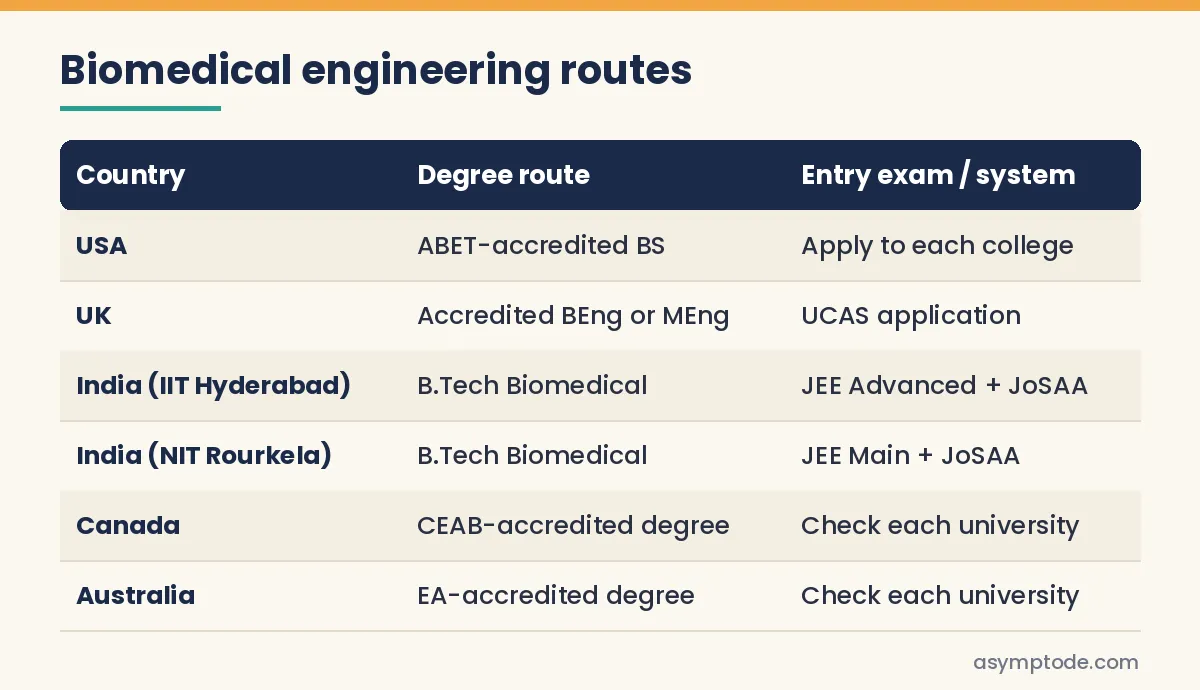 Degree routes and entry systems by country.
USA: an ABET-accredited BS in biomedical engineering, applying to each college.
UK: an accredited BEng or MEng, applying through UCAS.
India: B.Tech Biomedical at IIT Hyderabad (JEE Advanced) or NIT Rourkela (JEE Main), with seats through JoSAA.
Canada: a CEAB-accredited degree. Australia: a degree accredited by Engineers Australia (EA). For both, check each university's entry rules.
USA: ABET-accredited degrees and the optional FE and PE
In the US, look for a program accredited by ABET. ABET accredits programs, not whole universities, so check the exact degree you want. ABET has a search tool to find accredited programs.
A professional engineer (PE) licence is optional for most biomedical engineering jobs, but some engineers choose it. According to NCEES, the usual path is:
- A bachelor's degree from an EAC/ABET-accredited program.
- Pass the Fundamentals of Engineering (FE) exam.
- Gain about four years of acceptable work experience (most states).
- Pass the PE exam.
The FE exam is computer-based, given year-round at Pearson test centres, and has 110 questions. NCEES says it is designed for recent graduates and students close to finishing an accredited degree. Check which FE discipline fits your degree, and check your state board's rules.
Aiming for a top US school? Our guide on how to get into MIT covers the application process.
UK: accredited degrees, UCAS and Chartered Engineer (CEng)
In the UK, you apply through UCAS. For 2027 entry, the equal consideration date for most courses is 13 January 2027 at 18:00 UK time. For Oxford and Cambridge, it was 15 October 2026. You can make up to five choices.
Pick a degree accredited or recognised by the Engineering Council, which has a course search. This makes professional registration easier later.
The top professional title in UK engineering is Chartered Engineer (CEng). The Engineering Council says you show the competence standard (UK-SPEC) and apply through a professional engineering institution. For biomedical work, that body can be the Institute of Physics and Engineering in Medicine (IPEM). IPEM's CEng guidance says it is licensed by the Engineering Council to process CEng applications. The usual academic base is an accredited MEng, or an accredited BEng/BSc (Hons) plus further learning to master's level. There is also a work-based route. IPEM also lists training routes into clinical engineering, such as Clinical Scientist Training.
India: B.Tech Biomedical through JEE and JoSAA
In India, only a few top institutes offer a B.Tech in biomedical engineering. Here is what we verified on official pages:
| Institute | Program | Entry exam |
|---|---|---|
| IIT Hyderabad | B.Tech Biomedical Engineering | JEE Advanced, seats via JoSAA |
| IIT (BHU) Varanasi | Integrated Dual Degree (School of Biomedical Engineering) | JEE Advanced, seats via JoSAA |
| NIT Rourkela | B.Tech Biomedical Engineering (4 years) | JEE Main, seats via JoSAA |
IIT Hyderabad says its program was the first B.Tech in biomedical engineering among all IITs, announced in October 2020. IIT (BHU)'s School of Biomedical Engineering runs an Integrated Dual Degree program, not a standalone four-year B.Tech, so check the details on its page. NIT Rourkela lists a four-year B.Tech in Biomedical Engineering through JEE Main.
Other institutes may offer similar programs. The JoSAA seat matrix is the place to check. For 2026-27, JoSAA managed seats at 138 institutes, including 23 IITs and 31 NITs. The 2027 schedule is not yet published. We could not confirm a biomedical B.E. at BITS Pilani, so check BITS's official page if you are interested.
Key dates for JEE Main 2027:
- Two sessions: January 2027 and April 2027.
- Session 1 applications: 24 October to 22 November 2026 (11:50 PM).
- Session 1 exam days: 20, 21, 22, 23, 24 and 28 January 2027.
- Paper 1 is for B.E./B.Tech at NITs, IIITs and other centrally funded institutes. It is also the qualifying test for JEE Advanced, which leads to the IITs.
- JEE Advanced 2027 dates: not yet announced.
Read our full JEE Main 2027 guide and our guide on how to get into IIT.
Canada and Australia in brief
Canada: To practise engineering, you need a licence from one of the 12 provincial and territorial regulators. Engineers Canada says the usual path is a degree from a CEAB-accredited program, the work experience your province requires, and the Professional Practice Examination (PPE), which covers law and ethics.
Australia: Engineers Australia accredits university engineering programs and is a full signatory to the Washington Accord. It publishes a list of accredited programs. Engineers Australia has a Biomedical College, and its Chartered credential is its highest technical recognition.
We do not quote salaries for the UK, India, Canada or Australia, because we did not find an official national figure for this exact job.
Book a free demo class to plan your maths and science subjects for a biomedical engineering degree, or see our plans and fees.
Worked example: how do engineers turn an ECG into a heart rate?
Biomedical engineers often turn body signals into numbers. Here is a simple example from an ECG (electrocardiogram) heart monitor.
On an ECG, each heartbeat makes a tall spike called the R wave. The time between two R waves is the R-R interval.
 A heart rate worked out from one R-R interval on an ECG.
Step 1: measure the time between two R waves. Here it is 0.8 seconds.
Step 2: a minute has 60 seconds, so heart rate = 60 / 0.8.
Step 3: 60 / 0.8 = 75 beats per minute.
Check: 75 beats x 0.8 seconds = 60 seconds, which is one minute.
A heart monitor runs this same maths again and again, which is why maths and programming matter in this career.
How can school students get research experience and internships?
You do not need to wait for university. Here are practical ways to start:
- Do a science project on a health problem. Measure pulse before and after exercise, or build a simple sensor.
- Email university labs. Ask politely if they take high school students, and name the lab's work.
- Join a science fair. It teaches you to plan an experiment and write up results.
- Learn to code. The BLS lists computer programming as useful.
Our guide to research for high school students explains how to find a mentor and present your work. If you enjoy the lab more than building devices, see how to become a scientist.
In university, the BLS notes that many programs include co-ops or internships with hospitals and medical device or pharmaceutical companies. These count a lot when you apply for your first job.
What is the job outlook for biomedical engineers?
This section uses only the official US data from the BLS Occupational Outlook Handbook (page last updated 27 August 2026).
| Measure | Figure (US) |
|---|---|
| Median pay, May 2025 | $109,370 per year ($52.58 per hour) |
| Lowest 10% earned less than | $71,850 |
| Highest 10% earned more than | $168,180 |
| Number of jobs, 2025 | 23,800 |
| Projected growth, 2025-35 | 8% (much faster than average) |
| Employment change, 2025-35 | 1,800 |
| Openings per year (average) | About 1,200 |
Growth is fast in percentage terms, but the field is small. Most of the 1,200 yearly openings come from people retiring or changing jobs. The BLS expects demand from medical devices and procedures such as hip and knee replacements.
The BLS adds that leading a research team usually needs a graduate degree. Some biomedical engineers move into medical school, patent law or business management.
Is biomedical engineering a good career?
It can be, if you enjoy both biology and maths and want work that helps patients. But the field is small, so strong grades, internships and practical skills matter.
How Asymptode helps you with becoming a biomedical engineer
At Asymptode, a qualified mentor teaches your child one-to-one, live online, in the subjects this career needs: maths up to calculus, physics, chemistry and biology. The mentor follows your child's actual route, whether that is AP and US college applications, A-levels and the UCAS deadline, or JEE Main sessions in January and April 2027 for IIT Hyderabad or NIT Rourkela.
Between classes, your child gets practice built just for them. It is a worksheet made from what their last attempt showed they had not yet understood, such as rearranging a formula or reading a graph of a signal. It is set at their level and is never generic. This is Asymptode's AI-assisted practice, written to the mentor's brief and sent only after the mentor approves it.
The mentor marks the work, and you as a parent see what was understood and what to practise next. So preparation keeps correcting itself toward a strong engineering application. For research projects and personal statements, the mentor helps with planning, method and review.
Book a free demo class or see our fees.
Facts checked against official sources on 8 November 2026.
FAQ
How long does it take to become a biomedical engineer?
A bachelor's degree is the typical entry point. Length varies by country and university; NIT Rourkela's B.Tech, for example, is four years. Some roles need a master's degree, which adds more time. A US PE licence adds about four years of work experience in most states.
Can I become a biomedical engineer without biology at school?
Yes, many students do. The BLS lists biology alongside chemistry and physics as useful, but maths and physics are usually the hardest to catch up on later. In India, PCM is needed for JEE, and biology can be an extra subject.
Do biomedical engineers need a licence?
Not for most jobs. In the US, a PE licence through NCEES is optional for many roles. In Canada, you need a licence from a provincial or territorial regulator to practise engineering, so check the rules where you will work.
What is the salary of a biomedical engineer?
In the US, the BLS reports a median pay of $109,370 per year in May 2025. The lowest 10% earned less than $71,850 and the highest 10% more than $168,180. We do not quote figures for other countries because we did not find official national data for this job.
Which IITs offer biomedical engineering?
IIT Hyderabad offers a B.Tech in Biomedical Engineering, and IIT (BHU) Varanasi's School of Biomedical Engineering runs an Integrated Dual Degree. Admission to IITs is through JEE Advanced and JoSAA. Check the JoSAA seat matrix each year, as programs can change.
Is biomedical engineering harder than other engineering?
It is not harder, but it is broader. You study engineering core subjects like mechanics and circuits, plus biology and biomaterials. Students who are strong in maths and enjoy biology usually handle it well.
Ready to start? Book a free demo class and advisor call, or see our plans and fees.
Sources
- BLS Occupational Outlook Handbook: Bioengineers and Biomedical Engineers
- ABET: What is accreditation?
- NCEES: Licensure
- NCEES: FE exam
- Engineering Council: Chartered Engineer
- Engineering Council: course search
- IPEM: Your career
- IPEM: Guidance notes for CEng registration applicants
- UCAS: Dates and deadlines
- NTA JEE (Main)
- JoSAA
- IIT Hyderabad: B.Tech Biomedical Engineering
- IIT (BHU) School of Biomedical Engineering: Programs
- NIT Rourkela: Biotechnology and Medical Engineering programs
- Engineers Canada: Overview of the licensing process
- Engineers Australia: Accreditation