
If you want to know how to become a lawyer, the short version is this: you need a law degree, a licensing exam or training route set by your country, and a lot of reading, writing and reasoning along the way. The details change a lot from the USA to the UK, India, Canada and Australia. This guide walks students and parents through each route, step by step, starting in Grade 9.
Key takeaways
- Every country needs two things: a recognized law qualification and a licence from the body that admits lawyers.
- In the USA, law is a graduate degree: a bachelor's in any subject, the LSAT, a JD, then a bar exam and the MPRE.
- In England and Wales, solicitors qualify through SQE1, SQE2 and about two years of work experience. Barristers do a Bar course and pupillage.
- In India, you can join a 5-year integrated LLB after Class 12 (CLAT or AILET) or a 3-year LLB after a degree. Then you enrol and pass the AIBE.
- There is no "law" school subject you must take. Strong reading, writing, debate and logical reasoning matter most.
How to become a lawyer: what are the basic steps?
Quick answer: To become a lawyer, do well in reading-heavy school subjects, earn a recognized law degree (an LLB, or a JD after a first degree), then complete your country's licensing steps. That means a bar exam in the USA, the SQE in England and Wales, enrolment and the AIBE in India, or licensing and practical training in Canada and Australia.
What does a lawyer actually do?
Lawyers advise and represent clients in legal matters or business deals. According to the US Bureau of Labor Statistics, some act as advocates in criminal or civil cases. They negotiate settlements or appear in court. Others act as advisors who explain a client's rights and options.
Most of the job is reading, writing and thinking. A lawyer reads long documents, finds the rule that applies and writes a clear argument. Court work is only one part.
Ask yourself honestly: do you enjoy reading long texts closely, arguing a point with evidence and writing every day? If yes, law may suit you.
Which school subjects should you choose to become a lawyer?
No country on this list makes you study "law" at school. The American Bar Association says it "does not recommend any undergraduate majors or group of courses" for law school. Students arrive from almost every subject.
What the ABA does list is skills: problem solving, critical reading, writing and editing, speaking and listening, and research. It also lists basic pre-calculus math and the ability to analyze financial data as useful background. So do not drop maths too early.
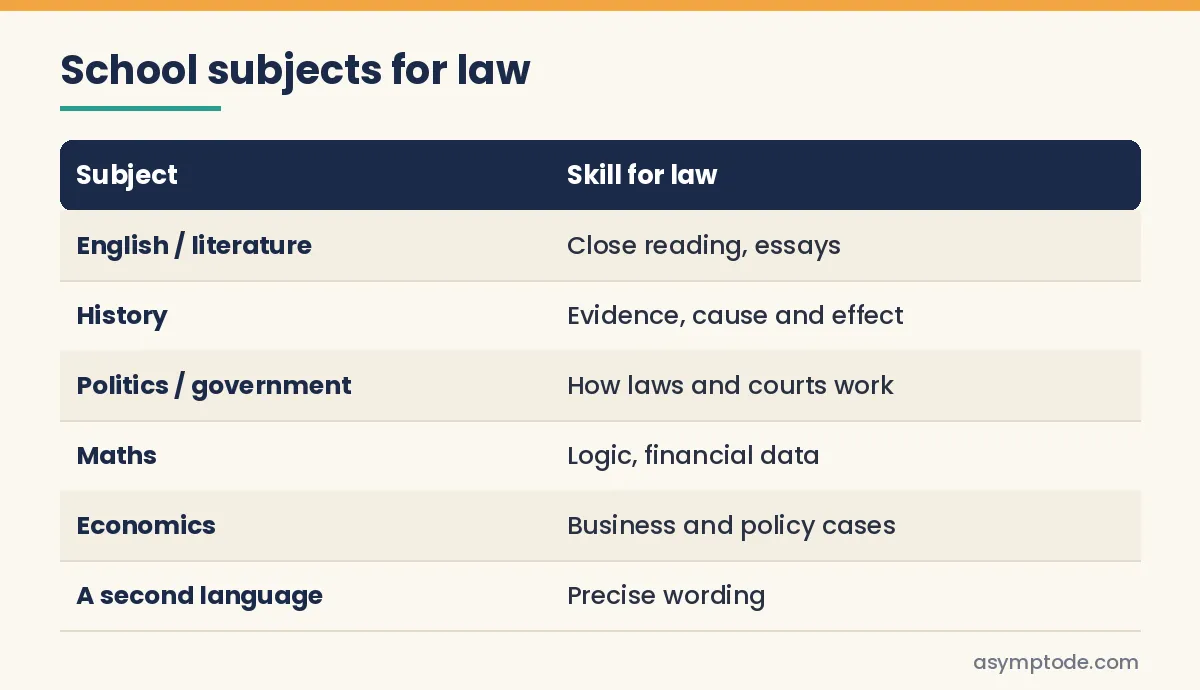 School subjects that build the skills law needs.
The table pairs each school subject with the skill it trains for law.
English and literature build close reading and writing. History and politics give you background on how laws and governments work.
Maths builds logical reasoning and helps with financial data. Economics helps with business and policy cases.
A second language and debate build clear speaking and listening.
| School subject | Skill it builds for law |
|---|---|
| English / literature | Close reading, essay writing |
| History | Evidence, cause and effect |
| Politics / government | How laws and courts work |
| Maths | Logical reasoning, financial data |
| Economics | Business and policy cases |
| A second language | Precise wording, global work |
How do you become a lawyer in the USA?
In the USA, law is studied after a first degree. The BLS says it usually takes about seven years of full-time study after high school: four years of undergraduate study and three years of law school.
Here is the US route:
- Bachelor's degree in any subject. Pick a major you enjoy and can do well in. Grades matter for law school admission.
- Take the LSAT. LSAC runs the LSAT. It is a four-section multiple-choice test plus a separate essay called LSAT Argumentative Writing. Our LSAT guide explains the sections.
- Earn a JD. Most jurisdictions require a Juris Doctor from an accredited law school (in the USA, law schools are accredited by the ABA).
- Pass the MPRE. The MPRE is a two-hour, 60-question ethics test (50 questions are scored). It is offered three times a year. It is required in 54 of 56 jurisdictions; Wisconsin and Puerto Rico do not require it.
- Pass the bar exam and character and fitness checks. Many states also require continuing legal education after you are licensed.
What is the NextGen bar exam and when does it start?
The NextGen Uniform Bar Exam is the new bar exam from the National Conference of Bar Examiners. It tests core lawyering skills using a focused set of legal concepts. NCBE says most jurisdictions will switch to it between July 2026 and July 2028.
| First NextGen exam | Jurisdictions (as listed by NCBE) |
|---|---|
| July 2026 | Connecticut, Idaho, Maryland, Missouri, Oregon, Washington, Guam, Northern Mariana Islands, Palau, Virgin Islands |
| July 2027 | Arizona, Iowa, Kentucky, Minnesota, Nebraska, New Mexico, North Dakota, Oklahoma, South Dakota, Tennessee, Vermont, Wyoming |
| February 2028 | Delaware, District of Columbia, Illinois, Montana |
| July 2028 | Most other adopting states, including California and Florida |
One honest note: NCBE reports that the July 2026 Washington NextGen exam was cancelled, and a make-up exam was held on September 1-2. Rules can change, so check your state's page before you plan.
If your goal is a top US university first, see how to get into Harvard and our SAT guide for parents.
How do you become a lawyer in the UK (England and Wales)?
England and Wales has two kinds of lawyer: solicitors and barristers. They train differently.
How do you qualify as a solicitor?
The Solicitors Regulation Authority sets four main steps:
- A degree in any subject, or an equivalent level 6 qualification.
- Pass SQE1 and SQE2, the Solicitors Qualifying Exam.
- Complete about two years of full-time qualifying work experience (QWE), or the part-time equivalent.
- Pass the SRA's character and suitability checks.
How do you qualify as a barrister?
The Bar Standards Board describes three parts:
- Academic: a law degree, or a non-law degree plus a conversion course (GDL). The degree must be at least a 2:2.
- Vocational: a Bar training course. You must join one of the Inns of Court before you start it. After this you are Called to the Bar, but you cannot practise yet.
- Pupillage: supervised training with an experienced barrister, in two parts that each usually last around six months.
Do you need the LNAT?
Only for some universities. The LNAT is required for undergraduate law at Bristol, Cambridge, Durham, Glasgow, King's College London, LSE, Oxford, SOAS and UCL. It lasts 2 1/4 hours: 42 multiple-choice questions on 12 passages in 95 minutes, then one essay in 40 minutes. Read our LNAT guide and how to get into LSE for details.
Book a free demo class to plan your child's law entrance test preparation, or see our plans and fees.
How do you become a lawyer in India?
India gives you two doors into law:
- 5-year integrated LLB after Class 12. Examples include the BA LLB (Hons) at NLSIU. Most National Law Universities admit through CLAT, run by the Consortium of NLUs. NLU Delhi uses its own test, AILET.
- 3-year LLB after a bachelor's degree. Universities such as the University of Delhi Faculty of Law offer the LL.B. for graduates.
After the degree, you enrol with a State Bar Council. Then you take the All India Bar Examination (AIBE), conducted by the Bar Council of India. The AIBE portal shows that passing candidates receive a Certificate of Practice.
For dates, syllabus and eligibility, read our CLAT 2027 guide, AILET 2027 guide and CLAT vs AILET comparison. Always confirm on the official sites, because they publish the final rules.
How do you become a lawyer in Canada?
Canada's route looks like the US one. Most students finish an undergraduate degree first, then take the LSAT, which Canadian law schools use. Next comes a common law degree (JD) from an approved school.
The Federation of Law Societies of Canada sets a "National Requirement": the skills a law graduate must have to enter a bar admission program. An updated version applies to students graduating on or after 1 January 2029.
Licensing is done by each province's law society. In Ontario, for example, the Law Society of Ontario requires barrister and solicitor licensing exams, experiential training and a good character check. Other provinces have their own rules.
How do you become a lawyer in Australia?
In Australia, you study an approved law degree (an LLB or a JD). Then you complete practical training and apply to be admitted.
In Victoria, the Victorian Legal Admissions Board admits applicants with an Australian law degree from an approved institution. Practical training can be an approved Practical Legal Training (PLT) course or Supervised Legal Training of at least 12 months under an approved plan. Suitability is also checked. In New South Wales, the Legal Profession Admission Board decides eligibility and suitability.
How do the lawyer routes compare by country?
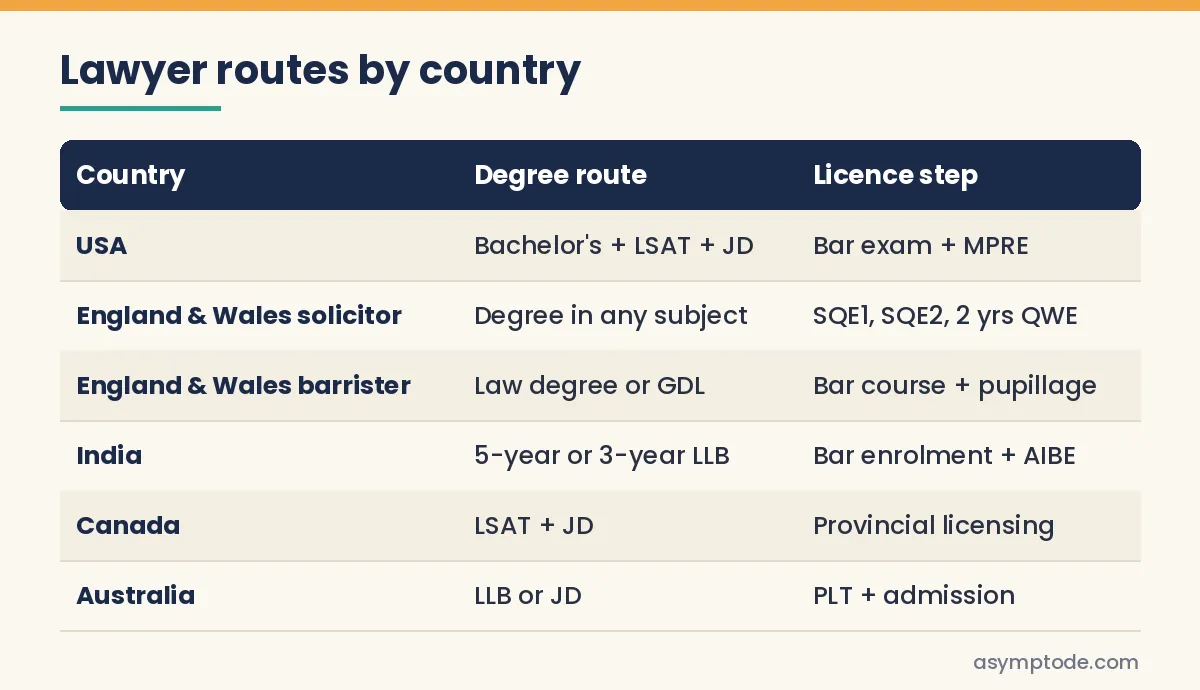 Lawyer routes by country at a glance.
In the USA, you need a bachelor's, the LSAT and a JD, then the bar exam and MPRE.
In England and Wales, solicitors need a degree, SQE1 and SQE2 and two years of QWE. Barristers need a Bar course and pupillage.
In India, you take a 5-year LLB (CLAT or AILET) or a 3-year LLB, then enrol and pass the AIBE.
In Canada, you need the LSAT and a JD, then provincial licensing. In Australia, you need an LLB or JD, then PLT and admission.
| Country | Degree route | Licence step |
|---|---|---|
| USA | Bachelor's + LSAT + JD | Bar exam + MPRE |
| England and Wales (solicitor) | Degree in any subject | SQE1, SQE2, 2 years QWE |
| England and Wales (barrister) | Law degree or GDL | Bar course + pupillage |
| India | 5-year LLB or 3-year LLB | State Bar enrolment + AIBE |
| Canada | LSAT + JD | Provincial law society licensing |
| Australia | LLB or JD | PLT + admission |
What is the job outlook and pay for lawyers?
We only use official numbers here. These are from the US Bureau of Labor Statistics Occupational Outlook Handbook page for lawyers, last modified August 27, 2026. They describe the USA only.
| BLS measure (USA) | Figure |
|---|---|
| Median pay, 2025 | $159,670 per year ($76.76 per hour) |
| Number of jobs, 2025 | 863,700 |
| Job outlook, 2025-35 | 5% (faster than average) |
| Employment change, 2025-35 | 40,600 |
| Openings per year (average) | About 28,700 |
A median is the middle value: half of lawyers earn more and half earn less. We do not quote salaries for other countries, because we could not check an official figure for each.
What can you do in school to prepare for a law career?
You do not need to "do law" early. You need habits that law schools and employers notice:
- Debate. It trains you to build an argument and answer the other side.
- Model UN. You research a position, write it up and negotiate.
- Mooting and mock trial. These are practice court hearings. Many schools and universities run them.
- Reading and writing. Read long articles, summarize each in five lines, and write one essay a week.
- Short internships or court visits. Shadow a lawyer for a few days if you can, or watch public court hearings where this is allowed.
- Logical reasoning practice. LSAT, LNAT, CLAT and AILET all test reasoning. Maths and logic puzzles help here.
What is a step-by-step plan from Grade 9?
 A simple plan from Grade 9 to a law entrance test.
The animation shows five steps.
Grade 9: read daily and join debate.
Grade 10: keep maths and essays strong. Grade 11: pick a country route and its test.
Grade 12: sit CLAT, AILET or LNAT, or apply to college. After that: law school, training and licence.
- Grade 9: build the reading habit. Read one long article a day. Join debate or Model UN.
- Grade 10: keep maths and essay writing strong. Do not drop maths. Write one essay a week.
- Grade 11: choose your country route. Decide between the US, UK, India, Canada or Australia path. Learn which entrance test it needs.
- Grade 11 to 12: start entrance test practice. For India, prepare for CLAT or AILET. For UK universities on the list, prepare for the LNAT. For the US and Canada, focus on grades and college admission first; the LSAT comes during or after your bachelor's.
- Grade 12: sit the test or apply. Then plan for law school, practical training and the licence.
 The four stages every lawyer route shares.
The flow has four boxes.
School: reading, writing and reasoning.
Law degree: LLB, or JD after a first degree.
Training: QWE, pupillage, articling or PLT. Licence: bar exam, SQE, AIBE or admission.
What are the common mistakes students make?
- Dropping maths too early. Entrance tests reward logical reasoning, and the ABA lists basic maths and financial data skills as useful.
- Mixing up country routes. Each country sets its own licence rules, and in the USA each state does. Choose the country where you plan to work.
- Starting test practice too late. CLAT, AILET and LNAT need steady practice, not a last-month rush.
- Ignoring writing. Every route has essays or written answers.
- Trusting old dates. Bar exam formats are changing. Always check the official page.
How Asymptode helps you with becoming a lawyer
Asymptode does not teach law. We help with the parts of the lawyer route where method and practice make a real difference. A qualified mentor works with your child one-to-one, live online, and follows the law entrance test your route needs, whether CLAT, AILET, LNAT or, later, the LSAT, with its real official dates. The mentor's strength is maths and logical reasoning. For reading comprehension, legal reasoning and essays, the mentor helps honestly with planning, method and practice review.
Between classes, your child gets practice built for them. It is a worksheet made from what their own last attempt showed they had not understood, at their level, never generic. This is Asymptode's AI-assisted practice. It is written to the mentor's brief and sent only after that mentor approves it.
The mentor marks it. You, the parent, see what was understood and what to practise next. That way preparation keeps correcting itself toward the entrance test your child needs. Book a free demo class or see our plans and fees.
Facts checked against official sources on 8 November 2026.
FAQ
How many years does it take to become a lawyer?
In the USA, the BLS says it usually takes about seven years of full-time study after high school: four years of college and three years of law school, then the bar exam. In India, a 5-year integrated LLB starts right after Class 12. Other countries add practical training before you are licensed, so check each official route.
Do I need to study law at school to become a lawyer?
No. The ABA does not recommend any specific major or set of courses, and students come from almost every subject. In England and Wales, the SRA accepts a degree in any subject for the solicitor route. Focus on reading, writing, history or politics, and maths.
What is the NextGen bar exam?
It is the new Uniform Bar Exam from NCBE. It tests core lawyering skills with a focused set of legal concepts. NCBE says most jurisdictions will switch between July 2026 and July 2028, starting with states like Connecticut, Maryland, Missouri and Oregon.
Is the LSAT used outside the USA?
Yes. LSAC says the LSAT is part of law school admission in the United States, Canada and a growing number of other countries. It has four multiple-choice sections plus a separate argumentative writing task.
Which exam do I need for law in India?
Most National Law Universities admit through CLAT, run by the Consortium of NLUs. NLU Delhi uses AILET. After your LLB, you enrol with a State Bar Council and pass the AIBE to get a Certificate of Practice.
How much do lawyers earn?
The BLS reports a 2025 median pay of $159,670 per year for US lawyers (page last modified August 27, 2026). Pay varies widely by city, field and employer. We do not quote figures for other countries because we could not verify official numbers.
Ready to start? Book a free demo class and advisor call, or see our plans and fees.
Sources
- BLS Occupational Outlook Handbook: Lawyers
- NCBE: NextGen UBE
- NCBE: MPRE
- LSAC: The LSAT
- ABA: Preparing for Law School
- SRA: Solicitors Qualifying Exam
- Bar Standards Board: Becoming a barrister
- LNAT: Do I need to sit the test?
- LNAT: Test format
- Consortium of National Law Universities (CLAT)
- National Law University Delhi (AILET)
- Bar Council of India
- All India Bar Examination
- Federation of Law Societies of Canada: National Requirement
- Law Society of Ontario: Lawyer licensing process
- Victorian Legal Admissions Board
- NSW Legal Profession Admission Board