

CLAT 2027 is the Common Law Admission Test that most National Law Universities (NLUs) in India use to fill their five-year law and LLM seats. The exam is on Sunday, 6 December 2026, and applications close on 31 October 2026 at 11:59 pm. This guide covers dates, fees, eligibility, the paper pattern, counselling and a simple plan to prepare.
Key takeaways
- CLAT 2027 is on Sunday, 6 December 2026, from 2:00 pm to 4:00 pm, in offline (pen-and-paper) mode.
- Online applications opened on 3 August 2026 and close on 31 October 2026 (11:59 pm). The fee is Rs 4,000 for General/OBC and Rs 3,500 for SC/ST/BPL/PwD.
- UG needs 10+2 with 45% (40% for SC/ST/PwD). There is no upper age limit, and students sitting Class 12 in March/April 2027 can apply.
- The UG paper has 120 one-mark questions in 2 hours, with 0.25 marks taken off for each wrong answer.
- Quantitative Techniques is only about 10% of the paper, but it is the easiest section to make accurate with practice.
- NLU Delhi does not use CLAT. It runs its own exam, AILET.
What is CLAT 2027 and who runs it?
Quick answer: CLAT 2027 is a national entrance test run by the Consortium of National Law Universities. It is used for admission to the five-year integrated LLB (UG) and the one-year LLM (PG) at participating NLUs for the 2027-28 academic year. The exam is on 6 December 2026, and you apply online only.
The Consortium is a group of NLUs. Its office is at the National Law School of India University (NLSIU), Bengaluru. It sets the paper, runs the exam, publishes results and runs common counselling for seats.
CLAT is an aptitude test. It checks reading, reasoning and basic maths. You do not need to know any law before you sit it. The official syllabus guide says the test is about the skills needed for legal education, not prior knowledge.
Which NLUs accept CLAT 2027 scores?
The Consortium's participating universities page lists the NLUs that admit through CLAT 2027. The official instructions refer to 26 NLUs; the list shows 27 entries because GNLU's Silvassa campus is listed on its own. They include:
- NLSIU Bengaluru, NALSAR Hyderabad, WBNUJS Kolkata, NLU Jodhpur, NLIU Bhopal
- GNLU Gandhinagar (and its Silvassa campus), HNLU Raipur, RMLNLU Lucknow, RGNUL Punjab
- CNLU Patna, NUALS Kochi, NLUO Odisha, NUSRL Ranchi, NLUJA Assam
- DSNLU Visakhapatnam, TNNLU Tiruchirappalli, MNLU Mumbai, MNLU Nagpur, MNLU Chhatrapati Sambhajinagar
- HPNLU Shimla, DNLU Jabalpur, DBRANLU Haryana, NLU Tripura (Agartala), RPNLU Prayagraj, IIULER Goa, NLU Meghalaya
Each NLU publishes its own brochure with seats, fees and reservation rules. Some NLUs have changed reservation categories this cycle (for example, MNLU Mumbai, WBNUJS and NLU Meghalaya posted notices in September and October 2026), so read the brochure of every NLU you plan to list.
What are the CLAT 2027 exam date and important dates?
The exam date and application window come from the Consortium's press release of 22 July 2026 and the official UG instructions.
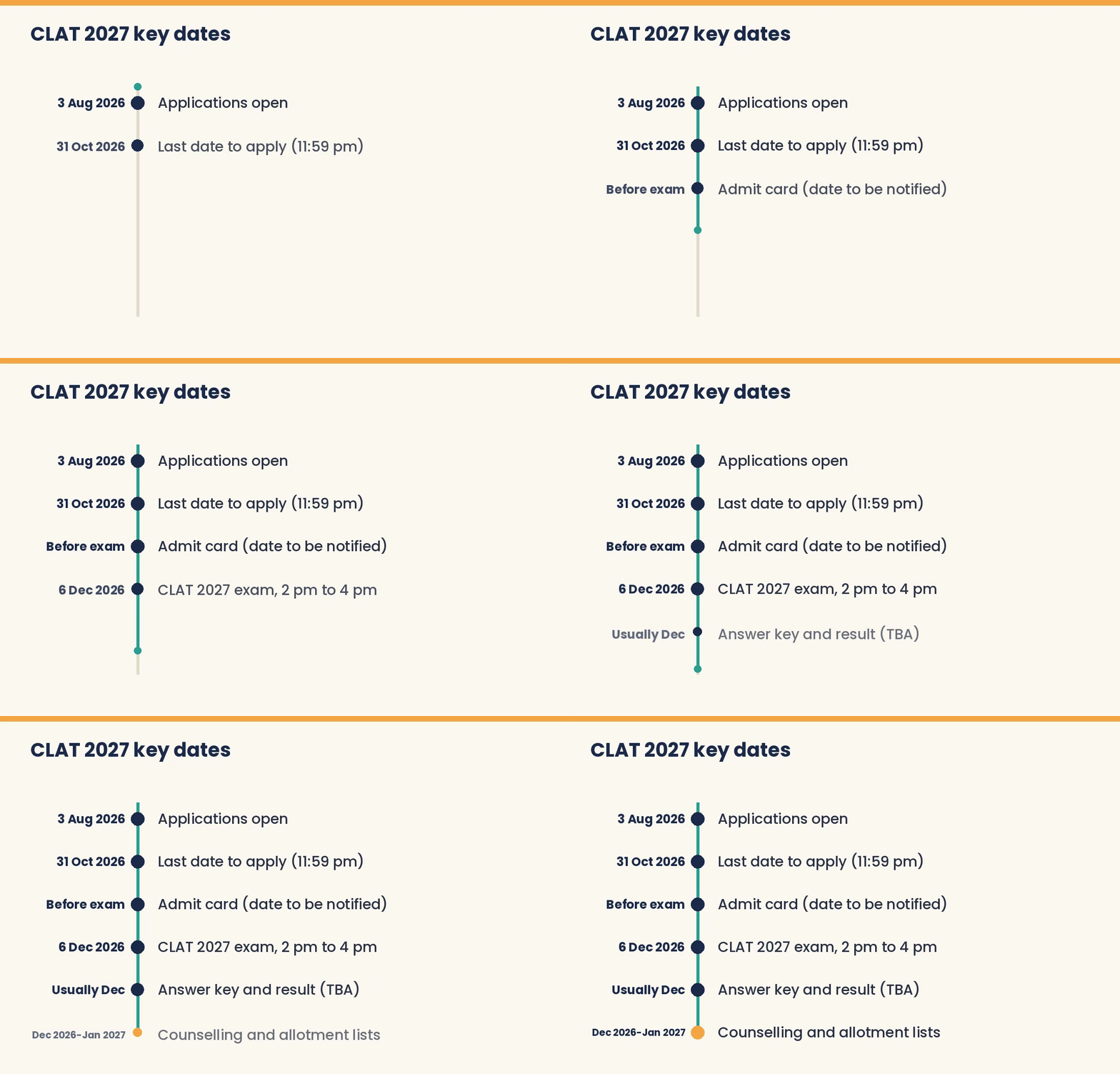
| Date (CLAT 2027 cycle) | Event | Status |
|---|---|---|
| 3 August 2026 | Online applications opened | Official |
| 31 October 2026, 11:59 pm | Last date to submit and pay | Official |
| Before the exam | Admit card download from your CLAT login | Date to be notified on the website |
| 6 December 2026, 2:00-4:00 pm | CLAT 2027 exam (PwD candidates: 2:00-4:40 pm) | Official |
| Usually December | Provisional answer key, objections, final key and result | Official dates not yet announced |
| December 2026 / January 2027 | Counselling and allotment lists | Month given in the official FAQ |
For reference, in the last cycle the CLAT 2026 result came out on 16 December 2025, as reported by Careers360. Treat that only as a rough guide. Watch the Consortium's notifications page for the real 2027 dates.
Today is 25 October 2026. If you have not applied, you have six days left. Incomplete forms are not considered, and once you pay you cannot change your programme, category or BPL field.
What is the CLAT 2027 application fee?
Fees are paid online only and are not refundable, per the official UG instructions.
| Category | CLAT 2027 application fee |
|---|---|
| General / OBC | Rs 4,000 |
| SC / ST / BPL / PwD | Rs 3,500 |
| Previous years' question papers (optional) | Rs 500 extra |
Bank transaction charges are extra and are shown on the payment page.
Who is eligible for CLAT 2027?
The rules below are from the official UG eligibility and PG eligibility pages.
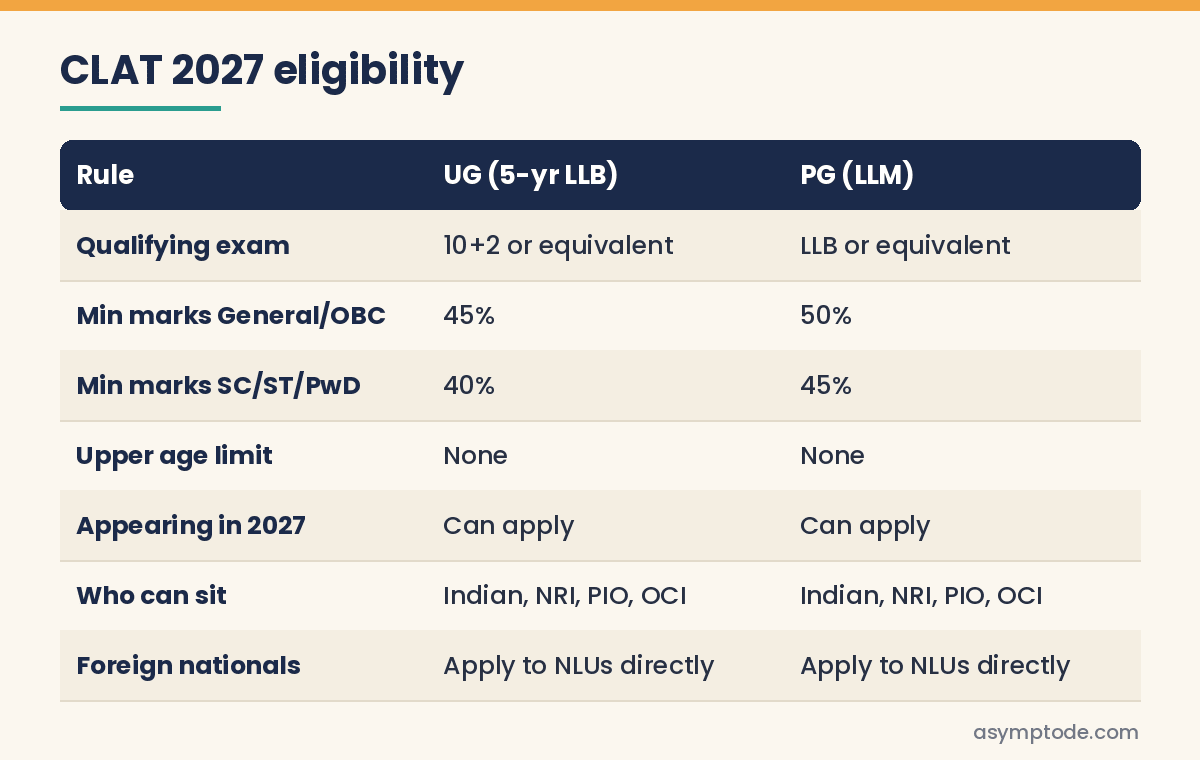
| Rule | UG (5-year LLB) | PG (LLM) |
|---|---|---|
| Qualifying exam | 10+2 or equivalent | LLB or equivalent |
| Minimum marks (General/OBC) | 45% | 50% |
| Minimum marks (SC/ST/PwD) | 40% | 45% |
| Upper age limit | None | None |
| Still sitting the qualifying exam? | Yes, if exams are in March/April 2027 | Yes, if exams are in 2027 |
| Who can sit | Indian nationals, NRIs, PIO and OCI card holders | Same |
If you are still in Class 12, you can apply now. You must show proof that you passed when you take admission. If you do not, you lose your seat.
Can NRIs and foreign nationals take CLAT 2027?
NRIs, PIO card holders and OCI card holders can sit CLAT 2027. Foreign nationals cannot. The official instructions say foreign nationals must apply to each NLU directly.
NRI and NRI-sponsored seats are also handled directly by each NLU. The Consortium does not allot these seats. So if you want an NRI seat, read each NLU's brochure and website for its process and deadlines.
What is the CLAT 2027 exam pattern?
Quick answer: The UG paper has 120 multiple-choice questions, one mark each, in 2 hours. A wrong answer costs 0.25 marks. An unanswered question costs nothing. There are five sections, and three of them are mostly reading passages of about 450 words.
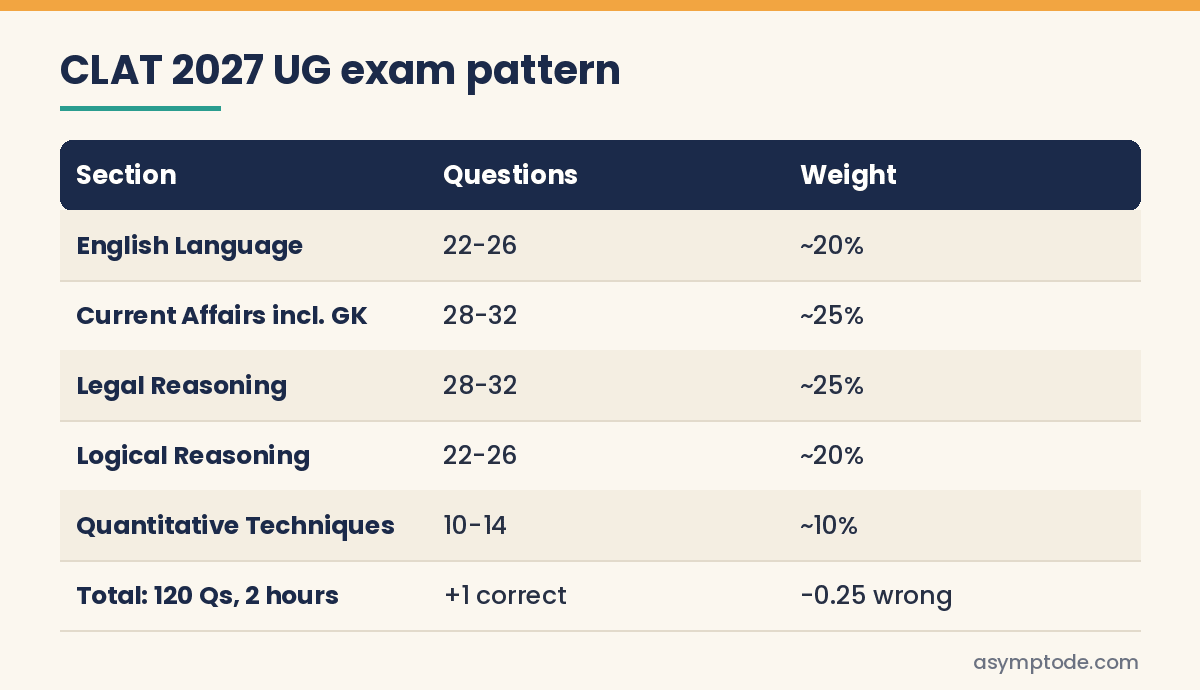
| Section | Approx. questions | Approx. weight |
|---|---|---|
| English Language | 22-26 | 20% |
| Current Affairs, incl. General Knowledge | 28-32 | 25% |
| Legal Reasoning | 28-32 | 25% |
| Logical Reasoning | 22-26 | 20% |
| Quantitative Techniques | 10-14 | 10% |
| Total | 120 (2 hours) | +1 correct, -0.25 wrong |
Source: UG question paper format.
How the marking works. Say you attempt 100 questions. You get 84 right and 16 wrong. Your score is 84 - (16 x 0.25) = 84 - 4 = 80. The 20 you left blank cost you nothing.
What is in each section?
- English Language: passages of about 450 words. Questions test the main idea, inference, summary and word meaning in context.
- Current Affairs, including GK: passages from news and non-fiction. Questions cover Indian and world events, arts and culture, international affairs and history.
- Legal Reasoning: passages about legal or moral situations. You apply the rule given in the passage. No prior legal knowledge is needed.
- Logical Reasoning: short passages with arguments. You spot premises and conclusions, and judge what strengthens or weakens an argument.
- Quantitative Techniques: short sets of numbers, tables or text. You use Class 10 maths, such as ratios and proportions, basic algebra, mensuration and statistical estimation.
These descriptions come from the official UG syllabus guide.
What is the CLAT 2027 PG pattern?
The PG format page lists 120 one-mark multiple-choice questions in 2 hours, with 0.25 marks off for each wrong answer. Topics cover constitutional law and other areas, such as jurisprudence, contract, torts, criminal law and more.
Mode, language and test centres
CLAT 2027 is an offline exam: you mark answers on paper at a test centre. You choose a test centre city when you apply. In September 2026 the Consortium removed Vellore and Tiruvarur as test cities. Candidates who picked them must choose a new city before 31 October 2026. All the official passages and guides are in English, and the Consortium has not announced any other language version.
How do CLAT 2027 scores lead to an NLU seat?
Your CLAT score gives you a rank. Counselling then matches ranks to seats based on your NLU preferences, your category and seat availability.
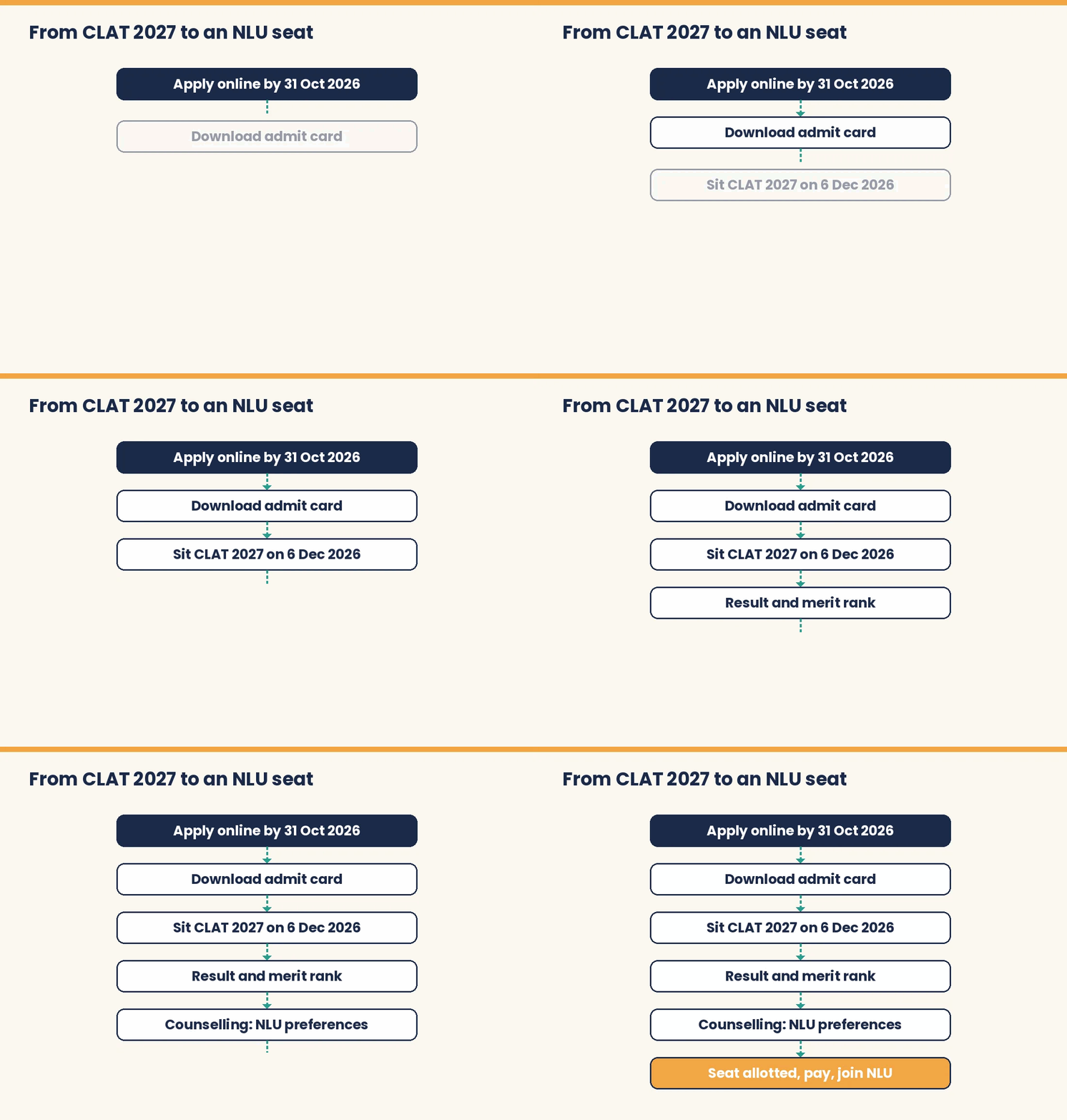
- Apply online by 31 October 2026.
- Download your admit card when the Consortium releases it.
- Sit CLAT 2027 on 6 December 2026.
- Check the result and your merit rank.
- Register for counselling and list your NLU preferences.
- Get a seat in an allotment list, pay the fee and join the NLU.
The Consortium's website has space for up to five provisional allotment lists. The official FAQ says counselling will be in December 2026 or January 2027. Full counselling rules, fees and dates will come in a later notice.
Two more points from the official instructions:
- Ties are broken first by higher marks in Legal Reasoning, then by higher age, then by a computer draw.
- Allotments are provisional. If your documents do not match your form, the offer can be cancelled.
What is AILET, and how is it different?
NLU Delhi is not part of CLAT admissions. It runs its own exam, the All India Law Entrance Test (AILET). According to NLU Delhi's official website, AILET 2027 applications opened on 7 August 2026 and close on 10 November 2026. Admit cards come out on 30 November 2026, and the exam is on 13 December 2026, one week after CLAT. (Updated 25 October 2026: AILET dates now confirmed on the official NLU Delhi site.) Many students prepare for both, because the skills overlap a lot.
How to prepare for CLAT 2027 in the time left
With about six weeks to go, focus on timed practice and review. Do not try to learn everything new.
- Apply first. Finish and pay your form before 31 October 2026.
- Take one full mock now. Time it at exactly 2 hours. Mark it with +1 and -0.25.
- Find your weak section. Look at both accuracy and time per section.
- Read daily. Spend 45-60 minutes on editorials and long-form non-fiction. This helps English, Current Affairs and Legal Reasoning.
- Keep a current affairs file. Cover the last 12-18 months of Indian and world news.
- Drill Quantitative Techniques. Revise percentages, ratios, averages, simple algebra and area and volume. Do 2-3 short data sets a day.
- Practise argument questions. For Logical Reasoning, name the conclusion and the premises before you look at the options.
- Use previous papers. The Consortium sells past papers for Rs 500. Real papers show the true level.
Want a mentor to fix your quant and reasoning method in the final weeks? Book a free demo class or see our fees.
Worked example: a CLAT-style Quantitative Techniques question
This is an original practice question in the CLAT style.
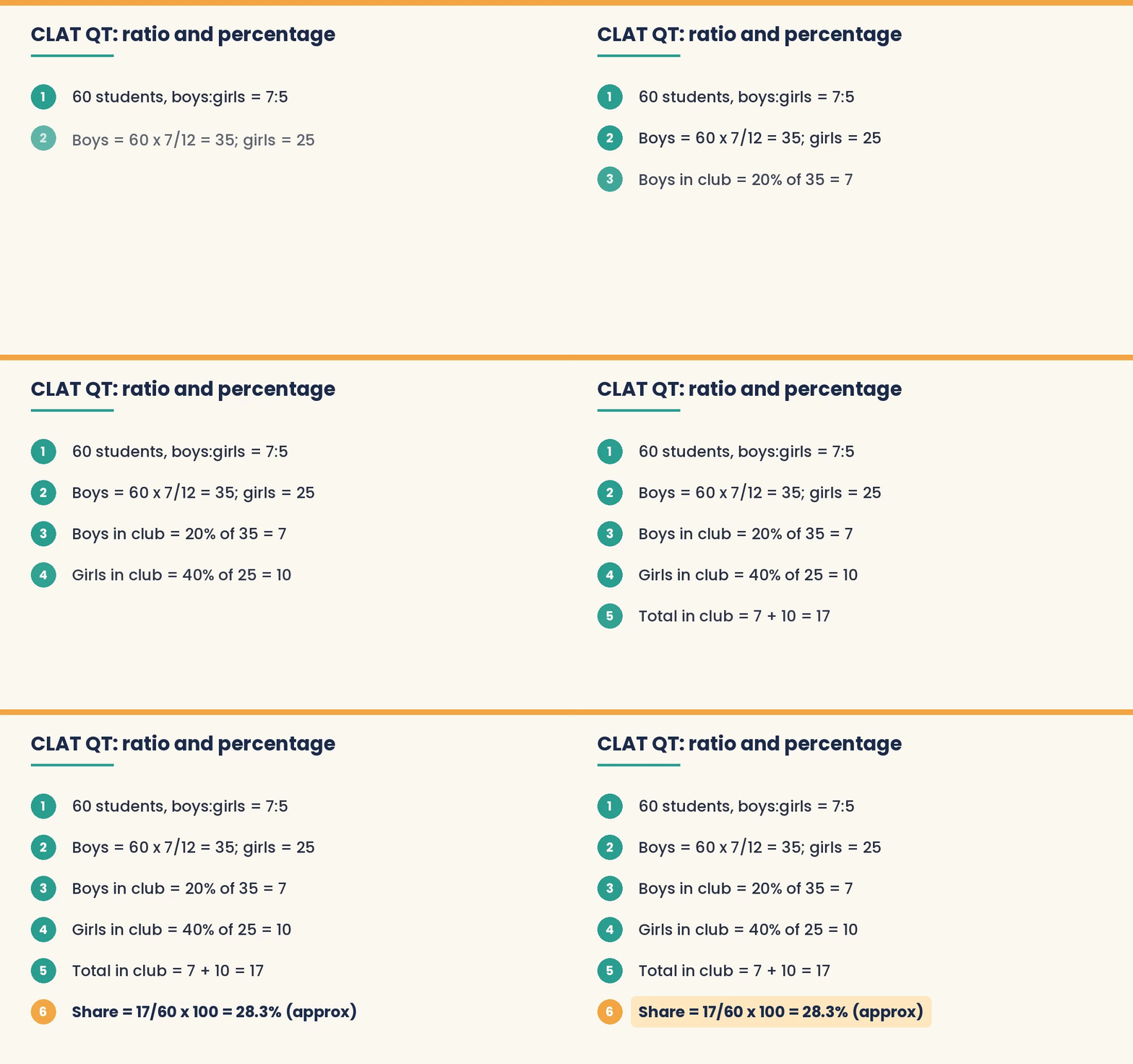
A class has 60 students. The ratio of boys to girls is 7 : 5. 20% of the boys and 40% of the girls join the debate club. What percentage of the class joins the debate club?
- Class: 60 students, boys : girls = 7 : 5.
- Total parts = 7 + 5 = 12. Boys = 60 x 7/12 = 35. Girls = 60 x 5/12 = 25.
- Boys in club = 20% of 35 = 7.
- Girls in club = 40% of 25 = 10.
- Total in club = 7 + 10 = 17.
- Share of class = 17/60 x 100 = 28.3% (approx.).
Check: 35 + 25 = 60, so the split is right. A common trap is to average 20% and 40% to get 30%. That is wrong, because there are more boys than girls. The answer must be closer to 20% than to 40%, and 28.3% is.
For more practice with algebra methods that show up in QT, see our guide to solving quadratic equations three ways.
Common CLAT 2027 mistakes to avoid
- Missing the 31 October deadline. A form that is not submitted and paid by 11:59 pm does not count.
- Choosing the wrong category or programme. You cannot change these after paying.
- Guessing wildly. Each wrong answer costs 0.25. Guess only when you can rule out at least one or two options.
- Skipping Quantitative Techniques. It is a small section, but its answers are clear-cut. Accurate QT marks can lift your rank.
- Reading passages too slowly. Most of the paper is passage-based, so reading speed is score.
- Not reading NLU brochures. Seats, fees and reservation rules differ by NLU. Some NLUs changed categories this cycle.
- Forgetting AILET. If you want NLU Delhi, you need a separate form and exam.
A 6-week CLAT 2027 study plan (late October to 6 December 2026)
| Week | Focus | Daily target |
|---|---|---|
| Week 1 (to 1 Nov) | Submit form. Take a full mock. List weak areas. | 1 mock + 1 hour review |
| Week 2 | Reading speed. QT basics: percentages, ratios. | 3 passages + 10 QT questions |
| Week 3 | Legal and Logical Reasoning method. | 4 passages + current affairs notes |
| Week 4 | Two full mocks. Deep review of errors. | Error log after every mock |
| Week 5 | Two to three mocks. Revise current affairs file. | 1 mock every 2 days |
| Week 6 (to 6 Dec) | Light mocks, revision, rest. Check admit card and centre. | Short sets only; sleep well |
Keep an error log. For each mistake, write why you got it wrong: misread, wrong method, time pressure or a guess. Fix the cause, not just the question.
How 1-on-1 tutoring helps with CLAT 2027
Asymptode is a maths and science tutoring company, so we are clear about what we do. We do not teach law, English or current affairs. We help with the parts of CLAT where method matters most:
- Quantitative Techniques: your mentor revises Class 10 maths with you, such as ratios, percentages, averages, algebra and mensuration, and drills CLAT-style data sets.
- Logical Reasoning method: a clear, step-by-step way to find premises, conclusions and assumptions, and to check each option.
- Study planning: a weekly plan built around your exam date, mock schedule and school timetable.
How it works:
- 1-on-1 live online sessions with one dedicated mentor.
- Method-first teaching. Your mentor watches each step of your working and fixes the method, not just the answer.
- Personalised homework with feedback.
- Short parent updates, so families know how things are going.
- Every class is recorded for revision.
- Flexible times across time zones, useful for NRI students preparing from abroad.
If CLAT is part of a wider plan, our guide on how to choose an online math tutor can help you compare options, and how many hours of math tutoring per week can help you set a realistic schedule.
Facts checked against official sources on 25 October 2026.
Ready to sharpen your quant and reasoning before 6 December? Book a free demo class or see our fees.
FAQ
When is the CLAT 2027 exam?
CLAT 2027 is on Sunday, 6 December 2026, from 2:00 pm to 4:00 pm. Eligible PwD candidates get until 4:40 pm. The Consortium says the date may change only if necessary.
What is the last date to apply for CLAT 2027?
The last date is 31 October 2026, by 11:59 pm. Your form must be complete and paid by then. Applications opened on 3 August 2026.
Is there an age limit for CLAT 2027?
No. There is no upper age limit for UG or PG. You need 45% in 10+2 for UG (40% for SC/ST/PwD) and 50% in LLB for PG (45% for SC/ST/PwD).
Can a Class 12 student apply for CLAT 2027?
Yes. If you sit your Class 12 exams in March/April 2027, you can apply. You must show proof that you passed when you take admission.
Can foreign nationals take CLAT 2027?
No. Foreign nationals cannot sit CLAT. They must apply to each NLU directly. NRIs, PIO and OCI card holders can sit CLAT, but NRI seats are handled by each NLU, not the Consortium.
How hard is the maths in CLAT 2027?
The maths is Class 10 level. Quantitative Techniques has about 10-14 questions on ratios, percentages, basic algebra, mensuration and estimation. The challenge is speed and accuracy, not hard topics.
Sources
- Consortium of NLUs: CLAT 2027 Press Release (22 July 2026)
- CLAT 2027 UG General Instructions (dates, fees, admit card)
- CLAT 2027 UG Eligibility
- CLAT 2027 PG Eligibility
- CLAT 2027 UG Question Paper Format
- CLAT 2027 UG Syllabus and Guide
- CLAT 2027 PG Question Paper Format
- CLAT 2027 Participating Universities
- CLAT 2027 FAQs (counselling month)
- National Law University Delhi (AILET)