
The LSAT is the test that every law school in the US and Canada accepts. This guide explains the 2026-27 LSAT in plain words: who runs it, the new in-person rule, the format now and from August 2027, scores, dates, fees and how to prepare.
Key takeaways
- The LSAT is run by LSAC. It is the only test that all law schools accept.
- From August 2026, most people must test in person at a Prometric centre.
- Tests through June 2027 have four 35-minute sections. Three are scored.
- Scores run from 120 to 180. Wrong answers cost nothing, so answer every question.
- The LSAT costs $253 in 2026-27. From August 2027, it drops to three sections.
What is the LSAT and who uses it?
Quick answer: The LSAT is the Law School Admission Test. It is run by LSAC (Law School Admission Council), a not-for-profit. LSAC calls it an "integral part of law school admission in the United States, Canada, and a growing number of other countries." Some schools accept other tests, but the LSAT is the only test all law schools accept.
LSAC also runs CAS (Credential Assembly Service), which sends your application files to law schools. You will use two official sites: lsac.org for registration and your JD Services account, and lawhub.org for official practice.
Still in high school? Strong college applications come first. Our guides on how to get into Harvard and SAT vs ACT can help.
Do you have to take the LSAT in person now?
Yes, for most people. From the August 2026 LSAT, LSAC requires in-person testing at Prometric centres. LSAC announced this on 19 May 2026. The ABA Journal reported the change followed a cheating scandal in China. There is no in-person LSAT in Quebec because of Bill 96.
Who can still test remotely?
LSAC lists four remote testing exceptions:
- Certain disability accommodations that need remote testing.
- US military on active duty abroad, plus spouses and dependents.
- Living more than 180 miles or 3 hours' drive from a centre with space (US/Canada only).
- Test centre closures.
Approved remote takers need a smartphone as a second camera and can only book the Friday test day.
What is the LSAT format in 2026-27?
Tests through June 2027 use the current LSAT format: four 35-minute multiple-choice sections, three scored.
- Logical Reasoning (LR): two scored sections. Each question has its own short passage.
- Reading Comprehension (RC): one scored section with 4 passage sets.
- Unscored section: LR or RC, used to test new questions. It can come at any point, so treat every section as real.
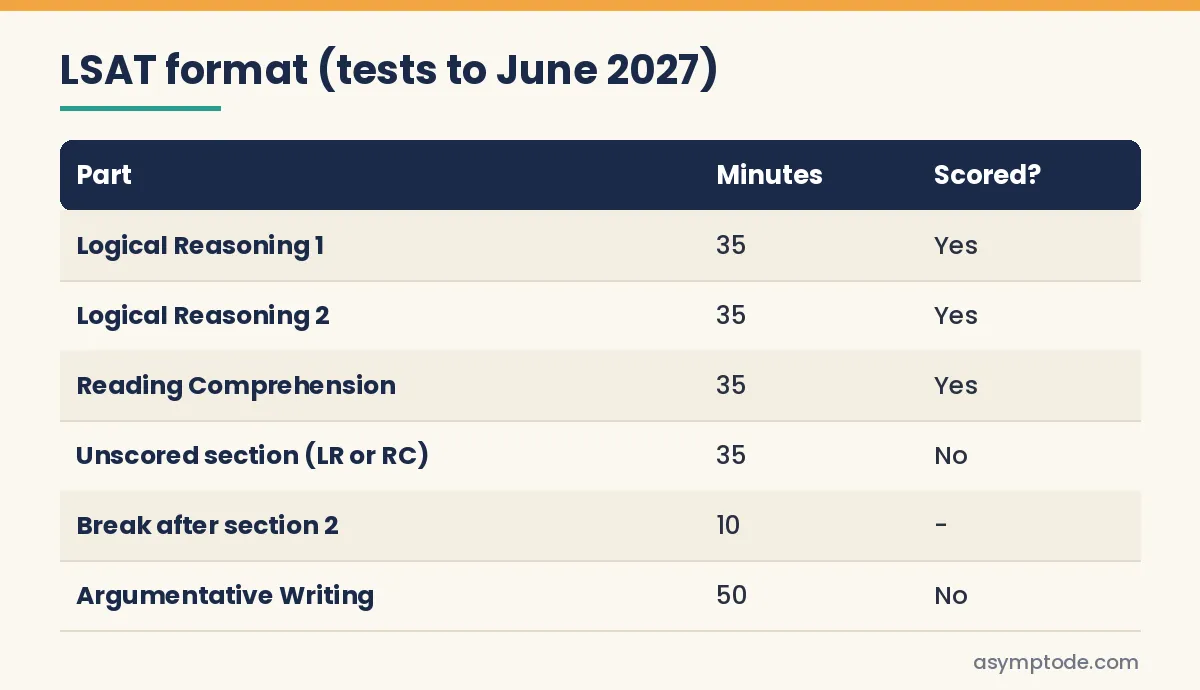 The LSAT format for tests through June 2027.
There are two scored Logical Reasoning sections and one scored Reading Comprehension section, each 35 minutes.
One more 35-minute section is unscored. It is LR or RC and can come in any position.
A 10-minute break comes after section 2, with no electronic devices allowed.
Argumentative Writing is a separate, unscored 50-minute online task.
The multiple-choice part is 140 minutes, and the whole session about 3 hours. There are about 25 scored questions per LR section and 27 in RC.
What happened to Logic Games?
Logic Games were removed from the August 2024 LSAT. A second scored LR section replaced them. The 120-180 scale stayed the same. LSAC said research on over 200,000 test sessions showed virtually no impact on scores.
What are the LSAT 2027 changes?
On 26 October 2026, LSAC announced a new format from August 2027. The standalone unscored section goes away. Unscored questions are mixed into the scored sections instead.
| Feature | Now (to June 2027) | From August 2027 |
|---|---|---|
| Sections | 4 (3 scored + 1 unscored) | 3 |
| Order | Unscored can be anywhere | RC, then LR, then LR |
| Reading Comprehension | 35 min, 4 passage sets | 52 min, 6 passages, 40 questions (27 scored) |
| Logical Reasoning | 35 min each | 45 min each, 32 questions (25 scored) |
| Breaks | One 10-minute break | Two 10-minute breaks |
| Score scale | 120-180 | 120-180 |
The session is about 10 minutes longer. Question types and scored question counts do not change. New-format practice arrives on LawHub in February 2027.
What is LSAT Argumentative Writing?
LSAT Argumentative Writing (AW) is an unscored essay. You take it online on your own computer with secure proctoring software.
- Time: 50 minutes (15 minutes of prewriting analysis plus a 35-minute essay).
- Task: a debatable issue with 3 or 4 perspectives. You take a position.
- When: it opens 8 days before your test date.
- Key rule: first-time takers need an approved AW before their score is released. Processing can take up to 3 weeks.
AW is included in the LSAT fee.
How is the LSAT score calculated?
Your LSAT score is based on correct answers. All questions count the same, and there is "no deduction for incorrect answers." The raw score is then converted to the 120-180 scale, so different test forms can be compared.
 How an LSAT score is built, in four steps.
Step 1: answer every question, because wrong answers cost nothing.
Step 2: your raw score is your correct answers in the 3 scored sections.
Step 3: the raw score is converted to the 120-180 scale. The conversion varies by test form.
Step 4: your percentile is the share of scores below yours over 3 years. For example, 160 is 71.06%.
What do LSAT percentiles mean?
Your percentile is the share of scores lower than yours over the previous 3 testing years. These are LSAC's official percentiles for 2023-2026:
| LSAT score | Percent below |
|---|---|
| 180 | 99.85% |
| 175 | 98.72% |
| 170 | 94.48% |
| 165 | 85.17% |
| 160 | 71.06% |
| 155 | 54.03% |
| 150 | 36.56% |
| 145 | 21.48% |
Scores come out at 9 a.m. ET on release day in JD Services. If you retake, LSAC says the "average LSAT score is the best predictor," but "some schools place more weight on a candidate's highest score." Each school decides.
What are the LSAT test dates for 2026-2027?
These are the LSAT test dates for the US and Canada. Deadlines are 11:59 p.m. ET, and LSAC says "These dates are subject to change."
| Test | Dates | Register by | Scores |
|---|---|---|---|
| Aug 2026 (past) | 5-8 Aug 2026 | 25 Jun 2026 | 26 Aug 2026 |
| Sep 2026 (past) | 9-12 Sep 2026 | 28 Jul 2026 | 30 Sep 2026 |
| Oct 2026 (past) | 7-10 Oct 2026 | 27 Aug 2026 | 28 Oct 2026 |
| Nov 2026 | 11-14 Nov 2026 | 1 Oct 2026 (closed) | 2 Dec 2026 |
| Jan 2027 | 13-16 Jan 2027 | 1 Dec 2026 | 3 Feb 2027 |
| Feb 2027 | 12-13 Feb 2027 | 29 Dec 2026 | 3 Mar 2027 |
| Feb 2027 (Puerto Rico) | 18-20 Feb 2027 | 5 Jan 2027 | 10 Mar 2027 |
| Apr 2027 | 8-10 Apr 2027 | 25 Feb 2027 | 28 Apr 2027 |
| Jun 2027 | 9-12 Jun 2027 | 29 Apr 2027 | 30 Jun 2027 |
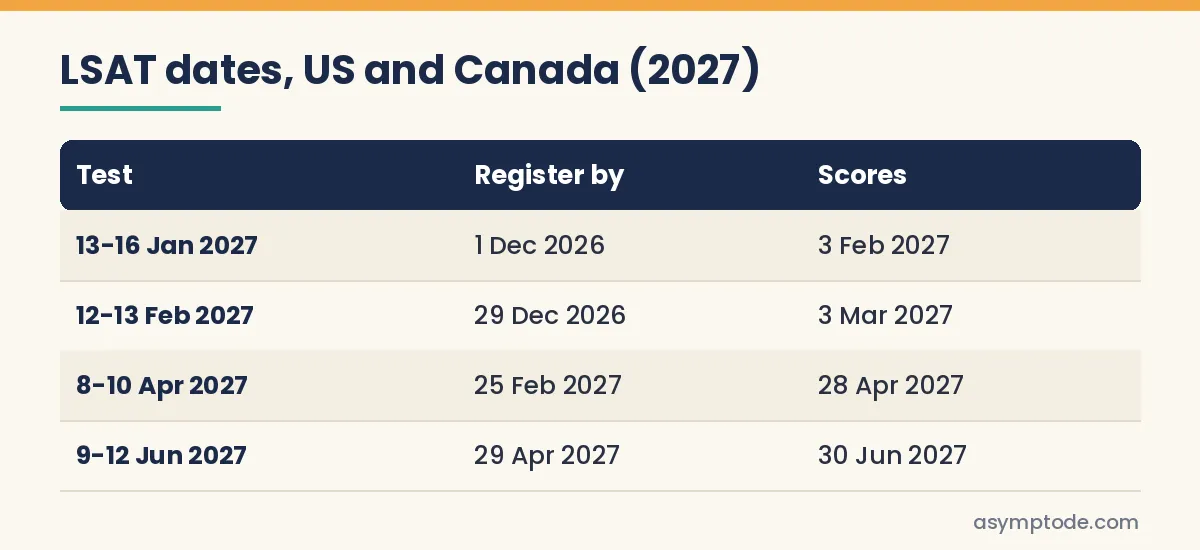 Upcoming LSAT dates in the US and Canada.
January 2027: register by 1 Dec 2026, scores on 3 Feb 2027.
February 2027: register by 29 Dec 2026, scores on 3 Mar 2027.
April 2027: register by 25 Feb 2027, scores on 28 Apr 2027.
June 2027: register by 29 Apr 2027, scores on 30 Jun 2027.
The registration deadline is usually also the last day for accommodation requests, free date changes and full refunds.
LSAT for international students: which dates apply?
International tests run on 15-16 Jan, 9-10 Apr and 11-12 Jun 2027. They share the US deadlines and score dates. (The October 2026 international test, 9-10 Oct, is past.) Regions include Europe/Africa/Middle East, Australia and New Zealand, Asia, and Latin America. LSAC says "Testing in mainland China is currently unavailable for the January 2027 LSAT."
Aiming for an Indian law school? See our CLAT 2027 guide.
How much does the LSAT cost?
These are the LSAT fees for 2026-27, in US dollars:
| Item | Fee |
|---|---|
| LSAT (with Argumentative Writing) | $253 |
| CAS (active 5 years) | $219 |
| Law School Report, per school | $45 |
| Score Preview | $46 before testing, $87 after |
| Score Audit | $150 ($75 with fee waiver) |
| Test date change | Free to deadline; then $153, then $253 |
| LawHub Advantage | $124/year |
Repeat takers pay the same $253. For tutoring costs, see our plans and fees.
Can you get an LSAT fee waiver?
Only US citizens, nationals or permanent residents, and Canadian citizens, permanent residents or protected persons can apply. Income and asset limits apply. Tier 1 gives 2 LSATs, 5-year CAS, 6 reports and 1 year of LawHub Advantage. Tier 2 gives 1 LSAT, CAS, 3 reports and LawHub Advantage. Waivers last 2 years.
How many times can you take the LSAT?
You can take it 5 times in the current reportable period (since July 2021) and 7 times in your lifetime. Cancelled scores count, but absences and withdrawals do not. If you scored 180 in the current period, you can't retake.
With Score Preview, you see your score first and have 6 calendar days to keep or cancel it.
What ID do you need for the LSAT?
Bring a physical, valid passport, or a government photo ID from the US, US territories or Canada. It can be expired by no more than 3 months. Your name must exactly match your LSAC account. Student IDs and photocopies are not accepted. See LSAC's ID rules.
How do you register for the LSAT?
Here is LSAT registration step by step:
- Pick a test date and note its deadline.
- Create or sign in to your LSAC JD account. Pay $253, or apply for a fee waiver first.
- Request accommodations or remote exceptions in JD Services by the deadlines.
- Wait for your scheduling window ("first register, first in line"). Then book a Prometric slot in ProScheduler.
- Take AW online, then the multiple-choice test with an accepted ID.
- Check JD Services at 9 a.m. ET on score release day.
Book a free demo class to plan your LSAT logic and timing practice with a mentor.
How do you apply to law school with CAS?
CAS collects transcripts and letters and sends a report with your LSAT scores to each school. Most ABA-approved schools require CAS. Canadian schools and some US schools do not.
Many schools want your LSAT by November or December for entry the next fall. LSAC suggests testing in June or September/October.
Can you get into law school without the LSAT?
ABA Standard 503 requires a "valid and reliable test." Since November 2024, the ABA Council lets schools apply for a variance to admit some students without a test score. A 2022 plan to make tests optional was not approved by the ABA House of Delegates. Check each school's own page.
How to prepare for the LSAT
Start with a free LawHub account, which includes free full Official LSAT PrepTests.
| Time left | Focus |
|---|---|
| 6+ months | Learn each LR and RC question type. Review every miss. |
| 3-5 months | Timed sections weekly. Track weak question types. |
| 1-2 months | Full timed PrepTests. Prepare for AW. |
| Final week | Light review, check ID and centre, rest. |
How should you time a 35-minute section?
 A simple timing plan for one 35-minute section.
In Logical Reasoning, 35 minutes for about 25 scored questions is about 84 seconds per question.
In Reading Comprehension, 35 minutes for 4 passages is about 8.75 minutes per passage.
Try about 3 minutes reading and 5-6 minutes on questions. This split is our suggestion, not LSAC's.
A worked Logical Reasoning example
Here is a made-up argument: "Students who eat breakfast score higher on tests. So Maya should eat breakfast to score higher."
- Find the conclusion. Look for "so" or "therefore." Here: Maya should eat breakfast to score higher.
- Find the evidence. Students who eat breakfast score higher.
- Find the gap. The evidence shows a link, not a cause. Maybe breakfast eaters also sleep more.
- Use the gap. A "weaken" answer offers another cause. An "assumption" answer says breakfast really is the cause.
Common LSAT mistakes
- Leaving blanks, even though wrong answers cost nothing.
- Forgetting AW, which first-timers need before scores are released.
- Bringing an ID whose name does not match your account.
How 1-on-1 tutoring helps with the LSAT
Asymptode tutors maths and science. We do not teach law. For the LSAT, your mentor helps with logic method, timing and planning:
- One dedicated mentor, live online 1-on-1. Your mentor watches each step of your reasoning, like finding the conclusion and the gap.
- A plan built around your test date. We follow your timeline and LSAC deadlines.
- Personalised homework with feedback. Practice targets the logic skills you miss most, with short parent updates.
- Every class recorded, plus a free demo class. Rewatch any class, and try one free first.
Planning a different path? See our MCAT 2027 guide or how to start research in high school.
Facts checked against official sources on 31 October 2026.
FAQ
Is the LSAT still offered online at home?
For most people, no. From August 2026, LSAC requires in-person testing at Prometric centres. Remote testing is only for a few exceptions. Argumentative Writing is still always online.
What is a good LSAT score?
It depends on your target schools. A 160 is higher than 71.06% of scores, and a 170 is higher than 94.48%. Check each school's page.
When should I take the LSAT?
Many schools want your LSAT by November or December for entry the next fall. LSAC suggests testing in June or September/October. Leave time for a retake.
Does the LSAT still have Logic Games?
No. Logic Games were removed in August 2024. A second scored Logical Reasoning section replaced them.
Will the LSAT change in 2027?
Yes. From August 2027, the test has 3 sections: Reading Comprehension, then two Logical Reasoning sections. The scale and scored question count stay the same.
Can international students take the LSAT?
Yes. LSAC runs international tests in January, April and June 2027 across four regions. Fee waivers are only for US and Canadian applicants.
Ready to start? Book a free demo class and advisor call, or see our plans and fees.
Sources
- LSAC: About
- LSAC: LSAT Test Format
- LSAC: LSAT Dates, Deadlines and Score Release Dates
- LSAC: Remote Testing Distance Exceptions
- LSAC: Starting August 2027, the LSAT Will Look a Little Different
- LSAC: LSAT Scoring
- LSAC: LSAT Percentiles
- LSAC: Fees
- LSAC: Limits on Repeating the LSAT
- ABA: Standard 503 Variance