

The 11+ maths test can feel like a mystery, because different areas and schools use different exams. The good news is that the maths itself is mostly the same everywhere. This guide explains who sets the test, which topics come up, how to practise, and a simple 6-month plan.
Key takeaways
- 11+ maths is built on the KS2 national curriculum, mostly Year 5 and early Year 6 maths.
- The test format depends on your area or school: GL Assessment, Kent Test, FSCE (formerly CSSE), ISEB Pre-Test or the school's own paper.
- CEM no longer sets 11+ tests for state grammar schools. Most former CEM areas now use other providers.
- Many 11+ maths papers do not allow a calculator, so mental maths and written methods matter.
- About 6 months of steady, calm practice is a common plan. Fix gaps first, then do timed papers.
What is 11+ maths?
Quick answer: 11+ maths is the maths part of the entrance test for grammar schools and many independent schools in the UK. Most children sit it near the start of Year 6. It tests KS2 maths, often with harder word problems and less time per question than school tests.
The 11+ is not one single exam. A grammar school area, a group of schools or one independent school chooses its own test. That is why the first step is always to check exactly which test your child will sit.
Who sets the 11+ maths test?
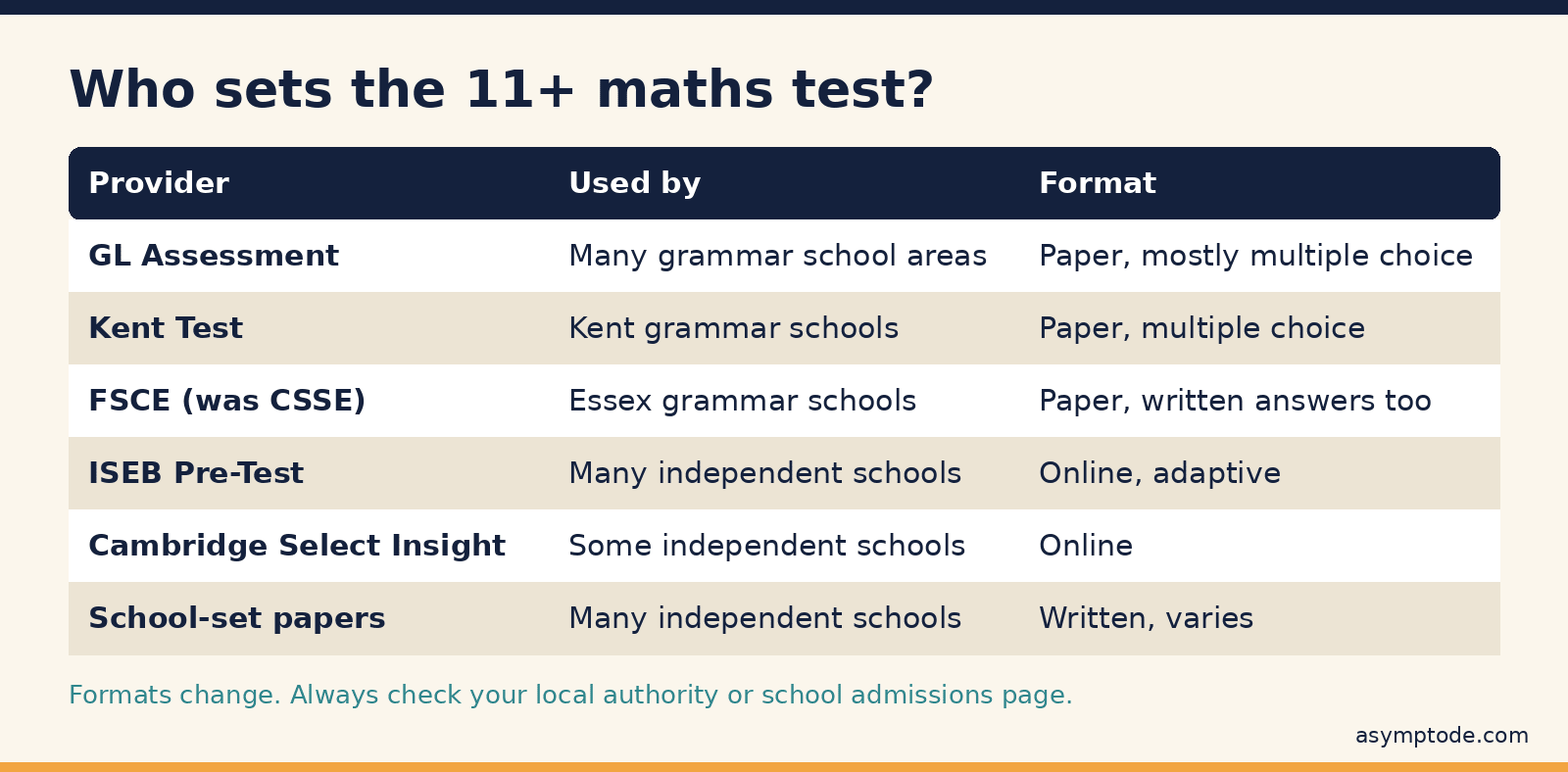
Quick answer: Most grammar school areas use GL Assessment papers. Kent has its own Kent Test, and Essex grammar schools use FSCE (formerly CSSE). Many independent schools use the online ISEB Pre-Test or their own papers.
| Provider | Used by | Format |
|---|---|---|
| GL Assessment | Many grammar school areas | Paper, mostly multiple choice |
| Kent Test | Kent grammar schools | Paper, multiple choice |
| FSCE (formerly CSSE) | Essex grammar schools | Paper, includes written answers |
| ISEB Pre-Test | Many independent schools | Online and adaptive |
| Cambridge Select Insight | Some independent schools | Online |
| School-set papers | Many independent schools | Written, varies by school |
A note on CEM: for years, CEM set the 11+ in places like Birmingham and Gloucestershire. CEM stopped setting state grammar school 11+ tests after the 2022 round. Most of those areas now use GL Assessment, and a few use other providers. Old "CEM-style" practice books are still useful for maths skills, but they may not match your area's format.
The ISEB Pre-Test is online and adaptive. That means the next question gets harder or easier depending on the last answer. It has four parts: maths, English, verbal reasoning and non-verbal reasoning. Schools often ask children to sit it in Year 6 or Year 7.
Always check your local council or school admissions page. It lists the test provider, the date, the registration deadline and any familiarisation booklet. For grammar schools, registration usually closes in the summer term of Year 5.
What topics are in 11+ maths?
Quick answer: 11+ maths covers number and place value, the four operations, fractions, decimals and percentages, ratio, measurement, geometry, statistics and simple algebra. These all come from the KS2 curriculum, but the questions are often longer and need more steps.
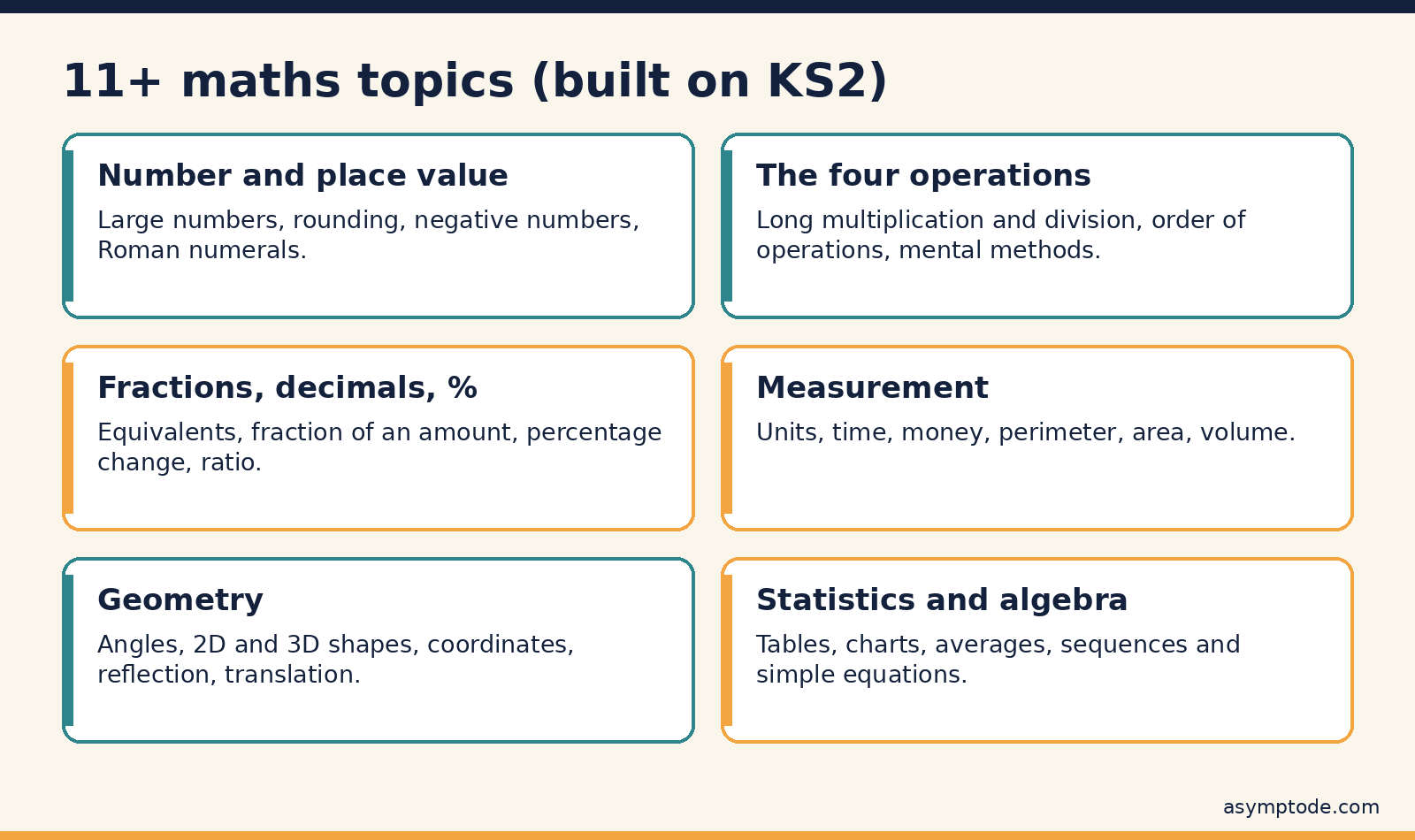
| Topic | What to practise |
|---|---|
| Number and place value | Large numbers, rounding, negative numbers, Roman numerals |
| Four operations | Long multiplication and division, order of operations, mental methods |
| Fractions, decimals, percentages | Equivalents, fraction of an amount, percentage change |
| Ratio and proportion | Sharing in a ratio, scaling recipes, best buys |
| Measurement | Units, time, money, perimeter, area, volume |
| Geometry | Angles, 2D and 3D shapes, coordinates, reflection, translation |
| Statistics | Tables, bar charts, pie charts, line graphs, mean |
| Algebra | Sequences, simple formulas, missing-number equations |
Some areas include topics from early Year 6, so check the familiarisation material. Children who have not met a topic at school yet need it taught carefully, not just drilled.
What do 11+ maths questions look like?
Here are four typical question types, worked step by step. None of them need a calculator.
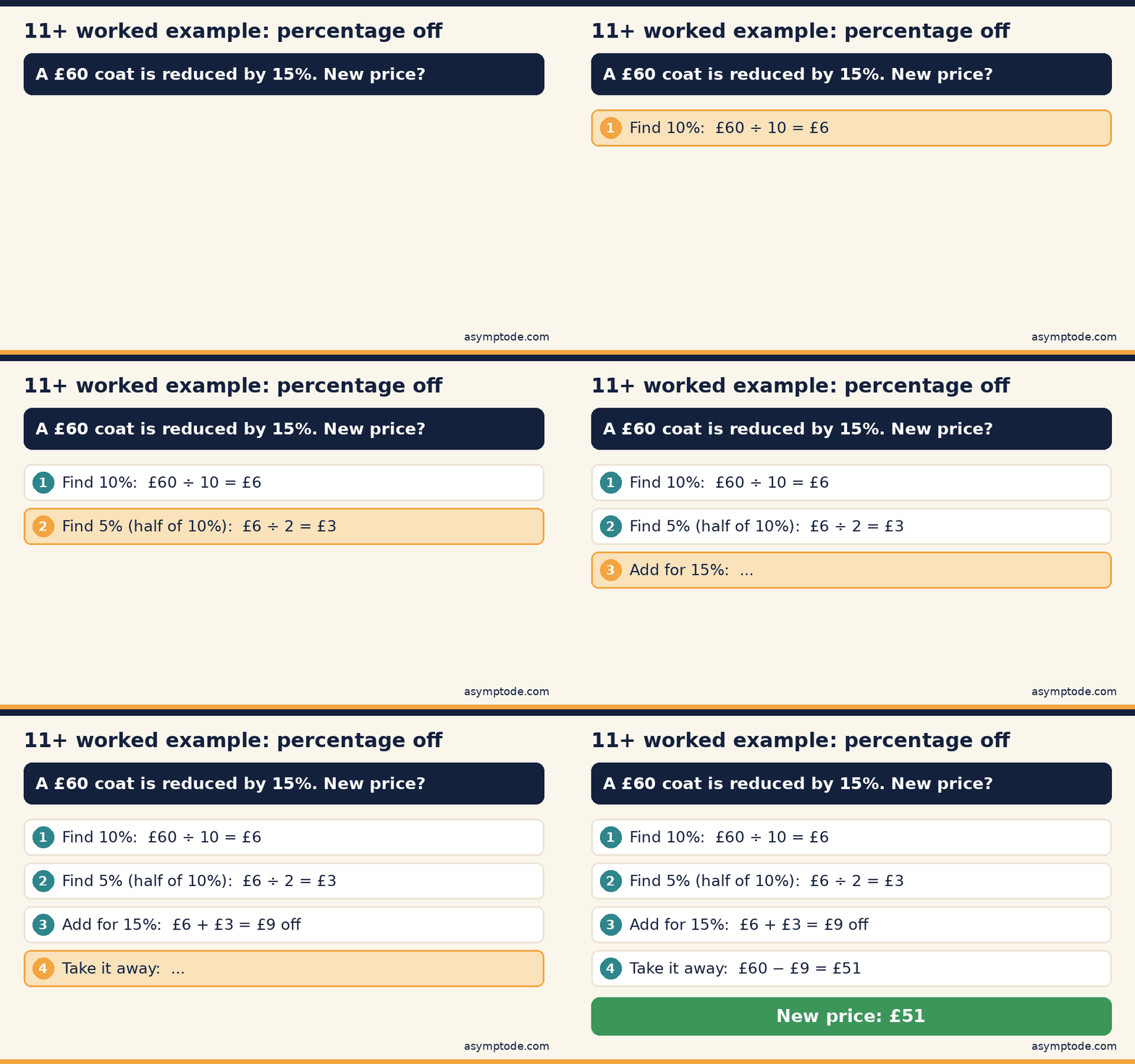
Example 1: percentage reduction
A £60 coat is reduced by 15%. What is the new price?
- Find 10%: £60 ÷ 10 = £6.
- Find 5% (half of 10%): £6 ÷ 2 = £3.
- Add them for 15%: £6 + £3 = £9.
- Take it away: £60 − £9 = £51.
Example 2: sharing in a ratio
Sam and Priya share 35 sweets in the ratio 3 : 4. How many does Priya get?
- Add the parts: 3 + 4 = 7 parts.
- Find one part: 35 ÷ 7 = 5.
- Priya has 4 parts: 4 × 5 = 20 sweets.
- Check: Sam has 3 × 5 = 15, and 15 + 20 = 35. Correct.
Example 3: area of a compound shape
A rectangle is 8 cm by 5 cm. A 3 cm by 2 cm rectangle is cut from one corner. What is the area left?
- Area of the big rectangle: 8 × 5 = 40 cm².
- Area of the cut-out: 3 × 2 = 6 cm².
- Area left: 40 − 6 = 34 cm².
Example 4: sequences
The sequence starts 4, 7, 10, 13 … What is the 20th term?
- The numbers go up by 3 each time.
- The first term is 4, so the rule is 3n + 1. (Check: 3 × 1 + 1 = 4.)
- 20th term: 3 × 20 + 1 = 61.
Notice that every example ends with a quick check. In a multiple-choice paper, checking helps your child spot a trap answer.
How should my child prepare for 11+ maths?
Quick answer: Start with a short diagnostic test to find gaps. Spend the first months fixing core skills like times tables, fractions and place value. Then move to timed practice in your area's exact format, and finish with full mock papers.
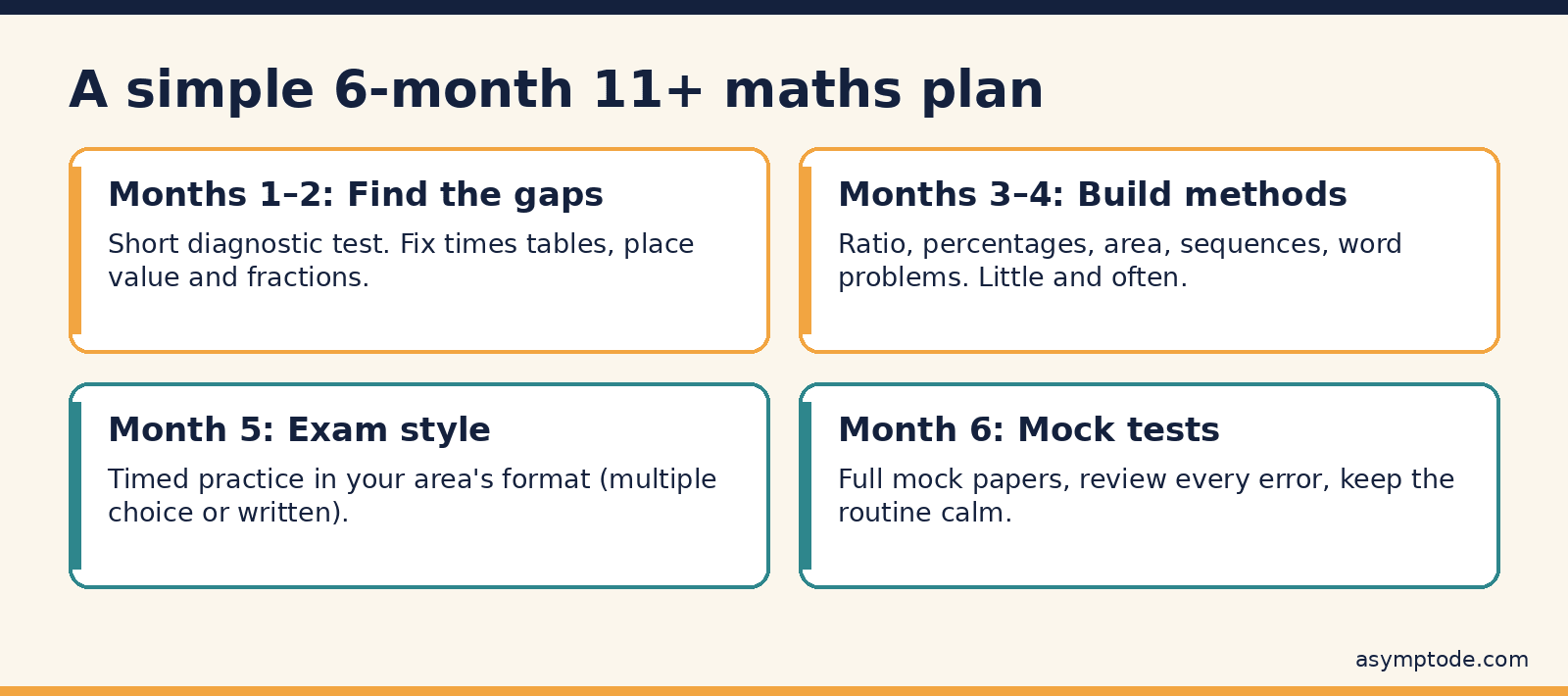
| Months before the test | Focus | Practice |
|---|---|---|
| 6–5 | Find and fix gaps | Times tables to 12 × 12, place value, fractions |
| 4–3 | Build methods | Ratio, percentages, area, sequences, word problems |
| 2 | Exam style | Timed sections in your area's format |
| 1 | Mock tests | Full papers, then review every error |
Simple habits that help:
- Little and often. 20 to 30 minutes, four or five times a week, is better than one long session.
- Mental maths warm-ups. Five quick questions at the start of each session build speed.
- Read the whole question. Many 11+ errors come from missing a word like "not" or "more than".
- Practise the answer format. Shading a multiple-choice answer sheet is a skill. So is showing working on written papers.
- Keep it calm. A confident child thinks more clearly. Praise effort and good methods, not just scores.
If fractions are a weak spot, our guide to adding and subtracting fractions is a good place to start. Our factors and multiples guide also helps with number questions.
What are the most common 11+ maths mistakes?
- Slow times tables. Without fast recall, every multi-step question takes too long.
- Unit mix-ups. Mixing cm and m, or minutes and hours, gives a wrong answer even with the right method.
- Answering a different question. For example, finding the discount but not the new price.
- Running out of time. Children spend too long on one hard question. Teach them to skip and come back.
- Practising the wrong format. A child used to written answers may struggle with a fast multiple-choice paper, and the other way round.
How 1-on-1 tutoring helps with 11+ maths
Every child starts 11+ preparation with different gaps. One child is quick at mental maths but weak at word problems. Another knows the methods but panics under time pressure. A group class can't fix both at once.
At Asymptode, your child works with one dedicated mentor in live 1-on-1 online lessons:
- A starting assessment shows exactly which topics need work, so time is not wasted on what your child already knows.
- A plan to the test date. The mentor plans backwards from your area's 11+ date and format.
- Method first. The mentor watches each step of the working and fixes the method, not just the final answer.
- Personalised homework on the topics taught that week, checked by the same mentor.
- Progress updates for parents, so you know what has improved and what still needs practice.
- Recorded lessons, so your child can rewatch an explanation before a mock test.
Book a free demo class to meet a mentor, or see our fees.
FAQ
When do children sit the 11+ maths test?
Most grammar school 11+ tests are in September of Year 6. Independent school tests, like the ISEB Pre-Test, are often taken during Year 6 or Year 7. Check your area or school for exact dates.
Is a calculator allowed in the 11+?
Many 11+ maths papers do not allow a calculator. Your child should be confident with mental and written methods.
What maths level is the 11+?
It is based on the KS2 curriculum, mostly up to Year 5 and early Year 6. The questions are often harder than school SATs because they need more steps.
Is CEM still used for the 11+?
CEM stopped setting state grammar school 11+ tests after the 2022 round. Most of those areas now use GL Assessment or another provider. Check your local admissions page.
How long should my child prepare for 11+ maths?
Many families start about 6 months before the test. Children with bigger gaps may need longer. Steady practice matters more than the number of months.
Can my child prepare for the 11+ online?
Yes. Live online lessons work well for 11+ maths, as long as they are interactive and the tutor can see your child's working step by step.
Ready to make a plan? Talk to an Asymptode advisor for a free demo class, or check our fees.