
The Euclid Contest 2027 is a senior mathematics contest from the University of Waterloo's CEMC. It is written on Tuesday, April 6, 2027 in North and South America, and on Wednesday, April 7 elsewhere. This guide covers who should write it, the format, the fees, how to sign up and a calm way to prepare.
Key takeaways
- Date: April 6, 2027 (North and South America) or April 7, 2027 (elsewhere).
- Ordering deadline: March 11, 2027. Your school orders the contest.
- Format: 10 questions in 2.5 hours, scored out of 100.
- Who: final-year secondary or CÉGEP students. Motivated younger students are welcome.
- It is not required for admission to Waterloo's Faculty of Mathematics.
When is the Euclid Contest 2027?
Quick answer: The Euclid Contest 2027 is on Tuesday, April 6, 2027 for schools in North and South America, and on Wednesday, April 7, 2027 for schools elsewhere. Schools must order it by Thursday, March 11, 2027.
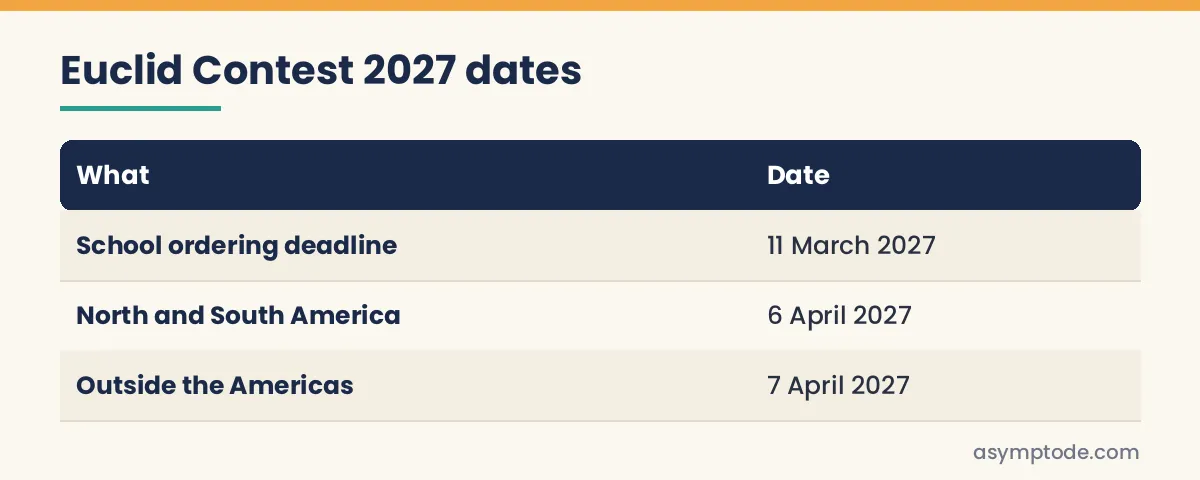 The key 2027 dates, from CEMC.
Teachers who run the contest are asked to start it as early in the school day as possible in their time zone.
Who should write it?
CEMC aims the Euclid at students in their final year of secondary school, or CÉGEP. Motivated students in lower grades are welcome too. Many students who want a strong score in their final year have already written it one or more times before.
So you can start early. A Grade 11 student can try it once, learn how it feels, and come back stronger in Grade 12. For younger students, see our guide to the Pascal, Cayley and Fermat contests.
What is the format?
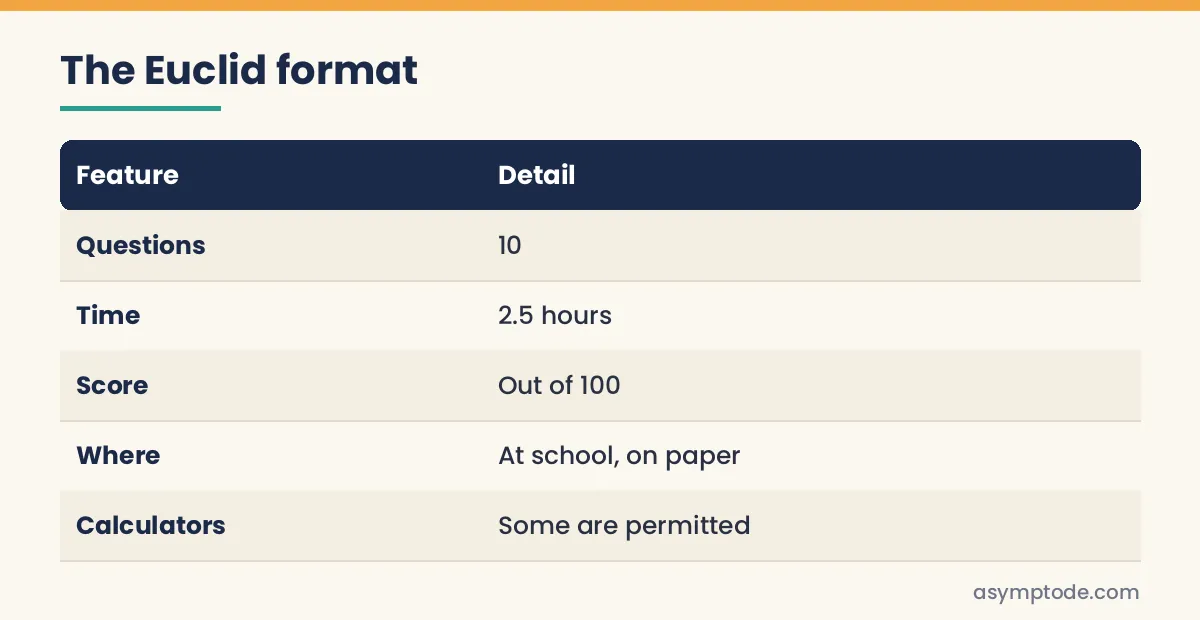 The Euclid format at a glance.
- 10 questions, a mix of final-answer-only and full-solution.
- 2.5 hours, written individually, on paper, at school.
- Some calculators are permitted. Check CEMC's rules and ask your teacher.
- Presentation counts. Solutions are judged on completeness, clarity and presentation. A correct solution that is poorly presented will not get full marks.
Most problems use maths up to and including the final year of secondary school, but some may need ideas beyond your own school's course.
What kind of thinking does it test?
Here are two of our own practice examples, not CEMC questions. If x + y = 10 and xy = 21, what is x² + y²?
 Use an identity instead of solving for x and y.
Since (x + y)² = x² + 2xy + y², we get x² + y² = (x + y)² − 2xy = 100 − 42 = 58. You never need x and y themselves.
Now find 1 + 3 + 5 + … + 99.
 Spot the pattern, then use it.
The first two odd numbers add to 2², the first three to 3². There are 50 odd numbers from 1 to 99, so the sum is 50² = 2,500. In a full-solution question, you would also explain why the pattern holds.
How do you sign up, and what does it cost?
Students write the Euclid at school, so ask your maths teacher. The school orders it from CEMC by March 11, 2027.
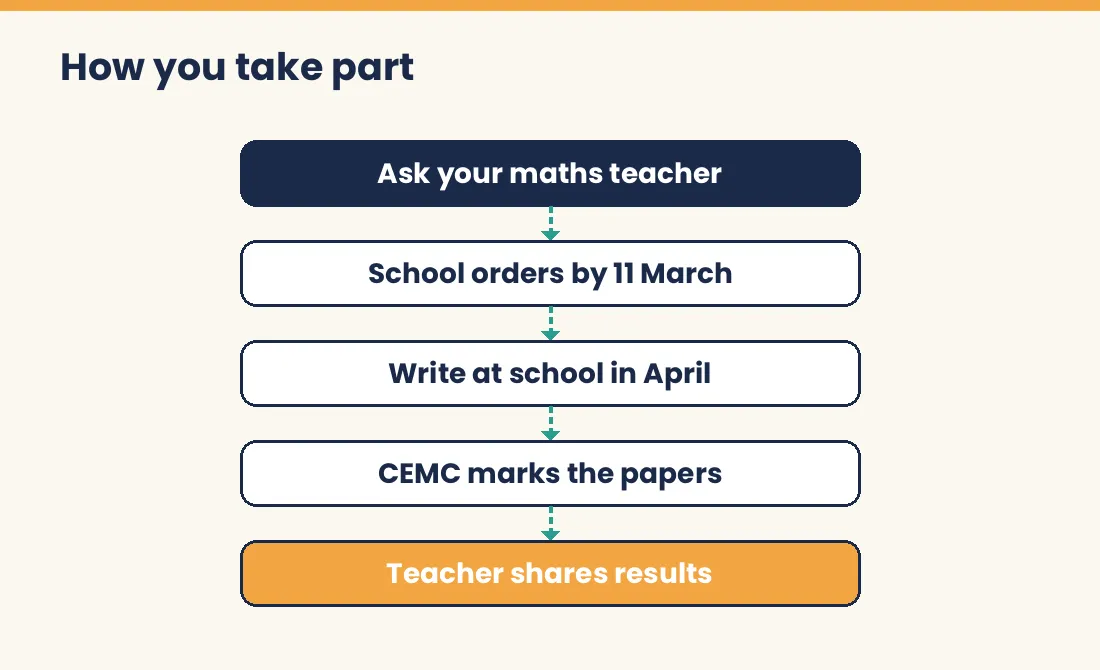 How a student takes part.
CEMC lists $18 per participant, plus a $5 processing fee per order. Shipping is $5 per order for schools in Canada, and 15% of the order total (at least $10) for schools outside Canada. Schools also pay to send completed papers back. Orders cannot be refunded or cancelled. Your school decides what families pay.
Does the Euclid help with university?
CEMC says that taking the Euclid is not required for admission to Waterloo's Faculty of Mathematics. Waterloo has separate pages on how contests are used for Math and Science scholarships, so read those if that matters to you. The contest is not a pass-or-fail test. Its real value is practice in solving unfamiliar problems and writing clear solutions.
How can your child prepare?
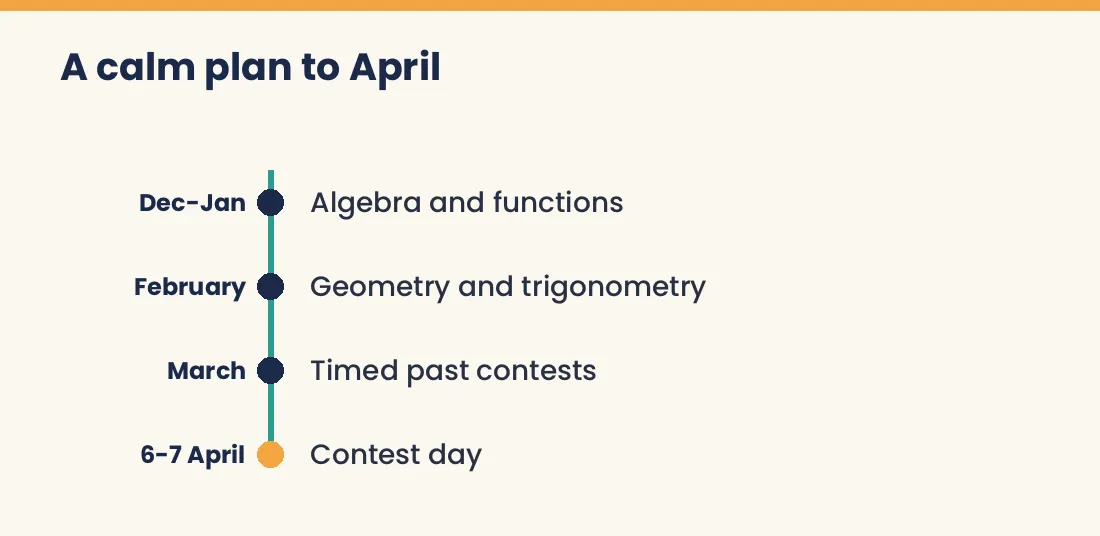 A simple plan from now to April.
- Use past contests. CEMC publishes them with solutions and preparation resources.
- Write full solutions. Practise explaining each step in clear sentences.
- Build core topics first. Our guides to logarithms, trigonometric identities and functions help.
- Do not rush. One careful problem teaches more than five skimmed ones.
How Asymptode Can Help You Prepare for the Euclid Contest
- One mentor, one child, live online. The mentor works from your child's school course and plans around the real date, April 6 or 7, 2027.
- Practice at your child's level. Between classes, AI-assisted practice is built from what your child's last attempt showed they had not yet understood, for example solving for x and y when an identity was enough, and goes out only after the mentor approves it. The AI supports the mentor and never replaces them. Work that fits builds confidence instead of wearing it down.
- Every class is recorded and searchable, and the parent view shows what was understood and what to practise next.
- Lessons are reviewed, so the quality of the teaching is checked, not assumed.
- Start early, gently. A calm year of problem solving beats one rushed month.
We never promise a score or an award. Book a free demo class or see our plans and fees.
Facts checked against official sources on 25 November 2026: the CEMC Euclid Contest page, University of Waterloo.
Related guides
- Pascal, Cayley and Fermat contests
- AMC 10 and AMC 12 guide
- Ontario Grade 12 math courses
- How to get into the University of Toronto
FAQ
When is the Euclid Contest 2027?
Tuesday, April 6, 2027 in North and South America, and Wednesday, April 7, 2027 elsewhere.
Can a Grade 11 student write the Euclid?
Yes. It is aimed at final-year students, but CEMC welcomes motivated students in lower grades.
How long is the Euclid Contest?
It lasts 2.5 hours and has 10 questions, scored out of 100.
How do I register for the Euclid?
Ask your maths teacher. The school orders the contest from CEMC by March 11, 2027.
Is the Euclid required for Waterloo admission?
No. CEMC says it is not required for admission to Waterloo's Faculty of Mathematics.
Are calculators allowed?
Some calculators are permitted. Check CEMC's rules and confirm with your teacher.