
The EJU (Examination for Japanese University Admission for International Students) is the main entrance test that Japanese universities use for international students who want to study at undergraduate level. It is run by JASSO twice a year, in June and November. This guide covers the 2026 dates, subjects, fees, test cities, scores, the scholarship and a simple study plan, all checked against official JASSO pages.
Key takeaways
- The next EJU is on Sunday 8 November 2026. Applications closed on 30 July 2026, and scores are due 15 December 2026 (tentative).
- June 2027 dates are not yet announced. JASSO says next year's schedule appears "from around November".
- You pick subjects to suit each university: Japanese, Science (2 of Physics, Chemistry, Biology), Japan and the World, and Maths Course 1 or Course 2.
- Science, Japan and the World and Maths can be taken in English. There is no pass mark, and scores are valid for two years (four sessions).
- High scorers can be picked for a JASSO scholarship reservation worth JPY 48,000 per month. You apply by ticking one box on the EJU application.
What is the EJU?
Quick answer: The EJU is a paper-based exam run by the Japan Student Services Organization (JASSO). It checks the Japanese language skills and basic academic ability of international students who want undergraduate places in Japan. It runs in June and November, has no pass mark, and each university decides which subjects and scores it needs.
The EJU has run twice a year since 2002, with support from MEXT, Japan's education ministry.
As of October 2026, JASSO lists 954 schools that use the EJU. That includes 508 universities (77 national, 61 public, 370 private). You can search the official list of schools that use the EJU to see the subjects and exam language each one wants.
Some universities offer pre-arrival admission, so you can get an offer without travelling to Japan.
Who can take the EJU?
Anyone can. JASSO's FAQ says "No specific qualifications are needed, anyone can take the EJU." There is no age limit, no limit on attempts and no nationality rule for sitting it. Universities set their own entry rules. Undergraduate entry generally needs 12 years of schooling, and some schools, such as the University of Tokyo, have nationality rules.
If you are comparing systems across Asia, our guides to the gaokao and the Suneung explain how China's and Korea's national exams work.
When are the EJU exam dates?
The EJU runs twice a year. The 1st session is in June and the 2nd is in November.
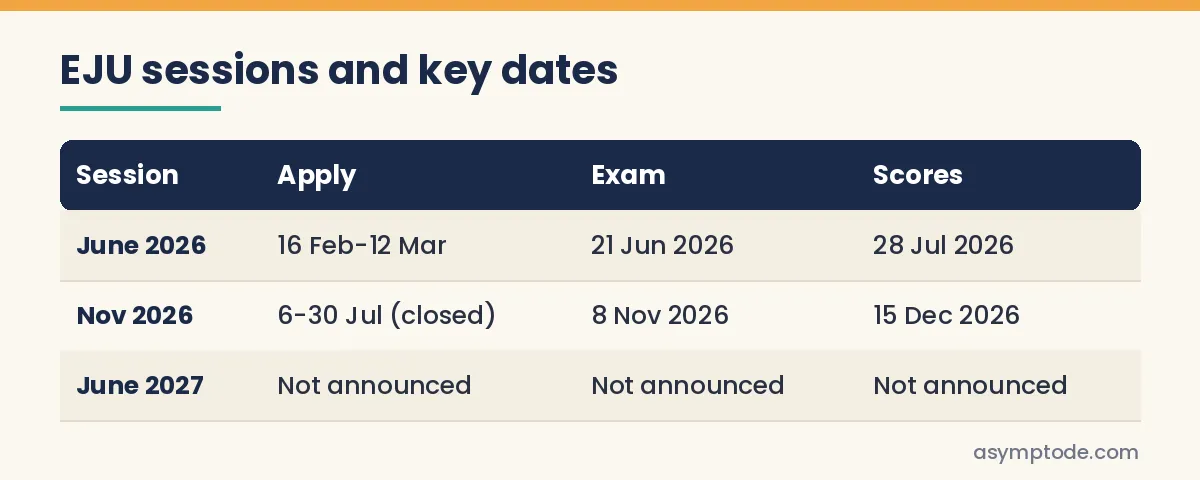 EJU sessions and key dates, 2026 to 2027.
June 2026: applications ran 16 February to 12 March, the exam was on 21 June 2026 and scores came out on 28 July 2026. November 2026: applications ran 6 to 30 July (now closed), the exam is on 8 November 2026 and scores are due at 0:00 JST on 15 December 2026 (tentative). June 2027: the application window, exam date and score date are not announced yet.
For the November 2026 session, 32,853 people applied (24,509 in Japan and 8,344 outside Japan). Vouchers for Japan addresses were mailed on 16 October 2026.
When will the June 2027 EJU dates be published?
Not yet. JASSO says the next year's schedule "will be posted on the website from around November". Watch the official EJU schedule page.
How do EJU dates fit university deadlines?
Each university decides which sessions it accepts. For University of Tokyo 2027 entry (Category 1, privately financed students), applications run 1 to 7 December 2026, and it only accepts EJU scores from June 2026 or November 2026.
What are the EJU subjects?
There are four subjects. You only take the ones your target universities ask for.
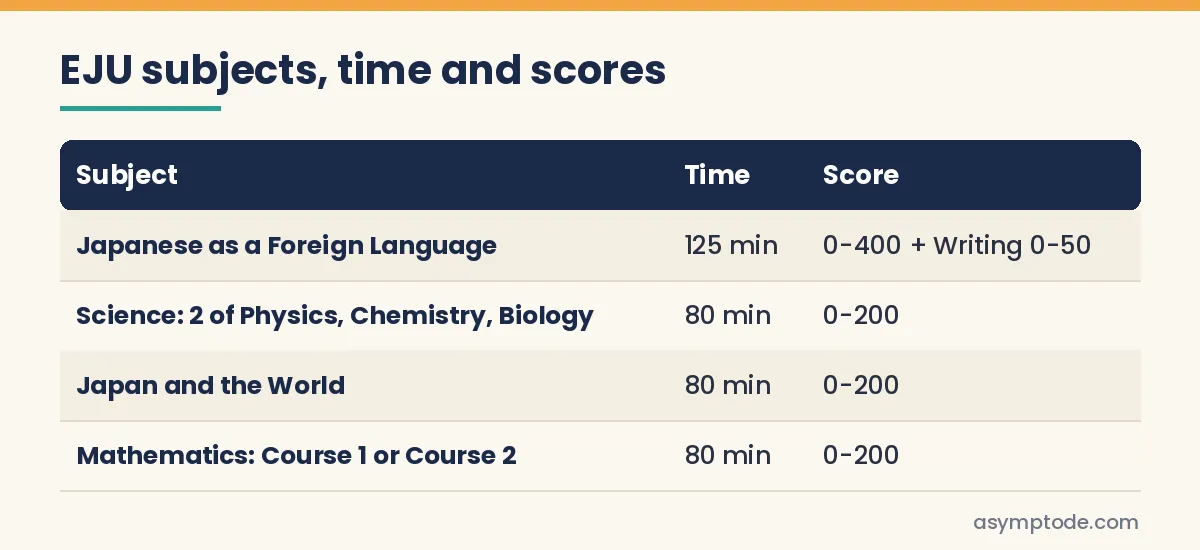 EJU subjects, answer time and score range.
Japanese as a Foreign Language takes 125 minutes and is scored 0-400, plus a separate Writing score of 0-50. Science (choose 2 of Physics, Chemistry and Biology) takes 80 minutes and is scored 0-200. Japan and the World takes 80 minutes and is scored 0-200. Mathematics (Course 1 or Course 2) takes 80 minutes and is scored 0-200.
A few rules matter:
- Japanese has Writing (30 min), Reading (40 min), and Listening-Reading and Listening (about 55 min). Audio plays once only.
- Science: answer exactly two subjects, or Science is not graded. Each is reported out of 100.
- Science and Japan and the World happen at the same time, so you cannot take both in one session.
- Everything except Japanese Writing is multiple choice on a mark sheet, filled in with an HB pencil.
In Japan, Japanese runs 9:30-12:00, Science or Japan and the World 13:30-15:00, and Maths 15:40-17:10.
Can you take the EJU in English?
Yes, for three subjects. Science, Japan and the World and Mathematics come in Japanese or English. Japanese as a Foreign Language is in Japanese only. You choose one language when you apply, because the booklets are different. Check which language each university accepts.
EJU math Course 1 vs Course 2: which one?
| Course 1 | Course 2 | |
|---|---|---|
| Who it is for | Humanities, and science faculties that need little maths | Faculties that need advanced maths, such as science and engineering |
| Syllabus | Topics 1-7 (Maths I and A) | Topics 1-20 (Maths I, A, II, B, III, C) |
| Average, June 2026 | 97.3 / 200 | 108.5 / 200 |
You choose the course on exam day, following your university's instructions. Picking the wrong one can ruin an application. At the University of Tokyo, humanities streams need Course 1 and science streams need Course 2, and the wrong course makes the application invalid.
A new maths syllabus started in the June 2026 session. Course 1 adds expected value. Course 2 adds expected value and probability distributions. Nothing was removed.
Worked Course 1 example: expected value
 Expected value, one of the topics added to the 2026 EJU maths syllabus.
A game pays 300 yen with probability 1/5 and 100 yen with probability 1/2. Otherwise it pays 0. Multiply each prize by its probability and add: E = 300 × 1/5 + 100 × 1/2 + 0. That gives E = 60 + 50 = 110, so the expected value is 110 yen per game.
Check the working:
- The chance of winning nothing is 1 − 1/5 − 1/2 = 3/10, so the probabilities add to 1.
- 300 × 1/5 = 60, 100 × 1/2 = 50 and 0 × 3/10 = 0.
- E = 60 + 50 + 0 = 110 yen.
Worked Course 2 example: derivative and turning points
Find the local maximum and minimum of f(x) = x³ − 6x² + 9x + 1.
- Differentiate: f′(x) = 3x² − 12x + 9.
- Factorise: f′(x) = 3(x² − 4x + 3) = 3(x − 1)(x − 3). So f′(x) = 0 at x = 1 and x = 3.
- Check the sign. f′(x) is positive for x < 1, negative between 1 and 3, and positive for x > 3. So x = 1 is a maximum and x = 3 is a minimum.
- Substitute: f(1) = 1 − 6 + 9 + 1 = 5 (local maximum). f(3) = 27 − 54 + 27 + 1 = 1 (local minimum).
If you have studied calculus in A-Level Maths or the IB Diploma, much of Course 2 will feel familiar. See the JASSO maths syllabus page.
How much are the EJU fees?
In Japan, the 2026 fee is JPY 12,000 for one subject and JPY 23,000 for two or three subjects, tax included. Fees are not refunded or moved to a later session.
| Location | 2026 EJU fee |
|---|---|
| Japan | JPY 12,000 (1 subject) / JPY 23,000 (2-3 subjects) |
| Hong Kong | HKD 600 (1) / HKD 1,150 (2-3) |
| India | INR 1,300 |
| Indonesia | IDR 110,000 |
| Malaysia | MYR 90 |
| Mongolia | MNT 70,000 |
| Myanmar | USD 20 |
| Philippines | PHP 750 |
| Republic of Korea | KRW 65,000 (1) / KRW 110,000 (2-3) |
| Singapore | SGD 65 |
| Sri Lanka | LKR 1,850 |
| Taiwan | TWD 1,500 (1) / TWD 2,000 (2-3) |
| Thailand | THB 400 |
| Vietnam | VND 275,000 |
2027 fees are not yet announced. See the official exam fee page.
Where are the EJU test centres?
In Japan, the 2026 exam runs in 17 prefectures, from Hokkaido to Okinawa. Tokyo has 12 venues for November 2026.
Outside Japan, it runs in 17 cities in 13 countries and regions:
- Hong Kong; India (New Delhi); Indonesia (Jakarta, Surabaya); Malaysia (Kuala Lumpur); Mongolia (Ulaanbaatar); Myanmar (Yangon)
- Philippines (Manila); Republic of Korea (Seoul, Busan); Singapore; Sri Lanka (Colombo); Taiwan (Taipei)
- Thailand (Bangkok, Chiang Mai); Vietnam (Hanoi, Ho Chi Minh City)
It is not held in the USA, Europe, Africa or mainland China. Without a local centre, you can sit it in another country if you have a local proxy for the application, understand the test-room language and arrange your own visa.
How are EJU scores worked out?
All scores except Writing are scaled scores. Different sessions use different papers, so JASSO uses item response theory to put them on one common scale. An easier paper does not give you an advantage. Writing is graded against published criteria in steps of 0, 10, 20, 25, 30, 35, 40, 45 or 50.
What is a good EJU score?
There is no pass or fail. Each university sets its own requirement. For context, official June 2026 averages were 237.0/400 in Japanese, 33.1/50 in Writing, 53.8/100 in Physics, 52.4 in Chemistry, 63.8 in Biology and 122.5/200 in Japan and the World.
Kyoto University's Faculty of Engineering (2026 entry) shows a real threshold. It wants the EJU in Japanese. Japanese (excluding Writing) + Maths Course 2 + Physics + Chemistry must total at least 680. Or the total must be at least 650 with Maths Course 2 + Physics + Chemistry at least 350. It also asks for TOEFL iBT 72 or IELTS 6.0.
How long are EJU scores valid?
Scores are valid for two years, which is the four most recent sessions. Each university may accept fewer. You can choose which session to send, but all subjects must come from one session.
Scores are online only, on EJU Online. Universities request your scores directly from JASSO using your registration number. Keep your exam voucher, as some universities ask for a copy.
How do you apply for the EJU?
The EJU is not a university application. You sit it, then apply to each school separately.
 How the EJU fits into admission, step by step.
First, check each university's subjects and whether it wants Course 1 or Course 2. Next, apply through EJU Online (in Japan) or your overseas office, then sit the exam in June or November. Scores appear online and stay valid for two years, and each university requests your scores from JASSO.
Applying in Japan
- Read the EJU Bulletin and check each university's requirements.
- Get a My Page ID on EJU Online.
- Enter subjects, one language and a venue. Tick "Apply for Scholarship" if wanted. Upload a face photo.
- Pay by card, convenience store or bank transfer.
- Wait for the voucher by post, then check scores online on results day.
Applying outside Japan
Get the form from the EJU Overseas Representative in your city. Submit it in person or by post. You need three photos, 4 cm × 3 cm, taken within six months. Find your office on the JASSO overseas contacts page.
What do you bring on exam day?
Bring your exam voucher and an original photo ID (in Japan: Residence Card, Passport or My Number Card). Copies are refused. Bring HB pencils (not mechanical), a plain eraser, a sharpener and a plain watch. Smartwatches are banned, and there is no clock in the room.
What is the EJU scholarship?
It is the Reservation Program for the Monbukagakusho Honors Scholarship for Privately-Financed International Students. Top scorers in each subject combination become "reservation holders". Once they enrol as regular students at a Japanese undergraduate faculty, junior college, KOSEN (3rd year or above) or professional training college, they can receive JPY 48,000 per month (this may change each year). Graduate schools are not eligible.
- There is no separate form. Just tick the box on your EJU application.
- English-version takers are eligible.
- For the November session, notices appear at the end of January. Read the official scholarship page.
Book a free demo class with an Asymptode maths or science mentor to plan your EJU preparation, or compare our plans and fees.
How should you prepare for the EJU?
Your plan depends on how many months you have left.
| Time left | Focus |
|---|---|
| 12+ months | Pick universities. List each one's subjects, maths course, language and sessions. Learn the full syllabus. |
| 6-9 months | Finish the syllabus. Start timed sections. Find weak topics. |
| 3 months | Full papers under time. Review every mistake. Practise the new topics (expected value, probability distributions). |
| Final weeks | Light review, timing practice, and check your voucher, ID and exam-day items. |
Sitting on 8 November 2026? You have about one week. Focus on timing, not new topics. Past papers help, but since 2024 JASSO publishes only one session a year.
If you are also applying to universities elsewhere, see our guides on getting into NUS and the SAT vs ACT.
What are the most common EJU mistakes?
- Choosing the wrong maths course. Check each university first.
- Answering only one science subject. Science is then not graded.
- Choosing the wrong exam language. Some universities want Japanese.
- Bringing a copy of your ID. Only originals count.
- Mixing sessions. All subjects must come from one session.
- Missing the short application window.
How 1-on-1 tutoring helps with the EJU
Asymptode mentors help with the EJU Mathematics (Course 1 and Course 2) and Science (Physics, Chemistry, Biology) papers. We do not teach Japanese as a Foreign Language. For the Japanese paper and Japan and the World, your mentor can help with study planning and method.
- One dedicated mentor, live online 1-on-1. Your mentor follows the EJU syllabus, your chosen maths course and your exam session date.
- Method first. The mentor watches each step of your working, so mistakes like a missing probability or a sign error get fixed early.
- Personalised homework with feedback, plus short updates for parents.
- Every class is recorded, so you can rewatch hard topics. Start with a free demo class.
Facts checked against official sources on 31 October 2026.
FAQ
Is the EJU hard?
There is no pass mark, and universities set their own score needs. In June 2026, the average was 97.3 out of 200 in Maths Course 1 and 108.5 in Course 2.
Can I take the EJU without knowing Japanese?
You can take Science, Japan and the World and Mathematics in English. The Japanese as a Foreign Language test is in Japanese only.
How many times can I take the EJU?
There is no limit on attempts and no age limit. Scores stay valid for two years, or four sessions. You send scores from one session only.
When will the June 2027 EJU be held?
It is not yet announced. JASSO says next year's schedule will be posted from around November. Check the official schedule page.
Is there an EJU test centre in China, the USA or Europe?
No. The EJU runs only in Hong Kong for China, and not in the USA, Europe or Africa. You can sit it in another country or in Japan.
Does a good EJU score guarantee admission?
No. The EJU is not a university application. Each school has its own exams, interviews and documents. For tips on making a stronger application, see our guide to research for high school students.
Ready to start? Book a free demo class and advisor call, or see our plans and fees.
Sources
- JASSO: About the EJU
- JASSO: EJU schedule
- JASSO: Guidelines for the 2026 EJU (PDF)
- JASSO: 2026 EJU Bulletin, Japan (PDF)
- JASSO: 2026 EJU Bulletin, outside Japan (PDF)
- JASSO: EJU subjects
- JASSO: Examination fee
- JASSO: Number of schools using the EJU
- JASSO: Outline of results, 2026 1st session (PDF)
- JASSO: EJU scores
- JASSO: Score report
- JASSO: EJU mathematics syllabus
- JASSO: EJU FAQ (overseas)
- JASSO: Honors Scholarship reservation program
- University of Tokyo: 2027 admission guidelines for foreign school graduates (Japanese, PDF)
- Kyoto University Faculty of Engineering: 2026 international admission guidelines (Japanese, PDF)