

The Gaokao is China's National College Entrance Examination, the main way students in mainland China get into university. It is huge. In 2026, 12.9 million people registered for it, according to China's Ministry of Education. This guide explains the dates, subjects, 750-point score, who can sit it and how admission works, for families and students outside China.
Key takeaways
- The Gaokao is a national exam coordinated by China's Ministry of Education and run locally by each province.
- The 2026 exam started on 7 June. Most papers were on 7-8 June, and some provinces added papers on 9-10 June.
- Most provinces now use the "new gaokao" (3+3 or 3+1+2). 2026 was the last year Tibet and Xinjiang used the old model.
- The usual maximum score is 750: Chinese, Maths and a foreign language (150 each) plus three electives (100 each).
- Most foreign nationals do not take the Gaokao. They apply to Chinese universities directly, and many now need the CSCA test.
What is the Gaokao, and who runs it?
Quick answer: The Gaokao (高考) is China's national university entrance exam. The Ministry of Education coordinates it, and its National Education Examinations Authority sets papers. Each province registers students, runs the exam, marks it and manages admission. Universities admit students mainly by Gaokao score, province by province, through a ranked preference form called the "zhiyuan".
It is high-stakes. A single score decides which universities and majors a student can choose.
The exam is big. In 2025, 13.35 million people registered. The Ministry reported 7,899 test sites, 355,000 exam rooms and 1.05 million invigilators that year (MOE). In 2026 the number fell to 12.9 million. The Ministry also made Braille papers for blind candidates and gave support to more than 14,000 candidates with disabilities.
Two official websites matter most:
- Sunshine Gaokao (gaokao.chsi.com.cn), the Ministry's information platform for policies, university charters and preference advice.
- Your provincial exam authority's website, for registration, exam rules and results.
When is the Gaokao? Exam dates for 2026 and 2027
The Gaokao is held every June. The 2026 exam took place on 7-8 June 2026. Some provinces also had papers on 9 and 10 June, because their subject set-up is different (MOE, 6 June 2026). Provinces using the new models need extra days for the elective papers.
Gaokao 2027: the national exam dates are not yet announced (as of 29 October 2026). The exam is usually on 7-8 June, with extra days in some provinces. Registration for the 2027 cycle has already started in some places. For example, Beijing opened online registration on 25 October 2026.
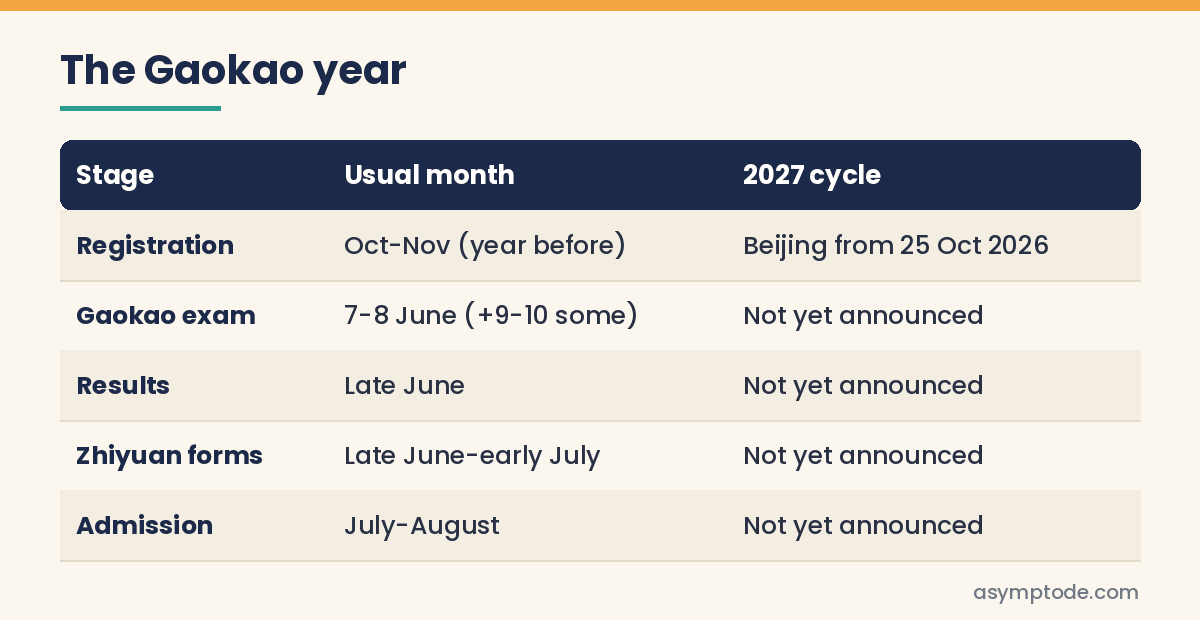
Students register in October or November of the year before. They sit the exam in early June and get results in late June. Preference forms follow from late June into early July, and admission runs in July and August.
| Stage | Usual timing | 2026 cycle (as held) | 2027 cycle |
|---|---|---|---|
| Registration | Oct-Nov of the year before | Autumn 2025 | Beijing: 25 Oct-11 Nov 2026 |
| Gaokao exam | 7-8 June (plus 9-10 June in some provinces) | 7-8 June 2026 (+9-10 June) | Not yet announced (usually 7-8 June) |
| Results | Late June | Shanghai 23 June; most provinces 24-25 June | Not yet announced |
| Zhiyuan forms | Late June to early July | e.g. Beijing 27 June-1 July | Not yet announced |
| Admission | July-August | By batch | Not yet announced |
The 2026 results and form dates above were reported by China News Service via Xinhua. Always check your own provincial authority for the exact times.
What subjects are on the Gaokao? Traditional, 3+3 and 3+1+2
All students take three core subjects: Chinese, Mathematics and a foreign language (usually English). What changes is the rest. China has moved through three models.
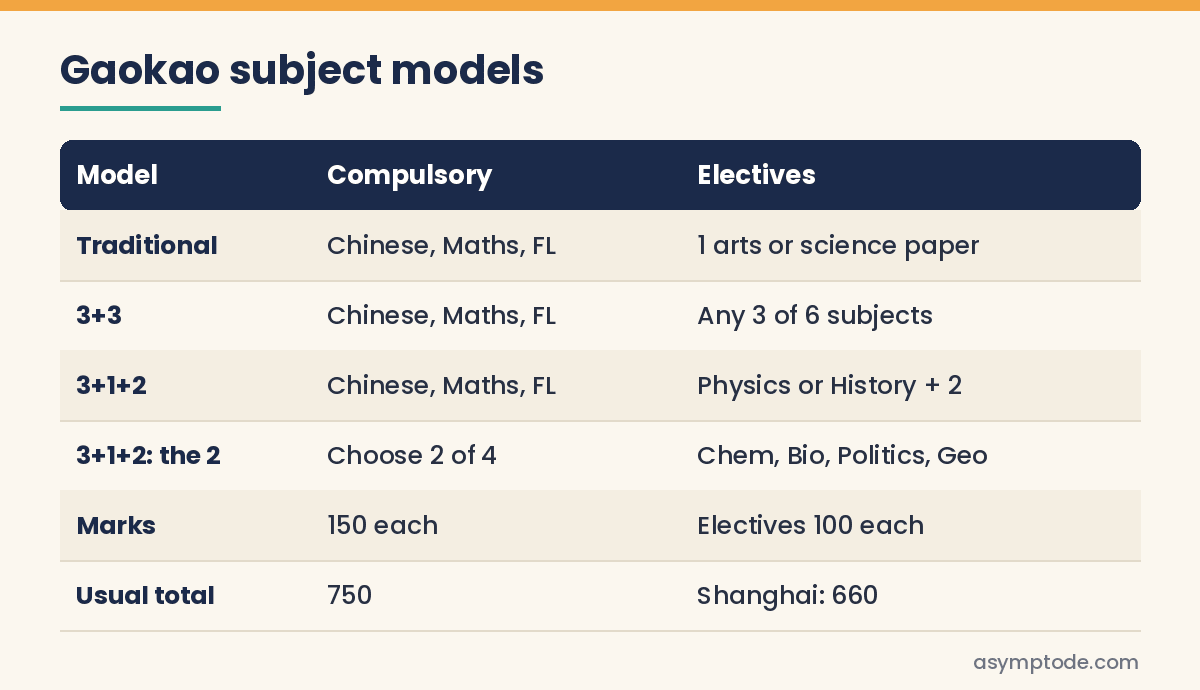
Every model keeps Chinese, Maths and a foreign language, each worth 150 points. The traditional model adds one combined arts or science paper. The 3+3 model lets students pick any 3 of 6 electives. The 3+1+2 model asks for physics or history, plus 2 more from chemistry, biology, politics and geography.
What was the traditional model?
Students chose an arts track or a science track. They then sat one combined paper: humanities (politics, history, geography) or science (physics, chemistry, biology). The Ministry says 2026 was the last year Tibet and Xinjiang used this model. By then, 29 provinces were already on the new Gaokao (MOE).
What is the 3+3 model?
The reform began with a 2014 State Council plan. It ended the arts/science split. A student's total is Chinese, Maths and a foreign language, plus 3 subjects the student chooses from politics, history, geography, physics, chemistry and biology. Shanghai and Zhejiang went first in 2017, followed by Beijing, Tianjin, Shandong and Hainan. In Beijing, the English listening and speaking test is a computer test held twice a year.
What is the 3+1+2 model?
From 2019, eight provinces (Hebei, Liaoning, Jiangsu, Fujian, Hubei, Hunan, Guangdong and Chongqing) chose 3+1+2 (MOE). Later batches of provinces followed the same pattern.
- 3: Chinese, Maths, foreign language (everyone).
- 1: Physics or History (the "first choice").
- 2: Two of Chemistry, Biology, Politics and Geography.
That gives 12 possible combinations. Universities set quotas and cut-off scores separately for the physics group and the history group. So the "1" choice matters a lot. Many science and engineering majors require physics, so check each university's subject requirements on Sunshine Gaokao.
How is the Gaokao scored? The 750-point total
In most provinces the Gaokao total is 750. Here is how Fujian, a 3+1+2 province, explains it (Fujian Education Department):
| Part | Subjects | Maximum |
|---|---|---|
| Core | Chinese, Maths, foreign language | 150 each (450) |
| First choice | Physics or History (raw score) | 100 |
| Second choices | 2 of Chemistry, Biology, Politics, Geography (converted score) | 100 each (200) |
| Total | 750 |
There are province differences. Shanghai converts each elective to a maximum of 70 points, so its total is 450 + 210 = 660 (Shanghai Education Commission). Always check your own province's rules.
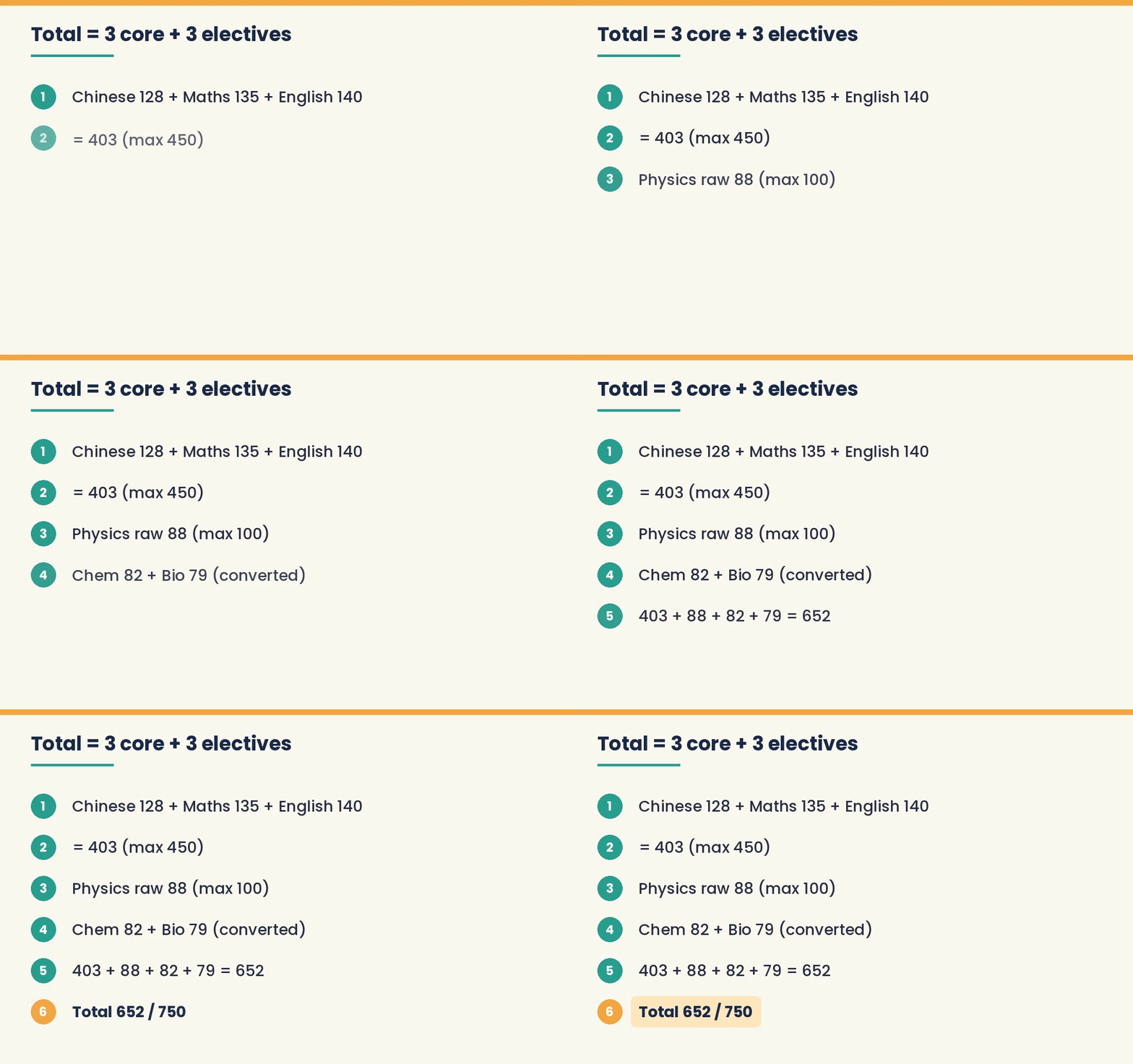
In this example, a student scores Chinese 128, Maths 135 and English 140, which makes 403 out of 450. They add Physics 88 (raw score). Then they add Chemistry 82 and Biology 79, both as converted scores. The total is 403 + 88 + 82 + 79 = 652 out of 750.
Why are some elective scores "converted"?
Raw marks across different electives are not fair to compare. In Fujian, the four second-choice subjects use grade bands. Students are ranked into bands A to E (15%, 35%, 35%, 13% and 2% of candidates). Each band maps to a score range: A = 86-100, B = 71-85, C = 56-70, D = 41-55, E = 30-40. Inside each band, a raw mark is converted in proportion.
How does a converted score work? A worked maths example
This is a linear map between two intervals.
Problem: In one year, band B in Chemistry covers raw marks 64 to 80 (made-up numbers). Band B converts to 71-85. A student has a raw mark of 76. What is the converted score?
- Find how far the student is through the raw band: 76 - 64 = 12, out of 80 - 64 = 16.
- That fraction is 12 / 16 = 0.75.
- Apply the same fraction to the converted band: 85 - 71 = 14, and 0.75 x 14 = 10.5.
- Add the bottom of the band: 71 + 10.5 = 81.5.
- Round as your province's rules say. Rounded to a whole number, this is 82.
The formula is T = T1 + (Y - Y1) x (T2 - T1) / (Y2 - Y1). Here Y is the raw mark, Y1 and Y2 are the raw band limits, and T1 and T2 are the converted band limits. This linear interpolation skill also appears in A-Level Maths and on the Digital SAT Math section.
Who can take the Gaokao? Hukou, residence and foreign students
Students usually register in the province where they have their household registration (hukou) and meet local school rules. Each province publishes its own conditions. Beijing's 2027 notice is a clear example (Beijing Education Examinations Authority). It allows:
- students with a Beijing hukou;
- children of migrant workers who meet set conditions (for vocational college exams only);
- foreigners who have settled in Beijing and hold a PRC Foreign Permanent Residence ID card issued by Beijing police.
So most candidates are Chinese citizens registering where they live and study. A few foreign permanent residents can register in some provinces. Always read your province's notice.
Can foreigners take the Gaokao?
Most foreign nationals do not. They apply to Chinese universities directly as international students. Tsinghua University, for example, runs an online application with a review and sometimes an interview. It accepts school results and tests such as the SAT, ACT, A-Level, AP and IB. Chinese-taught degrees there usually need HSK Level 5.
Many universities now also ask for the CSCA (China Scholastic Competency Assessment). It was launched by the China Scholarship Council. For 2026 and 2027 entry, it is required for international undergraduate applicants to Chinese Government Scholarship universities (Shanghai government guide). Mathematics is compulsory. Physics and Chemistry are optional, but science, engineering and medicine applicants must take at least one. These papers can be taken in English.
Former Chinese citizens face extra nationality rules. Tsinghua says they must meet Ministry of Education Document No. 83 (2009). It also says Chinese citizens who hold permanent residence abroad are not eligible to apply as international students.
What about Hong Kong, Macao, Taiwan and overseas Chinese students?
They have a separate route: the Joint Entrance Examination (JEE). Hong Kong, Macao and overseas Chinese students take the JEE. Taiwan students can use the JEE or their GSAT results (HKUST Guangzhou). Jinan University and Huaqiao University also run a joint exam for these groups. In 2026 it was held on 30-31 May (Jinan University).
How does Gaokao admission work? Zhiyuan, batches and offers
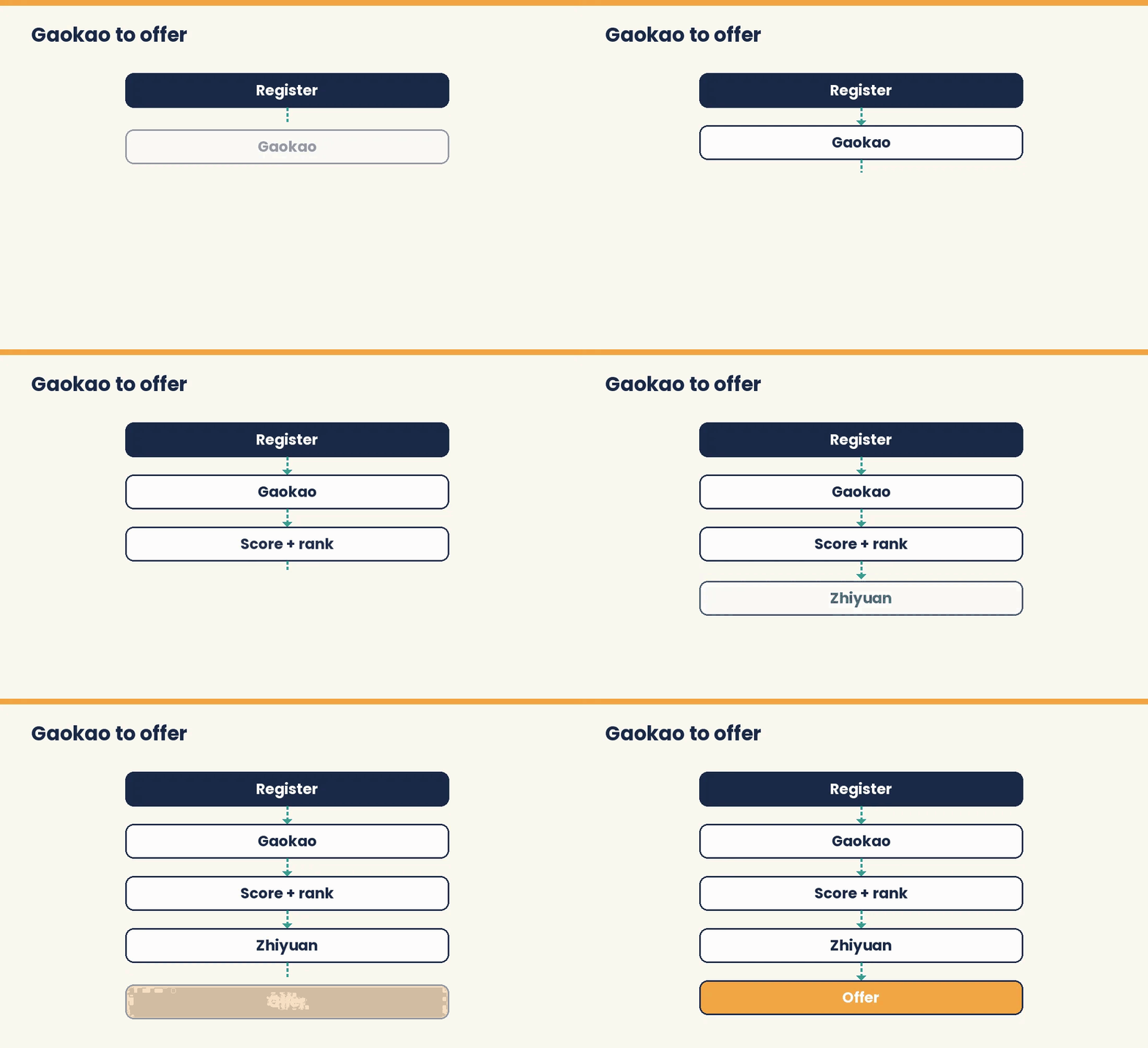
A student registers, sits the Gaokao and gets a score. They fill in a zhiyuan (preference) form, and universities make offers by score and rank.
- Register with the provincial exam authority in the autumn before the exam.
- Sit the Gaokao in June.
- Get your score and rank. Provinces publish cut-off lines for each batch.
- Fill in the zhiyuan form. You list universities and majors in order. Many provinces use "parallel preferences". Beijing's undergraduate general batch, for example, allows 30 of them. In 3+1+2 provinces, undergraduate choices use a "university + major group" model.
- Admission. Files are sent to universities batch by batch, highest scores first. Universities check subject requirements and make offers.
Admission is local. Each university sets a quota per province, so the same score can mean different chances in different provinces. Use Sunshine Gaokao to check each university's admission charter and its required electives.
Gaokao vs SAT, A-Level and IB: how do they compare?
| Feature | Gaokao | SAT | A-Level | IB Diploma |
|---|---|---|---|---|
| Who runs it | Ministry of Education and provinces | College Board | UK exam boards | International Baccalaureate |
| Scoring | Usually out of 750 | 400-1600 | Grades A* to E per subject | Out of 45 (24 to pass) |
| How often | Once a year, June | Several dates a year | Main series in May-June | May and November sessions |
| Subjects | Chinese, Maths, foreign language + 3 electives | Reading and Writing, Math | Usually 3-4 subjects | 6 subjects + core |
| Main use | Admission in mainland China | Mostly US admission | UK and worldwide | Worldwide |
| Retakes | Next year's exam | Easy to retake | Possible | Possible |
Sources: College Board, IB.
The biggest difference is the stakes. The SAT is one part of a US application. The Gaokao is often almost the whole decision. For more detail, see our guides to the SAT vs ACT and the IB Diploma Programme.
How to prepare for the Gaokao maths paper
Maths is worth 150 points in every model, so it moves the total a lot. The Ministry says the 2026 papers kept overall difficulty stable. They focused on core knowledge and cut tedious calculation (MOE). That means method and understanding matter more than tricks.
- Learn the core topics first. Functions, sequences, trigonometry, vectors, probability, solid geometry and calculus basics.
- Show every step. Long questions give marks for method. Write the reasoning, not just the answer.
- Practise past-paper style questions under time. Use papers from your own province's model.
- Keep an error log. Write down each mistake, the reason, and the fix. Review it weekly.
- Train speed on the short questions. Then save time for the hard final questions.
- Pick electives with care. In 3+1+2 provinces, check which majors need physics before you choose.
Book a free demo class to try a live 1-on-1 maths or science session with an Asymptode mentor.
How 1-on-1 tutoring helps with the Gaokao
Asymptode teaches maths and science live online, 1-on-1, in English. We help with the maths and science method behind Gaokao-style questions, and with CSCA Maths, Physics and Chemistry. We do not teach the Chinese-language papers. For those parts, your mentor helps with study planning and exam method.
- One dedicated mentor, live 1-on-1: the same mentor follows your syllabus, your province's model and your exam dates.
- Method first: the mentor watches each step of your working, so mistakes in algebra, functions or physics reasoning are fixed early.
- Personalised homework with feedback: practice sets matched to your weak topics, marked with clear comments.
- Short parent updates and recorded classes: every class is recorded for review, and parents get brief progress notes. Start with a free demo class.
Related guides
- SAT vs ACT: which test is right for you?
- Digital SAT Math guide
- IB Diploma Programme guide
- A-Level Maths guide
- How to get into NUS
- How to get into the University of Toronto
Facts checked against official sources on 29 October 2026.
FAQ
When is Gaokao 2027?
The national dates for Gaokao 2027 are not yet announced. The exam is usually held on 7-8 June, with extra days in some provinces for elective papers. Registration has already begun in places like Beijing, which opened it on 25 October 2026.
What is the Gaokao total score?
In most provinces the total is 750. Chinese, Maths and a foreign language are worth 150 each, and three electives are worth 100 each. Some provinces differ. Shanghai, for example, has a total of 660.
What does 3+1+2 mean in the Gaokao?
"3" is Chinese, Maths and a foreign language. "1" is a choice of physics or history. "2" is two of chemistry, biology, politics and geography. Universities set quotas separately for the physics and history groups.
Can foreigners take the Gaokao?
Most foreign nationals do not take it. They apply directly to Chinese universities, and many need the CSCA test. Some provinces, such as Beijing, let foreigners with a Chinese permanent residence card who are settled there register. Check the provincial notice for exact rules.
How many students take the Gaokao?
The Ministry of Education says 12.9 million people registered in 2026. In 2025 the figure was 13.35 million. It is one of the largest exams in the world.
Is the Gaokao harder than the SAT?
They test different things. The Gaokao covers more subjects, is held once a year, and usually decides admission almost alone. The SAT covers reading, writing and maths and can be retaken several times a year.
Ready to start? Book a free demo class and advisor call, or see our plans and fees.
Sources
- MOE: 2026 Gaokao registrations and safety work
- MOE: 2026 Gaokao dates reminder
- MOE: 2026 papers and end of comprehensive reform
- State Council: 2014 exam and admission reform opinions
- MOE: Eight provinces publish 3+1+2 reform plans
- Fujian Education Department: 3+1+2 scoring
- Beijing Education Examinations Authority: 2027 registration notice
- Sunshine Gaokao (MOE platform)
- Tsinghua University: undergraduate applicants of foreign citizenship
- Shanghai government: CSCA FAQs