
Suneung 2027 is South Korea's national university entrance exam, and it takes place on Thursday 19 November 2026. This guide explains what the test is, who can sit it, how it is scored, how it fits into admission, and how to prepare. It is for students and parents everywhere, including Korean families abroad and international students curious about studying in Korea.
Key takeaways
- The Suneung 2027 (Korean CSAT) is on Thursday 19 November 2026. Scores come out on Friday 11 December 2026.
- Registration ran from 24 August to 4 September 2026. It is now closed, with no extensions.
- Korean, Math and Inquiry get a standard score, percentile and grade. English and Korean History get a grade only.
- For 2027 entry, about 80% of places go through early admission and about 20% through regular admission, which leans on the Suneung.
- Most foreign students do not take the Suneung. They apply through separate foreign-student tracks, usually with a TOPIK score.
What is the Suneung 2027, and who runs it?
Quick answer: The Suneung 2027 is the College Scholastic Ability Test (CSAT) for students entering Korean universities in 2027. It is set and run by the Korea Institute for Curriculum and Evaluation (KICE). It is a one-day paper test on 19 November 2026, covering Korean, Math, English, Korean History, Inquiry and an optional second foreign language.
"Suneung" is the Korean short name for the College Scholastic Ability Test. In English it is also called the CSAT or the Korean CSAT. KICE writes the papers, sets the rules and publishes the results. Its official exam site is suneung.re.kr. The rules in this guide come from the official KICE detailed plan, published on 1 July 2026.
As reported by The Financial News and Money Today, KICE said 551,864 people registered for the 2027 test, down 2,310 (0.4%) from the year before. If you know China's national exam, the Suneung plays a similar role. Our Gaokao guide explains that one.
What are the key Suneung 2027 dates?
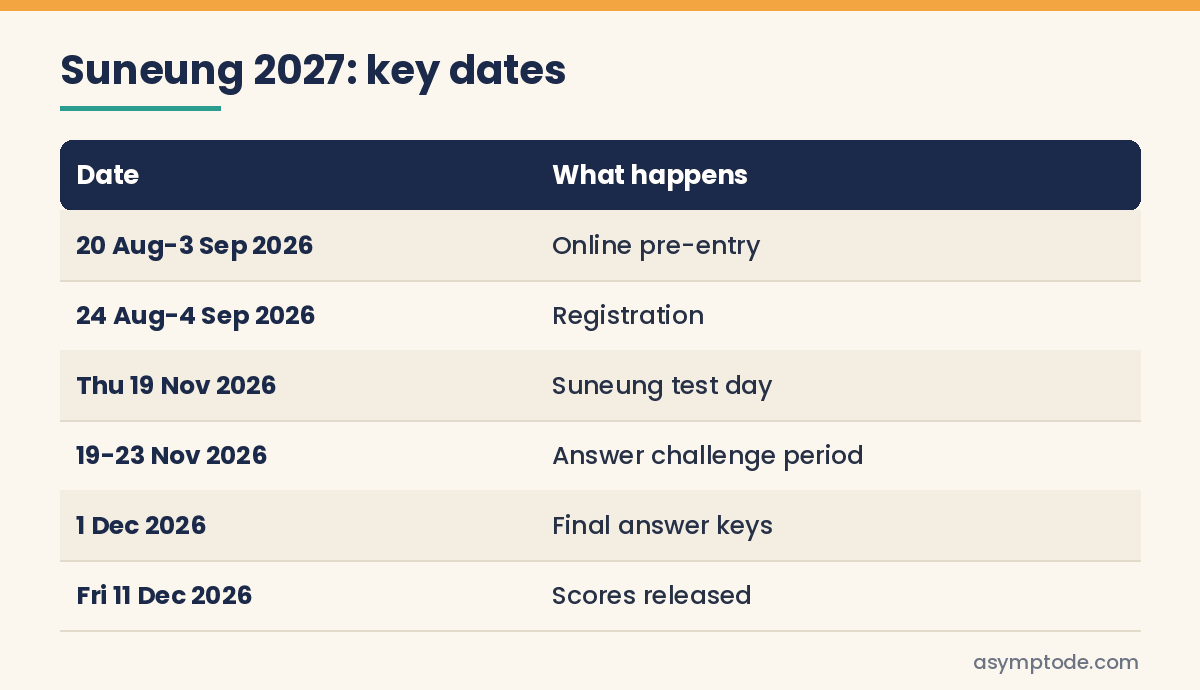
The table shows three key dates. Registration ran from 24 August to 4 September 2026. The test is on 19 November 2026. Scores are released on 11 December 2026.
| Event | Date |
|---|---|
| June and September mock tests | 4 June and 2 September 2026 |
| Registration | 24 August to 4 September 2026 |
| Early admission applications | 7 to 11 September 2026 |
| Test day | Thursday 19 November 2026 |
| Final answers published | 1 December 2026 |
| Score release | Friday 11 December 2026 |
Can I still register for the Suneung 2027?
No. Registration closed on 4 September 2026, and KICE allowed no extensions. Current students applied at their own school and graduates at the school they finished. If you missed it, the next test is in November 2027, for 2028 entry.
Who can sit the Korean CSAT?
KICE lists three groups:
- Students expected to finish high school in the 2026 school year.
- High-school graduates.
- People with an education legally recognised as equal to high-school graduation, such as passing the equivalency exam.
The rules are about education level only. They do not set an age rule. As reported by The Financial News, graduates made up 31.5% of 2027 applicants.
Do international students take the Suneung?
Usually not. Most international students enter Korean universities through separate foreign-student admission. The official Study in Korea site explains these tracks and does not mention the Suneung.
You are usually eligible for a foreign-student track if both your parents are not Korean citizens, or if you finished all 12 years of primary and secondary school outside Korea. Universities usually ask for TOPIK (Test of Proficiency in Korean) level 3 or above, but this varies. You will need transcripts, a graduation certificate, a study plan, a language certificate and your passport. Some universities add an interview or a Korean language course first. Each university sets its own timetable.
There is also the Global Korea Scholarship (GKS-U). As reported by Korea JoongAng Daily, applicants must be under 25 and not hold Korean citizenship. Check the official NIIED notice before applying. Comparing options across Asia? See how to get into NUS.
How much does the Suneung cost?
The fee depends on how many test areas you take.
| Number of areas | Fee |
|---|---|
| 4 areas or fewer | KRW 37,000 |
| 5 areas | KRW 42,000 |
| 6 areas | KRW 47,000 |
As reported by Newsis, the fee is waived for low-income households on basic livelihood or near-poverty support.
What subjects are on the Suneung 2027, and what is the timetable?
The test runs in five periods on one long day. You must be in your test room by 08:10. For later periods, entry closes 10 minutes before the start.
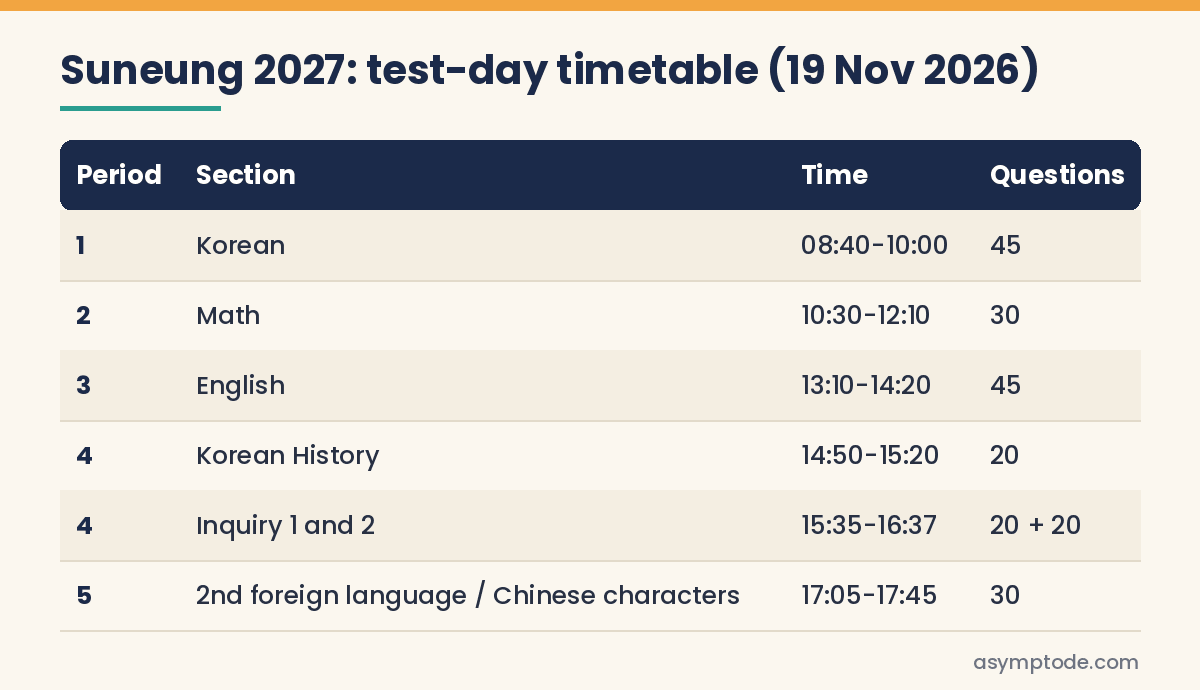
The timetable shows each period on 19 November 2026. Korean starts at 08:40 and Math at 10:30. English follows lunch at 13:10. Korean History and Inquiry come next, and the optional second foreign language ends at 17:45.
| Period | Subject | Time | Questions | Points |
|---|---|---|---|---|
| 1 | Korean | 08:40-10:00 | 45 | 100 |
| 2 | Math | 10:30-12:10 | 30 | 100 |
| 3 | English | 13:10-14:20 | 45 (17 listening) | 100 |
| 4 | Korean History (required) | 14:50-15:20 | 20 | 50 |
| 4 | Inquiry, 1st subject | 15:35-16:05 | 20 | 50 |
| 4 | Inquiry, 2nd subject | 16:07-16:37 | 20 | 50 |
| 5 | 2nd Foreign Language (optional) | 17:05-17:45 | 30 | 50 |
How does the Math section work?
Math has 30 questions in 100 minutes. About 30% are short-answer, where you write a number. About 75% is the common part (Math I and Math II). About 25% is an elective: Probability and Statistics, Calculus, or Geometry. Each question is worth 2, 3 or 4 points. As reported by The Financial News, 64.9% of applicants chose Probability and Statistics, 32.4% Calculus and 2.7% Geometry.
What about the other sections?
- Korean: a common part plus one elective (Speech and Writing, or Language and Media).
- English: 45 questions, with listening lasting up to 25 minutes.
- Inquiry: up to 2 of 17 subjects, mixing social studies and science freely. Science options include Physics, Chemistry, Life Science and Earth Science, at levels I and II.
- Second foreign language: 1 of 9 options, such as German I, Japanese I or Chinese Characters I.
Candidates with disabilities can get extra time: 1.7 times for severe visual impairment and 1.5 times for mild visual or motor impairment.
How is the Suneung scored?
The CSAT uses two kinds of scoring.
| Subject | What your report shows |
|---|---|
| Korean, Math, Inquiry | Standard score, percentile and grade (1-9) |
| English, Korean History, 2nd Foreign Language | Grade only (absolute grading) |
What do standard score, percentile and grade mean?
A standard score compares your raw mark with everyone who sat that paper, so the same raw mark can give a different standard score in another year. Your percentile is the share of candidates who scored below you. Grades run from 1 (best) to 9, and for Korean, Math and Inquiry they depend on your place among all candidates.
What is absolute grading?
English and Korean History use fixed raw-score cut-offs. Your grade depends only on your own marks. As reported by Aju News and Busan Ilbo, grade 1 in English needs 90 or more out of 100, and grade 1 in Korean History needs 40 or more out of 50. Check the official KICE page for the full bands.
How does the Suneung fit into university admission?
Korea has two main routes: early admission (susi) and regular admission. These are the official 2027 figures from the Korean Council for University Education (KCUE):
| Route | Places | Share |
|---|---|---|
| Early admission (mostly school-record based) | 277,583 | 80.3% |
| Regular admission (mostly Suneung based) | 68,134 | 19.7% |
| Total | 345,717 | 100% |
Suneung-based selection covers 63,195 places, or 92.8% of regular admission.
Does the Suneung matter if I apply early?
Often, yes. Many early-admission places still set minimum Suneung grades. You could win a place on your school record, then lose it if you miss those grades in November. Rules differ by university, so check each guide. The exact 2027 regular-admission dates were not found, so check the KCUE notice.
What changes in the 2028 Suneung reform?
As reported by The Financial News, the Suneung 2027 is the last version with elective subjects. The Ministry of Education confirmed the 2028 reform on 27 December 2023. From the November 2027 test:
- All candidates take the same Korean and Math, with no electives.
- Social studies and science become Integrated Social Studies and Integrated Science.
- Advanced maths (Calculus II and Geometry) is not included.
- Test areas and the scoring method stay as they are.
If you might retake, plan for the new format now.
What are the rules on test day?
Bring: your admission ticket and photo ID. A lost ticket must be reissued before test day.
Allowed: a computer sign pen (also handed out), black pencil, eraser, white correction tape, black 0.5mm leads, and an analogue watch with no communication or payment function.
Banned: phones, smartwatches, earphones, and any device that can communicate, pay, or has an electronic screen.
As reported by Newsis, each room holds at most 28 candidates, and Korean History and Inquiry use separate answer sheets.
Book a free demo class with a maths or science mentor, and see our plans and fees.
Suneung-style maths: two worked examples
How do you find the sum of a geometric sequence?
Question: A geometric sequence has all positive terms, with a2 = 6 and a4 = 54. Find a1 + a2 + a3 + a4 + a5.
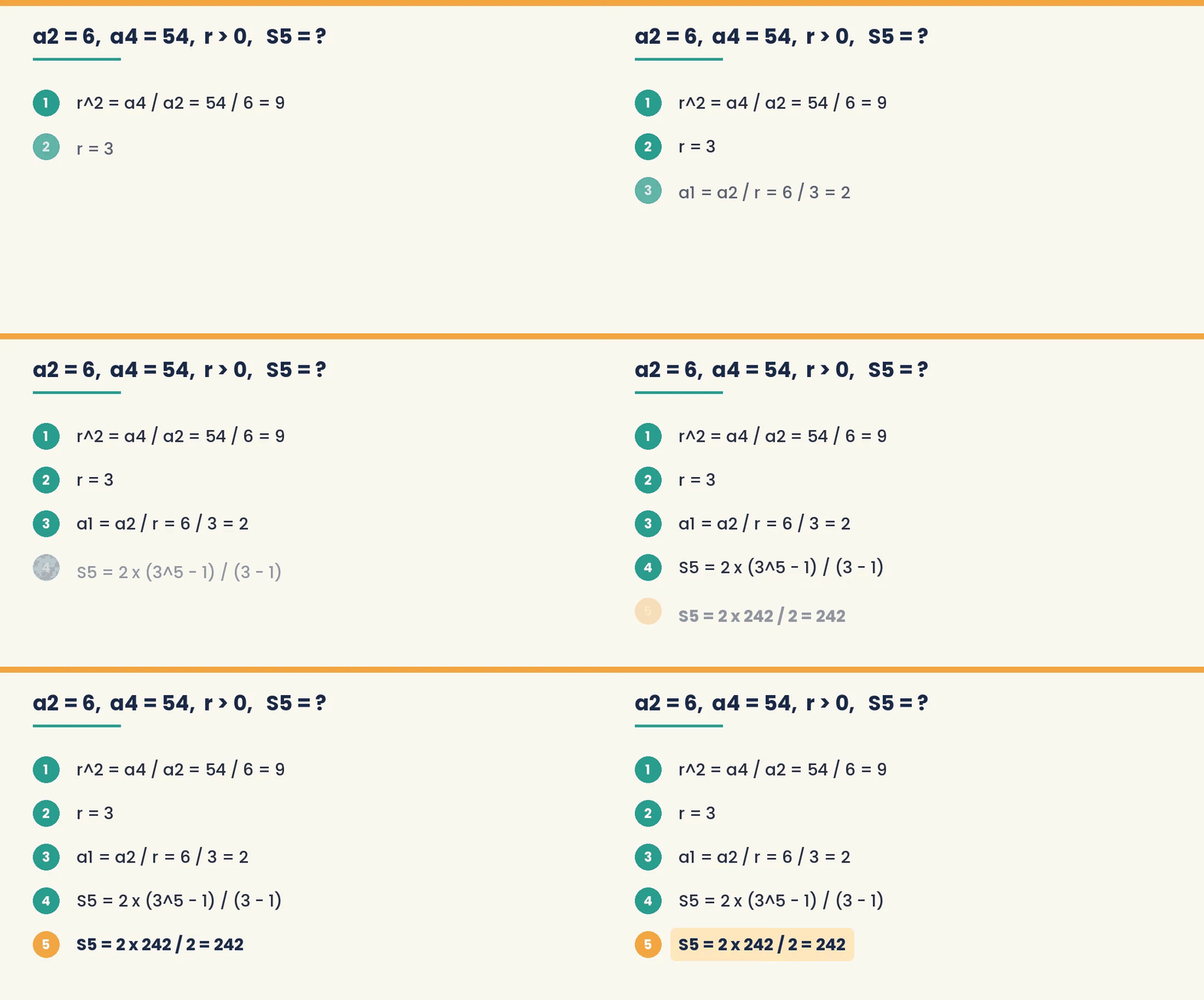
The animation starts from a2 = 6 and a4 = 54. Dividing gives r squared = 9, so r = 3. The first term is 2. Adding five terms gives S5 = 242.
- Let the first term be a and the ratio r, with r > 0. So ar = 6 and ar³ = 54.
- Divide: r² = 54 ÷ 6 = 9, so r = 3.
- Then a = 6 ÷ 3 = 2. The terms are 2, 6, 18, 54, 162.
- Sum: S5 = a(r⁵ − 1) ÷ (r − 1) = 2 × 242 ÷ 2 = 242.
- Check: 2 + 6 + 18 + 54 + 162 = 242.
Answer: 242. Short-answer Suneung answers are natural numbers, so a whole number is a good sign.
How do you find a local minimum with derivatives?
Question: For f(x) = x³ − 3x² + 2, find the local maximum and minimum values.
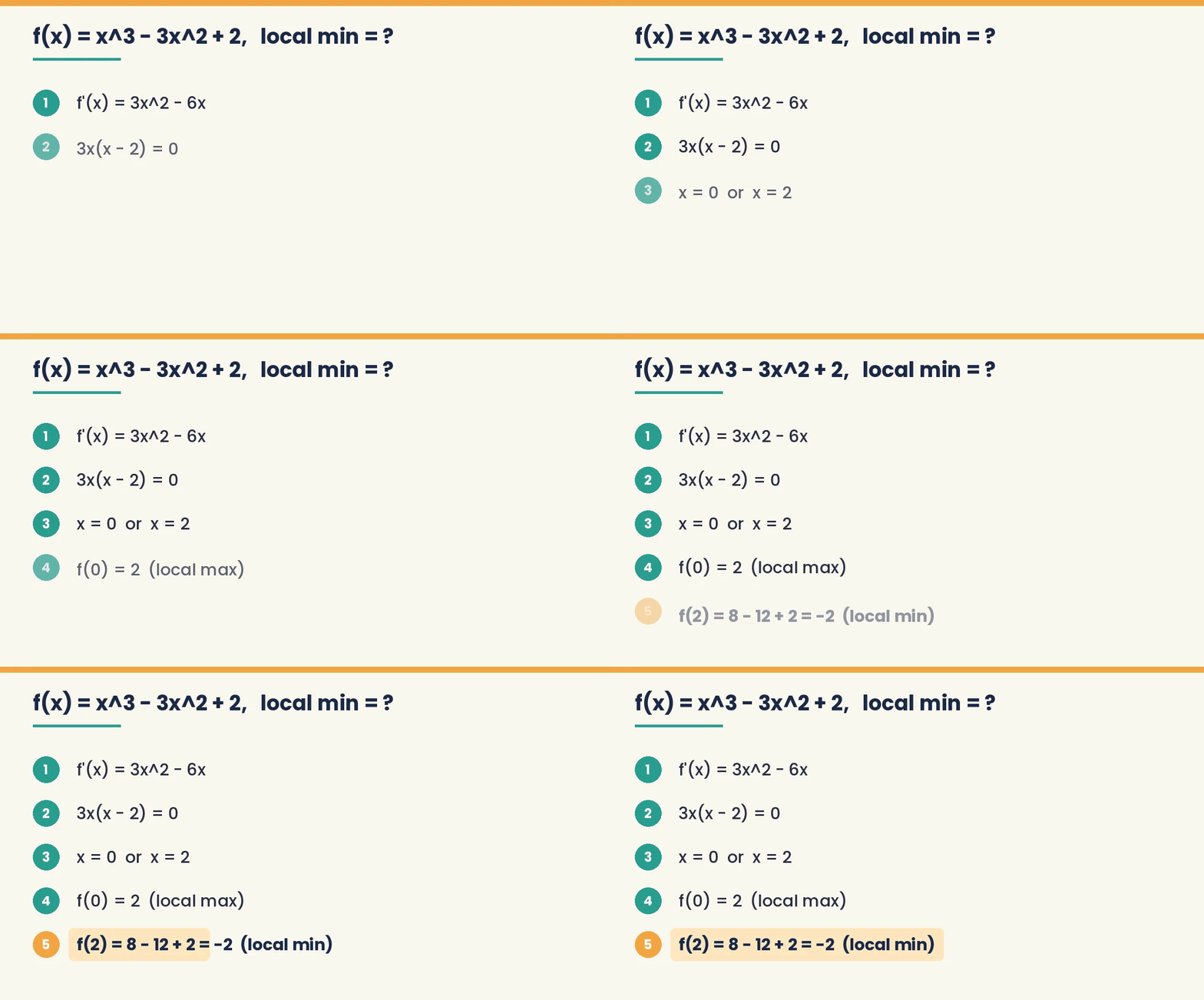
The animation draws f(x) = x³ − 3x² + 2. It rises to a peak of 2 at x = 0. Then it falls to a low point of −2 at x = 2 and rises again.
- Differentiate: f′(x) = 3x² − 6x = 3x(x − 2).
- So f′(x) = 0 at x = 0 and x = 2.
- Sign check: f′ is positive before 0, negative between 0 and 2, and positive after 2.
- Local maximum: f(0) = 2.
- Local minimum: f(2) = 8 − 12 + 2 = −2.
Answer: maximum 2, minimum −2. The sign check tells you which point is which. For similar practice, see our A-Level Maths guide and Digital SAT Math guide.
What are the most common Suneung mistakes?
- Running out of time in Math. 30 questions in 100 minutes is tight. Practise with a timer.
- Skipping the check. Short-answer questions have no options to catch errors. Substitute your answer back.
- Treating English as "only a grade". With fixed cut-offs, every mark near a boundary counts.
- Neglecting Korean History. It is required for every candidate.
- Bringing a banned item. Check your bag for phones and smartwatches twice.
- Ignoring early-admission minimum grades. Know what your target universities ask for.
- Skipping past papers. KICE publishes papers and answer keys at kice.re.kr after each test.
How should I prepare in the final weeks?
With three weeks to go, sharpen rather than start new topics.
- Sit full timed papers on the real timetable, starting at 08:40.
- Redo every mock-test error from your error log.
- Drill one or two weak topics, not everything.
- Check every Math answer in a few seconds.
- Shift your sleep so an early start feels normal.
- Pack your bag and plan your trip to arrive by 08:10.
What is a good long-term Suneung study plan?
| Stage | Focus |
|---|---|
| 12+ months out | Learn the full curriculum. Build basics in functions, sequences and calculus. |
| 6-12 months out | Past papers by topic. Keep an error log. |
| 3-6 months out | Weekly timed papers. Use the June and September mock tests to check progress. |
| Final month | Timed mocks, error review, test-day routine, rest. |
Rotate subjects each week so none goes cold. If you love science, research for high school students can deepen it, and how to become a scientist shows where it can lead.
How 1-on-1 tutoring helps with the Suneung
Asymptode teaches maths and science 1-on-1, live online. For the Suneung, that means Math and science Inquiry. For Korean, English and Korean History, your mentor helps with planning and study method.
- One dedicated mentor, live 1-on-1, following your syllabus, electives and exam dates, including mock tests.
- Method first. Your mentor watches each step of your working, so errors in sequences or derivatives get fixed at the source.
- Personalised homework with feedback, plus short updates for parents.
- Every class recorded, so you can rewatch before test day. Start with a free demo class.
Facts checked against official sources on 30 October 2026.
FAQ
When is the Suneung 2027?
It is on Thursday 19 November 2026. Candidates must be in their test room by 08:10. Scores are released on Friday 11 December 2026.
Can foreigners take the Korean CSAT?
Eligibility depends on education level, not nationality. But most international students do not need it. They apply through each university's foreign-student track, usually with a TOPIK score.
Is English graded differently on the Suneung?
Yes. English uses absolute grading, so you get a grade only, based on fixed cut-offs. Korean History works the same way.
Which Math elective is most popular?
As reported by The Financial News, 64.9% of 2027 applicants chose Probability and Statistics. Choose the elective that fits your strengths and target courses.
What is the difference between early and regular admission?
Early admission (about 80% of 2027 places) is mostly based on your school record. Regular admission (about 20%) is mostly based on Suneung scores. Many early places still set minimum Suneung grades.
What changes in the 2028 Suneung?
From the November 2027 test, there are no electives. Everyone takes the same Korean and Math, plus Integrated Social Studies and Integrated Science. The scoring method stays the same.
Ready to start? Book a free demo class and advisor call, or see our plans and fees.
Sources
- KICE Suneung official site
- KICE 2027 Suneung detailed plan (notice 2026-91), Gyeonggi Provincial Office of Education copy
- KICE (papers and answer keys)
- Newsis: KICE 2027 Suneung basic plan
- The Financial News: 2027 Suneung applicants
- Money Today: 2027 Suneung applicants
- KCUE: 2027 university admission plan
- KCUE: 2027 early admission application dates
- MOE 2028 university admission reform (KDI mirror)
- Study in Korea: foreign student admission
- Korea JoongAng Daily: GKS-U 2027
- Aju News: English absolute grading
- Busan Ilbo: Korean History absolute grading