

As a parent, you want your child to do well on the SAT and open doors for their future. It's natural to think that more practice questions mean better scores. But what if that belief is quietly leading to burnout, frustration, and a shallow understanding that doesn't last?
Many test prep approaches emphasize sheer volume, leaving parents stressed and children overwhelmed. At Asymptode, we believe there's a smarter way. This guide focuses on quality over quantity, turning mistakes into learning, and building confidence that lasts well beyond test day.
The Pitfall of "More Is Better": Why Quantity Can Lead to Burnout
It's an understandable assumption: the more SAT practice questions a student completes, the higher the score. As parents, we push for more practice, hoping to cover every possible scenario. But a "more is better" mindset often leads to burnout and what we call shallow pattern-matching instead of real understanding.
Consider a student who was doing 50+ questions a day. They rushed through problems looking for quick fixes rather than engaging with the concepts. They could recognize a pattern for one question type but couldn't adapt when the same idea was phrased differently. The result was exhaustion, frustration, and scores that stayed stubbornly flat despite hours of effort.
This isn't just inefficient. It erodes confidence. Your child starts to dread practice, seeing it as an endless chore instead of a path to mastery. They can feel like they're falling behind despite working hard, which affects their self-esteem and can make them dislike subjects they once enjoyed.
Deliberate Practice: Finding the "Just Right" Amount
We champion deliberate practice. That doesn't mean doing fewer questions for the sake of it. It means making every question count. The focus shifts from the number of problems completed to the depth of learning from each one: fewer, carefully chosen problems, followed by a deep review of every mistake.
Take that same student. We cut their volume in half and slowed down to analyze errors properly. Within weeks, their scores began to rise steadily. This wasn't magic. Quality of reflection beats quantity of questions.
So what's the right amount? It's whatever keeps your child sharp and confident without draining their energy. A few signs you may have crossed into diminishing returns:
- Your child is finishing sets quickly but repeating the same mistakes
- They're guessing or rushing rather than reasoning
- Practice sessions have become something they dread
- Scores have stalled despite increasing volume
If you notice these, the answer is rarely more questions. It's slower, more careful review, or a rest.
Turning Mistakes into Milestones: Reframing Wrong Answers
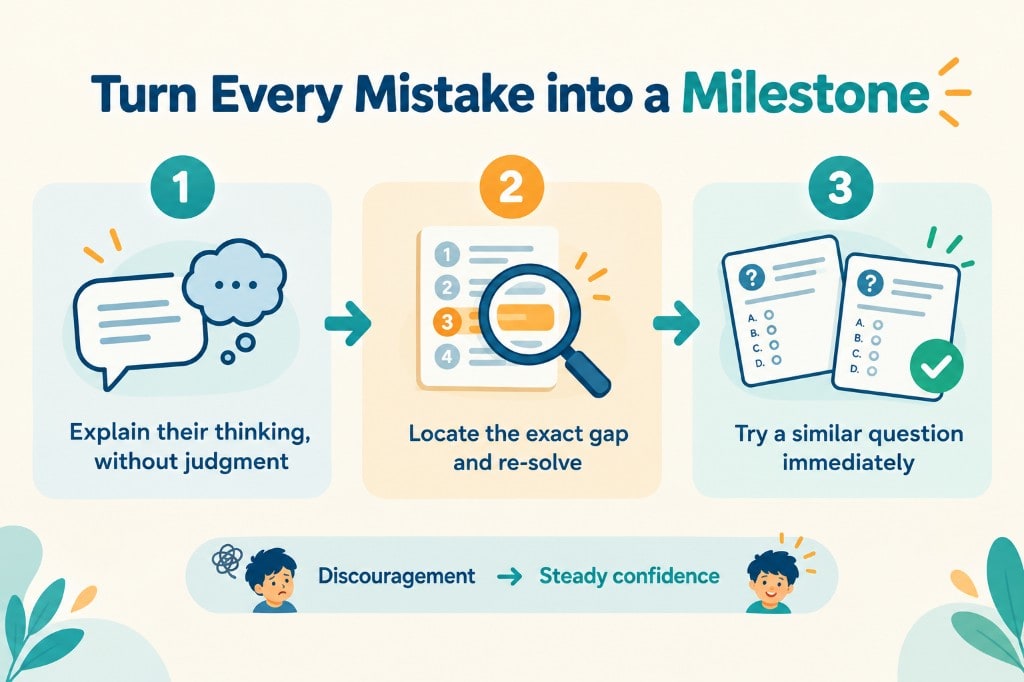
When a child keeps getting practice questions wrong, it's discouraging for both of you. It's easy to see errors as failure. We treat every wrong answer as useful information, not failure. That reframing is what turns frustration into progress.
Our most effective approach has three steps:
- Explain their thinking, without judgment. The student walks us through their original thought process. This shows us where the misunderstanding began and tells them their effort is valued.
- Locate the exact gap and re-solve. Together, we pinpoint the specific conceptual or logical gap, then re-solve the problem from that point.
- Try a similar question immediately. The student applies the corrected idea straight away, which locks in the new understanding and shows them they've really got it.
This process turns discouragement into steady confidence because mistakes become clear steps forward. It also helps children rediscover the enjoyment of learning, so they stop dreading maths and science and feel less stressed.
Beyond the Score: Using SAT Practice as a Diagnostic Tool
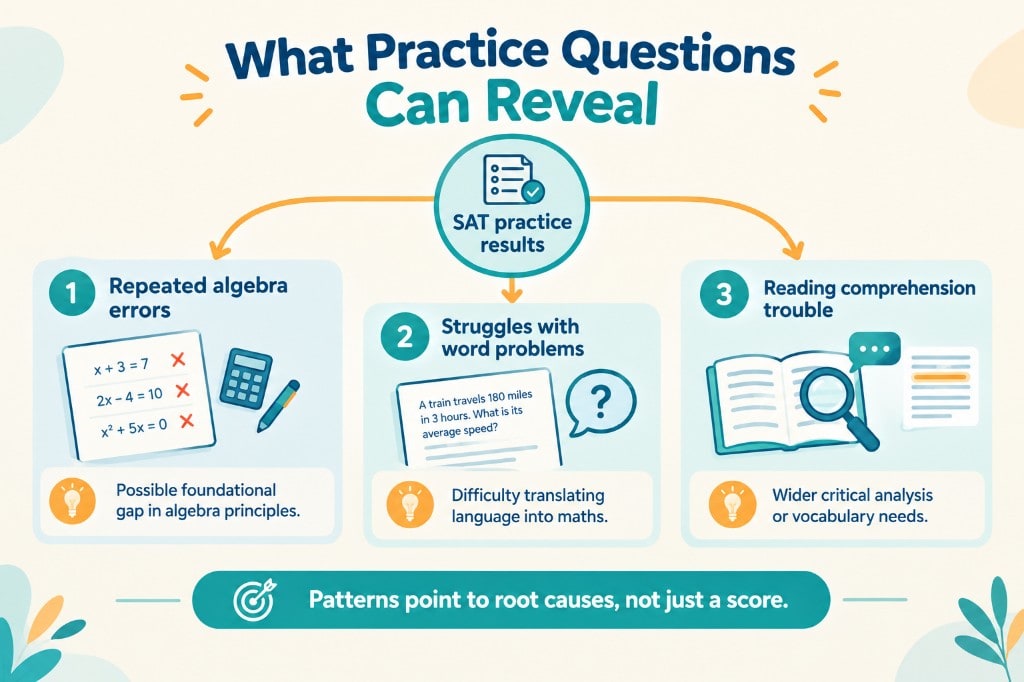
Many parents see SAT practice questions only as a route to a higher score. They're also powerful diagnostic tools. They can reveal your child's underlying academic skills and challenges, and shape a longer-term learning plan.
Performance on specific question types often points to broader needs:
- Repeated errors in algebra may indicate a foundational gap in algebraic principles, not just a test-taking slip.
- Struggles with word problems may show difficulty translating language into mathematical relationships, a skill that matters across maths and science.
- Trouble with reading comprehension questions may point to wider issues with critical analysis or vocabulary that affect every subject.
By looking at these patterns, you gain a clearer picture of where your child is truly struggling and where they're strong. That allows targeted, personalized 1:1 support that addresses the root cause instead of teaching quick tricks for the exam. It's about building a strong academic foundation, not just chasing a score.
Key Takeaways
Optimizing SAT practice isn't about endless questions. It's about strategic, deliberate effort:
- Quality beats volume: fewer, well-chosen questions with careful review of every mistake.
- Mistakes are information: explain the thinking, find the gap, re-solve, then try a similar question.
- Practice is diagnostic: patterns in errors reveal what your child needs to work on beyond the SAT.
Together, these help your child build real understanding and lasting confidence, and a healthier relationship with learning that serves them for years.
Ready to turn your child's SAT prep into something that builds confidence and deep understanding? Explore Asymptode's personalized 1:1 online maths and science tutoring, paced to your child's unique stage, at asymptode.com.