
The chain rule explained simply: it is the rule for differentiating a function that sits inside another function. It shows up on AP Calculus, Ontario's MCV4U, IB Maths AA and A-level Maths. This guide works through it step by step, with worked examples and practice you can check yourself.
Key takeaways
- The chain rule differentiates a function inside a function: dy/dx = dy/du x du/dx.
- In words: differentiate the outside, keep the inside unchanged, then multiply by the derivative of the inside.
- It is tested in AP Calculus AB and BC (Unit 3), Ontario MCV4U, IB Maths AA (Topic 5) and A-level Maths.
- The most common mistake is forgetting to multiply by the derivative of the inside function.
- It works together with the product and quotient rules — knowing which rule to use is half the skill.
What is the chain rule explained simply?
Quick answer: The chain rule differentiates a "function of a function," such as (3x + 1)^5 or sin(2x). Treat the expression as an outer function wrapped around an inner function, differentiate the outer function, leave the inner function unchanged, then multiply by the derivative of the inner function.
A plain power rule, like turning x^5 into 5x^4, only works when x itself is the variable. The moment the variable is replaced by a whole expression, such as (3x + 1), you need the chain rule to account for how fast that inner expression is itself changing.
When do you need the chain rule?
Look for one expression nested inside another: a bracket raised to a power, such as (2x + 1)^5; a trig function of something other than plain x, such as sin(2x); an exponential or logarithm of an expression, such as e^(x^2); or a root of an expression, such as sqrt(4x^3 + 1). If you can rewrite the function as "an outer rule applied to an inner expression," the chain rule applies.
How do you use the chain rule, step by step?
- Identify the outer and inner function. Call the inner function u.
- Differentiate the outer function, treating u as the variable, unchanged.
- Differentiate the inner function on its own, to get du/dx.
- Multiply the two results: dy/dx = (derivative of the outer) x (derivative of the inner).
- Substitute u back in, so the answer is in terms of x.
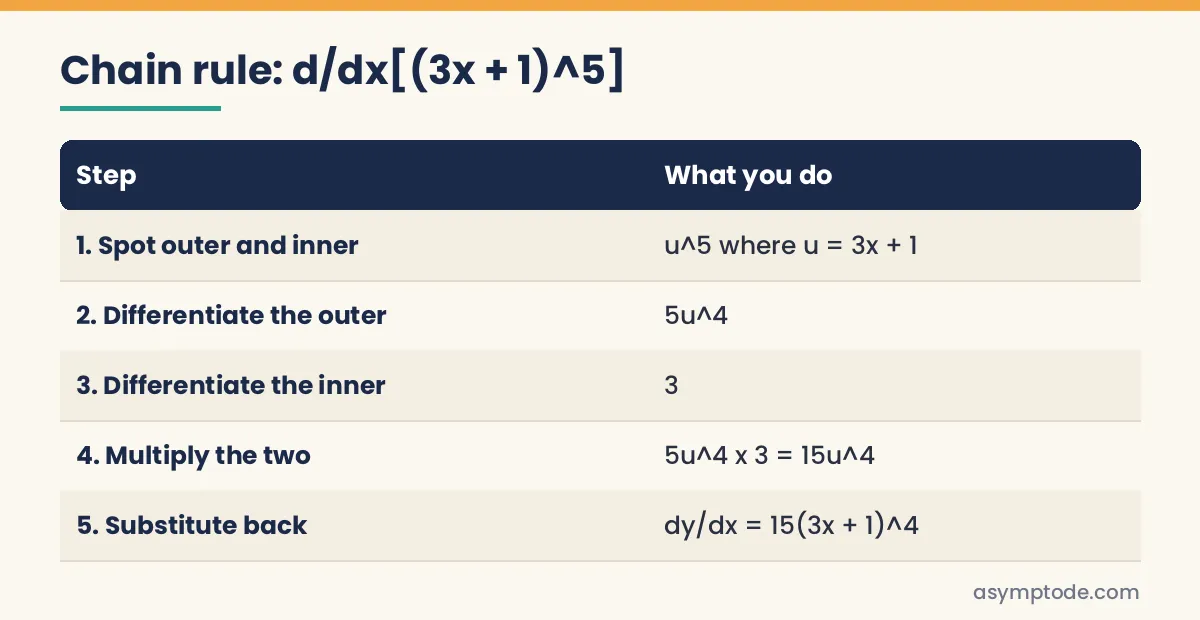 The chain rule applied to y = (3x + 1)^5, one step at a time.
The outer function is u^5 (derivative 5u^4), and the inner function is u = 3x + 1 (derivative 3). Multiplying 5u^4 by 3 gives 15u^4, and substituting u back in gives the final answer: dy/dx = 15(3x + 1)^4.
Worked example 1: a bracket raised to a power
Differentiate y = (2x + 1)^5. Outer u^5 (derivative 5u^4), inner u = 2x + 1 (derivative 2). dy/dx = 5u^4 x 2 = 10(2x + 1)^4.
Worked example 2: a trig function
Differentiate y = sin(2x). Outer sin(u) (derivative cos u), inner u = 2x (derivative 2). dy/dx = cos(2x) x 2 = 2 cos(2x). The same pattern gives e^(x^2) a derivative of 2x e^(x^2), and ln(5x^2 + 3) a derivative of 10x / (5x^2 + 3) — only the outer rule changes.
 Outer, inner, multiply, substitute — the chain rule in four moves.
The same four moves work for every chain rule question, whatever the outer and inner functions are: find the outer function's derivative, find the inner function's derivative, multiply them, then substitute the inner function back in.
How do you tell the chain, product and quotient rules apart?
| Rule | Use it for | Pattern |
|---|---|---|
| Chain rule | A function inside a function | dy/dx = dy/du x du/dx |
| Product rule | Two functions multiplied together | (uv)' = u'v + uv' |
| Quotient rule | One function divided by another | (u/v)' = (u'v - uv') / v^2 |
The three rules often combine: y = x^2 sin(3x) needs the product rule for "x^2 times sin(3x)," with the chain rule inside it to differentiate sin(3x). Spot the outer structure first — sum, product, quotient, or one nested function — to pick the right rule.
Talk to a learning expert about where your child is with calculus, or see our plans and fees.
Where is the chain rule examined?
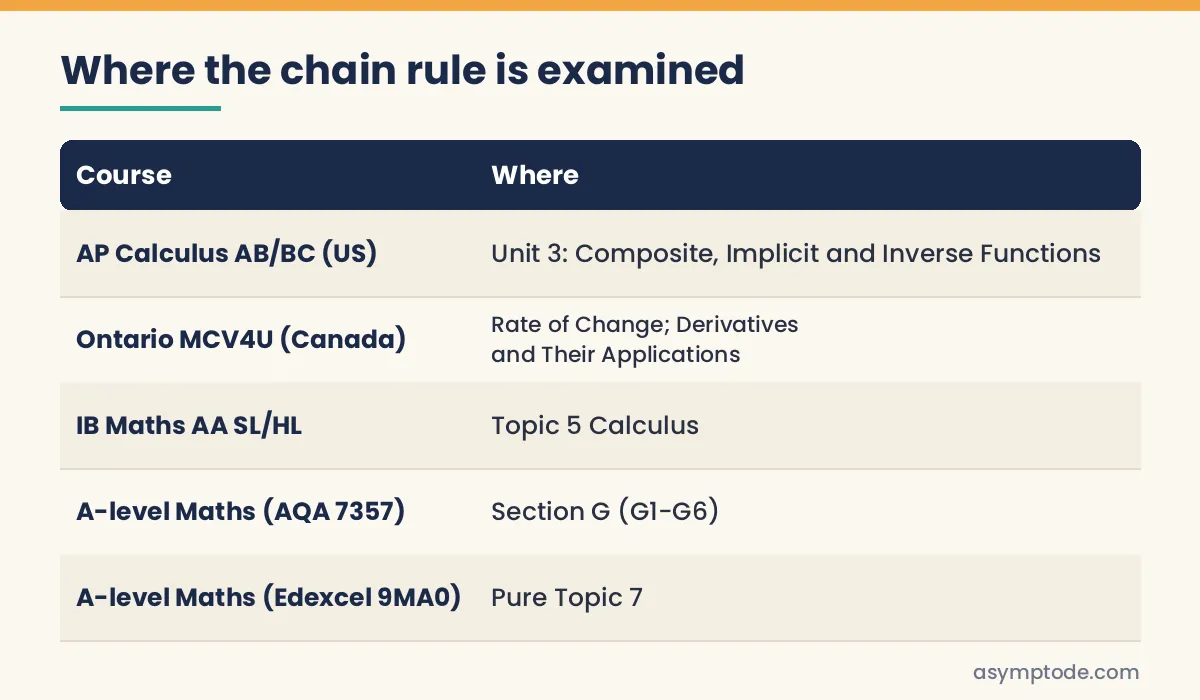 The chain rule sits inside the differentiation unit of every major calculus course.
None of these are separate "chain rule units" — it is always taught inside a wider differentiation unit.
- AP Calculus AB/BC (US): Unit 3, "Composite, Implicit, and Inverse Functions," weighted at 5-10% of the exam by the College Board's AP Calculus AB CED; unchanged for 2026-27. See our AB vs BC guide, AP exam dates 2027 and AP Precalculus guide.
- Ontario MCV4U (Canada): a Grade 12 university-prep course; its "Rate of Change" and "Derivatives" strands, per the Ontario curriculum.
- IB Maths AA: Topic 5, Calculus, building on SL 5.3 and 5.6, per the IB mathematics curriculum.
- A-level Maths: AQA 7357 Section G and Edexcel 9MA0 Pure Topic 7. See differentiation explained for the full rule set, or brush up on trigonometric identities, radians and logarithms first.
What are the most common chain rule mistakes?
- Forgetting to multiply by the derivative of the inside. (3x + 1)^5 gives 15(3x + 1)^4, not 5(3x + 1)^4.
- Expanding the bracket first, instead of using the much faster chain rule directly.
- Mixing up the chain and product rules. sin(2x) needs only the chain rule; x sin(2x) needs the product rule too.
Practice questions with answers
- Differentiate y = (4x - 1)^3.
- Differentiate y = cos(3x).
- Differentiate y = e^(2x + 1).
- Differentiate y = ln(x^2 + 4).
- Differentiate y = sqrt(2x + 5), then find the gradient at x = 2.
Answers
- dy/dx = 3(4x-1)^2 x 4 = 12(4x - 1)^2.
- dy/dx = -sin(3x) x 3 = -3 sin(3x).
- dy/dx = e^(2x+1) x 2 = 2e^(2x+1).
- dy/dx = 2x/(x^2 + 4).
- dy/dx = 1/sqrt(2x + 5). At x = 2: 1/sqrt(9) = 1/3.
How to get better at the chain rule
- Say the two functions out loud first: "outer is ..., inner is ...".
- Keep the inner function in brackets until the last step.
- Move to real exam questions from your own course once short examples feel automatic.
How Asymptode Can Help You Prepare for the Chain Rule
A single dropped step, like forgetting to multiply by the inner function's derivative, can cost marks on every later question built on it. At Asymptode, your child has live, one-to-one online classes with a mentor who teaches calculus at your child's level, following their actual course — AP Calculus AB or BC, Ontario's MCV4U, IB Maths AA, or A-level Maths — and its real exam dates. The mentor watches your child work through chain rule questions line by line, so a dropped step is caught and fixed in the moment, not weeks later on a graded test.
Between classes, your child gets AI-assisted practice built from what their own last attempt showed they had not yet understood, written to the mentor's brief and sent only after the mentor approves it. The AI supports the mentor; it never teaches or replaces the mentor. The mentor marks the work, and in the parent dashboard you can see what was understood and what to practise next.
Every class is recorded, so a confusing explanation can be rewatched. Book a free demo class or see our plans and fees.
Facts checked against official sources on 16 November 2026.
FAQ
What is the chain rule in simple terms?
The rule for differentiating a function inside another function: differentiate the outer function, leave the inner function unchanged, then multiply by the inner function's derivative.
What is the formula for the chain rule?
If y = f(g(x)), dy/dx = f'(g(x)) x g'(x). In dy/du notation, dy/dx = dy/du x du/dx.
How do I know when to use the chain rule?
Whenever one expression sits inside another — a bracket raised to a power, a trig function of something other than plain x, or an exponential or logarithm of an expression.
Is the chain rule the same as the product rule?
No. The chain rule is for a function inside a function, such as sin(2x). The product rule is for two functions multiplied together, such as x sin(2x). Some questions need both.
Is the chain rule on the AP Calculus exam?
Yes, in Unit 3, "Composite, Implicit, and Inverse Functions," weighted 5-10% of the AP Calculus AB and BC exams.
What is the most common chain rule mistake?
Forgetting to multiply by the inner function's derivative. (3x + 1)^5 differentiates to 15(3x + 1)^4, not 5(3x + 1)^4.
Ready to start? Book a free demo class and advisor call, or see our plans and fees.
Sources
- AP Calculus AB, AP Central
- AP Calculus AB/BC Course and Exam Description
- Ontario curriculum: Calculus and Vectors (MCV4U)
- IB Diploma Programme mathematics curriculum
- AQA 7357 specification (Section G), as reported by AQA
- Pearson Edexcel 9MA0 specification (Pure Topic 7), as reported by Pearson Edexcel
Sources
- AP Calculus AB course page, AP Central
- AP Calculus AB and BC Course and Exam Description
- Ontario curriculum: Calculus and Vectors, Grade 12, University Preparation (MCV4U)
- IB Diploma Programme mathematics curriculum
- AQA A-level Mathematics 7357 specification (Section G: Differentiation)
- Pearson Edexcel A-level Mathematics specification, Issue 4 (Pure Topic 7)