

CUET UG 2027 is the national entrance test you will most likely need for a seat at Delhi University and many other universities in the 2027-28 session. It is run by the National Testing Agency (NTA). As of 27 October 2026, NTA has not yet announced CUET UG 2027 dates. This guide uses the official CUET (UG) 2026 rules and dates, which are the latest available, and explains what usually stays the same.
Key takeaways
- CUET (UG) is run by NTA. Central universities use it, and so do many state, deemed and private universities.
- CUET UG 2027 is not yet announced (checked 27 October 2026). In 2026, the bulletin came out on 3 January and the exam ran from 11 May to 7 June 2026.
- You can take up to 5 tests. Each test has 50 compulsory questions in 60 minutes. You get +5 for a right answer and -1 for a wrong one.
- CUET (UG) 2026 had no age limit. Class 12 students in their final year could apply.
- In 2026 the fee was Rs 1,000 for up to 3 subjects (General) and Rs 4,500 at centres outside India.
- Delhi University does not use Class 12 marks for merit, only for tie-breaks. You must take CUET in the subjects you passed in Class 12.
What is CUET UG 2027 and when will it happen?
Quick answer: CUET UG 2027 will be the Common University Entrance Test (Undergraduate) for admission in 2027-28. NTA runs it as a computer-based test. No 2027 notice exists yet (27 October 2026). Based on the last two cycles, expect registration between January and March 2027, the exam in May-June 2027 and results around late June or July 2027.
CUET (UG) gives one score that many universities accept. NTA runs the test and declares scores, but each university makes its own merit list and runs its own counselling (Chapter 1 of the CUET (UG) 2026 Information Bulletin).
Which universities accept CUET UG?
The CUET (UG) 2026 bulletin lists 48 central universities. These include Delhi University, Jawaharlal Nehru University, Banaras Hindu University, Jamia Millia Islamia, Aligarh Muslim University and the University of Hyderabad. Each one decides which of its programmes use CUET scores. In its 2026 result press release, NTA says that state, deemed and private universities also take part. The full list is on the official participating universities page. Check that list again for 2027, because universities can join or leave each year.
What were the CUET UG 2026 dates?
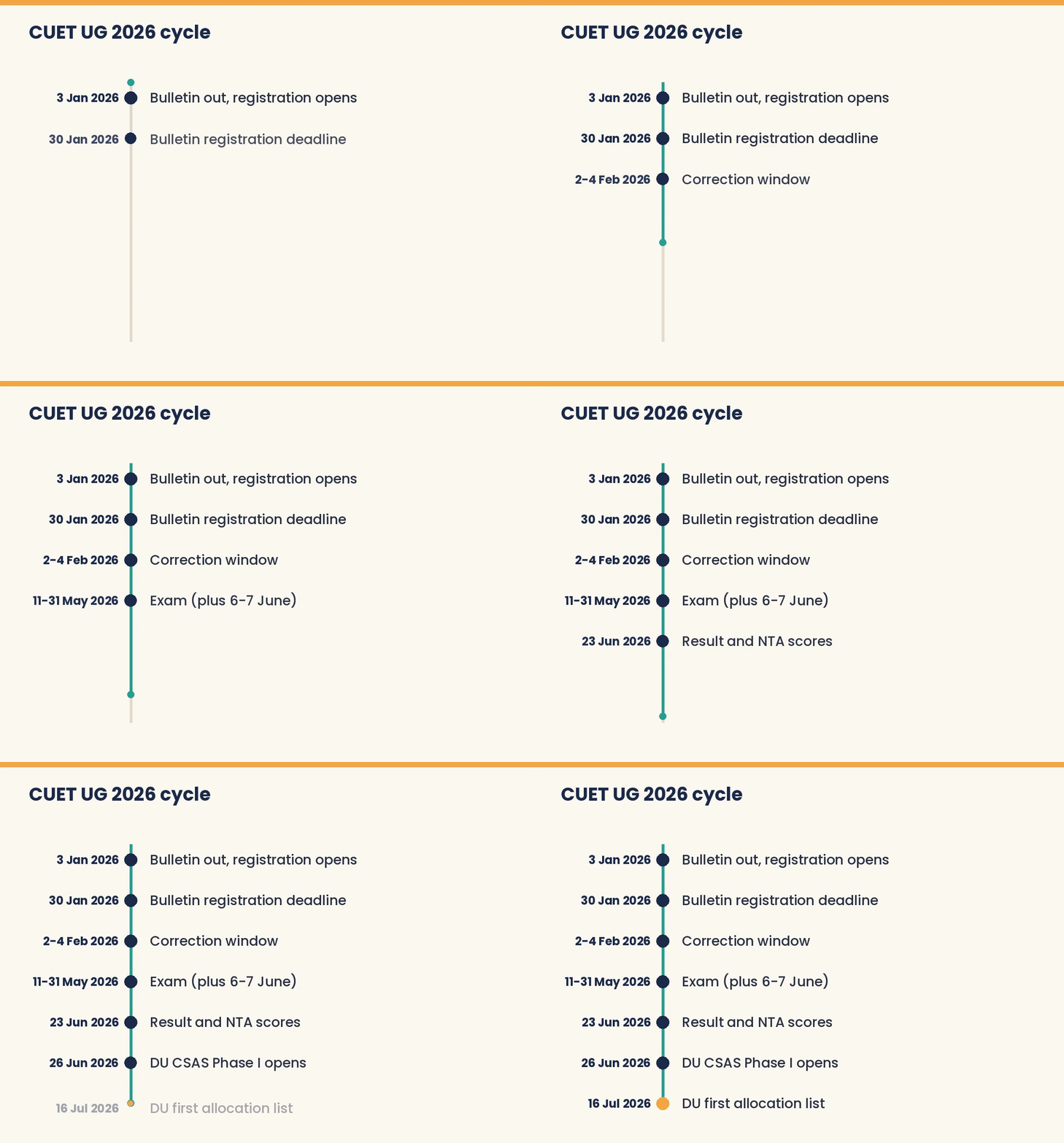
| Stage (2026 cycle) | Official date |
|---|---|
| Bulletin released, registration opened | 3 January 2026 |
| Registration window in the bulletin | 3-30 January 2026 (later notices can extend it) |
| Correction window in the bulletin | 2-4 February 2026 |
| Exam | 11-31 May 2026, plus 6-7 June 2026 for rescheduled candidates |
| Result (NTA scores) | 23 June 2026 |
| Delhi University CSAS Phase I opened | 26 June 2026 |
| DU first allocation list | 16 July 2026 |
For comparison, the 2025 bulletin had registration from 1 to 22 March 2025 and an exam window between 8 May and 1 June 2025. The registration month moves, but the exam has stayed in May-June. Be ready for registration to open as early as January 2027.
Who is eligible for CUET UG 2027?
For CUET (UG) 2026, the bulletin said:
- No age limit for the test itself. A university may still have its own age rule.
- You can apply if you have passed Class 12 (or equivalent) or are appearing in Class 12 in the same year.
- Accepted qualifications include CBSE, CISCE, state boards, NIOS (with at least five subjects), IB Diploma, Cambridge and GCE A levels.
- If you finished Class 12 abroad or at a board not on the list, you may need an equivalence certificate from the AIU or UGC, depending on the university.
Each university also sets its own rules on Class 12 subjects and marks.
Can NRI, OCI and foreign students take CUET UG?
Yes. In 2026, NTA ran CUET (UG) in 15 cities outside India: Manama, Munich, West Java, Kuwait, Kuala Lumpur, Kathmandu, Lagos, Muscat, Doha, Riyadh, Singapore, Dubai, Abu Dhabi, Sharjah and Washington DC. You choose up to four cities based on your present and permanent address. NTA can still give you a different city.
Delhi University's 2026 FAQ says Indian citizens and OCI cardholders apply through CSAS. Students who are not Indian citizens apply through the Foreign Students' Registry. Other universities have their own rules for foreign nationals, so check each one.
What documents do you need?
- A recent colour passport-size photo (10-200 KB, JPG) and a live photo taken by webcam or phone during the application
- Signature (10-50 KB, JPG)
- Identity check by Aadhaar or DigiLocker, or another photo ID upload (10-200 KB) if you cannot use those
- Category certificate (OBC-NCL, EWS, SC, ST), if you claim a category
- Disability or UDID certificate (PDF, 50-300 KB), if you are a PwD or PwBD candidate
- Class 10 and Class 12 details, your own email address and your own mobile number
What is the CUET UG exam pattern?
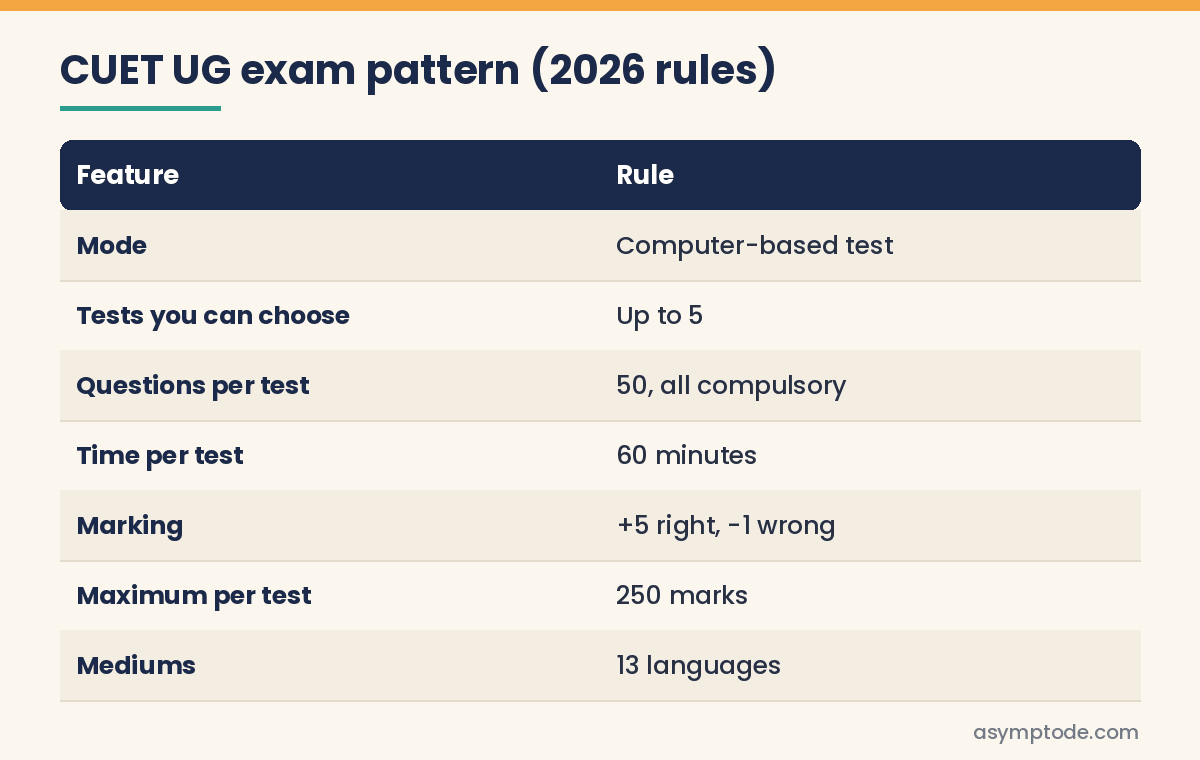
| Feature | CUET (UG) 2026 rule |
|---|---|
| Mode | Computer-based test (CBT) only |
| Tests you can choose | Up to 5, including languages and the General Aptitude Test |
| Questions per test | 50, all compulsory (no internal choice) |
| Time per test | 60 minutes (PwBD candidates who need it get 20 minutes extra) |
| Question type | Multiple choice, one correct answer |
| Marking | +5 right, -1 wrong, 0 if not answered |
| Maximum per test | 250 marks |
| Mediums | 13 languages |
The 13 mediums are English, Hindi, Assamese, Bengali, Gujarati, Kannada, Malayalam, Marathi, Odia, Punjabi, Tamil, Telugu and Urdu. "All compulsory" means there is no internal choice. You may still leave a question blank for zero.
Which subjects can you take?
CUET (UG) 2026 had 37 tests:
- 13 languages: English, Hindi, Assamese, Bengali, Gujarati, Kannada, Malayalam, Marathi, Odia, Punjabi, Tamil, Telugu, Urdu. These test reading comprehension, literary aptitude and vocabulary.
- 23 domain subjects: these follow the NCERT Class 12 syllabus. They include Physics, Chemistry, Mathematics/Applied Mathematics, Biology, Accountancy, Business Studies, Economics, Computer Science, History, Political Science, Geography, Psychology, Sociology, Sanskrit and more.
- 1 General Aptitude Test (GAT): general knowledge, current affairs, mental ability, numerical ability, simple maths (arithmetic, algebra, geometry, mensuration, statistics) and logical reasoning.
The official syllabus is on the CUET (UG) 2026 syllabus page. If you are also preparing for engineering or medicine, our JEE Main 2027 guide and NEET UG 2027 guide show where the syllabus overlaps.
How much is the CUET UG application fee?
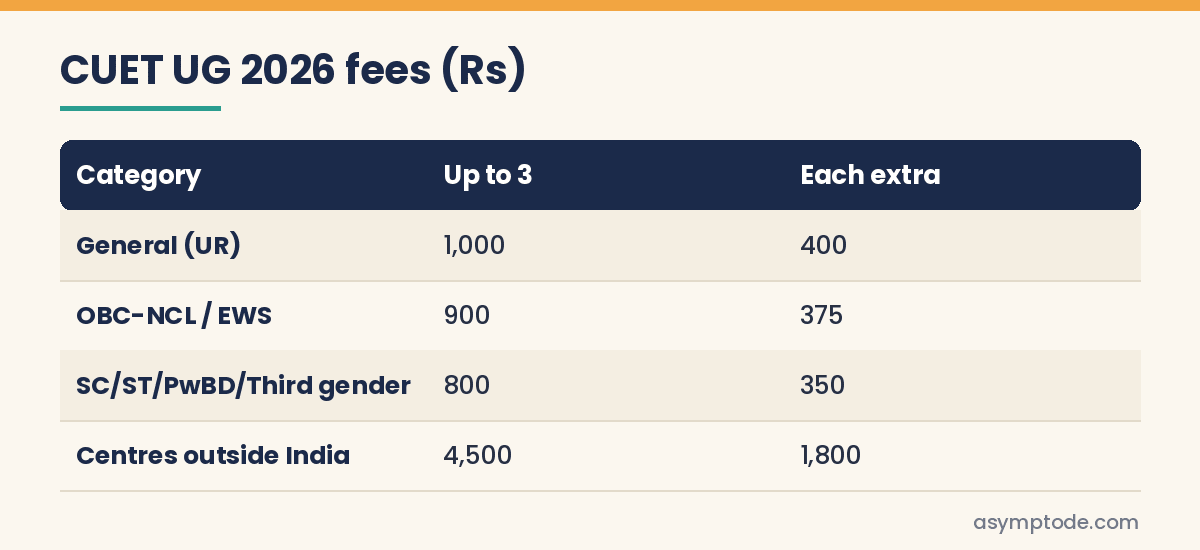
| Category (2026) | Up to 3 subjects | Each extra subject | Total for 5 subjects |
|---|---|---|---|
| General (UR) | Rs 1,000 | Rs 400 | Rs 1,800 |
| OBC-NCL / EWS | Rs 900 | Rs 375 | Rs 1,650 |
| SC / ST / PwD / PwBD / Third gender | Rs 800 | Rs 350 | Rs 1,500 |
| Centres outside India | Rs 4,500 | Rs 1,800 | Rs 8,100 |
Payment is online only (net banking, card or UPI), with no refunds. The 2027 fees are not yet announced.
How is CUET UG scored and normalised?
When a subject runs in more than one shift, the papers differ. One shift can be harder than another. To make this fair, NTA converts raw marks into an NTA Score using the equi-percentile method (Appendix VI of the bulletin):
- NTA calculates your percentile within your own shift.
- It matches equal percentiles across shifts.
- It turns this into a normalised score on the marks scale.
Universities build merit lists from these scores. In 2026, the score was valid only for the 2026-27 session, with no re-checking.
Book a free demo class to get a CUET maths plan that fits your Class 12 board dates: book a free demo class.
How does Delhi University use CUET scores in CSAS?
Delhi University (DU) admits students through its Common Seat Allocation System (CSAS) on the DU admissions site. You must fill in CSAS separately. Choosing DU on the CUET form is not enough.
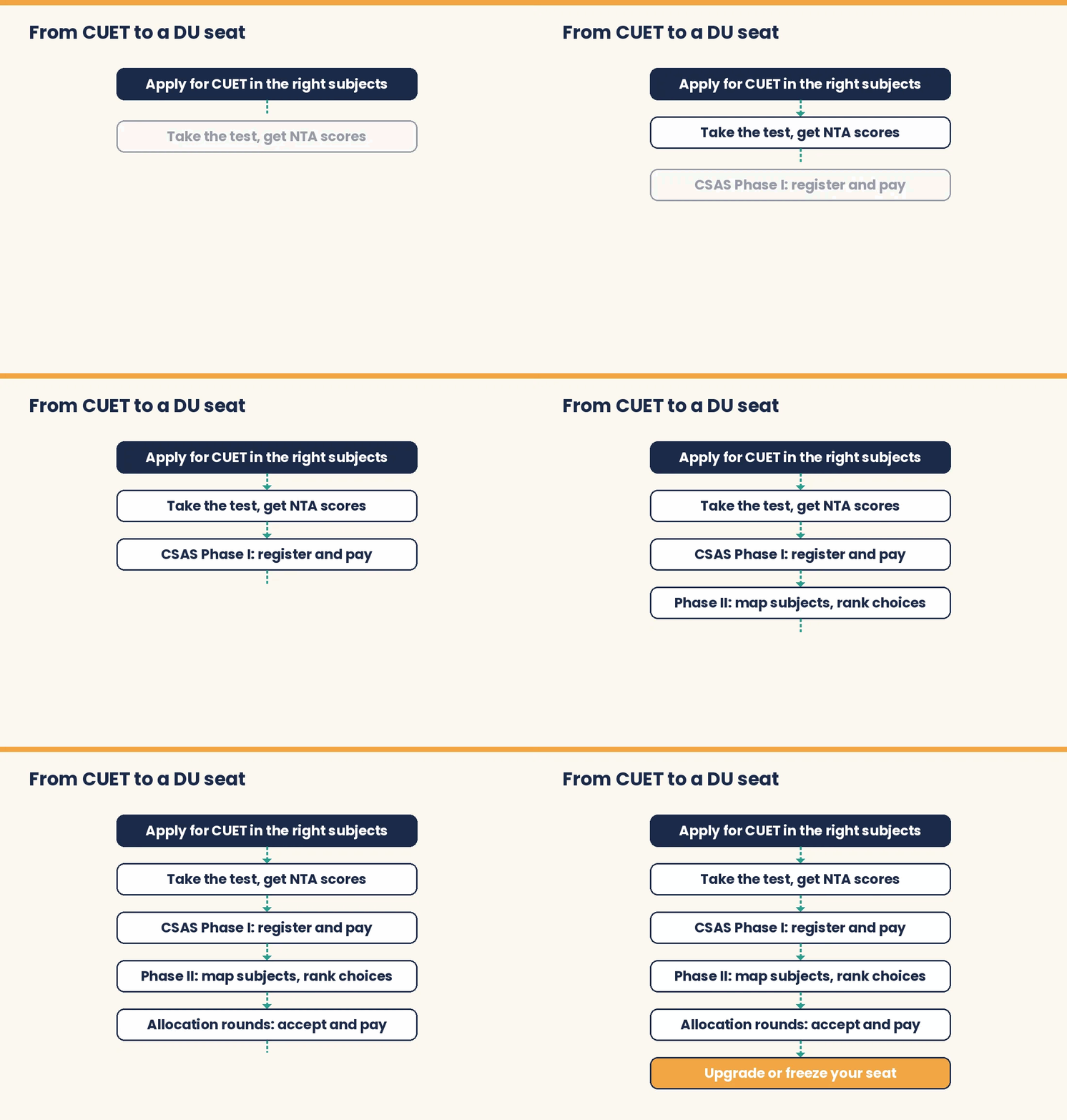
- Apply for CUET in the subjects DU needs for your programme.
- Take the test and get your NTA scores.
- CSAS Phase I: register and pay the DU fee (opened 26 June 2026).
- CSAS Phase II: map your Class 12 subjects to your CUET tests. Then choose and rank programme + college pairs.
- Simulated ranks and preference change (12-13 July 2026).
- Allocation rounds: accept your seat, pay the fee, then choose "Upgrade" or "Freeze".
Key DU rules from the 2026 FAQ and Bulletin of Information:
- You must take CUET in the subjects you passed in Class 12.
- Class 12 marks have no weight in merit. They are used only for the minimum eligibility check and tie-breaks.
- Merit uses the best CUET scores from the allowed combination for each programme.
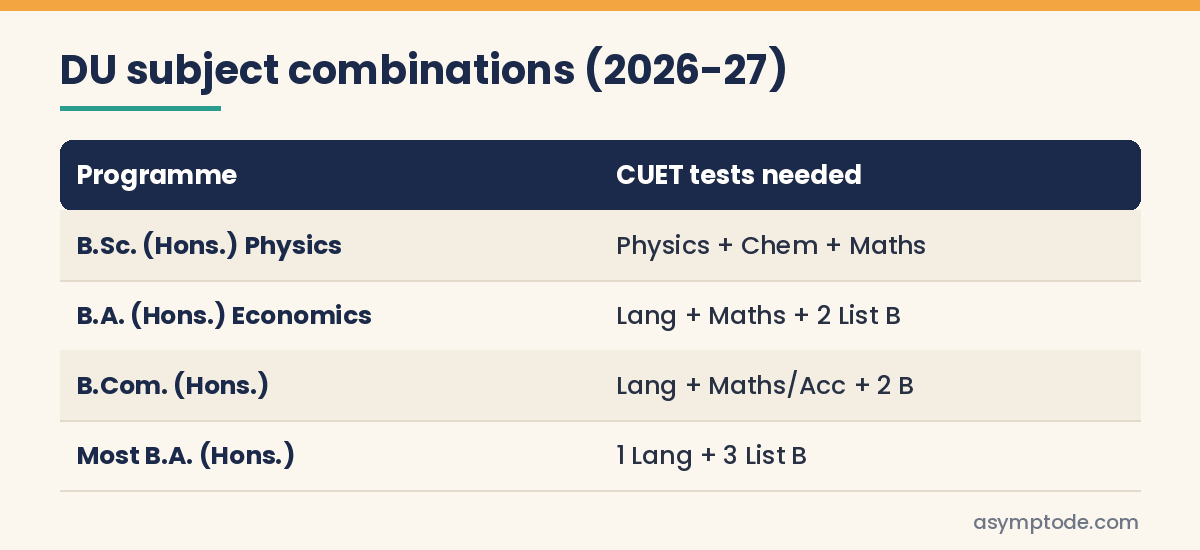
| DU programme (2026-27) | CUET combination needed |
|---|---|
| B.Sc. (Hons.) Physics | Physics + Chemistry + Mathematics/Applied Maths |
| B.A. (Hons.) Economics | 1 language + Maths/Applied Maths + 2 List B subjects |
| B.Com. (Hons.) | 1 language + Maths or Accountancy + 2 List B subjects |
| Most B.A. (Hons.) | 1 language + 3 List B, or 2 languages + 2 List B |
List A is languages and List B is domain subjects. Some DU programmes also need the General Aptitude Test.
How do you apply for CUET UG 2027, step by step?
- Choose your universities and programmes first. Read each one's eligibility and note the CUET subjects it needs.
- Pick up to 5 tests that cover every programme on your list.
- Register at cuet.nta.nic.in with your own email and mobile number. Save your application number.
- Fill in the form: personal details, education, programmes, tests, medium and four exam cities.
- Upload your photo, live photo, signature and any certificates.
- Pay the fee online and download the confirmation page.
- Use the correction window to fix mistakes. NTA does not accept changes by email or post.
- Download your admit card, check the city slip and sit the test.
- Check the answer key, then the result, and apply on each university's portal (such as DU CSAS).
What is a good CUET UG preparation plan?
Plan by how many months you have before May 2027. Every plan should fit around your Class 12 board exams.
| Months left | Focus |
|---|---|
| 7 or more (Oct-Nov 2026) | Finish the NCERT Class 12 syllabus for your domain subjects. Start one GAT maths topic each week. |
| 5-6 (Dec 2026-Jan 2027) | Register as soon as the form opens. Do timed 50-question sets twice a week. |
| 3-4 (Feb-Mar 2027) | Board exams come first. Keep CUET practice light: 20-30 minutes a day. |
| 1-2 (Apr-May 2027) | Full mock tests under 60 minutes. Review every wrong answer. Revise formulas. |
With 50 questions in 60 minutes, you have about 72 seconds per question. Most of your practice should be timed.
Worked example: a General Aptitude Test maths question
Question: A shopkeeper marks a bag 40% above its cost price. He then gives a 15% discount on the marked price. What is his profit percentage?
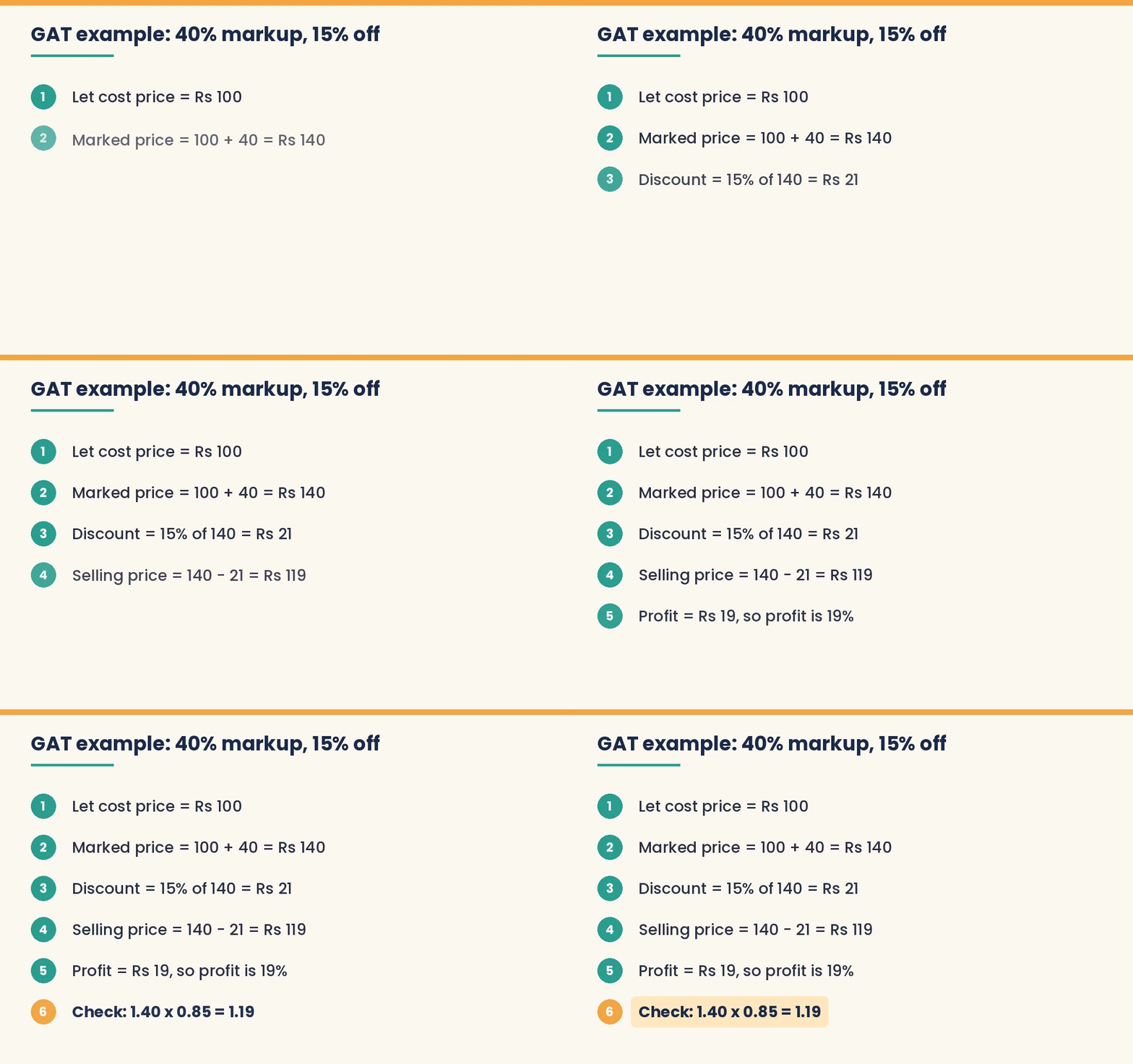
- Let the cost price be Rs 100. Using 100 makes percentages easy.
- Marked price = 100 + 40% of 100 = Rs 140.
- Discount = 15% of 140 = Rs 21.
- Selling price = 140 - 21 = Rs 119.
- Profit = 119 - 100 = Rs 19, so the profit is 19%.
Shortcut: 1.40 x 0.85 = 1.19, which is a 19% gain. A common trap is to subtract 15 from 40 and answer 25%. That is wrong because the discount is taken from the marked price, not the cost price.
Marking check: if a student answers 48 questions and gets 42 right and 6 wrong, the raw score is 42 x 5 - 6 x 1 = 204 out of 250. Careless errors cost more than they seem: each one loses the 5 marks you could have earned plus 1 more.
What are the most common CUET UG mistakes?
- Choosing subjects you did not study in Class 12. DU will not count them for most programmes.
- Leaving out Mathematics when you want Economics, B.Com. (Hons.) or some science courses.
- Using a parent's email for many forms. One email and one mobile number can be used for one form only.
- Wrong category or name details. These are hard or impossible to change later.
- Forgetting the university portal. A CUET score alone does not give you a seat. You must apply in CSAS or the university's own portal.
- Not doing timed practice. Knowing the syllabus is not enough at 72 seconds per question.
How 1-on-1 tutoring helps with CUET UG
At Asymptode, each student works live online with one dedicated mentor, with no batches. For CUET UG, the mentor focuses on the maths and logic parts: domain Mathematics or Applied Mathematics, Physics and Chemistry numericals, and the numerical ability and reasoning sections of the General Aptitude Test. The mentor watches each step of the working and fixes the method, not just the answer.
Classes follow your own syllabus and exam dates, with flexible scheduling across time zones for NRI and OCI families. You get personalised homework with feedback, parents get short updates, and every class is recorded. For the language papers and general knowledge, the mentor helps with planning and practice routines rather than subject teaching. If you are weighing other entrance tests too, see our CLAT 2027 guide or read why one-on-one tutoring works.
Ready to start? Book a free demo class or see fees.
Facts checked against official sources on 27 October 2026.
FAQ
Is the CUET UG 2027 date announced?
No. As of 27 October 2026, NTA has not published a CUET (UG) 2027 notice or bulletin. In 2026, registration opened on 3 January and the exam ran in May and early June. Check cuet.nta.nic.in for the official notice.
How many subjects can I take in CUET UG?
In 2026, you could take up to 5 tests in total. This count includes languages and the General Aptitude Test. Choose them based on what your target programmes need.
Is there negative marking in CUET UG?
Yes. You get +5 for each correct answer and -1 for each wrong answer. A question you leave blank scores zero.
Can a drop-year student take CUET UG?
Yes. In 2026 there was no age limit, and students who had already passed Class 12 could apply. Each university decides which years of passing Class 12 it accepts, so check the university's own rules.
Does Delhi University look at Class 12 marks?
Only for minimum eligibility and tie-breaks. Merit for DU programmes is based on CUET scores in the required subject combination. You must also have taken CUET in the subjects you passed in Class 12.
Sources
- NTA: CUET (UG) official website
- NTA: CUET (UG) 2026 Information Bulletin (PDF)
- NTA: Successful conduct of CUET (UG) 2026, press release 07 June 2026 (PDF)
- NTA: Result/NTA scores of CUET (UG) 2026, press release 23 June 2026 (PDF)
- NTA: CUET (UG) 2025 Information Bulletin (PDF)
- NTA: CUET (UG) participating universities
- NTA: CUET (UG) 2026 syllabus
- University of Delhi: Admissions website
- University of Delhi: Bulletin of Information UG 2026-27 (PDF)
- University of Delhi: Updated FAQs UG 2026-27 (PDF)
- University of Delhi: CSAS (UG) 2026 admission schedule (PDF)
- University of Delhi: Foreign Students' Registry