The AP Physics C Mechanics exam is on Monday, May 3, 2027, at 8 a.m. local time in most of the US. It is a 3-hour, calculus-based test. This guide for US and Canadian families covers the new 2027 timing, the 7 units, scoring, fees, two worked examples and a study plan.
Key takeaways
- The exam is on Monday, May 3, 2027, Session 1 (8 a.m. local time in the lower-48 US states, Hawaii and DC).
- New for 2027: 42 multiple-choice questions in 85 minutes, then 4 free-response questions in 95 minutes. Each section is 50% of the score.
- It is hybrid digital: multiple choice in the Bluebook app, but free-response answers are handwritten on paper.
- There are 7 units. Gravitation sits inside Units 2 and 6.
- The fee is $99 at schools in the US, US territories and Canada, and $129 in most other countries.
What is the AP Physics C Mechanics exam?
Quick answer: The AP Physics C Mechanics exam is a 3-hour College Board test for a calculus-based physics course. It equals one semester of introductory college physics. In 2027 it has 42 multiple-choice questions in 85 minutes and 4 handwritten free-response questions in 95 minutes. Scores run from 1 to 5.
The course covers motion, forces, energy, momentum, rotation and oscillations. You use derivatives and integrals to solve problems. College Board says students "should have taken, or be concurrently taking, calculus." So you can take calculus in the same year.
Physics C: Mechanics and Physics C: Electricity and Magnetism (E&M) are separate exams with separate scores. See the official course page on AP Central.
When is the AP Physics C Mechanics exam 2027?
The exam is on Monday, May 3, 2027, in Session 1, the first day of the 2027 AP Exams. The exams run May 3–7 and May 10–14. Human Geography shares the same session. 2027 is the first year College Board says "Session 1" and "Session 2" instead of morning and afternoon.
| Location | Session 1 start time |
|---|---|
| Lower-48 US states, Hawaii, DC | 8 a.m. local time |
| Alaska | 7 a.m. |
| UTC−3 in May (for example, Atlantic Canada) | 9 a.m. |
| UTC−2:30 (Newfoundland) | 9:30 a.m. |
An exam can start up to 1 hour after the listed time. For other Canadian time zones, check the official start times page with your school. Late-testing dates exist for conflicts. See the official exam dates page or our AP exam dates 2027 list.
What is the AP Physics C Mechanics format in 2027?
The exam lasts 3 hours and has two sections. Each is worth half your score.
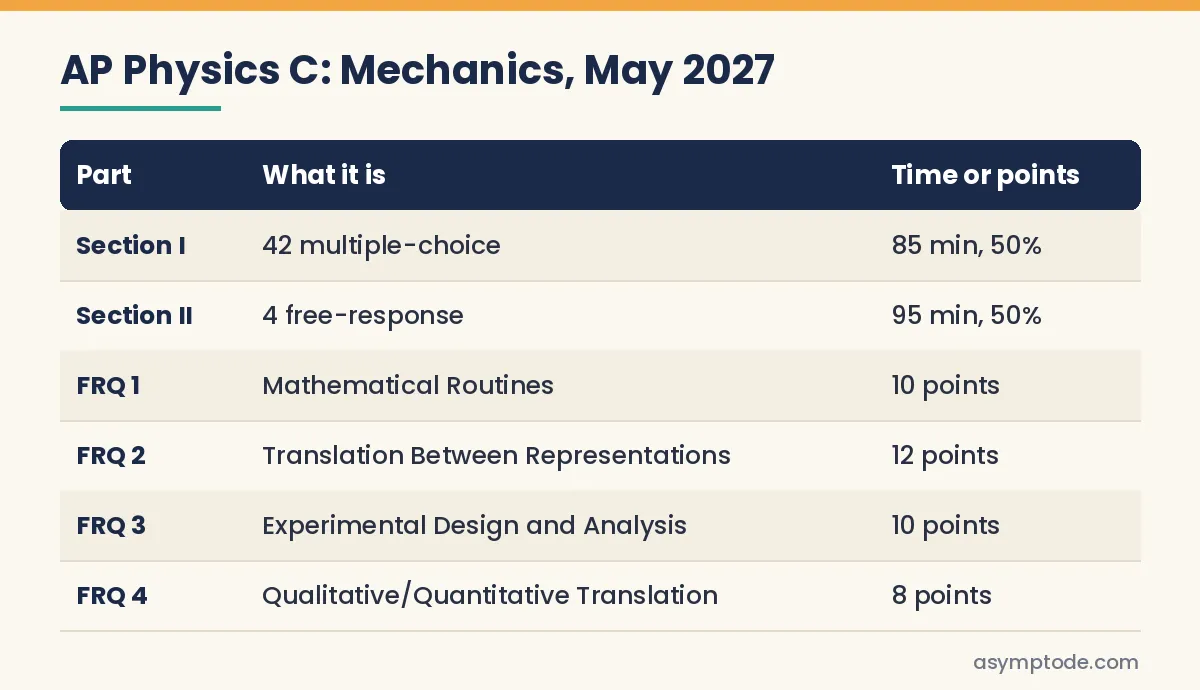 The 2027 AP Physics C: Mechanics exam format.
Section I: 42 multiple-choice questions, 85 minutes, 50% of the score.
Section II: 4 free-response questions, 95 minutes, 50% of the score.
The four questions are Mathematical Routines (10 points), Translation Between Representations (12 points), Experimental Design and Analysis (10 points) and Qualitative/Quantitative Translation (8 points).
What changed from 2025-26 to 2027?
| Section | 2025-26 exam | 2027 exam | Weight |
|---|---|---|---|
| Section I: multiple choice | 40 questions, 80 minutes | 42 questions, 85 minutes | 50% |
| Section II: free response | 4 questions, 100 minutes | 4 questions, 95 minutes | 50% |
The total is still 3 hours. You get 2 more multiple-choice questions and lose 5 minutes on free response. Some study sites still show old formats, so trust the College Board clarifications PDF.
Is the AP Physics C Mechanics exam digital?
It is hybrid digital. You answer multiple-choice questions and read free-response questions in the Bluebook app. Then you handwrite free-response answers in a paper booklet. Try a Bluebook test preview before May.
Can you use a calculator and an equation sheet?
Yes. College Board says "a four-function, scientific, or graphing calculator is allowed on both sections." Check your model on the official AP Calculator Policy page. Equations and constants are given in Bluebook, and printed copies are mailed to schools. Learn the sheet early.
What are the 4 free-response question types?
The four types always come in this order.
- Mathematical Routines (10 points). Solve a problem with algebra and calculus, such as setting up an integral. Practise: start each solution from a physics law and keep units in every line.
- Translation Between Representations (12 points). Move between graphs, diagrams, equations and words. Practise: draw one situation four ways. Our motion graphs guide is a good warm-up.
- Experimental Design and Analysis (10 points). Plan an experiment or analyse data, often with a straight-line graph and its slope. Practise: for each class lab, write the procedure, the variables and how a graph gives the answer.
- Qualitative/Quantitative Translation (8 points). Explain a result in words, then back it up with equations. Practise: answer in words first, then check with a short calculation.
Past free-response questions and scoring guidelines are free on AP Central. The guidelines show which steps and words earn points.
What are the AP Physics C Mechanics units?
There are 7 units. The weights apply to the multiple-choice section.
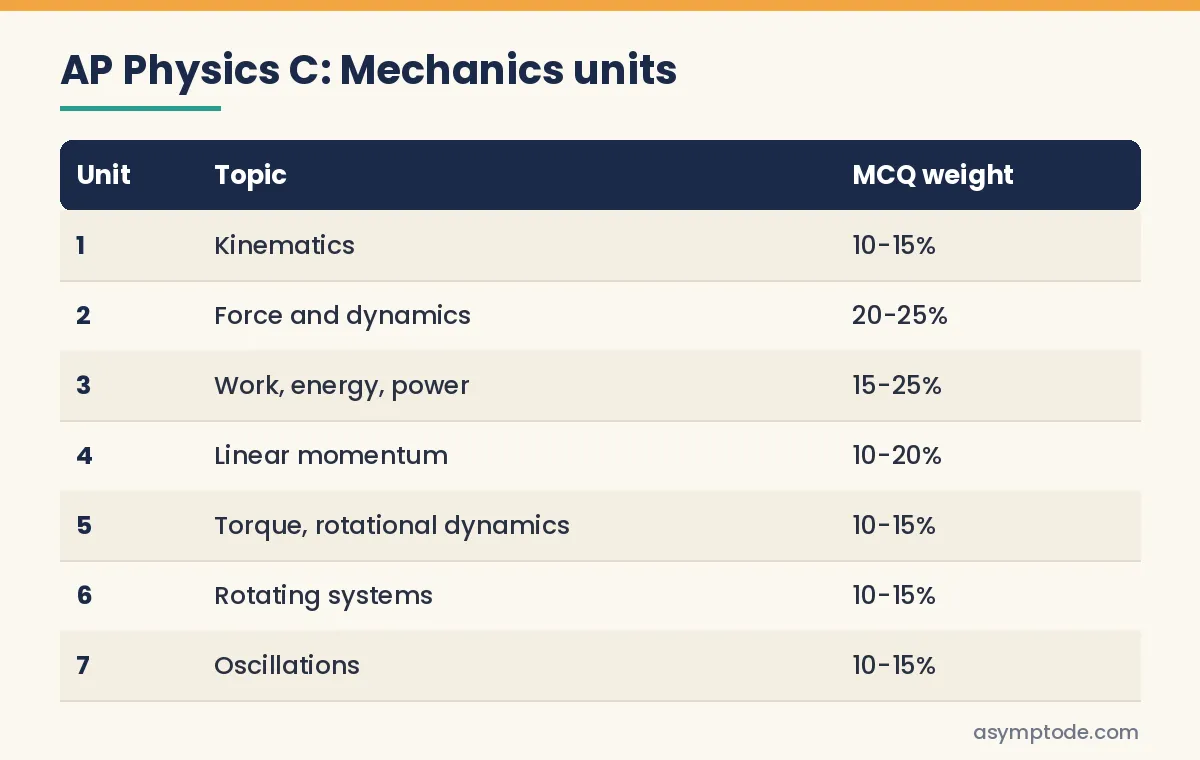 The 7 AP Physics C: Mechanics units and their multiple-choice weights.
Unit 2, Force and Translational Dynamics, is the largest at 20–25%.
Unit 3, Work, Energy, and Power, is 15–25%, and Unit 4, Linear Momentum, is 10–20%.
Units 1, 5, 6 and 7 are each 10–15%.
| Unit | Topic | MCQ weight |
|---|---|---|
| 1 | Kinematics | 10–15% |
| 2 | Force and Translational Dynamics | 20–25% |
| 3 | Work, Energy, and Power | 15–25% |
| 4 | Linear Momentum | 10–20% |
| 5 | Torque and Rotational Dynamics | 10–15% |
| 6 | Energy and Momentum of Rotating Systems | 10–15% |
| 7 | Oscillations | 10–15% |
Where is gravitation? It is not its own unit. It is in Topic 2.6 (Gravitational Force) and Topic 6.6 (Motion of Orbiting Satellites), per the official Course and Exam Description (CED).
For key topics, see our guides to the work-energy theorem, momentum and impulse and circular motion.
How much lab work is in the course?
College Board says 25% of class time should be hands-on lab work. Keep a lab notebook all year with aims, methods, data, graphs and errors. A college may ask to see lab work before giving credit, and the notebook also prepares you for the Experimental Design question.
What does calculus look like on the exam? Two worked examples
These two examples match Units 1 and 3. Every number was checked.
Example A: velocity and position from acceleration
A cart has a(t) = 6t − 4 (m/s²), with v(0) = 2 m/s and x(0) = 0. Find v and x at t = 2 s.
 Integrating a(t) = 6t − 4 twice, using the starting conditions each time.
Integrate a(t) = 6t − 4 and use v(0) = 2 to get v(t) = 3t² − 4t + 2.
At t = 2 s, v = 6 m/s.
Integrate again and use x(0) = 0 to get x(t) = t³ − 2t² + 2t.
At t = 2 s, x = 4 m.
- v(t) = ∫(6t − 4) dt = 3t² − 4t + C.
- v(0) = 2 m/s, so C = 2: v(t) = 3t² − 4t + 2.
- At t = 2 s: v = 12 − 8 + 2 = 6 m/s.
- x(t) = ∫v dt = t³ − 2t² + 2t + D, and x(0) = 0 gives D = 0.
- At t = 2 s: x = 8 − 8 + 4 = 4 m.
If you forget the "+ C", you get v(2) = 4 m/s, which is wrong.
Example B: work done by a variable force
A force F(x) = 3x² N acts along x on a 0.50 kg block that starts at rest on a frictionless surface. Find the work from x = 0 to x = 2 m and the final speed.
- W = ∫₀² 3x² dx = [x³]₀² = 8 J.
- The work-energy theorem gives W = ½mv², since the block starts at rest.
- v = √(2W/m) = √(2 × 8 / 0.5) = √32 ≈ 5.7 m/s.
You cannot use W = Fd here, because the force changes with x.
How is the AP Physics C Mechanics exam scored?
Scores run from 1 to 5. Many US colleges give credit or placement for a 3 or higher, but each college sets its own policy. See About AP Scores. Here is the 2026 score distribution:
| Score | 2026 Physics C: Mechanics | 2026 Physics C: E&M |
|---|---|---|
| 5 | 20% | 24% |
| 4 | 25% | 24% |
| 3 | 27% | 27% |
| 2 | 17% | 17% |
| 1 | 11% | 8% |
| 3 or higher | 72% | 75% |
College Board updates that page on a rolling basis. No official cut scores are published, so be careful with sites that quote them.
Book a free demo class to plan your Physics C year one-to-one, or see our plans and fees.
Physics C Mechanics vs E&M: can you take both in 2027?
Yes. Mechanics is on Monday, May 3, Session 1. E&M is on Wednesday, May 5, Session 2, so there is no same-day clash. But E&M shares its slot with Physics 1, so a student taking both of those would need late testing. College Board calls E&M "a full-year course following Physics C: Mechanics."
AP Physics C vs AP Physics 1: which one should you take?
The big difference is calculus.
| Question | Physics C: Mechanics | Physics 1 |
|---|---|---|
| Uses calculus? | Yes, taken before or at the same time | No |
| Exam date 2027 | Mon May 3, Session 1 | Wed May 5, Session 2 |
| Good fit for | Students taking calculus who plan STEM majors | Students starting physics without calculus |
If you are not yet in calculus, Physics 1 may be a better first step. Compare with our AP Physics 1 exam guide, and talk to your counselor.
How much does the AP Physics C Mechanics exam cost?
Families pay the school, not College Board. Schools set their own collection dates and may add charges. Official 2026-27 exam fees:
| Item | Amount |
|---|---|
| Schools in the US, US territories and Canada | $99 per exam |
| Most other countries | $129 per exam |
| Late order fee | $40 per exam, on top of the base fee |
| Unused or canceled exam | $40 |
| College Board fee reduction | $37 per exam |
Fees may vary at authorized test centers outside the US.
Deadlines: The on-time ordering deadline was November 13, 2026; schools can still order until March 12, 2027 with a $40 late fee per exam. The late fee does not apply to courses that start later or to students who transfer in. AP is offered in many Canadian schools at the same $99 fee. For the bigger picture, see our complete guide to AP for parents.
How should you study for the AP Physics C Mechanics exam?
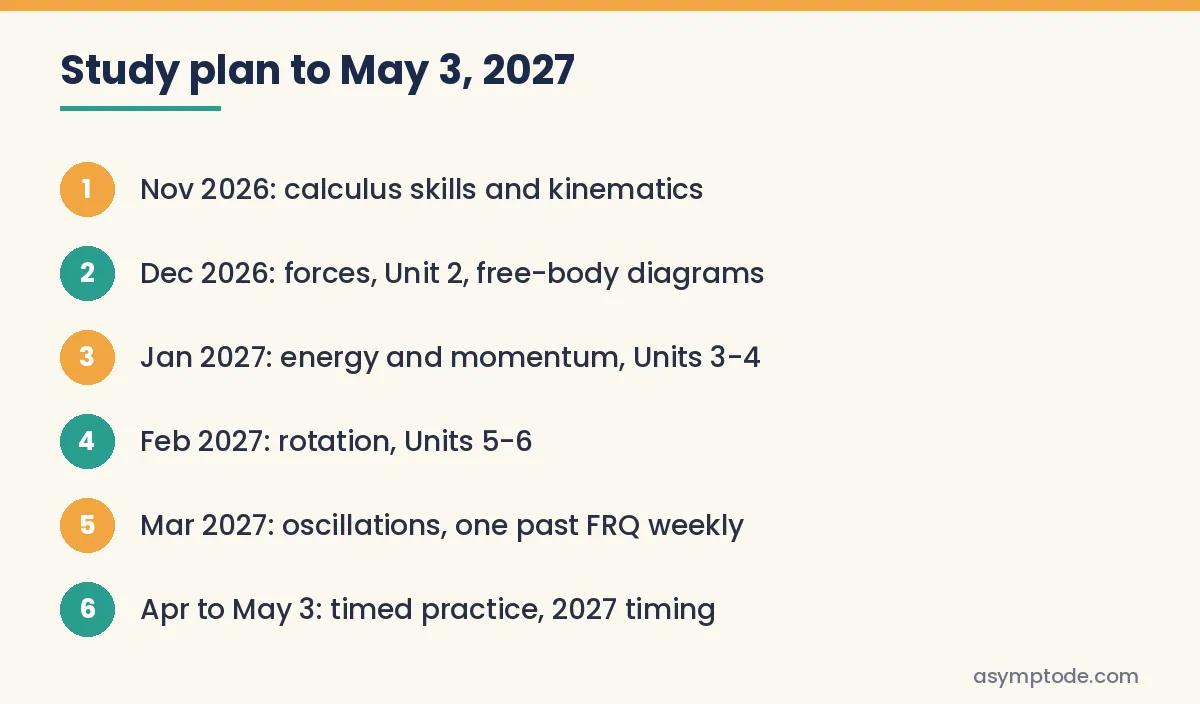 A six-step study plan from November 2026 to the May 3, 2027 exam.
The plan has six monthly steps.
It starts with calculus skills and kinematics, then forces, then energy and momentum.
Next come rotation, then oscillations with full past free-response questions.
It ends with timed practice in the 2027 format before May 3.
- November 2026: calculus and kinematics. Practise simple derivatives and integrals, and problems like Example A.
- December 2026: forces. Unit 2 is the largest unit. Draw a free-body diagram every time.
- January 2027: energy and momentum. Cover Units 3 and 4, including problems like Example B.
- February 2027: rotation. Cover Units 5 and 6. Treat torque like force and rotational inertia like mass.
- March 2027: oscillations and full FRQs. Finish Unit 7. Do one past free-response question a week and mark it with the scoring guidelines.
- April to May 3, 2027: timed practice. Do full sections in the 2027 timing and a Bluebook test preview.
What free official resources should you use?
- AP Classroom: topic questions and progress checks your teacher assigns.
- Past free-response questions with scoring guidelines on AP Central.
- The CED: every topic and skill in the course.
- The AP Students assessment page.
What are the most common mistakes?
- Sign errors. Pick a positive direction, write it down and keep it.
- Missing units. Write units in every line.
- Forgetting initial conditions. Every integral needs a "+ C", as in Example A.
- Not stating the system. Say which objects are in your system before using energy or momentum.
- Weak justification. Free-response points often need a reason in words, such as "the net external force is zero, so momentum is conserved."
- Old practice tests. Check that they use the 2027 format.
How Asymptode Can Help You Prepare for the AP Physics C: Mechanics Exam
Physics C rewards students who link calculus to physics one step at a time and explain each step in words. At Asymptode, an experienced physics mentor teaches your child one-to-one in live online classes, never in a batch. The mentor follows your child's own school AP course and works toward the May 3, 2027 exam date.
The mentor watches the working, not just the answer. When a step goes wrong, such as a sign error, a missing initial condition or a vague free-response justification, it is traced back to the idea behind it. Every class is recorded and searchable by topic, so your child can return to the minute a topic was taught.
After class, your child gets practice worksheets on the topics taught, built from what their last attempt showed. They are prepared with AI assistance and sent only after your child's own mentor approves them. The AI supports the mentor; it does not teach or mark on its own. After each class, you can read what was taught, how your child got on and what to practise next.
Book a free demo class and advisor call or see our fees.
Related guides
- AP Physics 1 exam guide
- AP exam dates 2027
- AP complete guide for parents
- Work-energy theorem explained
- Momentum and impulse explained
Facts checked against official College Board sources on 13 November 2026.
FAQ
When is the AP Physics C Mechanics exam in 2027?
It is on Monday, May 3, 2027, in Session 1. That starts at 8 a.m. local time in the lower-48 US states, Hawaii and DC. In Atlantic Canada (UTC−3) it starts at 9 a.m., and in Newfoundland at 9:30 a.m.
How many questions are on the AP Physics C Mechanics exam?
There are 42 multiple-choice questions in 85 minutes and 4 free-response questions in 95 minutes. Each section counts for 50% of the score.
Do I need calculus for AP Physics C Mechanics?
Yes. College Board says students "should have taken, or be concurrently taking, calculus." You can take calculus in the same school year.
Is the AP Physics C Mechanics exam on paper or on a computer?
Both. You answer multiple-choice questions and read free-response questions in Bluebook. You handwrite free-response answers in a paper booklet.
Are Physics C Mechanics and E&M the same exam?
No. They are separate exams with separate scores. In 2027, Mechanics is on Monday, May 3 and E&M is on Wednesday, May 5.
How much does the AP Physics C Mechanics exam cost in Canada?
It is $99 per exam at Canadian schools, the same as in the US. Most other countries pay $129. Families pay their school, which may add its own charges.
Ready to start? Book a free demo class and advisor call, or see our plans and fees.
Sources
- AP Physics C: Mechanics course page (AP Central)
- AP Physics C: Mechanics exam (AP Central)
- AP Physics C: Mechanics assessment (AP Students)
- AP Physics C: Mechanics Course and Exam Description
- AP Physics C: Mechanics CED clarifications
- AP Physics C: Mechanics course overview
- 2027 AP Exam dates
- 2027 AP Exam start times
- AP exam fees
- About AP Scores
- AP score distributions